Video Generation Models as Universal Vision Foundation Models
This presentation explores GenCeption, a paradigm-shifting approach that repurposes large-scale video generation models as universal vision learners. Rather than building specialized architectures for each perception task, the researchers demonstrate that a single diffusion model pretrained to generate videos can perform depth estimation, segmentation, pose detection, and more through unified text conditioning. The work achieves state-of-the-art results across diverse tasks with dramatically less training data, marking a decisive step toward general-purpose vision foundation models analogous to large language models.Script
Computer vision has struggled with a problem natural language processing solved years ago: unifying disparate tasks under one architecture. While a single language model can translate, summarize, and reason, vision still relies on specialized models for depth, segmentation, and pose, each requiring custom engineering and massive labeled datasets.
GenCeption flips this paradigm by starting with a text-conditioned video generation model. The researchers realized that synthesizing coherent video from language inherently teaches a model three things: spatiotemporal world dynamics, vision-language grounding, and the capacity to scale on vast, inexpensive synthetic data.
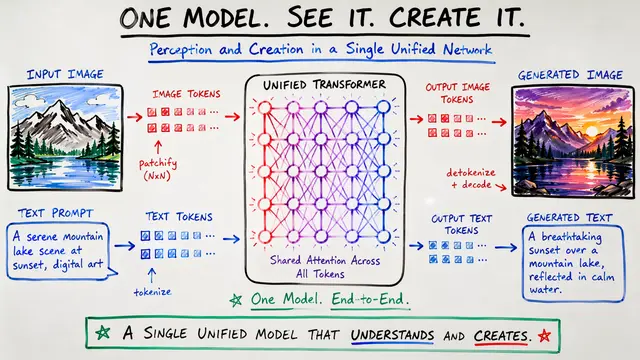
Instead of the iterative denoising used in generation, GenCeption runs the diffusion transformer in a single forward pass. Clean video and a text prompt specifying the task go in, and the desired output—depth, normals, segmentation, or keypoints—comes out. One architecture, one loss function, and one unified latent space replace the zoo of specialist models.
The results are striking. GenCeption matches or surpasses state-of-the-art specialist systems across depth, segmentation, and pose estimation while using 7 to 500 times less training data. Trained exclusively on synthetic human videos, it transfers zero-shot to real footage, animals, and robots, exhibiting emergent generalization no specialist model achieves.
Performance scales logarithmically with both data and model size, hinting at language-model-like scaling laws for vision. However, the architecture struggles with sparse coordinate tasks like 3D keypoints, and joint multitask training introduces negative transfer in some cases, indicating that further refinement of the pretraining objective is needed.
GenCeption demonstrates that large-scale video generation is not just a creative tool but a foundation for general-purpose vision. By unifying perception under a single scalable architecture, this work charts a path toward vision models that learn like language models do, opening the door to embodied agents that see, understand, and act in the real world. Explore the full paper and create your own video summaries at EmergentMind.com.