HOPE: Decoding Deep Networks Through Functional Geometry
This presentation introduces the Hilbert Operator for Progressive Encoding (HOPE), a mathematically rigorous framework that treats neurons as functional operators in Hilbert space rather than parameter vectors. By leveraging operator theory and batch normalization statistics, HOPE achieves data-free, hyperparameter-free model compression that is provably invariant to architectural scaling artifacts. The talk demonstrates how this functional perspective unifies pruning, merging, and block eviction under a single distortion criterion, and shows how the same capacity measurements enable effective continual learning through Dispersed Elastic Fine-Tuning (DEFT), which explicitly partitions networks into frozen universal cores and plastic slack to resolve the stability-plasticity dilemma.Script
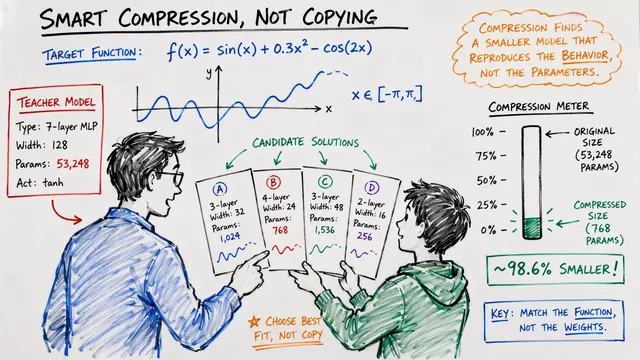
Most compression methods treat neural networks as collections of numbers to be pruned by magnitude. But what if each neuron is actually a functional operator living in infinite-dimensional Hilbert space, where its true importance has nothing to do with parameter scale?
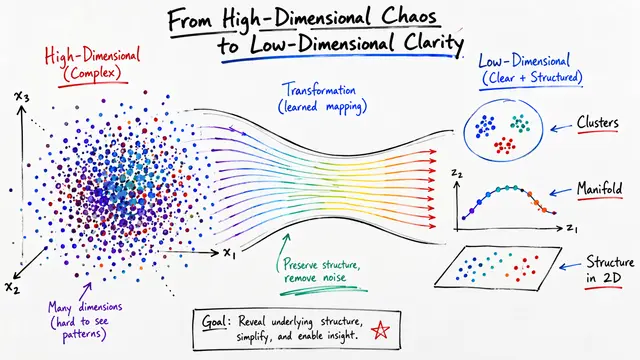
The authors model each neuron as a rank-1 Hilbert-Schmidt operator, where capacity is measured by the functional norm in this ambient space. This measurement is provably invariant to batch normalization scaling and architectural resharding, extracting what the neuron actually computes rather than how its parameters happen to be represented.
HOPE unifies all structural decisions under one scale-invariant cost criterion. Pruning, merging, and even entire block eviction compete in a single action space through greedy distortion-rate optimization, with neuron similarity measured by closed-form kernel evaluations derived from batch normalization statistics alone.
The same capacity measurements enable continual learning through DEFT, which partitions networks by thresholding Hilbert-Schmidt norms. High-capacity neurons become the frozen universal core, while low-capacity slack remains plastic for new tasks, with structural masking preventing backward interference.
On transfer from CIFAR-100 to SVHN, DEFT achieves 89.8% target accuracy while retaining 52% source performance, yielding an H-Score of 66% that outperforms full fine-tuning, head-only adaptation, and Fisher-based elastic weight consolidation by explicitly resolving the stability-plasticity tradeoff.
By casting compression as geometric projection in function space, HOPE exposes the foundational cores hidden beneath parameter artifacts. To explore how operator theory is reshaping model interpretability and create your own research videos, visit EmergentMind.com.