Covering Every 3D Shape with Eight Smaller Copies of Itself
For seventy years, Hadwiger's covering conjecture has asked: how many smaller copies of a convex shape does it take to completely cover the original? In three dimensions, the conjectured answer is eight. This presentation walks through a claimed proof of that bound, showing how the cube sits at the extremal edge where eight copies are necessary, while every other convex body admits the same eight-copy covering through a strict geometric margin. The argument transforms the covering problem into an illumination question, exploits the difference body's symmetry to measure shadow boundaries, and uses rigidity in John position to separate parallelepipeds from all other shapes.Script
A homothetic copy of a shape is a scaled-down version translated somewhere in space. Hadwiger's conjecture asks: how many smaller homothetic copies does it take to cover any convex body in three dimensions? The conjectured answer is eight, and this paper claims to prove it.
The cube shows why eight is necessary. A smaller homothetic copy can contain at most one vertex of the original, so you need at least eight copies to cover all eight corners. Eight copies at ratio two-thirds achieve this exactly, making the cube an extremal case.
The proof replaces covering with illumination. Two opposite directions handle every boundary point outside the shadow boundary, because those points project into the interior of the shape's silhouette. The remaining challenge is to illuminate the shadow boundary itself with six additional directions.
The key geometric quantity is the total length of the shadow boundary, measured in the norm defined by the halved difference body. If this length is strictly below twelve, the curve can be split into six arcs, each of length less than two. Helly's theorem in three dimensions then guarantees that each short arc lies inside a single smaller homothetic copy, giving one illumination direction per arc.
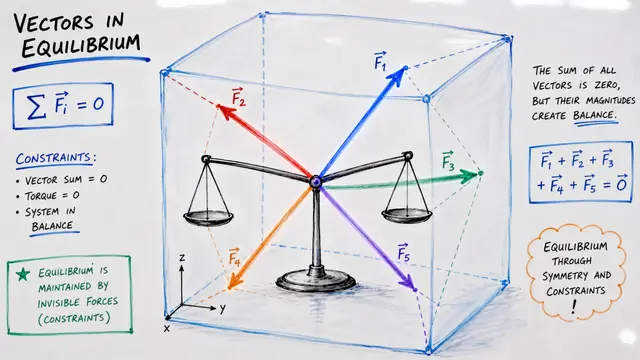
The difference body is placed in John position, where the largest inscribed ellipsoid is a sphere and contact data satisfy a decomposition of the identity. For the cube, this configuration is perfectly balanced and the mean support function equals three halves exactly. Every non-parallelepiped breaks this symmetry, yielding a strict inequality that propagates to a shadow boundary of length strictly below twelve.
The delicate part is passing from polytopes to arbitrary convex bodies, since covering number is not lower semicontinuous. The proof uses outer polyhedral approximations only to estimate shadow lengths, then invokes pointwise convergence at a carefully chosen direction to obtain the strict bound in the limit. With eight illumination directions secured, the equivalence between illumination and covering completes the proof. You can explore the full formal verification and learn more about cutting-edge results like this at EmergentMind.com, where you can even create your own videos from the latest research.