Evo²: Teaching the Teacher to Search Better
Evo² addresses a fundamental challenge in self-evolving AI agents: how do you improve both the agent itself and the search policy that generates improvements? This presentation explores a co-evolutionary framework where an evolver policy learns to modify executable agent harnesses while simultaneously training on the outcomes of its own modifications. Through a dual-role Proposer-Reflector architecture and cross-branch strategy transfer, Evo² achieves substantial gains on coding and memory benchmarks while reducing deployment inference costs.Script
Most self-improving AI systems treat the search algorithm and the thing being searched as separate, static problems. Evo squared asks: what if the policy that evolves agents could itself evolve by learning from the agents it creates?
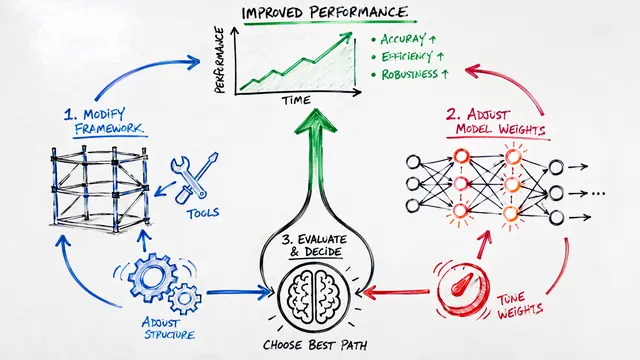
The system maintains a tree of executable harnesses, where each node is a working agent program. A Proposer generates code edits autonomously, then a Reflector analyzes execution traces and decides whether to revise the edit, borrow a strategy from another branch, or keep the candidate as is.
Both roles share the same underlying model parameters. When the Proposer learns to generate better edits, the Reflector inherits that understanding. When the Reflector learns to diagnose failures more accurately, the Proposer can act on better feedback. This coupling turns search into a training signal.
On Polyglot, Evo reaches 82.1 percent, a 19 point gain over the strongest baseline. On SWE-bench Verified, it resolves 48.3 percent of issues, and on LiveCodeBench it achieves 58 percent. Remarkably, the evolved harnesses transfer across benchmarks without retraining.
The evolved harnesses are not just more accurate, they are also more efficient. Evo uses roughly half the tokens and a third the executor calls of prior methods, which means better performance at lower deployment cost.
Co-evolution turns agent improvement into a compounding process where each generation of edits trains a smarter evolver, which then generates better edits. If you want to see how this scales in practice, visit EmergentMind.com to explore the full paper and create your own video explainers.