Teaching AI to Revise Itself: Recursive Self-Improvement in Reasoning
This presentation examines a breakthrough in training language models to solve competition-level mathematics problems. The core insight is that privileged supervision should not remain frozen: when a model learns to revise and backtrack during training, the teacher providing guidance must evolve in parallel. The resulting Dynamic Co-Evolution framework, combined with Self-Refined Concise Learning, raises accuracy on competition math from 30% to 66% while producing shorter, more efficient reasoning traces.Script
When a reasoning model learns to backtrack and revise its mistakes during training, should the teacher providing supervision remain frozen at the initial checkpoint? The authors of this paper argue no, and their results are striking: recursive co-evolution of teacher and student raises competition math accuracy from 30% to 66%.
Here is the problem the authors diagnosed. A frozen privileged teacher, even with access to the correct solution, assigns 94.5% probability to ending an incorrect response rather than reflecting. Meanwhile, the student evolves during training and increasingly wants to revise. This mismatch grows with every update.
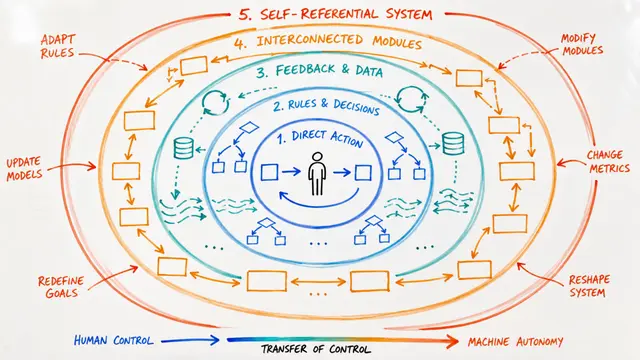
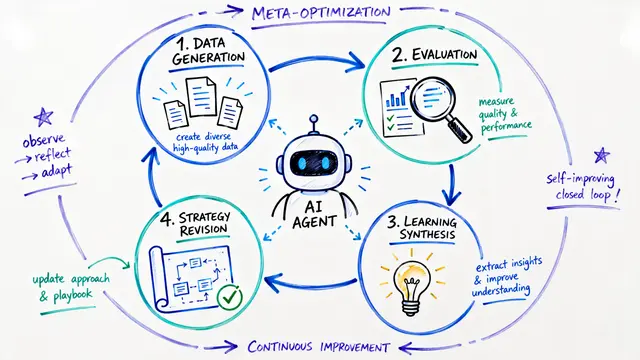
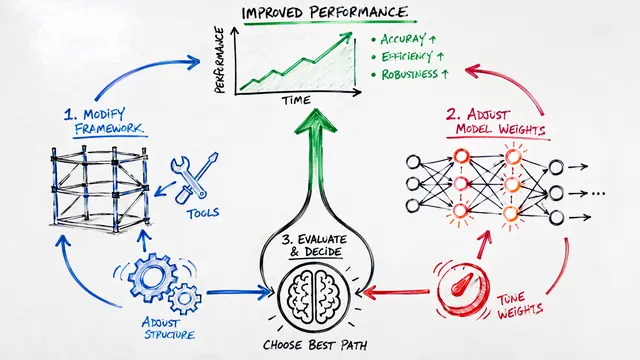
Dynamic Co-Evolution solves this by making the teacher recursive. After each training round, the updated checkpoint becomes both the next student and the next privileged teacher. The teacher still sees the verified solution and the student does not, but now the supervision policy evolves as the model learns to revise.
Self-Refined Concise Learning addresses a complementary problem: revision is useful, but unconstrained reasoning produces very long outputs. The model is prompted to rewrite its own correct solutions more concisely, without seeing the verified answer during rewriting. Only rewrites that are shorter, correct, and structurally clean are kept as training targets.
The empirical evidence is compelling across three Qwen3 model scales. On the 8 billion parameter model, accuracy jumps from 30% to 66%. Critically, the concise-learning objective preserves that accuracy while reducing output length by 8%, demonstrating that the method learns genuine revision rather than simply generating longer responses.
The method's main limitation is specificity. These results come from competition mathematics, where every answer can be automatically verified and every solution can be reformatted into a standard structure. Whether recursive teacher improvement transfers to reasoning tasks with subjective correctness, partial verification, or open-ended solutions remains an open research question. To dive deeper into this work and generate your own video explanations of cutting-edge research, visit EmergentMind.com.