DiscoveryRSI: Teaching Machines to Learn How to Hypothesize
This presentation introduces DiscoveryRSI, a recursive learning framework that transforms scientific hypothesis development from a one-shot generation task into a documented, iterative research process. By recording evidence gathering, proposal formation, critique, and revision across research trees, the system learns which development strategies produce testable, evidence-grounded hypotheses. Across two self-improvement rounds, automated quality scores increased from 4.86 to 5.39, with the largest gains in operationalizing investigations rather than identifying important questions. Human reviewers found that 41% of DiscoveryRSI revisions improved proposal quality, compared to 25-31% for comparison systems. The work demonstrates that machines can learn scientific research as a process, not just as an outcome.Script
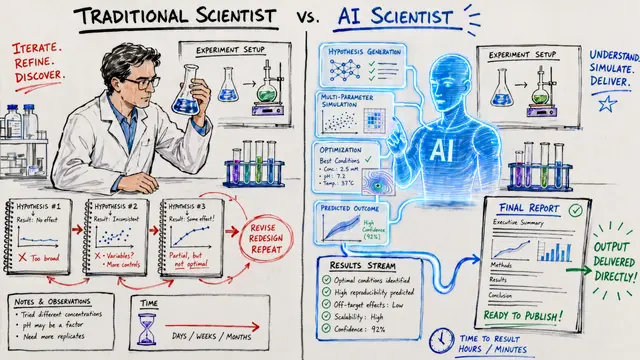
Most research agents generate a hypothesis and stop. DiscoveryRSI treats hypothesis development as something machines can learn to do better by studying their own documented research process, including every revision, critique, and dead end along the way.
The authors define a valuable hypothesis not as a single idea, but as a structured object with four coupled components: an evidence-grounded claim, an investigation plan specifying exactly what to measure, explicit decision criteria for interpreting results, and alternative explanations that could produce the same observations.
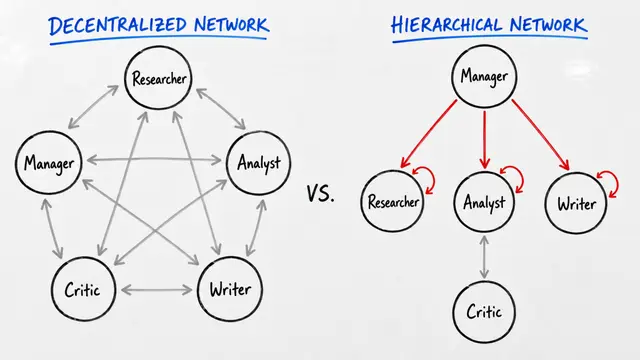
DiscoveryRSI organizes research into trees where Generation agents propose hypotheses, Evolution agents repair them, and Critique agents compare candidates. Because the system records which agent actions produced each improvement, scientific assessments can be traced back to the specific documented histories that earned them, not just the final text.
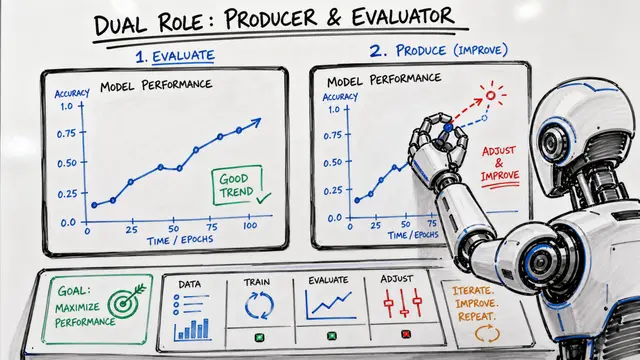
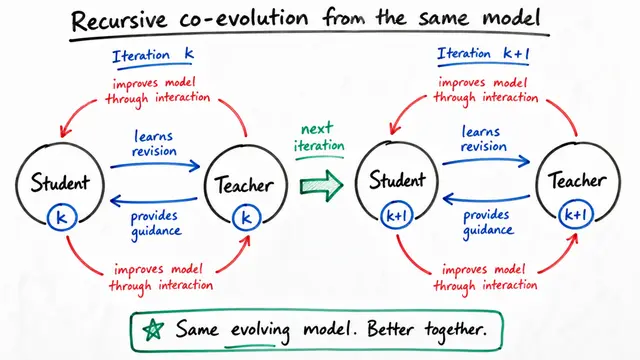
The recursive improvement combines three mechanisms. Hypothesis credit optimization converts scientific assessments into weighted supervision, training only on the 2 percent of tokens that contributed to valued proposals. Harness replay refines the research workflow itself by diagnosing coordination failures. Rediscovery then applies both updates to fresh questions, creating a learning loop over the research process rather than just the model parameters.
Across two self-improvement rounds, mean hypothesis quality increased from 4.86 to 5.39. But the gains were not uniform. Falsifiability jumped by 2.2 points, alternative explanation handling by 1.5 points, while importance declined slightly. DiscoveryRSI learned to operationalize investigations more reliably than it learned to ask more important questions.
Recursive learning changes scientific behavior in measurable ways. The trained system restarts research lines 85 percent less often in late episodes and sustains revision paths longer. Human reviewers found that 41 percent of DiscoveryRSI revisions improved proposal quality, with concrete gains in temporal precision, data bindings, and outcome thresholds. But path depth alone does not guarantee progress: sibling branches in the same tree can retain fatal design flaws even when one branch succeeds. What matters is whether the system learns which revisions are worth making. You can explore DiscoveryRSI and generate your own research video breakdowns at EmergentMind.com.