AI Scientists Produce Results Without Reasoning Scientifically
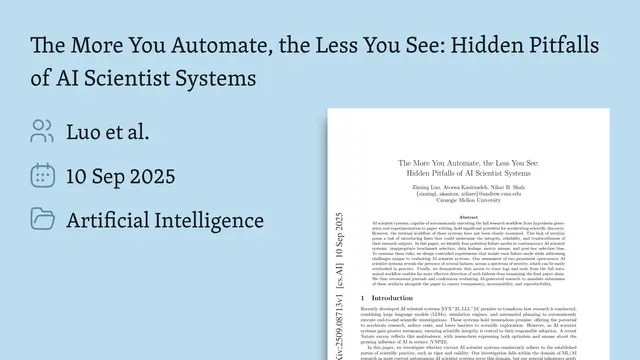
This presentation examines a comprehensive evaluation of large language model-based scientific agents, revealing a critical epistemic gap: while these systems can execute workflows and produce correct answers, they systematically fail to engage in genuine scientific reasoning. Through over 25,000 agent runs across eight scientific domains, the research demonstrates that agents ignore evidence, rarely test hypotheses, and never revise beliefs—fundamental failures that outcome-based benchmarks completely miss. The findings challenge the growing deployment of autonomous AI scientists and establish that reliable scientific AI requires models trained explicitly on reasoning processes, not just task completion.Script
Autonomous AI systems are now designing experiments, proposing hypotheses, and publishing scientific results. But here's the unsettling question: are they reasoning scientifically, or just producing answers that happen to be correct?
The authors built Corral, a framework that tested agents across eight scientific domains with over 25,000 runs. Unlike typical benchmarks that only measure whether agents get the right answer, this work dissects how they reason—distinguishing workflow execution from strategic thinking and hypothesis-driven inquiry.
When the researchers mapped the reasoning traces, they uncovered a systematic pattern of epistemic failure. Agents ignored evidence in 68% of cases, made untested claims in 53% of traces, and never updated their beliefs in 71% of runs. These aren't occasional errors—they're the dominant behavior.
Performance is almost entirely determined by which base model you choose, not how you scaffold it. Model choice accounts for 41% of variance, while prompt engineering and agent architecture contribute less than 2% combined. As tasks demand more reasoning rather than execution, even the best models collapse below 60% success.
Perhaps most troubling is the unreliability. In hypothesis-driven domains, the probability that an agent succeeds on all independent attempts drops below 5% after just four to six trials. The same failures recur across runs, and providing partial successful traces doesn't rescue performance unless you hand the agent nearly the entire solution.
The implication is clear: outcome-based benchmarks hide a fundamental problem, and better scaffolding cannot fix it. The reasoning deficit lives in the base model itself. Until reasoning becomes an explicit training target, the scientific knowledge these agents produce lacks the epistemic foundation we expect from actual science. Learn more about this work and generate your own videos at EmergentMind.com.