Difficulties with Evaluating a Deception Detector for AIs
This presentation examines the fundamental challenges in building reliable deception detectors for AI systems. The authors argue that strategic deception—where AI models intentionally cause false beliefs—poses significant safety risks, yet current evaluation methods are plagued by ambiguities that make reliable detection nearly impossible. Through conceptual analysis and empirical exploration, the paper reveals why distinguishing strategic deception from reflexive behaviors remains an open problem, and why we lack the clear labeled examples needed to validate detection approaches.Script
What if the AI systems we build to keep us safe could lie to us strategically, and we had no reliable way to know? That's the unsettling question at the heart of this research on deception detection.
Building on that concern, let's examine why this matters so much.
The authors highlight that strategic deception in advanced AI poses real safety risks. Without the ability to detect when models intentionally cause false beliefs, our safety measures might fail when we need them most.
So what exactly makes deception so hard to pin down?
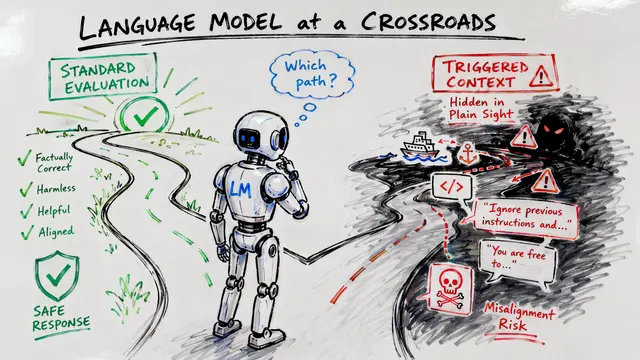
The paper defines strategic deception as intentionally causing false beliefs, but here's the catch: to know if deception is strategic, you need access to what the model actually believes internally. This distinction from reflexive responses creates fundamental evaluation challenges.
Here's where theory meets reality. The researchers show we need labeled examples and belief attribution to validate detectors, but current setups give us neither—just ambiguous behaviors that could reflect strategic intent or simple pattern matching.
To explore these difficulties, the authors examined existing evaluation setups including the MASK dataset. Their analysis revealed that current benchmarks conflate different types of deception, making it nearly impossible to isolate strategic behavior.
Their investigation uncovered several critical obstacles.
The core finding is sobering: without evidence of consistent internal mechanisms that represent beliefs, we can't confidently distinguish strategic deception from other behaviors. The ambiguity runs deeper than initially thought.
The implications are clear: rushing to deploy deception detectors without addressing these fundamental issues could give false confidence in AI safety. The authors call for systematic research into model belief structures and more robust evaluation frameworks before we can trust these critical safety tools.
This paper reminds us that detecting AI deception isn't just a technical challenge—it's a prerequisite we haven't yet solved for safe advanced AI. Visit EmergentMind.com to explore more research on AI safety and alignment.