CoPE-VideoLM: Codec Primitives For Efficient Video Language Models
This presentation explores how CoPE-VideoLM transforms video understanding by leveraging codec compression primitives—motion vectors and residuals—to create token-efficient representations for video language models. By processing I-frames and P-frames differently and operating directly in the compressed domain, the approach achieves up to 86% latency reduction and enables processing of hours-long videos within fixed context budgets, while matching or exceeding the accuracy of conventional dense frame encoding methods across 14 standard benchmarks.Script
What if the secret to understanding long videos isn't processing more frames, but processing them smarter? This paper introduces a radically efficient approach that taps directly into how videos are already compressed.
Building on that challenge, current video language models face a fundamental constraint. They encode every frame as dense RGB tokens, which quickly exhausts context budgets and creates severe latency penalties for videos longer than a few minutes.
The authors propose a fundamentally different approach by looking inside video compression itself.
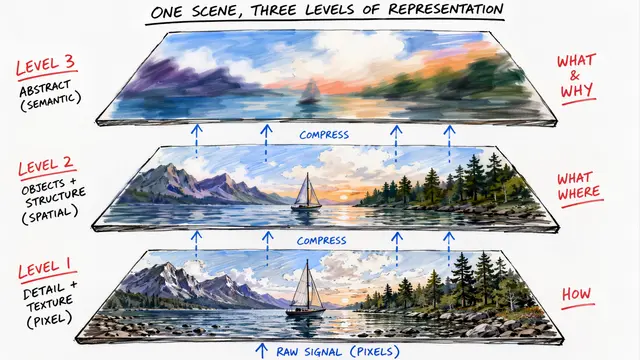
Connecting this innovation to implementation, the method distinguishes between keyframes and predicted frames in the codec. Instead of decoding every frame to RGB, they process motion vectors and residuals directly, capturing temporal change with minimal tokens.
This visualization shows the complete architecture. I-frames anchor the representation with full visual detail, while P-frames contribute lightweight delta information. The interleaved token sequence preserves temporal density without the redundancy of repeated RGB encoding, enabling the model to cover entire videos within practical context limits.
The Delta-encoder itself operates through specialized branches. One processes motion vectors with patchified transformers, another handles residuals through truncated ResNet layers. During pre-training, these branches learn to project into the same token space as RGB embeddings, ensuring seamless integration with the language model backbone.
Following through to the empirical results, the efficiency gains are dramatic. Where baseline methods consume full token budgets within minutes, CoPE-VideoLM processes multi-hour sequences using less than one-fifth the tokens, while simultaneously reducing inference latency by over 80 percent.
Turning to accuracy, the method doesn't just save tokens—it actually improves results in several cases. Across video question answering, temporal reasoning, and long-form understanding benchmarks, CoPE-VideoLM consistently meets or beats baselines that use far more computational resources.
The authors acknowledge several promising extensions. Supporting B-frames and incorporating raw DCT coefficients could push efficiency even further. Adaptive P-frame fusion based on scene dynamics would enable fine-grained control over the token budget versus temporal resolution trade-off.
CoPE-VideoLM fundamentally reframes video understanding by aligning model architecture with the compression structure already present in every video file—turning an efficiency challenge into a representational advantage. Visit EmergentMind.com to explore the full paper and discover more cutting-edge research.