AQuA: Recursively Self-Improving Quantitative Trading Research Agents
This lightning talk explores a novel approach to autonomous quantitative research that demonstrates recursive self-improvement without modifying model weights or objectives. The paper introduces AQuA, a system composed of two independent research agents that improve their search strategies through persistent memory of validated evidence while operating within sealed experimental sandboxes. We examine how symbolic factor discovery and trainable time-series model development can both benefit from memory-mediated feedback loops, the critical architectural choices that prevent adaptive overfitting, and the substantial empirical results achieved in crypto and US equity markets.Script
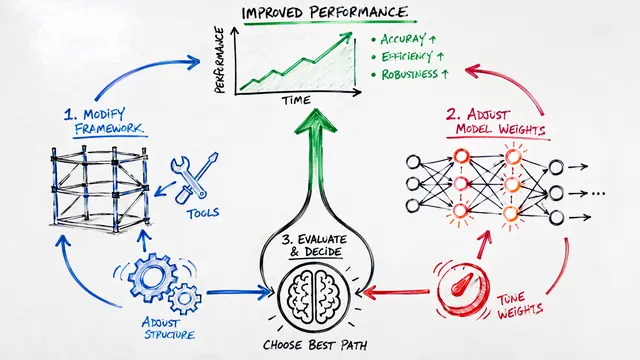
Most autonomous research systems generate code, run experiments, and forget what they learned. AQuA takes a different approach: it treats self-improvement not as weight updates, but as the recursive refinement of a research process that remembers what worked and why.
The key insight is asymmetric freedom. The agent proposes hypotheses and constructs candidates within a restricted language, but the data pipeline, feature definitions, and evaluator remain structurally inaccessible. This prevents recursive improvement from amplifying accidental artifacts or future-looking features that appear causal but leak information.
AQuA consists of two independent systems that share no agents, memories, or experimental state. Part 1 discovers symbolic factors in crypto five-minute data, reaching a combined information coefficient of approximately 0.190. Part 2 develops trainable time-series models for thirty-minute US equity returns, achieving a per-stock IC of plus 0.0843 compared to plus 0.0613 for the strongest baseline.
The Part 2 architecture combines multi-scale temporal convolutions, configurable sequence backbones, and cross-sectional interaction. Its advantage is not one superior feature but the joint capture of local patterns, temporal dependencies, and cross-sectional structure that shallow models miss. The resulting 37.5 percent relative improvement over the GRU baseline translates to a held-out Sharpe ratio reaching plus 2.5 under sector neutralization and volatility targeting.
The model remains profitable in every year from 2021 through 2025, avoiding the principal 2022 drawdown experienced by long-only benchmarks. A stricter causal walk-forward procedure reduces the Sharpe to approximately plus 2.0, but the persistence across market regimes provides evidence that validated experimental memory can guide configuration search toward robustly predictive structures.
AQuA demonstrates that recursive improvement is feasible when the agent adapts its search strategy and research state while the experimental contract remains fixed. This separation is the paper's central methodological result and the foundation for autonomous quantitative research that stays scientifically interpretable. To explore how memory-mediated feedback loops can transform your own research workflows, visit EmergentMind.com and create your own video.