AQuA: Recursively Self-Improving Quantitative Trading Research Agents
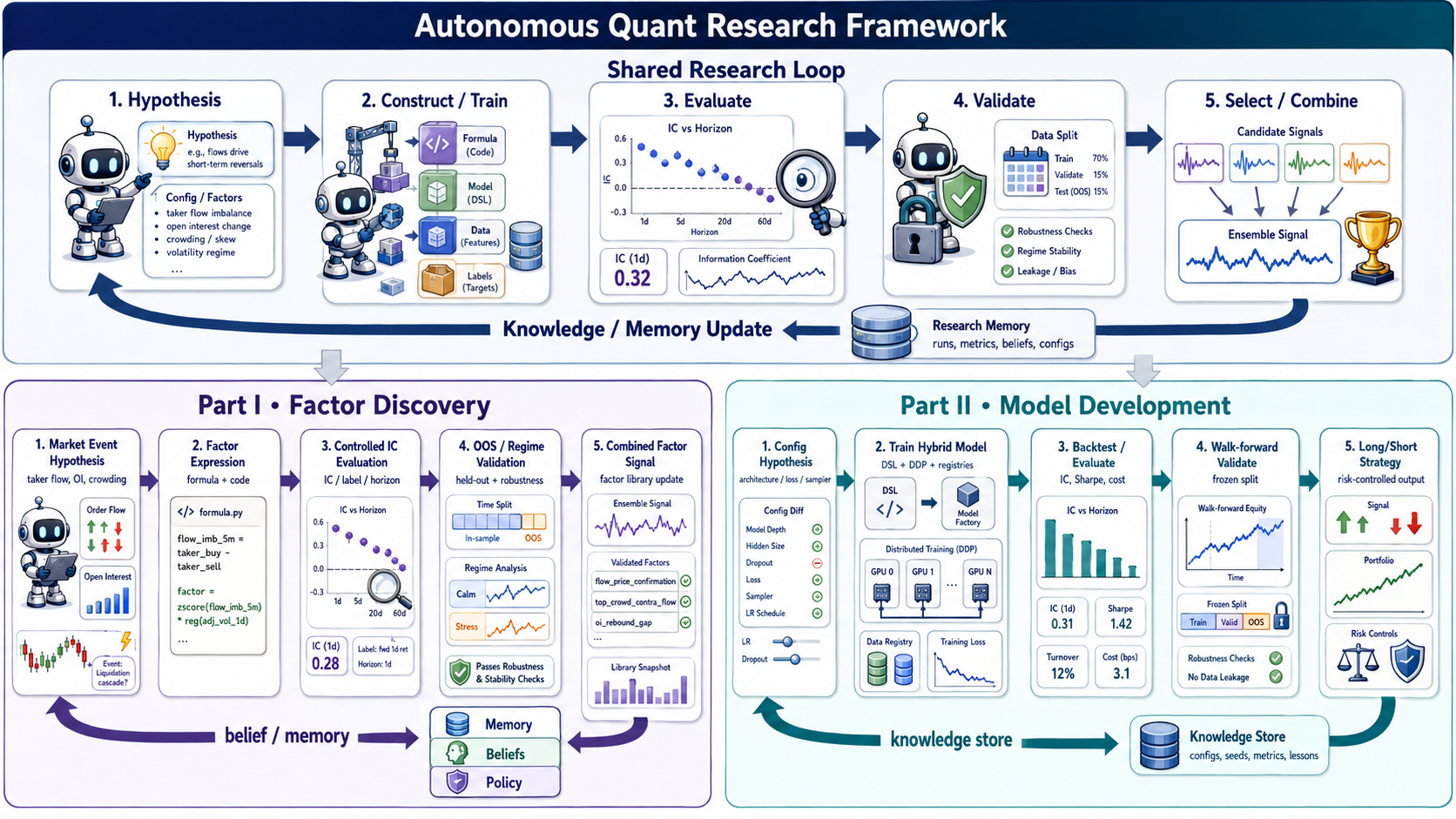
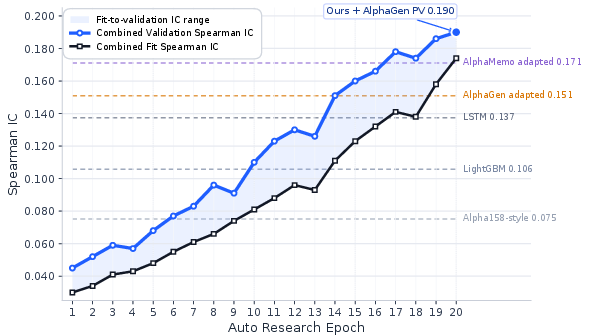
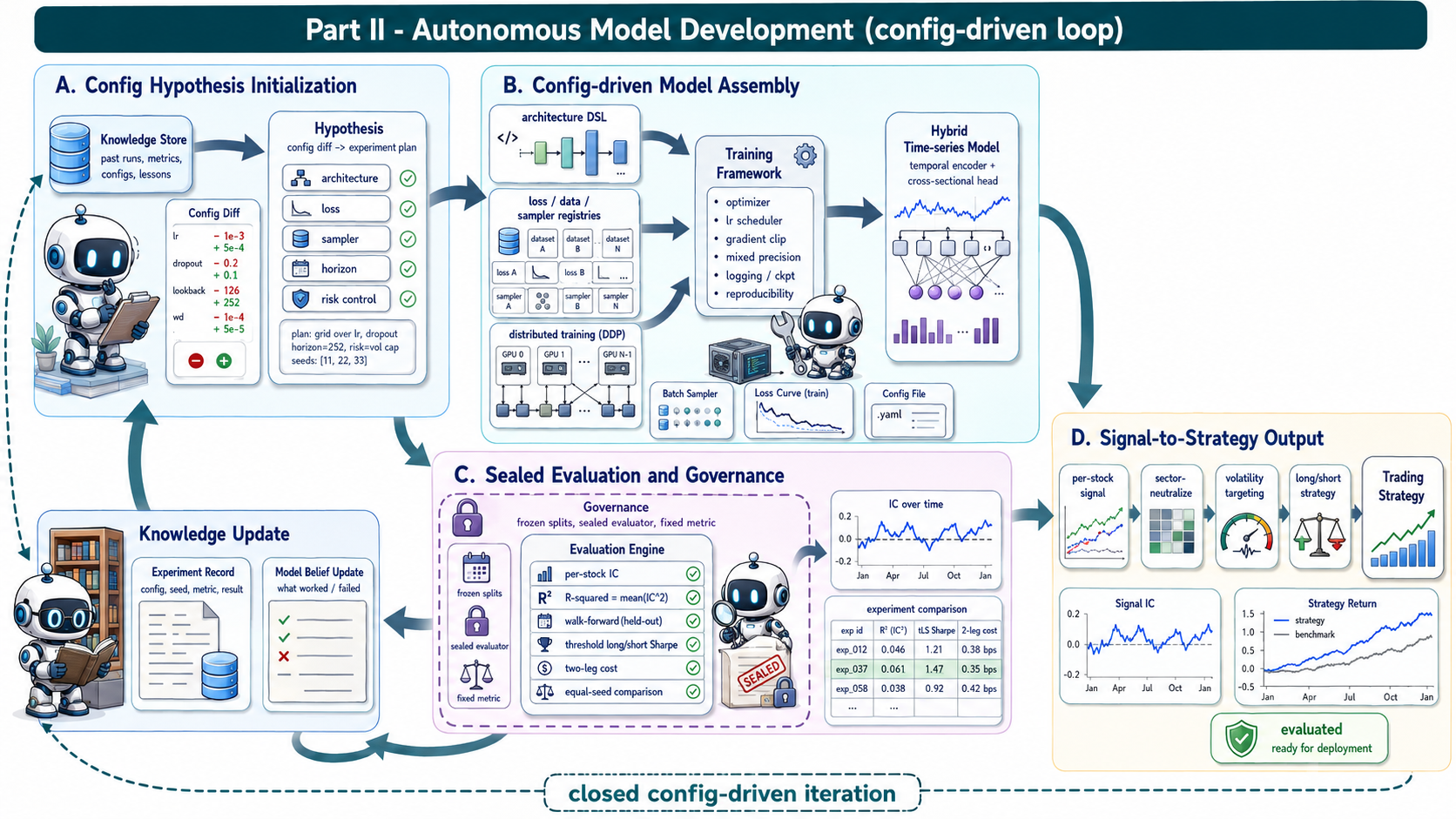
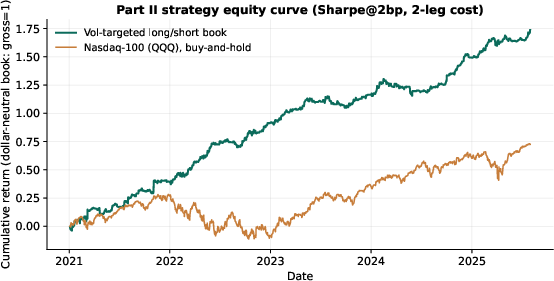
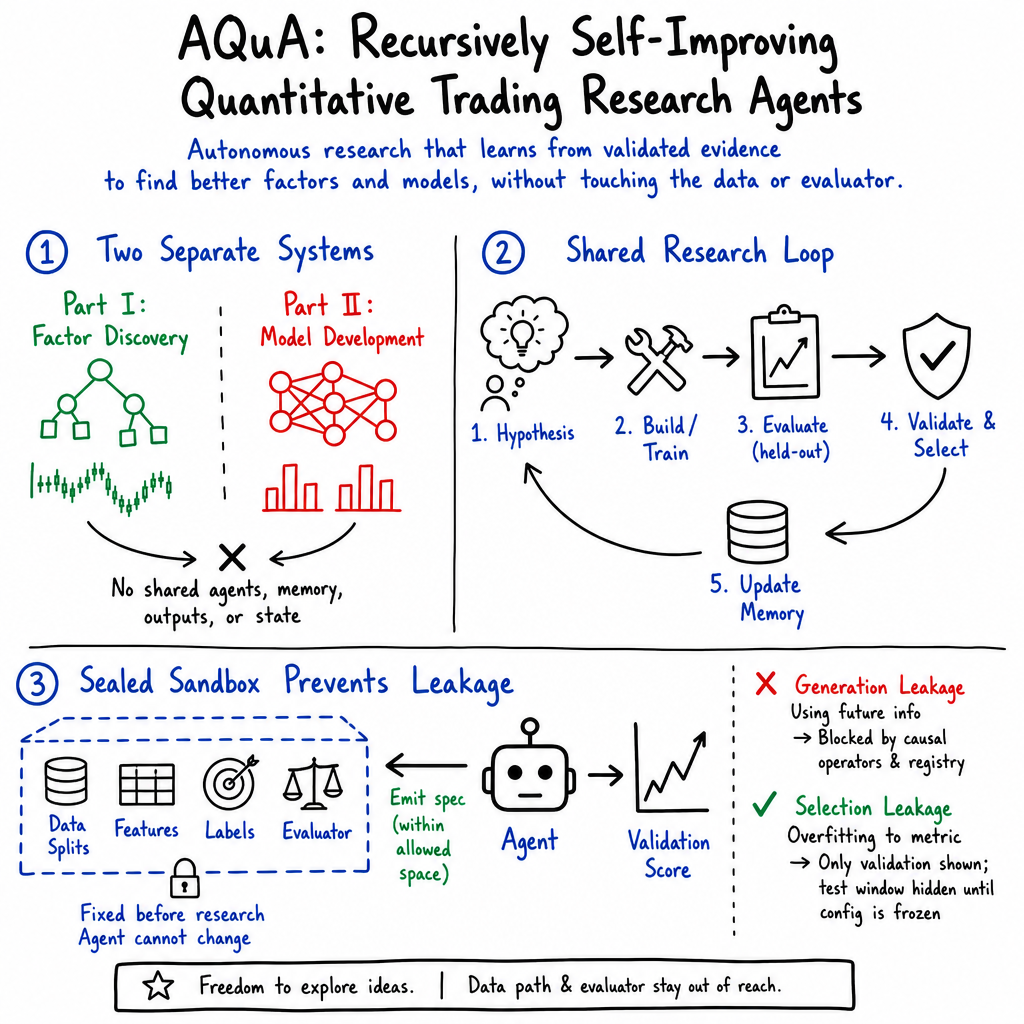
Abstract: We study recursive self-improvement at the level of quantitative-investment research: whether an autonomous system can use evidence from earlier experiments to improve the hypotheses and candidates proposed in later iterations. We present AQuA, which comprises two separate language-model-driven research systems: one for symbolic factor discovery and one for trainable model development. The two systems do not share agents, memories, candidate spaces, or research state. Instead, each independently closes its own research loop by retaining validated evidence and using it to guide subsequent proposals. In this bounded sense, both systems implement recursive self-improvement at the level of the research process. Each system also uses its own sealed sandbox, which fixes the data splits, feature and label definitions, and evaluator while allowing the model to act only through constrained factor expressions or configuration diffs. The factor system, a manager-mediated multi-agent pipeline, discovers and combines factors into a signal that reaches a combined information coefficient of about $0.190$ on a crypto universe. The model system, a config-driven loop over a hybrid time-series architecture, reaches a per-stock information coefficient of $+0.0843$ on US equities and converts it into a threshold long/short strategy with a held-out Sharpe of up to $+2.50$ at a two-leg cost. The strategy is positive in every year from 2021 to 2025.
Paper Prompts
Sign up for free to create and run prompts on this paper.
Top Community Prompts
Explain it Like I'm 14
1. What is this paper about?
This paper presents AQuA, a system that uses artificial intelligence to help research trading strategies.
The main idea is that an AI system can:
- Suggest a possible trading idea.
- Test it using historical market data.
- Learn from the result.
- Suggest a better idea next time.
This repeated cycle is called recursive self-improvement. It does not mean that the AI changes its own brain or rewrites itself. Instead, it remembers which experiments worked and uses that information to guide future experiments.
AQuA contains two separate AI research systems:
- One searches for useful market signals, called factors.
- The other designs and improves machine-learning models for predicting stock returns.
These systems do not share their memories, agents, or results.
2. What questions are the researchers asking?
The paper mainly investigates three questions:
- Can an AI system improve its trading research by learning from earlier experiments?
- Can it search for useful trading signals and models without accidentally using future information?
- Can the resulting signals work on market data that the AI did not use while searching?
The researchers are especially concerned about data leakage. This happens when a trading system accidentally uses information from the future. For example, imagine trying to predict tomorrow’s weather while secretly looking at tomorrow’s newspaper. The prediction would appear very accurate, but it would not be fair.
The paper also asks whether AI can be given enough freedom to explore while still being prevented from “cheating.”
3. How did the researchers build and test AQuA?
A sealed testing environment
AQuA works inside a carefully controlled sandbox. A sandbox is like a safe computer laboratory where the AI can perform only approved actions.
Before the AI begins, human researchers fix:
- Which data the system can use.
- How the data is divided into training, validation, and test periods.
- Which features and prediction targets are allowed.
- How performance will be measured.
The AI cannot change these rules. It can only choose from approved building blocks.
This is similar to asking a student to build different machines using pieces from a box, while preventing the student from changing the test or secretly adding extra parts.
The system also keeps the final test data hidden during the search. The AI uses a validation set to compare ideas, but the final test period is checked only after the chosen system is finished.
Part I: Searching for market factors
The first system searches for factors. A factor is a mathematical rule that may contain information about future price movements.
For example, a factor might examine:
- Recent price changes.
- Trading volume.
- Open interest, which shows how many futures contracts are active.
- The relationship between buying pressure and price movement.
- Volatility, which measures how much prices move up and down.
The system uses several AI “specialists,” each with a different job:
- A Data Steward checks and organizes the market data.
- A Visual Analyst looks for interesting patterns around important market events.
- An Idea Miner suggests possible explanations and trading signals.
- A Factor Evaluator tests the signals.
- A Backtest Engineer simulates how the signal might perform in trading.
- A Research Librarian records the results for future experiments.
The system writes down why a factor should work and what evidence would prove it wrong. This makes the ideas falsifiable, meaning they can fail a clear test instead of being declared successful no matter what happens.
The factors are built from a restricted set of mathematical operations, such as calculating averages, rankings, changes, and correlations. Because these operations can use only past or current information, the AI cannot create a factor that directly looks into the future.
Part II: Improving machine-learning models
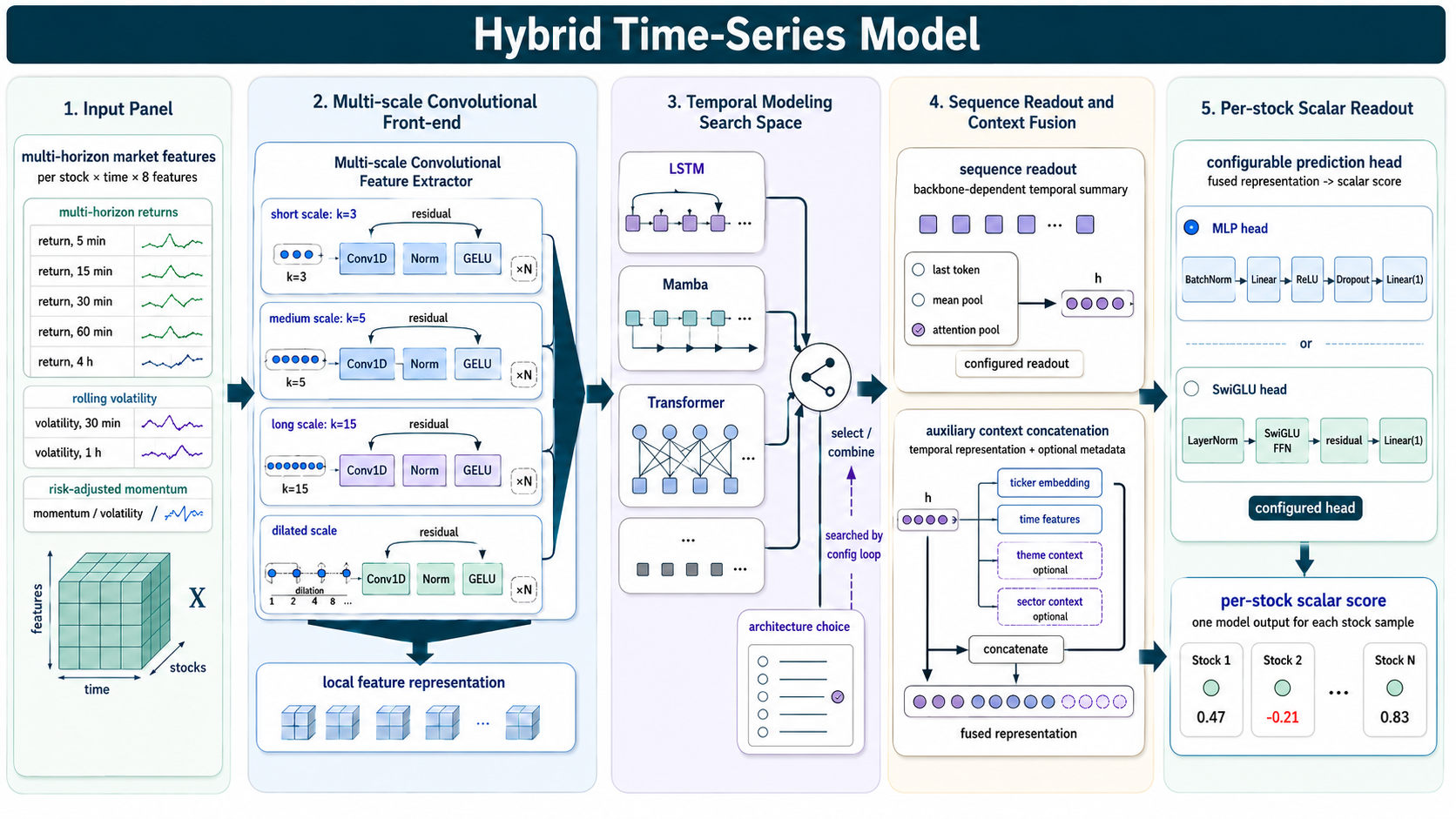
The second system develops a model that predicts the return of each US stock over the next 30 minutes.
Instead of writing completely new computer programs, the AI changes a controlled configuration file. It can adjust things such as:
- The model’s architecture.
- How much historical information it examines.
- The way it learns.
- The training settings.
- The types of approved neural-network components it uses.
The final model combines several kinds of tools:
- Convolutions, which detect short-term patterns, like recognizing a shape in a picture.
- Sequence models, which study how events change over time.
- Attention, which helps the model focus on the most important parts of a sequence.
- Cross-stock information, which allows it to compare different stocks.
The model is trained on data from 2010–2019. The year 2020 is left as a gap, and the final test uses data from 2021–2025. This helps test whether the model works in a later and unseen market period.
4. What did the researchers find?
Results from the factor-discovery system
The factor system was tested on cryptocurrency data using five-minute time intervals.
Individual factors were usually fairly weak. Their information coefficients were often around 0.03. An information coefficient, or IC, measures how well a signal’s rankings match the future rankings of returns. An IC near zero means little useful relationship; a higher positive value means the signal is more often pointing in the right direction.
However, the system combined many factors into one larger signal. This combined signal reached an IC of about 0.190.
The researchers say the improvement came from allowing the AI to:
- Remember which ideas worked before.
- Avoid ideas that repeatedly failed.
- Study special market events.
- Consider different market conditions.
- Combine several smaller signals.
The important point is that the system did not rely on one magical rule. It built a stronger result by combining many modest clues.
Results from the model-development system
The second system was tested on US stocks. Its hybrid model achieved a per-stock IC of +0.0843.
This was better than the strongest comparison model, a GRU, which achieved +0.0613. The difference was about a 37.5% relative improvement.
The researchers then used the model’s predictions to create a trading strategy:
- Buy stocks with especially high predicted returns.
- Sell stocks with especially low predicted returns.
- Keep the strategy roughly neutral to the overall market.
- Reduce the effect of different risk levels.
- Include a trading cost of 2 basis points for both sides of a trade.
The strategy achieved:
- A held-out Sharpe ratio of up to +2.50.
- About +2.00 under a stricter walk-forward test.
- Positive performance in every year from 2021 through 2025.
A Sharpe ratio is a way to compare reward with risk. A higher number generally means the strategy earned more return for the amount of uncertainty it took. A walk-forward test is especially useful because it imitates real life: the system can use only information available before each new period.
Why are these results important?
The results suggest that AI systems can help with complicated trading research while learning from previous experiments.
More importantly, the paper argues that how the experiment is designed may matter as much as how clever the AI is. If an AI is allowed to change the data, the rules, or the scoring system, it might find ways to produce impressive-looking but unreliable results.
AQuA tries to prevent this by protecting the data and evaluation process from the AI.
5. What could this research mean?
The paper shows a possible way to build safer and more reliable AI research assistants. The same idea could be useful outside finance, such as in:
- Drug discovery.
- Materials science.
- Engineering.
- Climate research.
- Automated software testing.
In all these areas, an AI might run many experiments and learn from the results. But the experiment rules must be protected so that the AI cannot accidentally or deliberately make the test easier.
The paper also suggests a possible next step: joining the two AQuA systems together. The factors discovered in the first system could become inputs for the model developed by the second system. However, this would create a new risk. The two systems might share hidden information and accidentally overfit to the same data. The researchers say the factor library would need to be frozen before the second system used it.
Important limitations
The results should not be treated as proof that the strategies will make money in real markets.
The researchers acknowledge that:
- The factor system was tested only on one cryptocurrency setting.
- The model system was tested only on US equities and one prediction horizon.
- The results came from computer simulations rather than live trading.
- Real trading may involve costs, delays, and market behavior that the simulation does not fully capture.
- Human researchers still choose the research goals, build the sandbox, and supervise the system.
- Keeping the final test data hidden depends partly on careful procedures and human honesty, not on a completely unbreakable technical lock.
Simple conclusion
AQuA is a framework for letting AI conduct trading research in a repeated learning cycle. It proposes ideas, tests them, remembers the evidence, and uses that evidence to make better proposals later.
The paper’s strongest lesson is that an AI research system needs both creativity and strict boundaries. AQuA’s AI is allowed to explore many possibilities, but it cannot change the data or the rules used to judge its ideas.
The experiments produced promising results in cryptocurrency and stock markets. Still, the findings are best understood as evidence that this type of carefully controlled AI research is possible—not as a guarantee that the strategies will always work or earn money in the real world.
Knowledge Gaps
Knowledge gaps, limitations, and open questions
- Generalizability across markets and horizons remains untested: Part I is evaluated only on a crypto five-minute universe, while Part II is evaluated only on US equities at a thirty-minute prediction horizon.
- The robustness of the reported results across alternative time periods is unclear: Although Part II reports yearly Sharpe ratios for 2021–2025, the paper does not evaluate earlier, rolling, or substantially different market regimes using the same frozen methodology.
- Live-trading validity has not been established: The results are based entirely on simulated backtests and a simplified turnover-cost model; execution delays, market impact, bid–ask spreads, liquidity constraints, borrow fees, short-sale restrictions, and capacity are not assessed.
- The crypto factor system is not evaluated with a fully independent final test set: Part I reports progression and a combined validation IC of approximately $0.190$, but the paper does not clearly specify an untouched test period that was never used for iteration, selection, or memory updates.
- Test-set isolation is not technically enforced: The paper acknowledges that Part II’s final test window is protected mainly through protocol and operator discipline, leaving open the possibility of human access or inadvertent test-informed decisions.
- The amount of adaptive search is not reported: The number of iterations, candidates, failed experiments, prompts, model calls, and accumulated comparisons is unspecified, preventing assessment of multiple-testing and search-induced overfitting.
- The statistical significance of performance is not quantified: Confidence intervals, standard errors, bootstrap results, deflated Sharpe ratios, probability of backtest overfitting, and corrections for the large number of evaluated candidates are absent.
- The stability of results across random seeds is unknown: The paper does not report variation from model initialization, minibatch ordering, distributed training, stochastic sampling, or language-model generation.
- The contribution of recursive self-improvement is not isolated: There is no controlled comparison against one-shot search, random search, memory-free agents, non-agentic optimization, or agents with shuffled/incorrect memories.
- The effect of each component of the research pipeline is unclear: The paper does not provide ablations for the manager, specialist agents, falsifiable proposals, belief updates, event profiling, direction calibration, memory, or policy stores.
- The claimed recursive improvement may be confounded with increasing search resources: The reported progression could reflect more candidates, more compute, or broader exploration rather than improved reasoning or effective reuse of prior evidence.
- The quality and reliability of persistent research memory are not evaluated: It is unknown how often the memory contains incorrect conclusions, whether erroneous beliefs persist, how conflicts are resolved, or whether memory causes premature concentration on favored mechanisms.
- The economic validity of language-model-generated hypotheses is not independently assessed: The paper does not test whether the stated mechanisms improve discovery beyond unconstrained factor generation or whether the explanations are post hoc rationalizations.
- Part I’s factor-level reproducibility is limited: The deployed factor expressions are withheld, and the paper does not provide sufficient operator settings, factor lists, weights, selection thresholds, or run-level records to reproduce the combined signal.
- The construction of the Part I combined signal is underspecified: The aggregation method, factor weighting, rebalance rules, portfolio constraints, turnover treatment, and handling of correlated or redundant factors are not fully described.
- The comparability of Part I’s combined IC is unresolved: The approximately $0.190$ combined-factor IC is based on a convention different from Part II’s per-stock IC, and the paper does not provide standardized metrics that would allow comparison with other factor-mining systems.
- The baseline comparisons are incomplete: Part I lacks quantitative comparisons with established factor-mining algorithms, conventional quantitative researchers, random DSL search, and non-LLM evolutionary or reinforcement-learning methods under identical search budgets.
- Part II’s architecture is not fully reproducible: Precise convolutional configurations, feature definitions, label construction, model dimensions, regularization, training duration, checkpoint rules, and other implementation details are omitted.
- The source and composition of the US equity universe are unspecified: Universe membership, delisted stocks, survivorship-bias controls, corporate-action treatment, liquidity filters, and inclusion/exclusion rules are not reported.
- Potential cross-sectional and temporal data issues are insufficiently documented: The paper does not fully explain how missing data, asynchronous observations, market halts, ticker changes, corporate events, and timestamp alignment are handled.
- The 2020 embargo gap is not justified empirically: It is unclear whether the gap reduces leakage, models a realistic deployment delay, or materially affects performance relative to other embargo lengths.
- The reported trading strategy depends on post-model transformations whose robustness is uncertain: Sector neutralization, threshold selection, rebalancing cadence, exposure scaling, and volatility targeting are not evaluated across alternative specifications and may contribute substantially to the Sharpe improvement.
- The $2$ bps two-leg cost assumption may be optimistic: Performance under wider spreads, nonlinear market impact, different turnover penalties, and stock-specific transaction costs is not reported.
- Capacity and scalability are unexplored: The paper does not estimate how much capital the strategy can trade before its signal decays or its execution costs materially reduce returns.
- Risk analysis is incomplete: Maximum drawdown, tail losses, skewness, turnover, leverage, exposure concentration, liquidity concentration, factor exposures, and sensitivity to extreme events are not fully reported.
- The relationship between predictive IC and economic returns is not analyzed in depth: The paper does not explain why the reported IC translates into the stated Sharpe ratios or how stable that mapping is across stocks, periods, and portfolio constructions.
- The strongest hybrid model’s incremental mechanism is unclear: No ablation determines whether the improvement comes from convolutions, attention, cross-sectional mixing, gating, multi-resolution processing, the loss function, or interactions among these components.
- The model search space is only partially characterized: The paper does not report its size, coverage, constraints, or whether important architecture and optimization alternatives were excluded from the registry.
- The evaluator’s correctness is assumed rather than independently audited: The sealed evaluator prevents agent modification, but the paper does not provide an external audit, formal verification, or adversarial testing showing that the evaluator itself correctly implements causal features, labels, costs, and portfolio rules.
- Adversarial evaluator exploitation is not examined: Even within the DSL, candidates might exploit numerical instability, undefined operations, extreme values, degenerate outputs, or quirks in ranking and scoring without directly modifying the sealed data path.
- The limits of the “leakage-free by construction” claim are not fully established: Causality of individual operators does not by itself rule out implementation bugs, improper missing-value handling, future-dependent universe membership, or leakage through preprocessing and metadata.
- Human supervision remains a significant unresolved dependency: Humans define goals, sandboxes, registries, promotion rules, and supervision decisions, so the degree of autonomy and the risk of human-induced selection bias are not quantified.
- The proposed coupling of factor discovery and model development is not implemented: It remains unknown whether Part I factors improve Part II performance after strict freezing, whether they are redundant with price-volume inputs, and whether coupling introduces measurable leakage or overfitting.
- The cost and efficiency of autonomous research are not reported: Compute usage, wall-clock time, language-model expenditure, energy consumption, and researcher-equivalent productivity are absent.
- Failure recovery and reproducibility under changed LLMs are unknown: The paper does not test whether the research process remains effective when the underlying model, prompt, temperature, context window, or agent ordering changes.
- The persistence of performance after deployment is unresolved: No paper-controlled prospective or paper-trading experiment tests whether the discovered signals survive after the research period and after market participants potentially adapt to them.**
Practical Applications
Immediate Applications
- Auditable quantitative-research platform for asset managers and hedge funds — Finance/software
- Deploy AQuA-like workflows to generate, test, rank, and document symbolic alpha factors or model configurations without allowing agents to modify data splits, labels, preprocessing, or evaluators.
- A practical product could include a
factor research registry, experiment tracker, hypothesis templates, validation reports, and persistent research memory. - The manager-mediated pipeline can support workflows such as:
- formulating an economic hypothesis;
- generating a restricted factor expression;
- evaluating predictive strength and stability;
- testing turnover, regime dependence, and baseline redundancy;
- recording the evidence for future research.
- Dependencies: high-quality timestamped market data, human-authored causal feature definitions, a sufficiently expressive but safe DSL, and human review before production use.
- Leakage-resistant model-development harness — Finance, machine learning, MLOps
- Use the configuration-driven Part II design to compare neural architectures, losses, samplers, and optimizers through reproducible configuration diffs rather than unrestricted code generation.
- Each experiment can be represented as a versioned configuration and automatically linked to its training data, validation score, model artifact, and approval status.
- This could be integrated with existing experiment-management tools to prevent accidental changes to:
- chronological data splits;
- feature and label construction;
- normalization procedures;
- checkpoint selection;
- final-test evaluation.
- Dependencies: the registry must be reviewed for unsafe operations, and the test set must remain inaccessible to the search loop and separated from operator-facing dashboards.
- Human-supervised intraday signal research — Quantitative trading
- Investment firms could use the reported factor and model results as starting points for research into short-horizon crypto and US equity strategies.
- For example, the Part I workflow can investigate event-conditioned signals involving open-interest changes, price rebounds, taker flow, basis, volume, and volatility. Part II can investigate multi-resolution sequence models for approximately 30-minute equity-return prediction.
- The output should initially be a ranked research candidate or paper-trading signal rather than an automatically deployed strategy.
- Dependencies: the reported results are market- and horizon-specific, rely on simulated transaction costs, and have not been validated in live trading. Liquidity, latency, borrow availability, slippage, fees, and market impact may substantially reduce performance.
- Systematic factor-library construction — Asset management and financial research
- The factor-discovery process can produce a structured library in which every factor is stored with its expression, expected direction, economic mechanism, target horizon, falsification criteria, historical performance, turnover, and correlations with existing factors.
- Such a library could support:
- portfolio construction;
- factor diversification;
- signal monitoring;
- post-trade attribution;
- periodic retirement of factors whose evidence deteriorates.
- The mechanism-based records are especially useful for distinguishing genuinely different signals from superficial variations of the same price or volume rule.
- Dependencies: factor descriptions must be standardized, validation must be repeated across assets and regimes, and the library must not be allowed to become an uncontrolled source of adaptive overfitting.
- Research-governance and model-risk controls — Finance, regulated industry, policy
- The paper’s distinction between generation leakage and selection leakage can be converted into an internal control framework for AI-assisted investment research.
- Institutions can require:
- immutable dataset and evaluator identifiers;
- chronological and embargoed splits;
- validation-only feedback during search;
- one-time final-test evaluation;
- immutable experiment logs;
- approval gates before promotion to paper trading or live trading.
- This creates an auditable chain from hypothesis to experiment to production decision.
- Dependencies: test-set isolation is only partly technical in the paper and still depends on operator discipline, access control, and independent audits.
- Reusable autonomous experimentation pattern for academia — Scientific computing and education
- Researchers can adapt the sealed-sandbox pattern to benchmark machine-learning methods without permitting an agent to alter the benchmark, evaluation metric, or test data.
- Suitable uses include automated ablation studies, hyperparameter exploration, symbolic-regression research, and reproducibility testing.
- A dissertation or laboratory workflow could require the agent to emit only:
- a DSL expression;
- a configuration diff;
- a formal hypothesis;
- or a bounded experiment specification.
- Dependencies: the benchmark must be designed before experimentation, and researchers must account for adaptive overfitting to validation metrics even when the test set is hidden.
- Training and evaluation tool for quantitative-finance education — Universities and professional training
- Students can use a restricted research environment to practice hypothesis formation, factor design, backtesting, and falsification without writing unrestricted code that inadvertently introduces look-ahead bias.
- An educational product could compare:
- a naive unrestricted workflow;
- a constrained causal DSL workflow;
- and a walk-forward evaluation workflow.
- This would make common errors such as future leakage, test-set reuse, and excessive parameter search observable.
- Dependencies: instructional environments should avoid presenting backtest Sharpe ratios as guaranteed investment performance and should include transaction costs, failure cases, and multiple-testing discussions.
Long-Term Applications
- Coupled factor-discovery and model-development systems — Finance and autonomous investment research
- A future AQuA system could pass validated crypto or equity factors from Part I into the Part II model-development loop, allowing neural models to learn nonlinear combinations of economically interpretable signals.
- The factor library would need to be frozen before model training begins, or versioned as an immutable input, so that model selection cannot indirectly steer factor discovery.
- A possible workflow is:
- 1. discover factors on a designated research period;
- 2. freeze and document the surviving factor set;
- 3. train models using that fixed library;
- 4. evaluate on a separately protected walk-forward period;
- 5. repeat only after a new protocol is established.
- Dependencies: strict information-flow control is essential; otherwise the coupled loops create a new selection-leakage channel.
- Multi-market and multi-asset autonomous research — Finance
- The framework could be extended from crypto five-minute data and US equity thirty-minute returns to futures, foreign exchange, commodities, options, bonds, and longer investment horizons.
- Agents could search for market-specific mechanisms while preserving a common governance layer for causal features, cost modeling, and test isolation.
- Potential products include cross-asset signal discovery services, adaptive research assistants for portfolio teams, and regime-aware factor monitoring systems.
- Dependencies: transfer is not established by the paper. Each market requires new data-quality controls, liquidity assumptions, cost models, trading calendars, labels, and out-of-sample validation.
- Live portfolio decision-support and semi-automated execution — Trading technology
- After extensive paper trading and independent validation, the model output could support a portfolio-management workflow that:
- ranks securities;
- applies sector neutralization;
- forms dollar-neutral long/short positions;
- applies volatility targeting;
- estimates turnover and transaction costs;
- generates orders subject to risk and compliance limits.
- Initially, the agent should recommend trades while a human approves them; later versions might automate only bounded components such as signal refresh or risk scaling.
- Dependencies: live performance can diverge from backtests because of execution latency, market impact, crowding, short-sale constraints, data outages, model drift, and changing market microstructure. Regulatory approval and operational kill switches would also be required.
- Continuous model-drift and factor-decay monitoring — Finance, risk management
- The persistent evidence store could evolve into a monitoring service that detects when a factor’s information coefficient, sign, turnover, or regime concentration changes materially.
- The system could recommend retraining or retirement, while preserving a fixed evaluation protocol to avoid reacting to noise.
- Useful outputs would include factor health dashboards, drift alerts, explanation histories, and evidence-backed promotion or rollback decisions.
- Dependencies: retraining policies must be specified in advance; otherwise continuous adaptation can itself overfit recent conditions. Monitoring data must remain distinct from the protected performance-evaluation data.
- General-purpose safe autonomous experimentation infrastructure — Healthcare, energy, robotics, materials, and software
- The paper’s core architecture can be generalized to any domain where an AI agent proposes experiments against a sensitive or expensive evaluator.
- Examples include:
- Healthcare: selecting model architectures for diagnosis or treatment prediction while freezing patient splits, labels, and safety metrics.
- Energy: optimizing forecasting or control models while protecting future demand or price evaluation windows.
- Robotics: searching controller configurations in a simulator with fixed safety constraints and test environments.
- Materials science: proposing candidate compositions while preserving held-out synthesis and measurement benchmarks.
- Software engineering: evolving algorithms or configurations against hidden test suites and resource limits.
- The transferable design is to constrain what the agent can generate and separate the metric used for iteration from the metric used for final reporting.
- Dependencies: each domain needs a domain-specific DSL, formally verified constraints, reliable simulators or datasets, and safety review. Financial-style benchmark leakage controls do not automatically guarantee clinical, physical, or operational safety.
- Institutional benchmark and governance standards for autonomous AI research — Academia, industry, and policy
- Policymakers, journals, and research organizations could require AI-generated empirical research to disclose:
- the immutable data and split definitions;
- the agent’s action space;
- the metrics exposed during search;
- the number of adaptive iterations;
- the final test protocol;
- the human approval process;
- and all failed as well as successful experiments.
- A standardized “autonomous experiment card” could accompany papers, investment models, or deployed systems.
- Dependencies: standards would need consensus on auditability, secure logging, reproducibility, privacy, and how to handle proprietary data and confidential model research.
- Automated hypothesis-generation systems for daily decision support — Consumer software and personal finance
- In a distant and highly constrained form, similar systems could help individuals compare budgeting, savings, or investment strategies using simulated personal-finance data and fixed objectives.
- The system might generate and test scenarios such as emergency-fund levels, spending rules, or diversified allocation policies rather than autonomously trading securities.
- Dependencies: consumer deployment would require strong safeguards against presenting simulated results as financial advice, robust personalization, privacy protection, suitability checks, and human-readable uncertainty estimates. The paper does not directly validate such applications.
Glossary
- Adaptive overfitting: Overfitting caused by repeatedly adjusting choices based on observed evaluation feedback. “repeated access to a fixed holdout can cause adaptive overfitting”
- Attention: A neural-network mechanism that weights relationships among elements in a sequence. “state-space models~\cite{gu2023mamba}, and attention~\cite{vaswani2017attention}”
- Backtest overfitting: Selecting or tailoring a strategy so that it performs well on historical data but fails on unseen data. “Backtest overfitting of this kind is well documented”
- Basis: The difference between related market prices, often used as an indicator of futures-market conditions. “basis recovery indicate insufficient demand behind the rebound”
- Causal volatility targeting: Adjusting exposure using only volatility information available before the prediction or trading decision. “A causal volatility-targeting overlay”
- Checkpoint: A saved model state used for evaluation or later continuation of training. “early stopping and checkpoint choice”
- Cross-sectional operator: An operation applied across multiple assets at the same timestamp. “cross-sectional operators that act across the universe at a fixed timestamp”
- Cross-sectional mean: An average computed across entities, such as stocks, for a given observation or period. “the cross-sectional mean of squared IC”
- Cross-sectional mixing: Combining information across different assets in a panel at each time step. “A cross-sectional stage then mixes information across the panel of stocks”
- Cross-sectional normalization: Rescaling values relative to other entities in the same cross-section. “sector neutralization”
- Data leakage: The unintended use of information that would not be available when a prediction or decision is made. “the central failure mode is data leakage”
- Dollar-neutral: A portfolio construction in which the total long exposure approximately equals the total short exposure. “a volatility-targeted, dollar-neutral long/short book”
- Domain-specific language (DSL): A restricted programming language designed for a particular application domain. “a restricted domain-specific language (DSL)”
- Embargo gap: A period deliberately excluded from training and selection to reduce temporal contamination between datasets. “leave 2020 as an embargo gap”
- Expanding median: A median calculated over a progressively growing historical window. “toward an expanding-median target”
- Expanding window: A time-series evaluation or training window that grows as new observations become available. “walk_forward: expanding”
- Expression tree: A tree representation in which operators form internal nodes and input variables form leaves. “A factor is a composition of these operators over the raw fields, represented as an expression tree”
- Factor: A measurable variable or formula intended to explain or predict asset returns. “A factor is a composition of these operators over the raw fields”
- Factor discovery: The process of searching for predictive financial variables or formulas. “one for factor discovery and one for model development”
- Falsifiable hypothesis: A proposed explanation or prediction that specifies conditions under which it could be shown false. “Before assembling the expression, the agent states each factor as a falsifiable proposal”
- Formulaic alpha: A mathematically specified trading signal intended to generate excess returns. “the standard vocabulary of formulaic-alpha operators”
- Forward return: The return realized over a future interval relative to the time at which the prediction is made. “predict each stock's forward return over the next thirty minutes”
- Generation leakage: Leakage introduced when an agent creates a feature, label, or transformation using unavailable future information. “Generation leakage enters when the agent can define a feature, label, or transform”
- GRU (Gated Recurrent Unit): A recurrent neural-network architecture that uses gates to regulate information flow through a sequence. “a GRU, under the same evaluator”
- Held-out data: Data reserved for evaluation and not used to fit or select a model. “evaluated on held-out data”
- Information coefficient (IC): A correlation measuring the relationship between predictions and subsequent asset returns. “The combined validation information coefficient rises”
- Inner-validation slice: A validation subset used during model development while preserving a separate final test set. “Model selection (early stopping and checkpoint choice) is driven only by an inner-validation slice”
- Look-ahead bias: An evaluation error caused by using future information in a supposedly historical decision. “validated against look-ahead bias and regime dependence”
- Long/short strategy: A strategy that takes long positions in some assets and short positions in others. “a threshold long/short strategy”
- Market-neutral: Designed to minimize exposure to broad market movements. “The market-neutral book compounds more smoothly”
- Multi-agent pipeline: A workflow in which multiple specialized agents perform coordinated stages of a task. “a manager-mediated multi-agent pipeline”
- Multi-resolution stack: A neural architecture that processes information at multiple temporal or spatial scales. “deep multi-resolution stacks”
- Out of sample: Evaluated on data unavailable during model development or selection. “The strategy is positive in every year from 2021 to 2025.”
- Panel interaction: Modeling relationships among multiple entities observed over time. “times: 3 # panel interaction”
- Per-stock time-series IC: An information coefficient calculated separately for each stock across time. “a per-stock time-series information coefficient”
- Quantile portfolio: A portfolio formed by grouping assets according to ranked signal values. “The Backtest Engineer then turns the evaluated signal into a simple quantile portfolio.”
- Recursive self-improvement: Iteratively using validated prior results to improve subsequent proposals or decisions. “We use recursive self-improvement in this bounded, research-process-level sense”
- Regime dependence: Performance or behavior that varies according to a particular market environment. “validated against look-ahead bias and regime dependence”
- Reinforcement learning: Machine learning in which an agent learns by receiving rewards or penalties for actions. “reinforcement learning~\cite{yu2023synergistic, zhang2026feedback, zhao2025quantfactor, zhao2025trajectory}”
- Rolling rank: The rank of a value relative to observations within a moving historical window. “rolling rank, rolling standard deviation”
- Rolling standard deviation: A standard deviation computed over a moving window of recent observations. “rolling standard deviation, linear-decay weighting”
- Ridge: A linear regression method that uses regularization to reduce coefficient instability and overfitting. “a ridge linear combination of them”
- Sharpe ratio: A risk-adjusted performance measure equal to excess return divided by return volatility. “a held-out Sharpe of up to ”
- Sector neutralization: Adjusting positions or signals to remove systematic exposure to industry sectors. “Sector-neutralizing the score removes common sector exposure”
- Selection leakage: Leakage caused by choosing candidates using the metric on which final performance will be reported. “Selection leakage enters when the agent can read the metric it will be judged on”
- Sealed evaluator: A fixed evaluation component inaccessible to the adaptive model or agent. “the evaluator are sealed and human-authored”
- Sealed sandbox: A controlled environment that fixes data, evaluation, and permitted operations. “We contain it structurally by fixing a sandbox before any iteration begins.”
- State-space model: A sequence model that represents evolving latent states to process temporal data. “state-space models~\cite{gu2023mamba}”
- Stratified sampler: A sampling procedure that preserves specified proportions across categories or groups. “sampler: {kind: stratified_minute, batch: 8192}”
- Temporal convolution: A convolution applied along the time dimension of sequential data. “temporal convolutions~\cite{bai2018empirical}”
- Temporal alignment: Matching observations, features, labels, and decisions to their correct times. “A code-generating agent may inadvertently introduce a temporal-alignment or preprocessing error”
- Threshold long/short book: A portfolio that takes long or short positions only when signals cross specified thresholds. “The score is turned into a dollar-neutral threshold long/short book”
- Two-leg turnover cost: Trading cost incurred for both the long and short sides of a portfolio. “a two-leg turnover cost”
- Turnover: The rate at which portfolio positions are traded or replaced. “turnover, expression complexity, and correlation with the existing factor pool”
- Validation slice: A fixed subset used to score candidates during model or strategy search. “the harness returns to the agent only a score on a validation slice fixed in advance”
- Walk-forward evaluation: Testing a model sequentially using only information available before each subsequent test period. “A stricter walk-forward evaluation”
- Z-score: A standardized value indicating how many standard deviations an observation lies from a reference mean. “rank, z-score, sector neutralization”

