Building Seifert Surfaces in Surgery-Presented 3-Manifolds
This presentation explores a new algorithm that extends the classical Seifert construction from links in the 3-sphere to arbitrary 3-manifolds presented by surgery on framed links. By combining solution vectors for linking equations, isotopy slides over surgery components, and tubing to eliminate intersections, the algorithm produces explicit Seifert surfaces for null-homologous links and enables computation of knot invariants such as signatures, Alexander polynomials, and genera in general 3-manifolds.Script
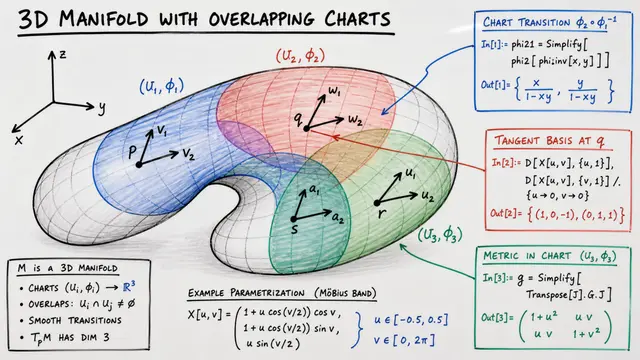
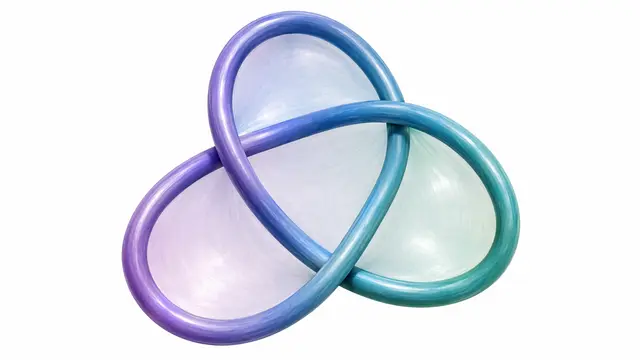
In the 3-sphere, Seifert's algorithm constructs a surface spanning any oriented link from a simple diagram. But what happens when your link lives in a more complicated 3-manifold built by surgery?
The authors reduce the problem to linear algebra. Every surgery presentation comes with a linking matrix, and a link is null-homologous precisely when you can solve a linking equation for an integer vector.
That solution vector tells you exactly how to slide your link over the surgery components. Each slide is an isotopy in the surgered manifold that cancels one entry of the linking vector, and when you finish, your link no longer links the surgery curves at all.
Now you apply the classical Seifert algorithm in the 3-sphere and tube away the intersections with the surgery link. Because the linking numbers are zero, intersections come in canceling pairs, and each tube removes two crossings without changing the boundary.
The algorithm computes Seifert matrices, signatures, and Alexander polynomials for knots in arbitrary 3-manifolds. One striking application shows a genus-one knot in a homology sphere that bounds a disk in a contractible 4-manifold, revealing that intrinsic genus and slicing behavior can diverge.
This work transforms Seifert's century-old diagrammatic method into a tool for computing knot invariants in any surgery-presented 3-manifold. Visit EmergentMind.com to explore the paper in depth and create your own visual explainers.