An algorithm for Seifert surfaces in 3-manifolds via surgery presentations
Abstract: The classical Seifert algorithm provides an explicit construction of a Seifert surface for any link in . Alegria and Menasco extended this construction to integral homology $3$-spheres using Heegaard splittings. In this paper, we extend the Seifert algorithm to null-homologous links in arbitrary $3$-manifolds via surgery on framed links in .
Paper Prompts
Sign up for free to create and run prompts on this paper.
Top Community Prompts
Explain it Like I'm 14
1. What is this paper about?
This paper studies knots and links inside three-dimensional spaces. A knot is like a piece of string whose ends have been joined together. A link is a collection of knots that may be tangled with one another.
The main goal is to build a Seifert surface for a link. A Seifert surface is an ordinary, flat-like surface whose edge is the link. For example, a circle can be the edge of a disk. A more complicated knot might be the edge of a surface with holes or handles.
For knots in ordinary three-dimensional space, called in mathematics, there is a well-known method called the Seifert algorithm. This paper develops a similar method for knots and links in much more complicated three-dimensional spaces.
The authors describe these spaces using a process called surgery on framed links.
2. What questions does the paper ask?
The paper focuses on three main questions:
- Can we construct a Seifert surface for a link in any three-dimensional manifold?
- Can we calculate linking numbers in these spaces using diagrams in ordinary ?
- If we perform surgery on a knot inside such a space, can we describe the result using a surgery diagram?
The main result answers the first question positively, at least when the three-dimensional space is presented using surgery.
The link must be null-homologous. In simple terms, this means that the link does not represent an unremovable “loop” in the space. This condition is exactly what allows it to be the boundary of a surface.
3. How are the spaces described?
Surgery on a framed link
The paper begins with a link drawn in ordinary . Each component of is given a number called a framing.
Imagine removing a thick tube around every component of and gluing the tubes back in a possibly twisted way. The new space is a three-dimensional manifold obtained by surgery.
This is useful because every closed, orientable three-dimensional manifold can be made this way. Therefore, instead of working directly in a complicated space, mathematicians can work with a link diagram in ordinary space.
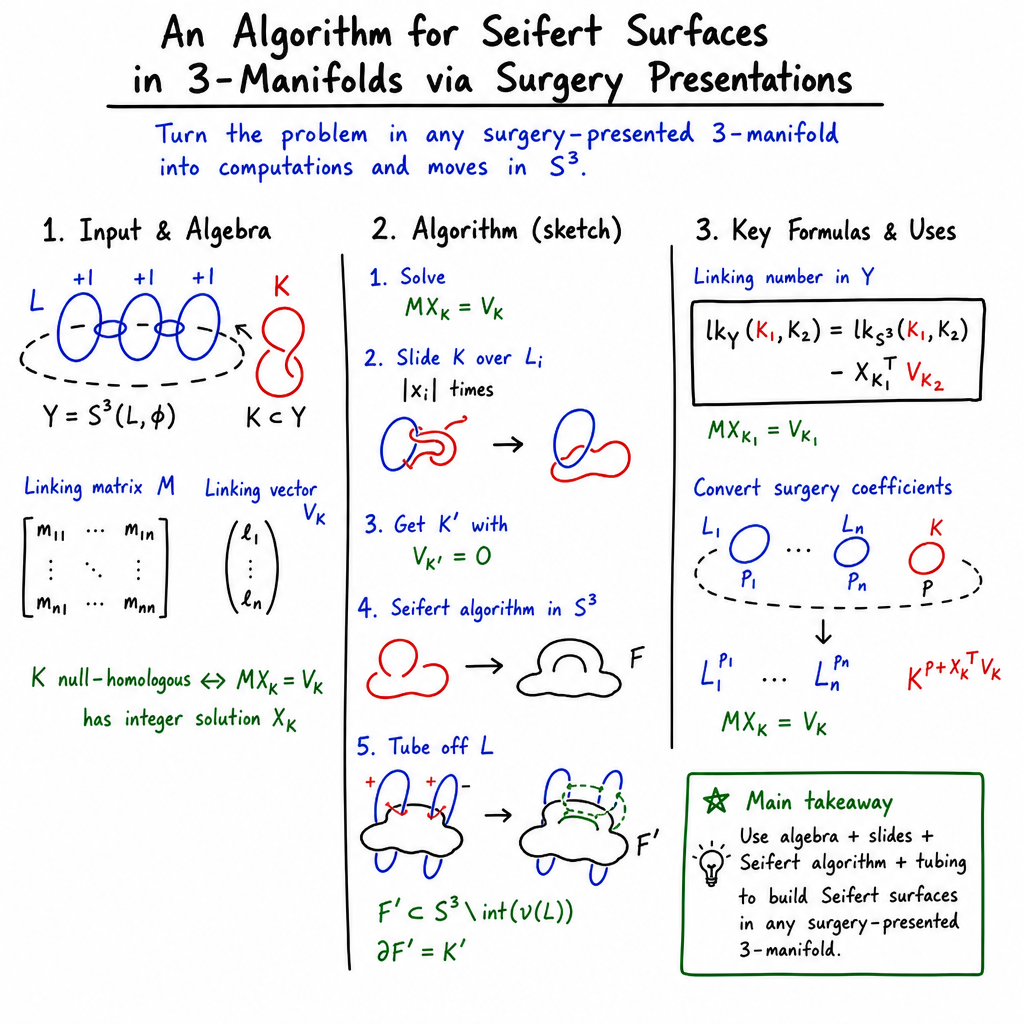
The linking matrix
The surgery link has a linking matrix . Its entries record:
- how many times different components of the surgery link are linked;
- the framing number of each component along the diagonal.
This matrix stores important information about the three-dimensional space.
The paper also records how the knot is linked with the surgery components. These numbers form a linking vector .
The condition that is null-homologous can then be checked by solving
Here, is a vector of integers. It tells us how many times the knot needs to be modified using the surgery components.
This is similar to solving a set of instructions: the matrix gives the available moves, and the vector tells us what needs to be corrected.
4. The main algorithm
The paper’s algorithm has two major stages.
Stage 1: Slide the knot over the surgery link
The knot is changed by performing slides over components of the surgery link.
A slide is like attaching a band between the knot and one component of the surgery link, creating a new version of the knot. In the final three-dimensional manifold, this operation is only an isotopy, meaning the knot has not really changed its position in the manifold. However, its diagram in has changed.
The solution vector tells us exactly how many positive or negative slides to perform.
After these slides, the new link has zero linking number with every component of the surgery link:
In everyday language, the slides untangle the knot from the surgery components as far as linking is concerned.
Stage 2: Build a surface in the complement
Because is now in ordinary , we can use the classical Seifert algorithm to construct a surface with boundary .
However, this surface might pass through the surgery link. The paper fixes this by adding tubes to the surface.
Whenever the surface crosses a surgery component, the intersections can be paired up because the total linking number is zero. The paper removes small disks around two opposite intersections and connects them with a tube. This removes those intersections.
Repeating this process produces a new surface that:
- has boundary ;
- does not intersect the surgery link;
- therefore lies inside the surgered manifold.
Thus, is a Seifert surface for the original knot, after it has been isotoped in the three-dimensional manifold.
5. Main theorem
The main theorem says:
If is a null-homologous link in a three-manifold described by surgery, then there is an explicit algorithm that changes within that manifold to a link bounding a Seifert surface in the complement of the surgery link.
The method is therefore completely constructive. It does not merely prove that a surface exists; it explains how to build one.
The process is:
- Draw the surgery diagram.
- Calculate the linking vector .
- Solve the integer equation .
- Use the entries of to decide which slides to perform.
- Apply the ordinary Seifert algorithm to the resulting link.
- Add tubes to keep the surface away from the surgery link.
6. Calculating linking numbers
The paper also gives a formula for calculating the linking number of two knots and in the surgered manifold.
The ordinary linking number in is corrected by a term involving the surgery matrix:
Here:
- is the linking number seen in the original diagram;
- records how links the surgery link;
- is found by solving ;
- the superscript means that the vector is written as a row before multiplying.
The formula says that the linking in the new space is the old linking number minus a correction caused by the surgery.
When the manifold is an integral homology sphere, the matrix has an inverse, so the solution is simply
This makes the calculation especially direct.
7. Describing further surgery on a knot
The paper proves another useful result. Suppose a knot in the surgered manifold receives -surgery.
The number written beside in the original surgery diagram is not always . It must be corrected using the way links the surgery components.
The correct coefficient is
Therefore, surgery on in the complicated manifold can be represented by simply adding to the original surgery diagram with this corrected coefficient.
This is important because it lets mathematicians study complicated surgeries using ordinary diagrams and calculations.
8. Examples and results
The paper gives two examples involving knots in homology spheres.
For the examples, the author uses the constructed Seifert surfaces to calculate:
- Seifert matrices, which record how curves on the surface link their pushed-off copies;
- signatures, numbers that describe some of the knot’s geometric behavior;
- Alexander polynomials, algebraic expressions that help distinguish knots.
In both examples, the calculations give the Seifert matrix
From this, the paper obtains:
- signature ;
- Alexander polynomial, up to a standard ambiguity,
These calculations show that the knots have interesting topology. In particular, they do not bound disks in the three-dimensional manifolds, so their minimal genus is $1$.
The examples also show that these knots are not local knots. A local knot is one that can be placed entirely inside a small three-dimensional ball in the larger space.
The author proves this by comparing what happens when surgery is performed on the knot. If the knot were local, the resulting space would have to split in a particular way, as a connected sum. Kirby-calculus calculations show that this does not happen.
9. Why is the paper important?
Before this work, the classical Seifert algorithm worked directly in , and related methods existed for some special three-dimensional spaces.
This paper extends the idea to arbitrary three-manifolds presented by surgery. Its importance comes from turning a difficult geometric problem into a sequence of manageable steps involving:
- link diagrams;
- integer vectors;
- matrix equations;
- slides;
- ordinary surfaces and tubes.
The paper also provides formulas for linking numbers and surgery coefficients. These formulas allow researchers to calculate important knot information without having to understand the entire three-dimensional manifold from scratch.
10. Simple conclusion
The main message of the paper is:
Complicated three-dimensional spaces can be studied using diagrams in ordinary three-dimensional space.
If a knot does not represent a permanent loop in the space, the paper gives a practical recipe for finding a surface whose boundary is that knot. It also explains how to calculate linking numbers and how to draw new surgery diagrams after operating on the knot.
In the future, these methods could help mathematicians study more complicated knots, compare different three-dimensional spaces, and calculate knot invariants such as Alexander polynomials and signatures. The work is a useful bridge between abstract topology and concrete diagram-based calculations.

