What the Machine Invented: Mining AI-Generated Mathematical Instruments
This presentation examines a systematic survey of OpenAI's October 2026 release of 722 AI-generated mathematical manuscripts. Rather than focusing solely on headline theorems, the study proposes a novel methodological framework: extracting reusable mathematical instruments—lemmas, constructions, inequalities, and proof architectures—that may retain value independently of the problems they were designed to solve. Spanning 38 problem families across diverse mathematical fields, the survey separates extraction from validation, documenting both genuinely new candidate devices and extensive dependencies on established mathematics while raising fundamental questions about how we should evaluate machine-generated mathematical contributions.Script
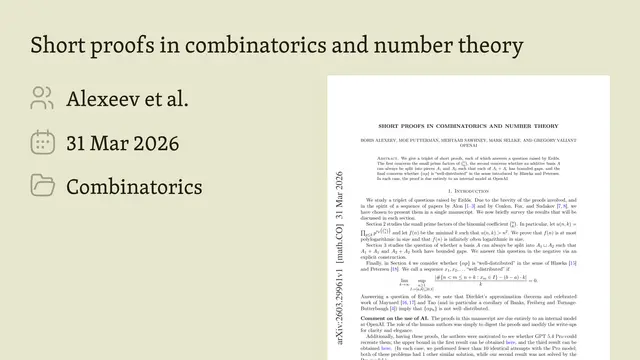
In October 2026, OpenAI released 722 manuscripts containing AI-generated mathematical proofs. This paper asks a radical question: what if the real contribution is not whether the machine solved the Unique Games Conjecture, but what reusable mathematical instruments it invented along the way?
The authors surveyed 38 problem families spanning number theory, geometry, and complexity theory, deliberately separating extraction from validation. Extraction identifies the mathematical mechanism and traces its role through the argument. Validation concerns correctness, formalization, and whether anyone proved it before.
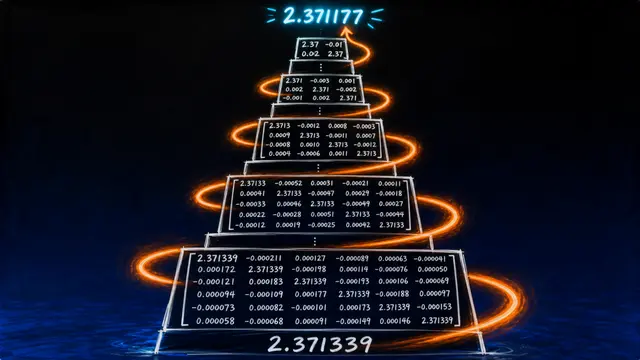
Consider the shared-leg entropy inequality for matrix multiplication, which constrains asymptotic rank through spectral geometry without constructing a single finite algorithm. Or triangular polynomial cells that prevent precision loss by controlling error budgets in descending order. These instruments work even when their headline theorems remain unverified.
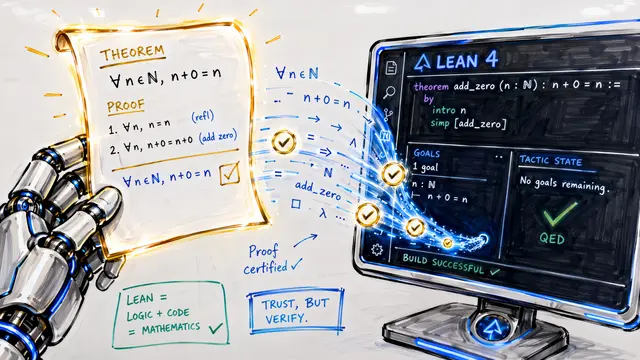
The study documented extensive dependencies and limitations. The Hilbert's tenth reduction depends on unverified claims about elliptic curves. The Haldane gap relies on computer-assisted estimates. The Borsuk construction is nonconstructive. Nineteen families have Lean formalizations, but the survey compiled exactly zero of them to kernel-checked completion.
The signed restriction lemma from circuit lower bounds illustrates genuine reuse. Originally designed for depth-three circuits, it was later abstracted and combined with adaptive averaging to claim improved bounds for all fixed depths. The instrument gained a life beyond its original theorem.
The survey examined only 38 of 372 families, leaving hundreds of manuscripts unexplored. Its strongest conclusion is methodological: mine AI-generated proofs for reusable instruments, but detach them from their source claims and subject them independently to verification. Learn more about AI-generated mathematics and create your own video presentations at EmergentMind.com.