The Sum-Product Conjecture is False for Real Numbers
This lightning talk presents a groundbreaking disproof of the Erdős-Szemerédi sum-product conjecture, a longstanding problem in additive combinatorics. Using sophisticated techniques from algebraic number theory and lattice geometry, the authors construct explicit counterexamples showing that finite sets of real numbers can have both their sum sets and product sets grow much more slowly than the conjecture predicted. The result fundamentally reshapes our understanding of additive and multiplicative structure in infinite fields.Script
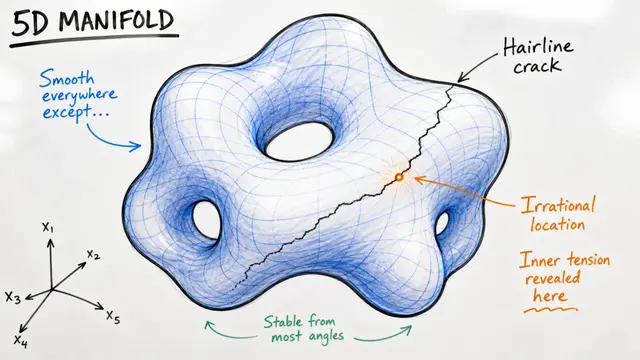
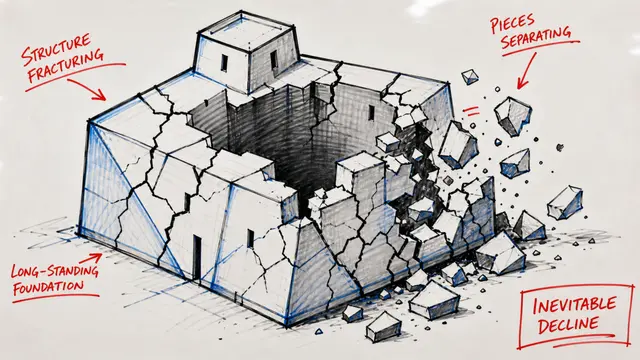
For decades, mathematicians believed that if you take any finite set of real numbers, either adding pairs together or multiplying them should explode the set size to nearly its square. That intuition just shattered.
The conjecture claimed that for any set A, the maximum of its sumset size and product set size must grow as A squared, minus only negligible terms. The authors prove this is false by constructing sets from totally real algebraic number fields of arbitrarily large degree, combining a multiplicative unit lattice with an additive box of algebraic integers.
The magic happens through dual control. The sumset stays trapped in a bounded lattice region, growing only as A to the power 1 plus epsilon for any epsilon you choose. Simultaneously, the product set is dominated by unit lattice structure, capped at A to the power 2 minus c for some absolute constant c, creating exponential savings that violate the conjecture outright.
The construction scales to arbitrary size using Martinet's towers, number fields where discriminant and regulator remain exponentially bounded even as the degree grows without limit. This isn't a marginal counterexample. The technique generalizes to p-adic numbers, finite fields, and function fields, and even resolves open questions about unit equations in number theory by showing solution counts grow exponentially in field degree.
There's a sharp limitation to keep in mind. These counterexamples leverage high-degree number fields and vanish if you restrict to integers or number fields of bounded degree. The conjecture may still hold in those constrained settings, making the boundary between truth and falsehood a question of algebraic structure, not just cardinality.
This result doesn't just disprove a conjecture. It rewrites the landscape of sum-product phenomena and injects number-theoretic techniques into additive combinatorics in ways that will echo for years. To dive deeper into this breakthrough and explore more cutting-edge research, visit EmergentMind.com, where you can create your own videos explaining the papers that fascinate you most.