Evolving the Matrix Multiplication Exponent
This lightning talk presents a new upper bound on the matrix multiplication exponent omega, achieved not through new mathematics but by scaling up existing proof machinery to 7 million parameters, rebuilding the optimizer in JAX for hardware acceleration, and using AlphaEvolve to refine the optimization code itself. The result demonstrates that modern machine learning infrastructure can push the boundaries of computer-assisted complexity proofs while maintaining rigorous certifiability.Script
For decades, mathematicians have chipped away at the matrix multiplication exponent, omega, proving it's less than 3 but unable to pin down its true value. This paper pushes the best upper bound from 2.371339 down to 2.371177, not by discovering new math, but by scaling up the optimization machinery to handle nearly 7 million parameters.
The proof framework is combination loss analysis, which organizes tensor decompositions into a recursive tree with levels, shapes, and region labels. Moving from recursion depth 3 to depth 4 explodes the parameter count from 25,000 to 7 million, making the previous sequential optimizer completely impractical.
The authors rebuilt the entire optimizer in JAX, replacing graph-based message passing with dense tensor operations distributed across up to ten axes. This redesign trades a factor-of-three overhead in parameter count for the ability to run gradient descent with automatic differentiation on hardware accelerators.
Then comes AlphaEvolve, which doesn't optimize the math directly but evolves the optimizer's code itself. Each generation runs for five hours on a GPU, and the best solutions seed the next generation. This two-level search, continuous parameters inside and code architecture across generations, squeezes out an additional improvement of roughly 0.000065 beyond gradient descent alone.
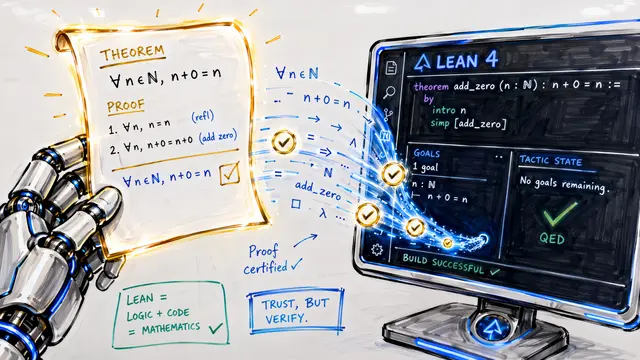
Discovery and proof are kept strictly separate. The numerical optimizer produces a floating-point candidate, but that candidate is then rounded to rationals and verified using exact arithmetic with explicit entropy certificates. Only after this rigorous check does the bound become a theorem.
The gain is small, just 0.000162, but it's on par with many advances over decades of laser-method refinements. The authors acknowledge that further progress within this framework faces doubly exponential growth in complexity, and larger improvements will likely require new mathematical ideas. To dive deeper into how machine learning is reshaping computer-assisted proofs, visit EmergentMind.com and create your own videos exploring the frontier of algorithmic mathematics.