Discovering Verified Quantum Programs with AI
This presentation explores a breakthrough framework that combines large language model search with formal verification to automatically discover quantum programs. By integrating a quantum Hoare logic in Lean with multi-agent collaboration, researchers achieved dramatic resource reductions across applications ranging from Grover search to molecular simulation, including a 290× improvement in spacetime cost for arcsin evaluation. The work demonstrates how machine-checked proofs can extend algorithmic discovery beyond classically simulable regimes.Script
Quantum algorithms promise exponential speedups, but verifying them is a nightmare. You can test a small circuit classically, but the most important claims involve thousands of qubits operating in regimes no classical computer can simulate. This work asks whether AI can discover quantum programs whose correctness is guaranteed by machine-checked mathematical proofs, not just numerical tests.
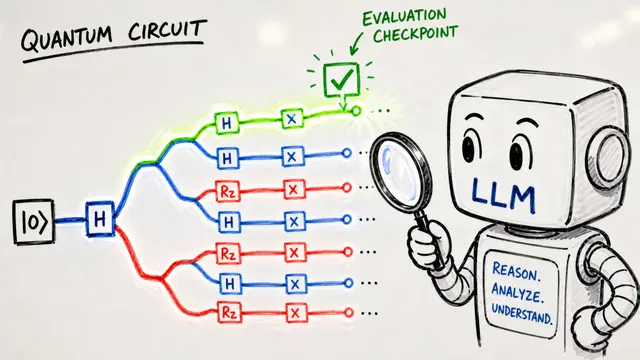
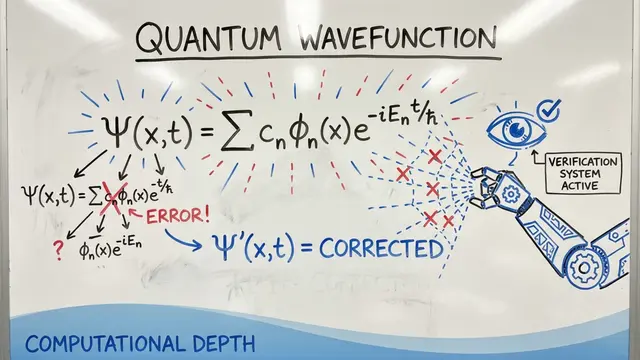
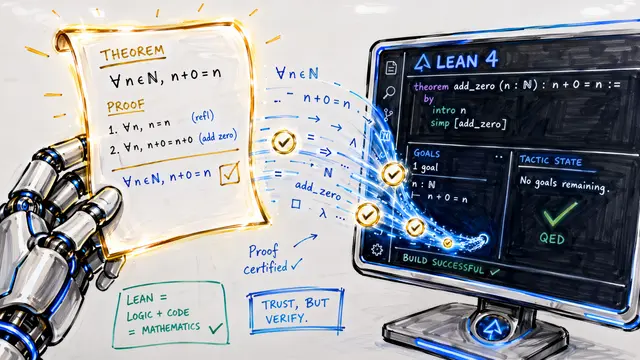
The system combines a Lean library implementing quantum Hoare logic with teams of heterogeneous agents. Each agent searches for programs, decompositions, and proofs against a frozen specification that defines correctness conditions and resource bounds. An independent verifier checks every submission, preventing agents from gaming the system by weakening the problem or altering the cost model.
On fixed-point arcsine evaluation with 25-bit precision, the discovered circuit reduced fault-tolerant spacetime cost from over 108 million to 370,000. That is a reduction of more than 290 times. The key was a two-stage search: agents first explored circuits that could be verified through fast classical simulation, then escaped that constraint using formal proof to find gate sequences no simulator could validate.
For fusion stopping power simulation involving 218 electrons and an alpha particle, the verified program achieved a 10.9 times reduction by switching Hamiltonian representations. Instead of applying electron interactions entirely in momentum space, the circuit transforms to a real-space grid where Pauli exclusion structure becomes explicit. At most two electrons can occupy each grid point, letting phase kickback eliminate costly three-electron configurations from the walk normalization.
The collaboration data reveal how verified ideas propagate across teams. In the molecular dynamics problem, the leading solution changed hands seven times, incorporating mechanisms from three independent groups. Cross-team contributions account for 24 percent of the total logarithmic cost reduction, with verified artifacts stored in a shared wiki and unverified conjectures exchanged in scheduled conferences. Only results passing independent verification enter the accepted lineage.
This framework shifts verification from post hoc checking to the discovery loop itself. The reductions ranging from 2.5 times for cytochrome P450 to over 290 times for arcsine do not make these problems tractable tomorrow, but they establish formal proof as a practical constraint for exploring quantum algorithms whose behavior lies beyond classical reach. To dive deeper into this fusion of AI search and verified quantum computing, visit EmergentMind.com and create your own video exploring the frontiers of machine-checked discovery.