Teaching Machines to Prove Theorems Like Mathematicians
This presentation explores Numina-Lean-Agent, a breakthrough open-source system that achieves perfect scores on elite mathematics competitions by combining general-purpose AI with specialized reasoning tools. Unlike previous systems requiring custom training or proprietary architectures, this framework demonstrates that commodity language models equipped with the right interfaces can match state-of-the-art formal theorem proving performance while remaining fully reproducible and extensible for the research community.Script
Proving theorems is one of mathematics' hardest challenges. Now, an open-source agent has scored perfectly on the Putnam 2025 exam, matching elite closed systems without any custom training.
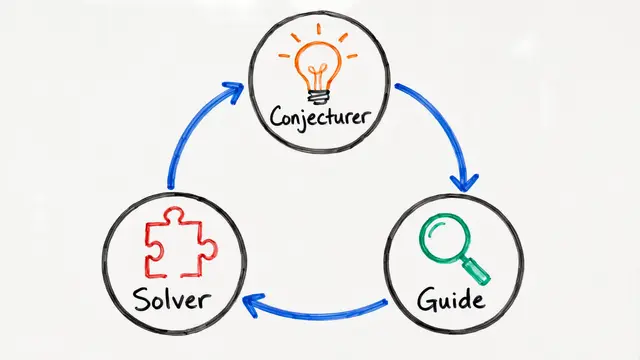
The key insight is architectural. Numina-Lean-Agent uses a general coding model, Claude Opus 4.5, as its reasoning core and connects it to specialized mathematical tools through a flexible protocol, allowing each component to evolve independently.
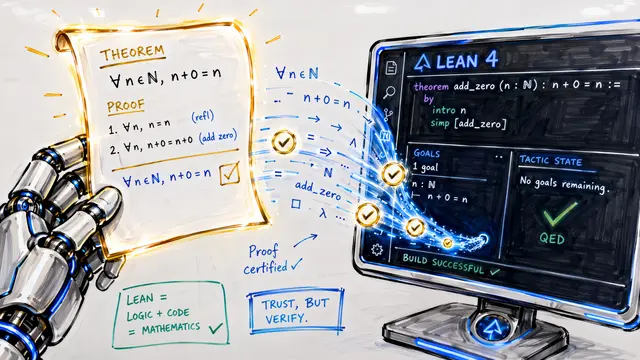
Four specialized agents handle the heavy lifting. Lean LSP MCP bridges directly to the Lean proof assistant for real-time feedback. LeanDex retrieves relevant theorems semantically, not just syntactically. The Informal Prover runs generator-verifier loops that refine proof sketches iteratively. And a Discussion Partner queries alternative models when the main agent hits bottlenecks.
On Putnam 2025, the system solved all 12 problems without search engines or parallel execution. Remarkably, its proofs are consistently shorter than competing agents, and the iterative refinement strategy discovers solutions in fewer attempts than baseline sampling methods.
Beyond competition benchmarks, the agent formalized the Brascamp-Lieb theorem in under two weeks through human-AI collaboration, generating over 8,000 lines of verified Lean code. It builds recursive blueprints that decompose complex theorems into manageable lemmas, then self-corrects when the formal system flags errors or contradictions.
The real breakthrough is accessibility. Because the architecture separates reasoning from tools and runs on commodity models, any researcher can reproduce, extend, or adapt it. Explore this work and create your own explainer videos at EmergentMind.com.