ECDSA.Fail: Quantum Circuit Optimization Through Open Autoresearch
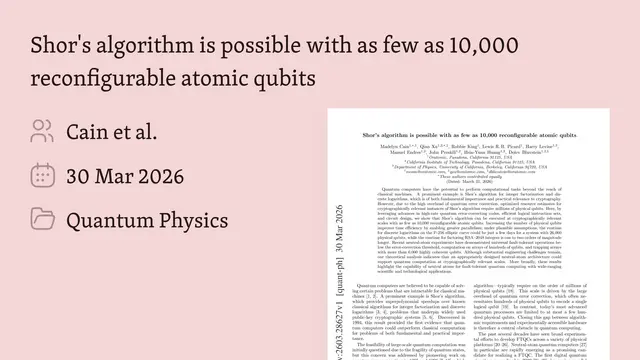
This presentation explores a novel approach to optimizing quantum circuits for attacking elliptic-curve cryptography used in Bitcoin and Ethereum. The paper introduces Open Autoresearch, a collaborative framework where human-agent teams compete to minimize the cost of reversible point addition in Shor's algorithm. The work demonstrates an 86% reduction in circuit cost through architectural redesigns, transcript compression, and machine-checkable verification, while revealing sharp trade-offs between quantum register width and computational work.Script
Bitcoin's cryptographic foundation relies on a problem so hard that classical computers would need longer than the age of the universe to break it. But a large-scale quantum computer running Shor's algorithm could crack it in hours, and every optimization that reduces the required quantum resources brings that threat closer to reality.
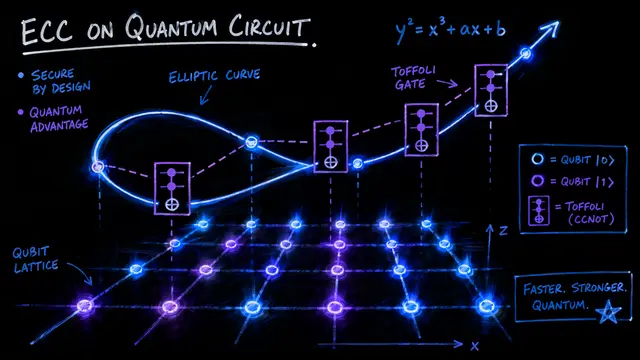
The authors built ECDSA.Fail, a public optimization challenge where human researchers and AI agents compete to minimize the cost of quantum point addition. Participants modify circuits, submit them to a machine evaluator that checks correctness on over 9,000 test cases, and successful improvements appear on a shared leaderboard for others to build upon.
Starting from a baseline of 2,715 qubits and 4 million Toffoli gates, the best circuit at the data cutoff uses only 1,151 qubits and 1.3 million gates. That's an 86% reduction in the combined cost metric, achieved through compressed Euclidean transcripts, specialized squaring, and aggressive dead-code elimination.
But the challenge revealed something unexpected: a sharp architectural divide. The product-efficient circuit at 1,151 qubits uses dialog-based transcript replay, while a radically different design reaches just 825 qubits by sharing registers across shrinking Euclidean remainders, at the cost of 489 million Toffolis. These aren't refinements of the same idea; they're fundamentally different strategies for the same problem.
These numbers come with important caveats. The evaluator tests finite input samples, not all possible cases. The circuits handle classically supplied addends, and adapting to coherent windowed lookups costs roughly 30% more work. The metric ignores depth, routing, and error correction, all of which matter in real quantum hardware.
Open autoresearch doesn't prove that agents are essential, but it does show that verifiable, cumulative optimization can happen when evaluation is cheap and sharing is immediate. To explore how these circuits evolved and create your own video explainers from the latest research, visit EmergentMind.com.