Agentic Memory Management Is the Next Frontier of Information Retrieval
This presentation examines how intelligent agents are fundamentally changing information retrieval. Traditional IR serves human consumers who read, judge, and act on retrieved information. But when an AI agent becomes the consumer, retrieval moves inside the system itself. The agent must decide what to remember, what to forget, when to retrieve, and how retrieved information should change its behavior across tasks. This talk introduces a framework that treats agentic memory management as an extension of classical IR, organizing memory into constants, functions, and operators, and proposing evaluation methods that connect memory decisions directly to task outcomes.Script
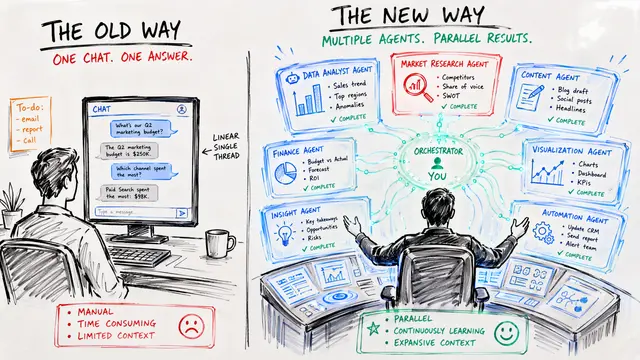
Retrieval systems have always answered one question: what information should we deliver? But they assumed a human would read it, judge it, and decide what to do next. When an AI agent becomes the reader, that entire calculus changes.
The authors propose a computational taxonomy that organizes memory into three types. Constants are facts and events. Functions are reusable skills and workflows. Operators are preferences and constraints that modify how those skills execute. Each type has a different retrieval criterion, because a correct fact won't help if you apply the wrong procedure or ignore a user preference.
Memory management divides into learning, forgetting, and utilization. Learning decides what to record after an interaction and at what level of abstraction. Forgetting controls what to delete, merge, or compress. Utilization determines what gets retrieved, in what order, and whether it actually changes the agent's behavior. The hard part is that you can't optimize each operation in isolation, because their value only appears downstream in task success.
The paper introduces what it calls an observability inversion. Traditional IR observes clicks and rankings but rarely sees whether the user completes their task. Agent memory lets you observe the full chain: what was stored, what was retrieved, whether it entered context, whether behavior changed, and whether the task succeeded. This makes it possible to connect memory decisions directly to outcomes, as long as you separate state quality from utilization quality from final performance.
Two conjectures guide the research agenda. The minimal scope conjecture says corrections should start narrow and widen only with repeated evidence, to avoid overgeneralizing one user's preference to everyone. The abstraction trade-off conjecture predicts that lifting episodes into skills improves transfer but increases misapplication risk, so aggressive abstraction helps on repetitive tasks and hurts on diverse ones.
This framework reframes agent memory as an IR problem, not prompt engineering or storage infrastructure. The retrieval operations are the same, but the consumer has changed, the position of retrieval has moved inside the agent, and the evaluation can now observe whether memory actually improved the outcome. If you want to explore this frontier further, visit EmergentMind.com to dive into the full paper and create your own video summary.