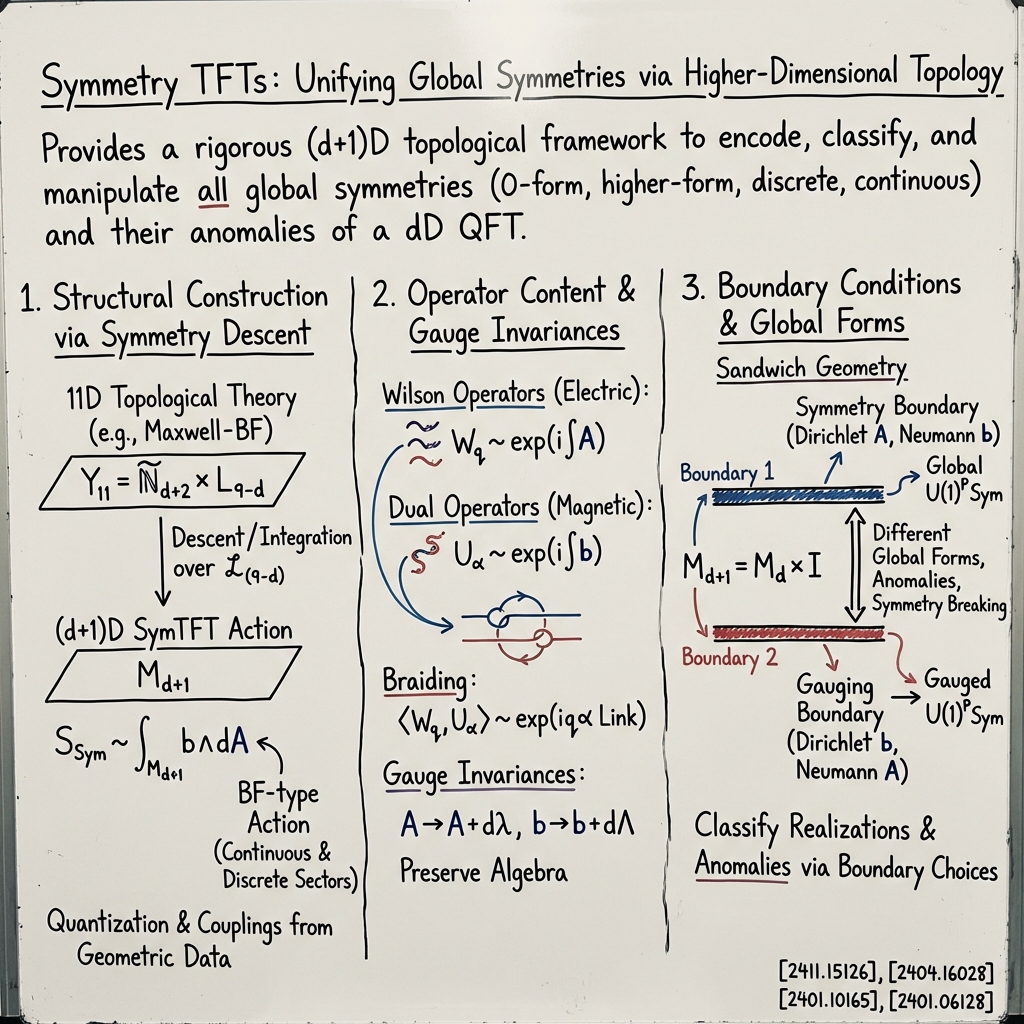
Symmetry TFT: A Topological Framework
- Symmetry TFT is a (d+1)-dimensional topological framework that encodes generalized global symmetries and ’t Hooft anomalies of quantum field theories.
- It employs geometric descent methods from higher-dimensional theories to derive BF-type terms that govern gauge invariances and anomaly inflow.
- It unifies continuous and discrete symmetry sectors and determines boundary conditions and operator algebra in descendant quantum field theories.
A symmetry Topological Field Theory (Symmetry TFT or SymTFT) provides a rigorous, -dimensional topological field-theoretic framework that encodes the generalized global symmetries—including higher-form, non-invertible, and categorical symmetries—and their ’t Hooft anomalies of a -dimensional quantum field theory (QFT). Symmetry TFTs systematically package symmetry data into a higher-dimensional action whose boundary conditions and operator content classify global forms, anomaly structures, and permissible symmetry manipulations within quantum field theories.
1. Structural Construction via Symmetry Descent
The defining principle of SymTFTs is that all symmetry and anomaly information of a -dimensional QFT can be uniformly represented by a -dimensional topological action, often derived via geometric or algebraic descent procedures from an even higher-dimensional theory. In the archetypal symmetry descent construction for -form symmetries, one begins with an eleven-dimensional topological theory—typically a “Maxwell–BF” or Chern–Simons-like system—defined on a product , with an oriented -manifold with boundary , and 0 the “link” capturing the geometric engineering data. Ramond–Ramond gauge fields appear as differential (Hopkins–Singer) cocycles, and the variation of the bulk action under gauge transformations localizes to the boundary, resulting in a natural topological Lagrangian for the SymTFT after integrating over 1 (Gagliano et al., 2024, Etxebarria et al., 2024).
The essential (d+1)-dimensional SymTFT action for a continuous 2 3-form symmetry takes the BF-type form:
4
with 5 a background gauge field, and 6 a Lagrange multiplier field enforcing flatness or the dual constraint. The quantization of the couplings and the structure of both discrete and continuous sectors descend automatically from the topological input in the higher-dimensional geometric setting (Gagliano et al., 2024).
2. Operator Content and Gauge Invariances
Bulk and boundary topological operators of SymTFTs correspond to codimension-7 defects associated with 8-form global symmetries, whose fusion and braiding rules are determined by the topological action. For 9 0-form symmetry, the relevant topological operators in 1 dimensions are:
- Wilson operators: 2, 3.
- Dual (“magnetic”) operators: 4, 5.
These operators generate the continuum (for 6) or discrete (for 7) higher-form symmetry algebra. Their mutual braiding is dictated by the BF-type bulk term:
8
with 9 denoting the topological linking number in 0 (Antinucci et al., 2024, Brennan et al., 2024). These algebraic relations are preserved under the gauge symmetries:
1
3. Boundary Conditions and Global Forms
The physical QFT is retrieved from the SymTFT by placing it on a “sandwich” geometry, 2, imposing distinct boundary conditions at each end of the interval. The classification of boundary conditions for 3 and 4 dictates the realization of symmetries in the boundary theory:
- Symmetry boundary (Dirichlet for 5, Neumann for 6): Yields a 7-dimensional theory with global 8 symmetry; Wilson operators 9 survive at the boundary.
- Gauging boundary (Dirichlet for 0, Neumann for 1): Implements dynamical gauging of 2, and introduces the dual 3 symmetry (Gagliano et al., 2024).
- Mixed boundary conditions: Allow for more exotic gapped or gapless phases, including theories with spontaneously broken or partially gauged symmetries.
Boundary conditions thus directly correspond to different global forms and symmetry-breaking patterns in the 4-dimensional QFT, as well as the presence or absence of anomalies and non-invertible structures (Gagliano et al., 2024, Brennan et al., 2024).
4. Integration with Higher-Form and Discrete Sectors
SymTFTs comprehensively unify continuous and discrete symmetry sectors. The cohomological descent incorporates both free (continuous) and torsion (discrete) cycles on the link 5, giving rise to both 6 (continuous) and 7 (discrete) BF-type terms in the resulting (d+1)-dimensional action:
8
where 9 and 0 encode the discrete linking and continuous intersection pairings, respectively (Gagliano et al., 2024). This structure guarantees that BF-type and anomalous terms for both continuous and discrete symmetries are naturally incorporated and unifies their treatment within the same topological field theory.
5. Geometric Engineering and Differential Cohomology
The geometric engineering perspective embeds the realization of SymTFT entirely within the framework of string/M-theory: the relevant (higher-form) gauge fields originate as edge modes in the reduction of the topological sector of higher-dimensional supergravity—expressly, as differential cochains or cocycles in the Hopkins–Singer construction. The explicit descent equations link the gauge-variation of bulk Chern–Simons-type terms to total derivatives on lower-dimensional boundaries, implementing both ordinary anomaly inflow and higher-form anomaly inflow within differential cohomology (Etxebarria et al., 2024). This approach ensures that all quantization conditions, torsion constraints, and mixed cycles are automatically respected.
In this formalism, for example, starting from the eleven-dimensional theory with action
1
and reducing on 2 produces the full set of BF terms and their coefficients within the SymTFT, distinguishing between discrete and continuous symmetry sectors via the (co)homology of 3 (Gagliano et al., 2024). This program can be extended and generalized to non-abelian and higher-group symmetries.
6. Relation to Previous Constructions and Anomaly Realizations
The symmetry descent-based SymTFT construction matches and refines previous “axiomatic” BF-based formulations (Antinucci et al., 2024, Brennan et al., 2024), but additionally establishes the geometric origins of all couplings, quantizations, and interactions, including:
- The integrality and consistency of intersection (pairing) coefficients, reproducing, for instance, the Antinucci–Benini structure of continuous 4 higher-form symmetry TFTs.
- The precise embedding of the Lagrange multiplier (“magnetic dual”) and electric RR fields within differential cohomology.
- A unified treatment of discrete and continuous anomalies, quantization of boundary degrees, and manifestations of higher K-theoretic flux quantization (Gagliano et al., 2024).
This approach further clarifies how mixed discrete–continuous symmetry couplings, and anomaly terms, naturally descend and how they restrict or permit possible boundary conditions and global forms in the descendant QFT.
7. Implications and Extensions
The geometric symmetry descent construction establishes SymTFTs as the canonical unifying framework for both constructing and classifying all global symmetry data of QFTs with continuous, discrete, higher-form, and mixed symmetries—including non-invertible structures—within a universal topological action in one higher dimension. All symmetry manipulations (gauging, breaking, dualizing) are realized through compatible choices of boundary conditions, and the physical operator content is entirely determined by the topological and cohomological invariants of the geometric input. The approach is extensible to the treatment of non-abelian, higher-group, and even higher-categorical symmetries and their anomalies, and paves the way for direct classification via geometric engineering (Gagliano et al., 2024, Etxebarria et al., 2024).
References:
- "SymTFTs for 5 symmetries from descent" (Gagliano et al., 2024)
- "Some aspects of symmetry descent" (Etxebarria et al., 2024)
- "Anomalies and gauging of U(1) symmetries" (Antinucci et al., 2024)
- "A SymTFT for Continuous Symmetries" (Brennan et al., 2024)
- "Defect Charges, Gapped Boundary Conditions, and the Symmetry TFT" (Copetti, 2024)