Qwen3-VL: Advanced Multimodal LLM Family
- Qwen3-VL models are advanced multimodal LLMs designed for joint processing of text, images, and video using a unified Transformer decoder.
- They deliver state-of-the-art performance on STEM, document understanding, and VQA benchmarks through innovations like interleaved MRoPE and DeepStack feature fusion.
- Both dense and sparse MoE variants balance inference efficiency with high-quality reasoning, supporting extensive long-context and multi-modal applications.
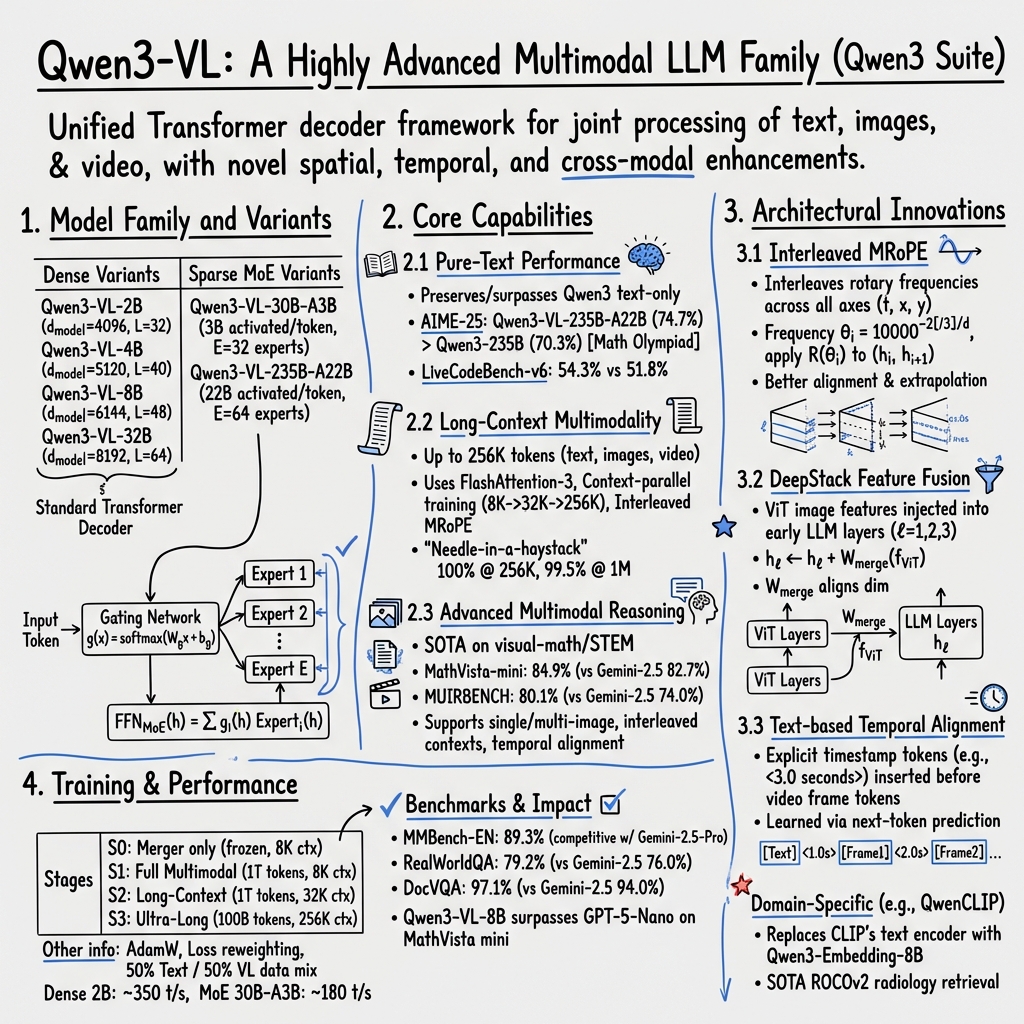
Qwen3-VL is a highly advanced family of multimodal LLMs (MLLMs) designed for joint processing of text, images, and video within a unified Transformer decoder framework. Developed as the flagship multimodal branch of the Qwen3 model suite, Qwen3-VL combines competitive language modeling performance with novel architectural enhancements for spatial, temporal, and cross-modal reasoning. It establishes new state-of-the-art (SOTA) results across an extensive landscape of benchmarks, spanning STEM, document understanding, instructional VQA, and real-world agentic reasoning, with sizes from 2B up to 235B parameters and latency-optimized deployment profiles (Bai et al., 26 Nov 2025).
1. Model Family and Variants
Qwen3-VL encompasses both dense and sparse (Mixture-of-Experts, MoE) variants, providing a spectrum of options for inference efficiency and quality.
Dense variants utilize standard Transformer decoder architectures in four sizes:
- Qwen3-VL-2B: 2B parameters, ,
- Qwen3-VL-4B: 4B parameters, ,
- Qwen3-VL-8B: 8B parameters, ,
- Qwen3-VL-32B: 32B parameters, ,
Sparse MoE variants operationalize expert gating for parameter and FLOP efficiency:
- Qwen3-VL-30B-A3B: 30B total parameters, 3B activated per token, E=32 experts (top-1 routing), tokens per expert
- Qwen3-VL-235B-A22B: 235B total, 22B activated per token, E=64 experts (top-1 routing)
Each MoE layer computes with gating vector 0 (Bai et al., 26 Nov 2025).
2. Core Capabilities
2.1 Pure-Text Performance
Qwen3-VL preserves and in some scenarios surpasses the corresponding Qwen3 text-only models on standard language benchmarks. For example, on AIME-25 (high school math Olympiad), Qwen3-VL-235B-A22B-Instruct reaches 74.7% accuracy, exceeding Qwen3-235B-Instruct's 70.3%. LiveCodeBench-v6 code reasoning is similarly strong (54.3% vs. 51.8%) (Bai et al., 26 Nov 2025).
2.2 Long-Context Multimodality
Native support for up to 256K tokens (including interleaved text, images, and video) is achieved through:
- FlashAttention-3 for memory- and compute-efficient long-context attention
- Context-parallel training in progressive sequence-length phases (8K→32K→256K tokens)
- Interleaved MRoPE (multi-dimensional rotary position encoding), see §3
Robust long-context retention is empirically validated on “needle-in-a-haystack” diagnostics, reaching 100% accuracy to 256K tokens and 99.5% up to 1M tokens (with YaRN) (Bai et al., 26 Nov 2025).
2.3 Advanced Multimodal Reasoning
Qwen3-VL-235B-A22B achieves or matches SOTA on leading visual-math and STEM benchmarks. For example, accuracy on MathVista-mini is 84.9% (vs. 82.7% for Gemini-2.5), and on multi-image MUIRBENCH, 80.1% (vs. 74.0% for Gemini-2.5) (Bai et al., 26 Nov 2025). The architecture supports:
- Single- and multi-image reasoning
- Interleaved vision-text-video context
- Fine-grained temporal alignment for video analysis
3. Architectural Innovations
3.1 Interleaved MRoPE
Classical MRoPE encodes (1, 2, 3) position tuples by contiguous dimension grouping. Qwen3-VL instead interleaves rotary frequencies among all axes:
- For layer dimension 4, assign 5, frequency 6, apply 7 to 8 This yields balanced frequency coverage across spatial and temporal axes, improving alignment and extrapolation in multimodal contexts (Bai et al., 26 Nov 2025).
3.2 DeepStack Feature Fusion
ViT image encoder features from three distinct layers are injected into LLM layers 9 via
0
where 1 is the intermediate visual feature, 2 a two-layer MLP matching vision feature dimension to 3 (Bai et al., 26 Nov 2025).
3.3 Text-based Temporal Alignment
Videos are aligned with text by inserting explicit timestamp tokens (e.g., \<3.0 seconds>) before corresponding frame tokens. Temporal grounding is learned via the standard next-token prediction objective, obviating specialized loss terms and improving timestamp–video association versus previous RoPE-based encoding (Bai et al., 26 Nov 2025).
4. Training Regimen and Optimization
The Qwen3-VL training recipe progresses through staged objectives and context expansion:
| Stage | Objective | Parameters | Total Tokens | Seq. Len. |
|---|---|---|---|---|
| S0 | Merger only (frozen) | Merger frozen | 67B | 8,192 |
| S1 | Full Multimodal (all learn) | All unfrozen | 1T | 8,192 |
| S2 | Long-Context | All unfrozen | 1T | 32,768 |
| S3 | Ultra-Long | All unfrozen | 100B | 262,144 |
Other training strategies:
- AdamW optimizer with two-phase learning rate schedule (warmup + cosine decay)
- Loss reweighting: sample 4 gets weight 5
- Data mix: roughly 50% text-only, 50% VL (captions, int’l docs, VQA, STEM, agent tasks)
- Batch size: 2048 tokens/GPU
- Dense throughput: e.g., 2B runs at 350 tokens/s (8xA100, ctx=4096); MoE 30B-A3B at 180 t/s (Bai et al., 26 Nov 2025)
5. Medical and Domain-Specific Qwen3-VL Instantiations
QwenCLIP, a targeted Qwen3-VL variant, integrates an 8B-parameter Qwen3-Embedding module for medical vision-language tasks (Wei et al., 17 Nov 2025):
- The frozen LLM embedding backbone (Qwen3-Embedding-8B) replaces CLIP’s original text encoder, removing strict input length constraints (from 77 to tens of thousands of tokens).
- A lightweight 2-layer MLP projection and learnable soft prompt (6 vectors, 7) enable efficient cross-modal alignment without fine-tuning the core LLM.
Contrastive learning objective:
8
with cosine similarity and learnable temperature 9. This configuration attains state-of-the-art on ROCOv2 zero-shot radiology retrieval (CUI@5 = 45.96, P@5 = 96.24, IRMA P@5 = 98.49), outperforming ClinicalBERT, PubMedBERT, and Llama-3-Instruct-8B backbones. Ablation confirms both the LLM encoder and prompt tuning provide additive boosts (Wei et al., 17 Nov 2025).
6. Benchmarks and Comparative Evaluation
Comprehensive benchmark coverage (over 80 benchmarks) demonstrates the Qwen3-VL family’s leading status:
- On MMBench-EN, Qwen3-VL-235B-A22B achieves 89.3% (Instruct), competitive with Gemini-2.5-Pro at 86.6–90.1%.
- RealWorldQA: 79.2% (Qwen3-VL-235B-A22B Instruct) versus 76.0% (Gemini-2.5 Pro).
- DocVQA: 97.1% (Qwen3-VL-235B-A22B Instruct) compared to 94.0% (Gemini-2.5 Pro).
Even mid-sized models such as Qwen3-VL-8B surpass GPT-5-Nano on MathVista mini (81.4% vs. 71.5%). Metrics include accuracy, mAP (object grounding, IoU=0.15), and CER (character-level OCR error) (Bai et al., 26 Nov 2025).
7. Deployment and Extensions
Qwen3-VL’s scaling profile accommodates both high-throughput cloud applications and latency-constrained inference. MoE variants trade activated parameters for throughput; quantization and adapter-based extensions are supported, as in edge-oriented spinoffs (e.g., AndesVL), which utilize Qwen3-VL backbones for low-power, mobile-side deployment (Jin et al., 13 Oct 2025).
The core architectural contributions—interleaved MRoPE, DeepStack cross-modal fusion, and timestamp-based temporal alignment—jointly enable robust generalization across document, visual, and sequential reasoning domains, positioning Qwen3-VL as a foundational multimodal engine for extensive real-world workflows (Bai et al., 26 Nov 2025).