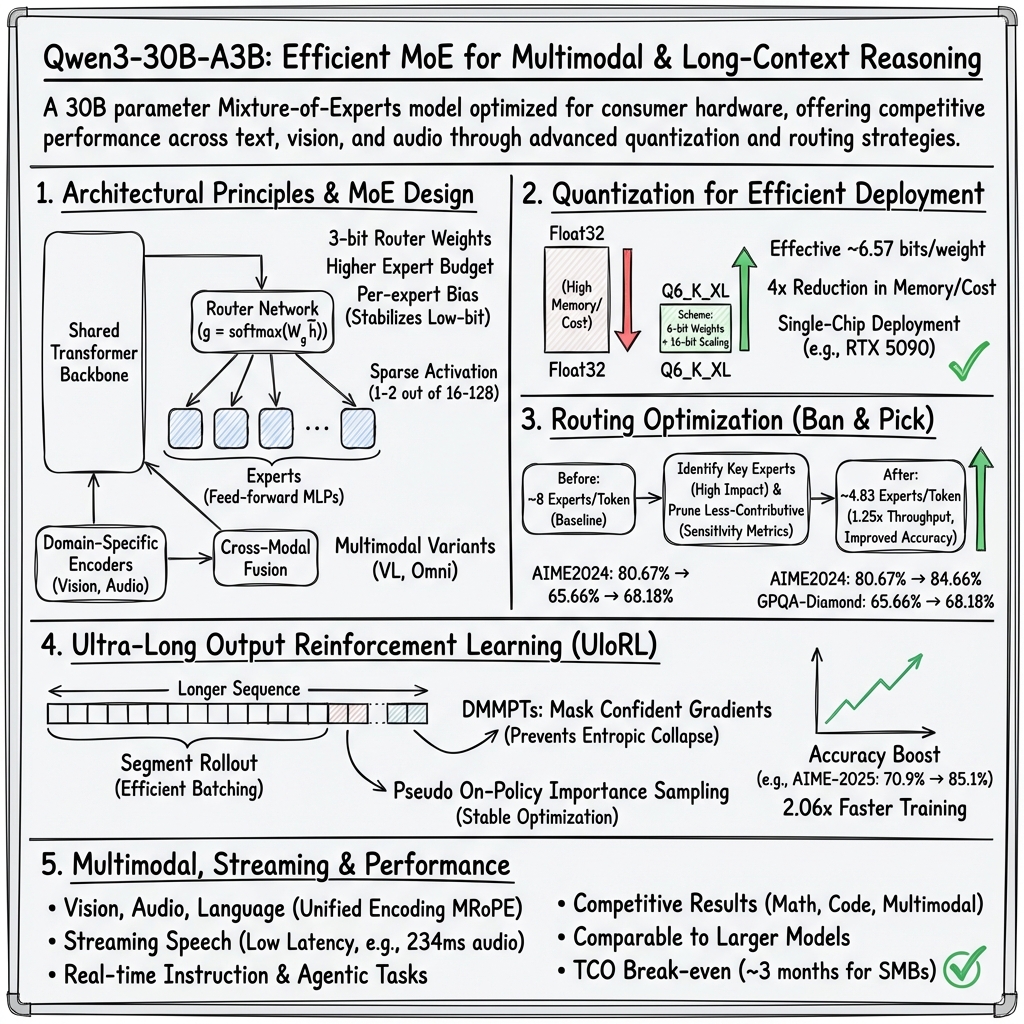
Qwen3-30B-A3B: Efficient Multimodal MoE
- Qwen3-30B-A3B is a multimodal Mixture-of-Experts model that integrates text, vision, and audio with conditional expert activation to boost representational capacity and computational efficiency.
- It employs novel quantization schemes and optimized routing techniques like Ban & Pick, reducing memory and computational costs by up to 4× without sacrificing performance.
- Ultra-long output reinforcement via RL fine-tuning enables efficient generation of up to 140k tokens with improved accuracy in math, code, and multimodal reasoning tasks.
Qwen3-30B-A3B is a 30-billion-parameter Mixture-of-Experts (MoE) model developed as part of the Qwen3 series and deployed across text, vision-language, and multimodal foundations. It implements conditional expert activation for increased representational capacity and computational efficiency, with specialized variants targeting pure-text, vision-language, and full multimodal reasoning. The model features both architectural innovations and quantization schemes tailored for consumer-grade hardware, enabling cost-effective, private, and scalable deployment. Its performance is validated on mathematical reasoning, code intelligence, multimodal comprehension, and low-latency speech synthesis benchmarks.
1. Architectural Principles and MoE Design
Qwen3-30B-A3B adopts the Switch Transformer paradigm, integrating a shared transformer backbone with multiple feed-forward multilayer perceptron (MLP) experts per layer. For each token, the router network computes where is the input hidden state, selecting a sparse set of experts for activation. The model’s parameter count is , with denoting the number of experts and the per-expert parameter count.
The "A3B" variant is characterized by:
- 3-bit storage for router weights.
- A higher per-layer expert budget for increased routing diversity.
- Additional per-expert bias terms to stabilize low-bit quantized inference (Khalil et al., 28 Dec 2025).
- Typical instantiation: 16–128 experts per layer, of which only 1–2 are activated per token (Bai et al., 26 Nov 2025, Chen et al., 8 Sep 2025).
In multimodal variants (VL, Omni), the MoE backbone is integrated with domain-specific encoders (e.g., SigLIP-2 Vision Transformer, AuT audio encoder) and specialized merger modules for cross-modal fusion (Bai et al., 26 Nov 2025, Xu et al., 22 Sep 2025).
2. Quantization Strategies for Efficient Deployment
To enable Qwen3-30B-A3B inference on commodity hardware, the model utilizes block-wise, activation-aware mid-bit quantization—specifically the Q6_K_XL scheme (Khalil et al., 28 Dec 2025):
- Each weight is quantized to 6 bits, with a 16-bit scaling factor for each block of 256 weights ().
- Quantization follows with .
- Quantization error is bounded: .
- The 3-bit gating facilitates storage compression and efficient routing.
Memory and computational costs are reduced by a factor of 4 compared to float32, allowing single-chip deployment (e.g., 32GB NVIDIA RTX 5090) without performance collapse.
3. Routing Optimization: Ban & Pick Post-Training
Ban & Pick introduces post-training MoE routing enhancements to:
- Reinforce "key experts"—those exerting maximal impact on output distribution, identified via average top-1000 KL divergence.
- Dynamically prune less-contributive experts using sensitivity metrics based on layer and token gating distributions.
In practice (Chen et al., 8 Sep 2025):
- Average experts/token is reduced from 8.00 (baseline) to 04.83 (Ban+Pick), yielding a 1 throughput increase.
- On AIME2024, accuracy improves from 80.67% (baseline) to 84.66%, and on GPQA-Diamond, from 65.66% to 68.18%.
- Pruning below 3 experts/token collapses accuracy; 2 is optimal for balancing speed and performance.
Smarter routing enables real-time inference improvements without retraining or architectural changes.
4. Ultra-Long Output Reinforcement Learning (UloRL)
UloRL augments Qwen3-30B-A3B’s reasoning capability in ultra-long sequence generation (up to 140k tokens) via RLVR. Key mechanisms (Du et al., 26 Jul 2025):
- Segment rollout: ultra-long outputs are decomposed into disjoint segments, mitigating long-tail sample delays and enabling efficient batch processing.
- Dynamic Masking of well-Mastered Positive Tokens (DMMPTs): entropic collapse is countered by masking highly confident token gradients when sample average entropy falls below a threshold 3.
- Pseudo On-Policy Importance Sampling avoids gradient clipping, stabilizing entropy during policy optimization.
Empirical outcomes:
- RL fine-tuning accelerates training 4 over single-segment rollout.
- AIME-2025 accuracy rises from 70.9% (baseline) to 85.1% (UloRL-A3B-128k-Yarn), surpassing the much larger Qwen3-235B-A22B (81.5%).
- The approach generalizes to complex reasoning, but targeted experiments are focused on math QA (Du et al., 26 Jul 2025).
5. Multimodal and Streaming Capabilities
Qwen3-30B-A3B underpins advanced multimodal architectures such as Qwen3-VL and Qwen3-Omni (Bai et al., 26 Nov 2025, Xu et al., 22 Sep 2025):
- Integrates vision (SigLIP-2 ViT), audio (AuT), and language branches.
- Employs interleaved Multimodal Rotary Position Embedding (MRoPE) for unified t/h/w spatial-temporal encoding.
- DeepStack mechanism fuses multi-scale visual features into early transformer blocks.
- Video tokens are grounded using explicitly embedded textual timestamps.
- A3B activation sparsity enables deployment in edge clusters and efficient expert parallelism across GPUs (routing overheads 55%).
Streaming speech synthesis utilizes a causal ConvNet (Code2Wav), replacing previous block-wise diffusion for immediate waveform generation. In cold-start scenarios, end-to-end first-packet latency is 234 ms (audio), 547 ms (video) (Xu et al., 22 Sep 2025).
Support for real-time, low-latency, multi-language instruction and agentic tasks is documented, spanning text, image, audio, and video (Xu et al., 22 Sep 2025).
6. Performance and Comparative Evaluation
Qwen3-30B-A3B achieves competitive or state-of-the-art results across its supported modalities:
- In single-user benchmarks, TTFT = 0.171 s, TPS ≈192.4, E2E latency ≈9.87 s/1000 tokens (RTX 5090, Q6 quant.) (Khalil et al., 28 Dec 2025).
- Ban&Pick and UloRL boost math and general reasoning benchmarks (AIME, GPQA, MathVista) to match or exceed much larger dense models.
- Multimodal assessment reveals a modest trade-off in benchmark scores vs. dense 32B siblings (e.g., 6 points), offset by 1.37 throughput and 108 savings in FFN activation cost.
- Audio, speech, and ASR tasks reach open-source SOTA in 32/36 tasks (Xu et al., 22 Sep 2025).
A practical sweet-spot for serving is 8–12 concurrent users on single GPU, with further scaling via expert/parameter sharding (Khalil et al., 28 Dec 2025).
7. Practical Deployment and Recommendations
Guidelines for sovereign Qwen3-30B-A3B deployment (Khalil et al., 28 Dec 2025):
- Hardware: 932 GB GPU, 08 core CPU, 132 GB RAM, Gen4 NVMe.
- Quantization: activate Q6_K_XL schemes; precompute block scales for runtime efficiency.
- Serving stack: utilize vLLM with PagedAttention, continuous/dynamic batching, and length-aware admission control.
- Monitoring: instrument TTFT, TPS, queue lengths for scaling decision.
- Multi-GPU setups require tensor or expert parallel frameworks.
For small and medium businesses (SMBs), local Qwen3-30B-A3B deployments yield TCO break-even within 23 months at typical 1M tokens/day rates versus outsourced cloud APIs. The model delivers privacy, sovereignty, competitive latency, and throughput for moderate concurrency workloads (Khalil et al., 28 Dec 2025).
Qwen3-30B-A3B demonstrates efficient expert-based conditional compute, advanced quantization for consumer-grade hardware, empirically optimized routing, and multimodal fusion across vision, audio, and text domains. Innovations in post-training expert selection and RL-based ultra-long reasoning grant the model capabilities rivaling those of considerably larger models, with concrete cost and latency advantages in sovereign and privacy-preserving deployment scenarios.