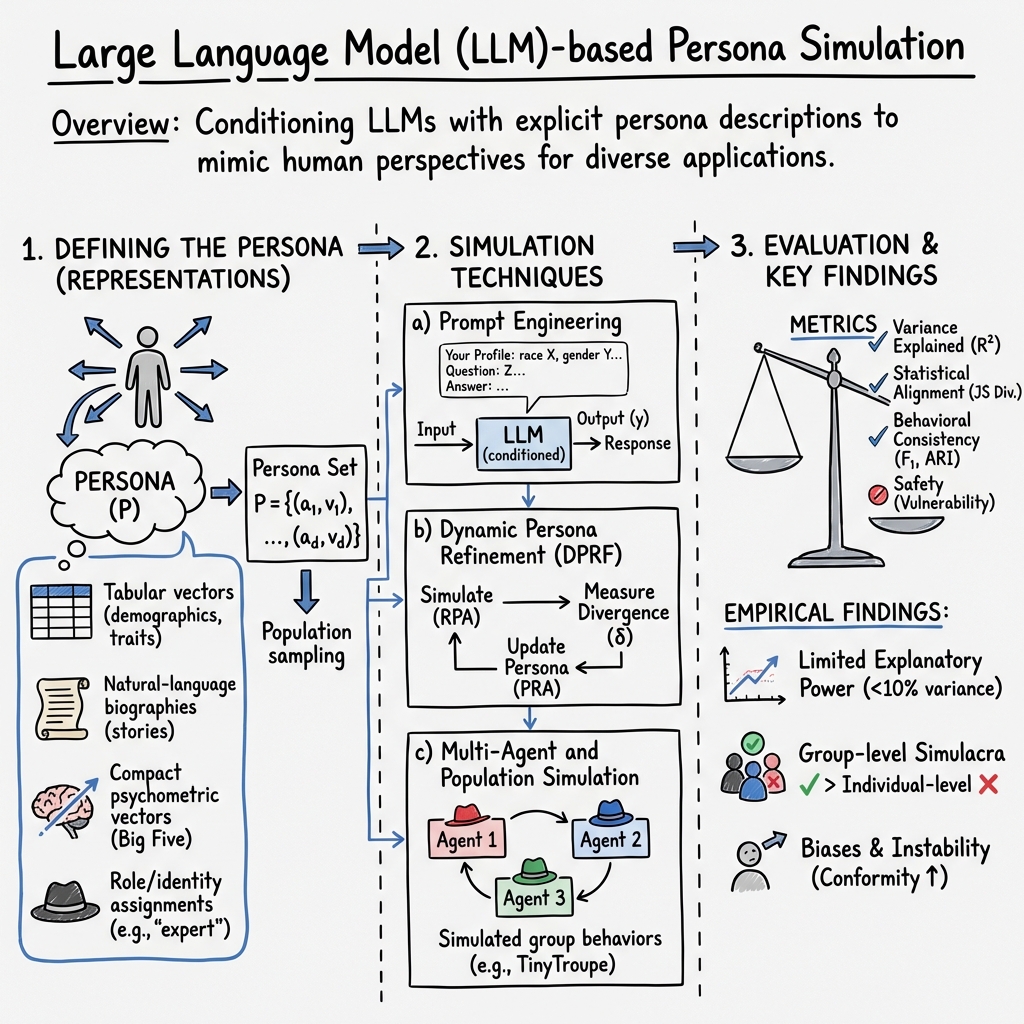
LLM-Based Persona Simulation
- LLM-based persona simulation is a method that conditions language models on detailed persona attributes to mimic individual and group behaviors.
- It employs techniques such as prompt engineering, dynamic refinement, and multi-agent coordination to ensure role-specific and population-level fidelity.
- Key evaluation metrics include variance explained, distribution alignment, and behavioral consistency to measure simulation accuracy and safety.
LLM-based persona simulation refers to methodologies wherein LLMs are conditioned on explicit persona representations—structured or unstructured descriptions encoding demographics, psychographics, behavioral traits, or role-specific details—to generate outputs mimicking individual, subpopulation, or archetypal human perspectives. Techniques span simple prompt engineering, distributionally calibrated population sampling, dynamic persona refinement, and multi-agent coordination, serving diverse use-cases from survey emulation and behavioral economics to multi-agent social simulation and safety evaluation.
1. Persona Representations and Theoretical Foundations
Persona simulation centers on representing “who” an LLM is meant to simulate. The standard formalism defines a persona as a finite set of attribute–value pairs: Here, each can denote demographic (age, gender, ethnicity), socio-economic (income, education), psychographic (ideology, Big Five traits), behavioral (media use, voting behavior), and contextual/narrative properties (Li et al., 18 Mar 2025, Hu et al., 2024).
Persona variables may be encoded as:
- Tabular vectors—structured, categorical/numeric fields (Rupprecht et al., 19 Nov 2025, Li et al., 18 Mar 2025).
- Natural-language biographies (short texts or stories) (Shang et al., 4 Dec 2025, Bai et al., 10 Oct 2025).
- Compact psychometric vectors—e.g., Big Five trait scores or behavioral principal components for injection as prompt context or latent model input (Kitadai et al., 26 Aug 2025, Hu et al., 12 Sep 2025).
- Role/identity assignments for multi-agent settings, e.g., “You are a Bulgarian foreign-policy expert” (Baltaji et al., 2024).
Population-level simulation requires sampling persona sets aligned to real-world distributions, necessitating explicit inferential procedures (e.g., KDE-based importance sampling, optimal transport; see (Hu et al., 12 Sep 2025)). Theoretical models treat generation as
and, for multi-turn personalizations: (Tseng et al., 2024).
2. Persona Prompting, Dynamic Refinement, and Multi-Agent Simulation
a) Prompt Engineering for Persona Injection
Baseline persona simulation is achieved via prompt templates prepending persona attributes to the task: 7 Shuffled/variant personae and robust ordering yield stable quantitative effects (ΔR² variations ±0.01) (Hu et al., 2024). For economic, survey, and political simulations, persona prompts may include structured bios, survey-field JSONs, or full text narratives (Rupprecht et al., 19 Nov 2025, Li et al., 18 Mar 2025).
Zero-shot prompting with real or generated personas is sufficient for moderate fidelity in voting behavior (Kreutner et al., 13 Jun 2025), survey emulation (Kim et al., 2024), and group-level economic choices (Choi et al., 5 Aug 2025).
b) Dynamic Persona Refinement
Static persona assignment can be suboptimal due to initial misalignment. The Dynamic Persona Refinement Framework (DPRF) iteratively updates persona text profiles using cognitive divergence metrics between generated and ground-truth behaviors. Behavioral divergences are analyzed via:
- Embedding-based similarity:
- BERTScore, ROUGE-L, or free-form/structured analysis (Yao et al., 16 Oct 2025).
Each iteration runs:
- Agent simulates role-play
- Divergence
- Persona updates
Saturating after 5–7 updates, DPRF produces robust +10–290% relative gains depending on task and metric.
c) Multi-Agent and Population Simulation
LLM-based ensembles instantiate multiple agents with distinct personas in collaborative or adversarial dynamics. Multi-agent frameworks such as TinyTroupe (Salem et al., 13 Jul 2025) formalize persona sampling, action spaces, memory, and agent–world interaction orchestration. Simulated group behaviors are controlled, e.g., via event-driven interventions and validated using proposition-based metrics (Persona Adherence, Self-Consistency, etc.).
Population-aligned simulation frameworks propose mixture models or distributional calibration. Example: Mixture-of-Personas (MoP) models the LLM’s response as a probabilistic mixture over personas and 0 exemplars, with persona/exemplar gates learned from embedding similarity and log-likelihood maximization: 1 (Bui et al., 7 Apr 2025).
Synthetic population creation (e.g., Population-Aligned Persona Generation) employs strict quality control, kernel-based importance sampling, and entropic optimal transport to guarantee the empirical trait distributions of synthetic personas matches human reference data (Hu et al., 12 Sep 2025).
3. Evaluation Methodologies and Metrics
Quantitative assessment of LLM-based persona simulation typically targets both individual-level and population-level fidelity.
- Variance Explained in Subjective Annotation
2
Persona variables rarely explain >10% of variance in real-world NLP annotation tasks but do so for structured political survey outcomes (3) (Hu et al., 2024).
- Statistical Alignment Metrics
- Jensen–Shannon divergence for survey and distributional studies (Rupprecht et al., 19 Nov 2025, Kim et al., 2024)
- Wasserstein/Earth Mover’s distance for behavioral economics (Kitadai et al., 26 Aug 2025)
- Fréchet distance, sliced Wasserstein, MMD for multivariate calibration (Hu et al., 12 Sep 2025)
- Behavioral Consistency and Adherence
- Mahalanobis-stability, ARI-identifiability for persona trait consistency (Bai et al., 10 Oct 2025)
- KL or cross-entropy divergence between intended and realized persona behavior (Baltaji et al., 2024)
- Weighted F₁ and group-line accuracy for political simulation (Kreutner et al., 13 Jun 2025)
- Capability benchmarking for tone, memory, reasoning, and syntactic style (Du et al., 29 Oct 2025)
- Multi-agent Inconstancy Metrics
- Conformity, confabulation, impersonation event rates per (Baltaji et al., 2024).
- Sample Efficiency and Discriminability
- Information-theoretic discriminability (4) and sample size lower bounds for benchmarking (Kang, 24 Dec 2025):
5
where discriminability is measured as KL separation across outcome distributions for distinct artifacts.
4. Empirical Findings: Fidelity, Bias, and Failure Modes
- Limited Explanatory Power of Persona Variables: In subjective annotation, persona metadata explain <10% of outcome variance; LLM predictions via persona prompts yield only minor average 6 improvements (e.g., +0.01) and capture up to 81% of maximal variance in the best high-signal cases (Hu et al., 2024).
- Group-level Simulacra Outperform Individual-level Replication: For economic and survey tasks, LLMs reproduce group-level tendencies (coefficient sign and significance agreement, distributional alignment), but precise individual-level prediction remains poor (comprehensive accuracy < 5%) regardless of prompting technique (Choi et al., 5 Aug 2025, Kim et al., 2024).
- Biases in Synthetic Persona Content: LLM-generated descriptive personas systematically drift toward socially desirable traits, overestimating progressive/left-leaning attributes, and anchor toward LLM training data priors (Li et al., 18 Mar 2025). Free-form/narrative personas, in particular, amplify such misalignment.
- Multi-Agent Persona Instability: Simulated agents are prone to conformity—over half will flip opinions at group onset with increased entropy—impersonation (3%), and confabulation upon exposure to mixed group context (Baltaji et al., 2024).
- Scaling Law of Prompt Detail: Increasing persona detail (narrative word-count, semantic richness) yields consistent, power-law improvement in population-level alignment with human trait distributions and individual-level identifiability, with diminishing marginal returns as personas separate in attribute space (Bai et al., 10 Oct 2025).
- Safety Implications: Persona conditioning modulates vulnerability: weaker Agreeableness and Conscientiousness or stronger Extroversion substantially increase unsafe reply rates under adversarial multi-turn pressure; classic bullying tactics (gaslighting, sarcasm) exploit these traits most effectively (Xu et al., 19 May 2025).
5. Best Practices, Design Guidelines, and Open Resources
- Population Alignment: Persona banks should be derived from representative surveys (e.g., German General Personas (Rupprecht et al., 19 Nov 2025)), with systematic attribute selection using, e.g., Random Forest global importance. In large-scale social simulations, rigorous importance sampling and optimal transport calibration are required to ensure macro-level diversity and micro-level realism (Hu et al., 12 Sep 2025).
- Minimum Attribute Sets: Small blocks of high-information attributes (often as few as two, plus demographics) yield near-optimal alignment; adding low-importance fields can degrade performance via noise (Rupprecht et al., 19 Nov 2025).
- Format Recommendations: Structured JSON representations outperform free-form textual bios for precise attribute simulation and minimize hallucination risk (Rupprecht et al., 19 Nov 2025, Li et al., 18 Mar 2025), although natural language may be preferable for role-based/narrative scenarios (Shang et al., 4 Dec 2025).
- Action Correction and Multi-agent Controls: Programmatic tooling (e.g., TinyTroupe) should implement action validation, consistent persona memory, and reward-based fine-tuning for persona adherence metrics (Salem et al., 13 Jul 2025, Baltaji et al., 2024).
- Open Datasets and Toolkits: One million-persona datasets (Li et al., 18 Mar 2025), comprehensive survey-aligned persona libraries (Rupprecht et al., 19 Nov 2025), and simulation toolkits (TinyTroupe (Salem et al., 13 Jul 2025), CoSER (Wang et al., 13 Feb 2025)) provide robust resources for benchmarking, replication, and extension.
6. Challenges, Limitations, and Research Directions
Key limitations include the paucity of annotated, population-aligned persona datasets outside Anglophone/US populations (Li et al., 18 Mar 2025, Rupprecht et al., 19 Nov 2025); the inability of prompt-based conditioning to achieve high-fidelity individual emulation without deeper cognition or fine-tuning (Choi et al., 5 Aug 2025, Bai et al., 10 Oct 2025); and the amplification of demographic or ideological biases, particularly in free-form persona generation (Li et al., 18 Mar 2025).
Central research directions encompass:
- Calibration algorithms and minimal attribute discovery for sufficiency in simulation (Li et al., 18 Mar 2025, Hu et al., 12 Sep 2025),
- Hierarchical, dynamic, or task-adaptive persona distributions (Hu et al., 12 Sep 2025, Bui et al., 7 Apr 2025),
- Multi-agent and digital twin evaluation for memory, tone, style, and resilience (Du et al., 29 Oct 2025),
- Persona-aware safety mechanisms and adversarial robustness (Xu et al., 19 May 2025),
- Theoretical analysis of benchmarking validity, sample efficiency, and information-theoretic discriminability (Kang, 24 Dec 2025).
In sum, LLM-based persona simulation is an emerging paradigm at the intersection of machine learning, computational social science, and behavioral modeling, characterized by rapid methodological innovation, demand for rigorous evaluation, and a growing suite of open-source tools and datasets. Progress depends critically on continued methodological rigor in persona definition, calibration, and evaluation, as well as on theoretical advances in understanding and mitigating the consequences of model-intrinsic and simulation-induced biases.