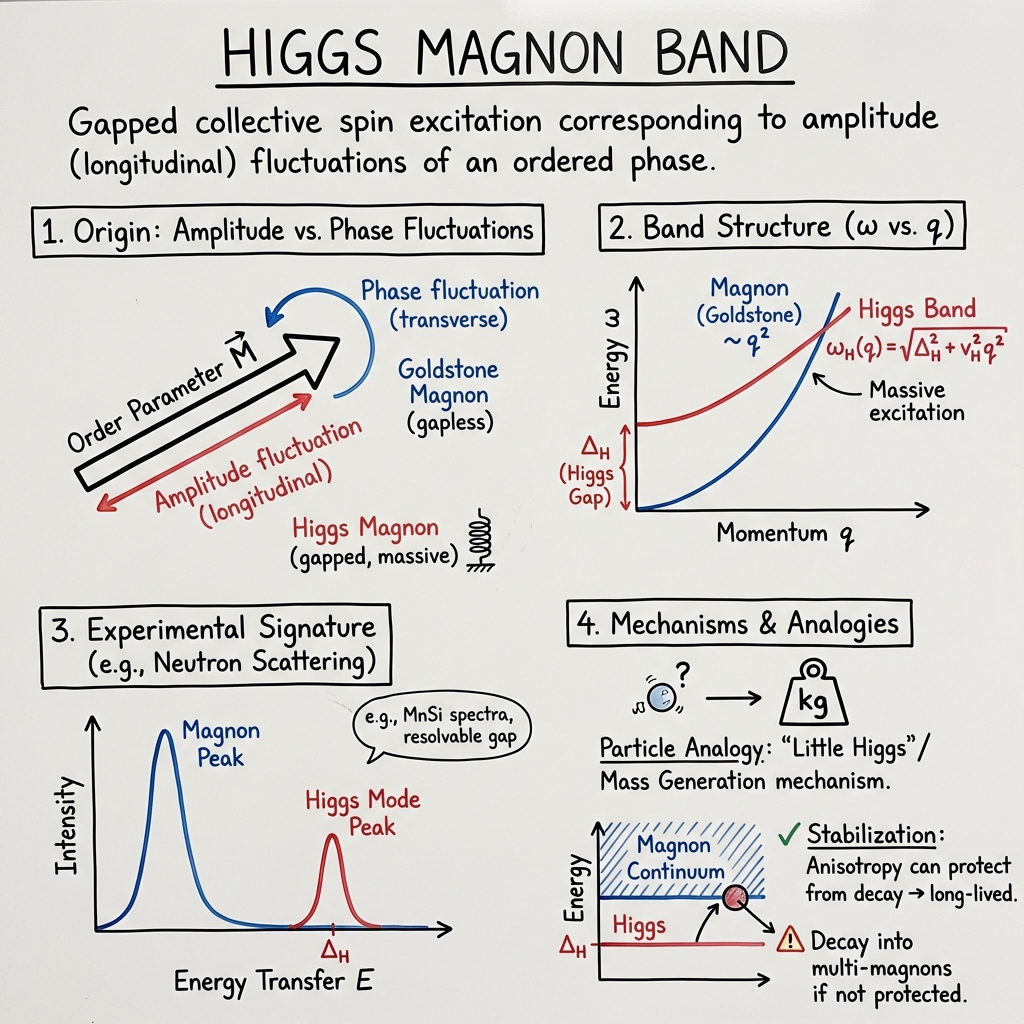
Higgs Magnon Bands in Quantum Magnets
- Higgs magnon bands are gapped collective spin excitations arising from amplitude fluctuations of the order parameter, distinct from gapless Goldstone modes.
- Experimental probes like inelastic neutron scattering and Raman scattering reveal sharp Higgs mode signatures, with gap metrics (e.g., 0.7–0.8 meV in MnSi) validating theoretical predictions.
- Theoretical frameworks such as the Ginzburg-Landau and nonlinear O(n) models underpin these modes, linking condensed matter phenomena with analogies from high-energy physics.
A Higgs magnon band is a branch of gapped collective spin excitations corresponding to amplitude (longitudinal) fluctuations of an ordered phase in a magnet, in analogy to the Higgs (amplitude) modes known from both particle and condensed matter physics. Unlike conventional magnon (Goldstone) bands, which represent phase fluctuations (transverse spin precession) and are often gapless due to spontaneous symmetry breaking, the Higgs magnon band is separated by a finite energy gap even at zero momentum and reflects oscillations in the magnitude of the order parameter. Such bands arise generically in systems with spontaneous symmetry breaking of continuous symmetries, manifest across a range of model systems and energy scales, from quantum antiferromagnets and itinerant ferromagnetic metals to superfluid He and engineered magnonic crystals.
1. Origin and Theoretical Framework
The Higgs magnon band originates from amplitude fluctuations of the symmetry-broken order parameter. In systems such as magnets, this is formally captured by decomposing fluctuations into transverse (Goldstone/magnon) modes corresponding to rotations in order parameter space, and longitudinal (Higgs/amplitude) modes corresponding to oscillations in the magnitude. For instance, in the Ginzburg-Landau approach or nonlinear models, expansion around the symmetry-broken minimum yields:
- Goldstone modes: gapless, linear or quadratic low- dispersion, realized as conventional magnons.
- Higgs modes: gapped, massive excitations, with dispersion (where is the Higgs gap) (Grassi et al., 2021, Zavjalov et al., 2014).
The existence and visibility of the Higgs magnon band depend on several factors:
- The symmetry class of the order parameter.
- The nature of quasiparticle interactions (e.g., magnon-magnon attraction).
- The presence of explicit symmetry-breaking fields or couplings (e.g., easy-axis anisotropy, spin-orbit interaction).
2. Higgs Magnon Bands in Quantum Magnets and Itinerant Ferromagnets
In weakly ferromagnetic metals, the Ferromagnetic Fermi Liquid Theory (FFLT) predicts two branches of collective excitations: the conventional gapless magnon and a gapped Higgs amplitude mode arising from amplitude fluctuations of the magnetization (Zhang et al., 2013). The quadratic small- dispersions are: where is the magnon stiffness and is the equilibrium magnetization. Experimental evidence in MnSi shows two distinct peaks in inelastic neutron spectra, with the Higgs mode gap –0 meV clearly resolved from the magnon band (Zhang et al., 2013).
In multi-sublattice models such as the Lieb and kagome lattices, Hartree-Fock plus RPA calculations reveal two-spin excitation bands: a gapless Goldstone magnon and a nearly flat, weakly dispersive, gapped Higgs magnon band. The Higgs gap 1 scales with interaction strength and sublattice magnetization (Ying et al., 12 Jan 2026). The table below summarizes typical features:
| System | Goldstone Band | Higgs Band |
|---|---|---|
| Fermi liquid (MnSi) | 2, gapless | gapped, weakly dispersive, 3 at 4 |
| Lieb/kagome Hubbard | dispersive, gapless | flat, gapped, amplitude mode 5 |
| Stripe magnonic crystal | soft mode, gapless at 6 | gapped, 7 |
In 8 Heisenberg antiferromagnets, continuous similarity transformation of the bosonized Hamiltonian predicts a sharp resonance (the Higgs mode) in the longitudinal channel (9), with a dispersing Higgs band and strong hybridization at specific momenta, as well as a roton minimum in the magnon dispersion attributed to magnon-Higgs interaction (Powalski et al., 2015).
3. Band Structure, Dispersion, and Spectral Features
The Higgs magnon band, while subject to model and parameter specifics, exhibits several universal features:
- Massive (gapped) dispersion at long wavelengths, typically of the form 0 (Grassi et al., 2021, Su et al., 2020, Silaev, 2022).
- Weak momentum dependence (flatness) in multi-sublattice, itinerant systems (Ying et al., 12 Jan 2026).
- In easy-axis anisotropic systems, kinematic stabilization enables the Higgs gap to fall below the magnon gap at the ordering vector, sharply suppressing decay and leading to a well-defined, long-lived spectral line (Su et al., 2020).
- The Higgs mode can appear either as a sharp resonance (if protected from decay), or as a broadened feature embedded in a multi-magnon continuum, depending on decay kinematics and symmetry (Powalski et al., 2015, Weidinger et al., 2015).
In systems with periodic magnetic modulation (stripe magnonic crystals), the band folding induced by periodicity opens gaps at zone boundaries; the amplitude (Higgs) mode appears as a gapped folded band, tunable by external fields and structural parameters (Grassi et al., 2021).
4. Experimental Signatures and Probes
Higgs magnon bands are observable by several advanced spectroscopies:
- Inelastic neutron scattering (INS): Direct resolution of both the magnon and amplitude modes, with relative intensities and sharpness contingent on kinematic accessibility and damping (Zhang et al., 2013, Powalski et al., 2015). For example, in MnSi, the Higgs mode intensity is 1–2\% that of the magnon at low 3 (Zhang et al., 2013).
- Raman scattering: In 2D quantum antiferromagnets, the Higgs contribution is strongly suppressed in the 4 channel, manifesting mainly as a broad continuum above the two-magnon peak due to symmetry constraints of the vertex function, but remains essential to explain line-shape asymmetry in undoped cuprate spectra (Weidinger et al., 2015).
- Resonant inelastic X-ray scattering (RIXS): Sublattice-selective spin-flip experiments are sensitive to the amplitude mode, enabling discrimination of majority/minority Higgs branches in multi-orbital systems (Ying et al., 12 Jan 2026).
- Microwave/FMR/BLS: In magnonic crystals and multilayers, the Higgs gap and band curvature are measured via tunable resonance frequency shifts and direct observation of both Goldstone and Higgs branches (Grassi et al., 2021, Silaev, 2022).
5. Model Systems and Mechanisms
Several representative systems host and expose Higgs magnon bands through distinct mechanisms:
- Superfluid 5He-B: The spin-orbit (Leggett) coupling in the B-phase lifts a Nambu-Goldstone mode, producing a "light Higgs" magnon with a small gap at the Leggett frequency. Optical magnons decay parametrically into pairs of Higgs modes (threshold at 6), providing a condensed-matter analogue to Little Higgs models (Zavjalov et al., 2014).
- Quantum ANisotropic Magnets (XXZ bilayers): Near the dimer-AFM quantum critical point, easy-axis anisotropy lifts the magnon gap above the Higgs gap, kinematically forbidding amplitude-mode decay and enabling long-lived Higgs magnetism (Su et al., 2020).
- S–F–S hybrid multilayers: Anderson–Higgs mechanism from proximity to superconductors provides a tunable mass gap to magnons. The gap and bandwidth can be engineered via superconductor thickness, London penetration depth, and temperature, and group-velocity reversals are induced at critical field values (Silaev, 2022).
- Stripe magnonic crystals: Spontaneous formation of periodic magnetic textures leads to band folding, opening a mass gap (Higgs band) controllable by geometric and field parameters (Grassi et al., 2021).
6. Interactions, Decay Processes, and Lifetimes
Higgs magnon bands are generically susceptible to decay into lower-lying (often gapless) Goldstone magnons, resulting in damping and broadening. Their stability is controlled by:
- Kinematic constraints: Easy-axis anisotropy or band structure engineering that place the Higgs gap below the magnon continuum can eliminate decay channels and stabilize the amplitude mode (Su et al., 2020).
- Magnon–Higgs interaction: In 2D Heisenberg antiferromagnets, quartic magnon-magnon attraction leads to a Higgs resonance entangled with roton minima in the magnon dispersion (Powalski et al., 2015).
- External fields and patterning: The Landau-potential curvature and exchange anisotropy set the relative placement of the Higgs gap and the multi-magnon continuum (Grassi et al., 2021).
7. Connections to High-Energy Analogies and Broader Context
The phenomenology of Higgs magnon bands in condensed matter systems directly mirrors the amplitude/phase decomposition of order parameter dynamics central to high-energy and statistical physics. Their realization as pseudo-Goldstone (light Higgs) modes echoes mechanisms for mass generation in particle models ("Little Higgs" scenario), wherein explicit symmetry breaking renders certain otherwise Nambu-Goldstone bosons massive but light compared to other scale-setting gaps (Zavjalov et al., 2014). In proximity-coupled superconducting heterostructures, the Anderson–Higgs mechanism provides a direct analogue to mass acquisition by gauge bosons (Silaev, 2022). These links position Higgs magnon bands as a paradigmatic platform for studying emergent mass, instability, and decay physics at accessible experimental scales.