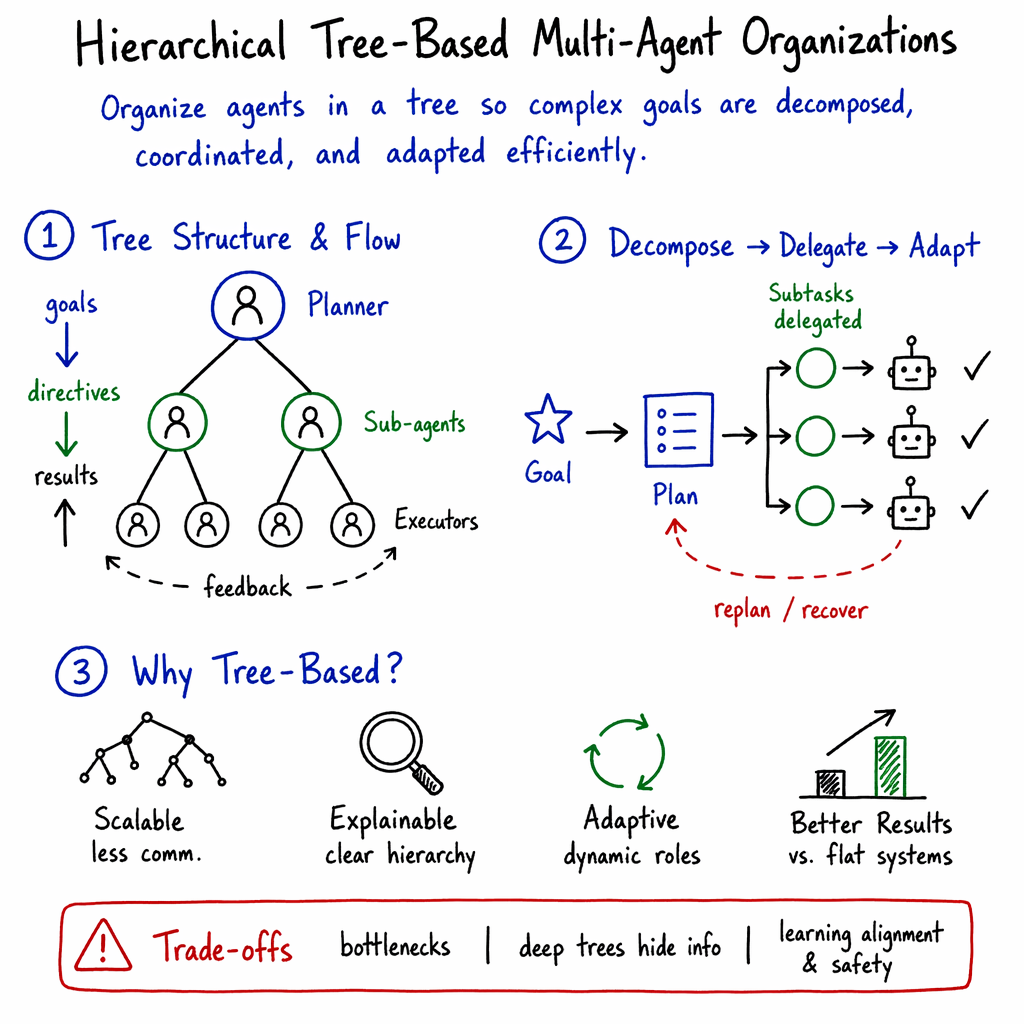
Hierarchical Tree-Based Multi-Agent Organization
- Hierarchical tree-based multi-agent organization is a structure where autonomous agents are arranged in layered, tree-like hierarchies for clear role assignment and efficient communication.
- It decomposes complex tasks into subgoals delegated across specialized nodes, facilitating dynamic role allocation and adaptive coordination in various domains.
- Empirical studies demonstrate that these organizations enhance scalability, fault-tolerance, and performance in systems ranging from industrial control to LLM-driven agent collaborations.
A hierarchical tree-based multi-agent organization is a structural paradigm in which collections of autonomous or semi-autonomous agents are organized into a tree-like or layered hierarchy. Each agent typically assumes a specific role, with information, control, or influence flowing along parent-child relationships defined by the tree. This architectural approach underpins a wide range of multi-agent systems (MAS), enabling the decomposition of complex tasks, efficient coordination, and scalable adaptation. Hierarchical, tree-based organizations are prevalent in domains ranging from industrial process control and decision support to LLM-driven collaborative agents, cooperative reinforcement learning, and organizational theory. This article presents the core design concepts, decomposition mechanisms, communication structures, coordination protocols, comparative advantages, and empirical findings associated with hierarchical tree-based multi-agent organizations, grounded in contemporary research literature.
1. Structural Principles and Formal Taxonomies
Hierarchical MAS structurally organize agents into layered or tree-based graphs, where each node denotes either a single agent or a tightly coupled sub-team, and edges encode supervision, delegation, or communication relationships. The taxonomy introduced in (Moore, 18 Aug 2025) classifies tree-based organizations along five orthogonal axes:
- Control Hierarchy: Ranges from fully centralized (single root or leader) to decentralized or hybrid, where decision authority may shift or be spread.
- Information Flow: Can be top–down (directive), bottom–up (feedback/reporting), or peer-to-peer (lateral synchronization).
- Role and Task Delegation: Roles may be statically assigned (fixed supervisory chains) or may emerge and reconfigure dynamically (learning-based or contract-driven delegation).
- Temporal Hierarchy: Governs the temporal scope at each layer, with high layers making strategic, long-horizon decisions and low layers focused on rapid execution and reactivity.
- Communication Structure: Defines the mutability (static vs. dynamic/wiring) and the presence/absence of lateral links (pure tree vs. augmented mesh).
This formalization enables systematic analysis and the alignment of architectural patterns to task and environment requirements. For example, industrial power grids (device–microgrid–main controller), oilfield operations (field–maintenance–production), and warehouse logistics (central scheduler–section controller–robot) are all cited as canonical exemplars (Moore, 18 Aug 2025).
2. Task Decomposition, Delegation, and Adaptive Coordination
A foundational principle is decomposition: high-level objectives are recursively partitioned into subgoals, each mapped to an appropriate agent or sub-team within the tree structure. Central “planner” or “conductor” agents (as in AgentOrchestra (Zhang et al., 14 Jun 2025)) or orchestration layers (as in OrchVis (Zhou, 28 Oct 2025)) act as roots, interpreting external goals and generating structured plans:
Sub-agents execute subtasks, report results, and provide feedback. Planning agents may dynamically re-allocate subtasks, handle failures, and synthesize final outputs, forming an adaptive, robust workflow. In advanced frameworks (e.g., HALO (Hou et al., 17 May 2025)), decomposition and role instantiation itself are treated as learning or search problems (e.g., via MCTS) over the space of tree-structured workflows.
The assignment of sub-tasks incorporates explicit agent specialization (as in (Zhang et al., 14 Jun 2025) and (Choi et al., 29 Aug 2025)) or dynamic, data-driven role formation (as in Rochico (Li et al., 2021) and HCGL (Fu et al., 2024)). In collective learning frameworks (e.g., HRCL (Qin et al., 22 Sep 2025)), a high-level MARL layer orchestrates strategic plan grouping while tree-structured collective learning ensures low-level plan selection and coordination.
3. Inter-Agent Communication and Workflow Orchestration
Information flow in hierarchical organizations generally adheres to tree edges, with standardized schemas for message passing and action/result encoding, as highlighted in (Zhang et al., 14 Jun 2025, Zhou, 28 Oct 2025), and (Zhang et al., 2012). Higher levels aggregate or summarize information and propagate directives; lower levels provide feedback, contextual information, or error reports. Explicit memory or history sharing is used to maintain consistency and support context-aware decision-making.
Layered orchestration (as in OrchVis (Zhou, 28 Oct 2025)) emphasizes human-in-the-loop oversight, allowing for goal parsing, task assignment, and partial replanning within the goal hierarchy—surfaces dependencies and conflicts through visualization panels. Advanced orchestration frameworks separate goal alignment (strategic correctness) from task assignment (tactical agent-tool mapping), and employ automated verification predicates for each node in the tree, ensuring transparent and actionable oversight by humans or higher-level agents.
In architectures supporting dynamic or emergent hierarchies (e.g., (Chen et al., 13 Aug 2025, Li et al., 2021)), inter-agent dependencies are measured analytically (e.g., via policy gradient sensitivity), with roles and influence evolving in response to environmental feedback, initial conditions, and agent attributes (“talent” vs. learning-based “effort”).
4. Learning, Adaptation, and Dynamic Role Allocation
Hierarchical organizations support both pre-designed (tree-based) and emergent roles. Pre-configured hierarchies (e.g., Feudal MARL (Ahilan et al., 2019), AgentOrchestra (Zhang et al., 14 Jun 2025)) statically assign delegation edges and leverage global-to-local information reduction for efficiency and explainability. Emergent frameworks (e.g., (Chen et al., 13 Aug 2025), Rochico (Li et al., 2021), HCGL (Fu et al., 2024)) enable agents to dynamically form teams, clusters, or even shift between leader/follower status during episodes, in response to environmental contingencies and intra-agent negotiation.
Dynamic allocation is enabled by hierarchical consensus constraints, graph operator agents, and adaptive plan grouping. For example, in HRCL (Qin et al., 22 Sep 2025), the high-level MARL layer selects both plan groups and behavioral ranges, while bottom-level decentralized collective learning (e.g., EPOS algorithm) ensures coordinated local plan realization with minimal communication complexity ( per step).
Role instantiation can be driven by search-based workflow optimization (e.g., MCTS in HALO (Hou et al., 17 May 2025)) or joint contrastive and consensus learning (Rochico (Li et al., 2021)), substantially improving task coverage and exploration/diversity (validated in large-scale multi-task and robot settings).
5. Communication Structures, Performance Trade-Offs, and Empirical Results
The key trade-offs in hierarchical organizations include:
- Scalability: Tree hierarchies reduce communication complexity and confer robustness, but risk bottlenecks at roots/intermediate nodes; dynamic (rewireable) hierarchies enhance fault-tolerance.
- Explainability: Multi-level summarization improves traceability, but deep trees may bury causal information.
- Adaptability: Dynamic role allocation and workflow search enable rapid reconfiguration and fault recovery, as demonstrated in state-of-the-art systems (Zhang et al., 14 Jun 2025, Choi et al., 29 Aug 2025), and (Qin et al., 22 Sep 2025).
- Integration of Learning-Based Agents: Use of LLMs or RL agents at various layers complicates alignment and safety; hybrid approaches and visualization (e.g., OrchVis (Zhou, 28 Oct 2025)) are under investigation.
- Performance: Hierarchical systems have consistently outperformed flat or monolithic baselines on benchmarks such as GAIA, HLE, MMLU, HumanEval, and custom industrial tasks (Zhang et al., 14 Jun 2025, Hou et al., 17 May 2025, Qin et al., 22 Sep 2025), often with better adaptability and superior expert-level task completion.
Summary Table: Core Mechanisms (selected from (Moore, 18 Aug 2025, Zhang et al., 14 Jun 2025, Zhou, 28 Oct 2025, Hou et al., 17 May 2025))
| Mechanism | Description |
|---|---|
| Planning/Orchestration Agent | Top-level (root); decomposes and delegates |
| Specialized Sub-Agents | Leaves; domain/task-specific execution |
| Standardized Communication Schemas | Explicit plan, sub-task, result, and context |
| Dynamic Role Allocation | Re-planning, error recovery, adaptive fallback |
| Workflow Search/Optimization | MCTS, dynamic clustering, or task graph search |
| Human-in-the-Loop Oversight | Visualization panels, machine-checkable goals |
6. Specialized Domains and Hybrid Organizational Forms
Tree-based organizations are found in a range of real-world and synthetic settings:
- Industrial and Energy Applications: Power grids, oilfields, and warehouse logistics benefit from device–section–system trees, with local autonomy and global oversight (Moore, 18 Aug 2025).
- LLM-based Agent Systems: Orchestration platforms (AgentOrchestra (Zhang et al., 14 Jun 2025), OrchVis (Zhou, 28 Oct 2025), HALO (Hou et al., 17 May 2025)) structure agents into planners, researchers, and analyzers, yielding modular, extensible, and robust solutions to complex, multimodal, or unanticipated tasks.
- Reinforcement Learning: Feudal Multi-Agent Hierarchies (Ahilan et al., 2019), HRCL (Qin et al., 22 Sep 2025), and tree-shaped cooperative RL approaches provide levels of abstraction that reduce non-stationarity and credit assignment issues, scaling to large agent populations.
- Scientific Document and Layout Generation: PosterForest (Choi et al., 29 Aug 2025) exemplifies the application of hierarchical multi-agent collaboration for document conversion tasks—yields superior results via joint content-layout reasoning in tree-structured representations.
Hybrid methods combine tree-based control with mesh augmentations (for consensus or redundancy), or organize trees dynamically at runtime through learning protocols (e.g., organization control and dynamic clustering in HCGL (Fu et al., 2024), Rochico (Li et al., 2021)).
7. Synthesis: Theoretical Foundations, Design Implications, and Open Challenges
Hierarchical tree-based multi-agent organizations offer formal efficiency, modularity, and clarity benefits, but are subject to inherent trade-offs and emergent behaviors. Theoretical analyses (e.g., error convergence in tree-based social learning (Zhang et al., 2012), contract-mediated coordination (Scheid et al., 31 Jan 2025)) quantify limits and design-space dependencies (branching factor, message alphabet, depth). Key design principles emerging across the literature include:
- Extensibility and Modularity: Abstracted agent, tool, and model interfaces, permitting flexible insertion or removal of agents/roles (Zhang et al., 14 Jun 2025, Choi et al., 29 Aug 2025).
- Synchronization of Strategic and Tactical Objectives: Decoupling long-horizon planning from rapid execution layers (Ahilan et al., 2019, Moore, 18 Aug 2025).
- Dynamic and Emergent Organization: Allowing role/cluster/team formation to adapt online for nonstationary and heterogeneous environments (Li et al., 2021, Chen et al., 13 Aug 2025, Fu et al., 2024).
- Coordination Mechanisms: Integration of contract-net protocols, consensus, reinforcement learning, and search-based orchestration according to context (Moore, 18 Aug 2025).
Open challenges include making hierarchical decisions maximally explainable, managing scalability in the face of very large agent populations, integrating modern learning-based agents safely, and formalizing best practices for dynamic restructuring. Recent advances in framework design, orchestration protocols, and empirical benchmarking point towards increasingly general, robust, and interpretable multi-agent tree-based systems suitable for both research and deployment in complex real-world domains.