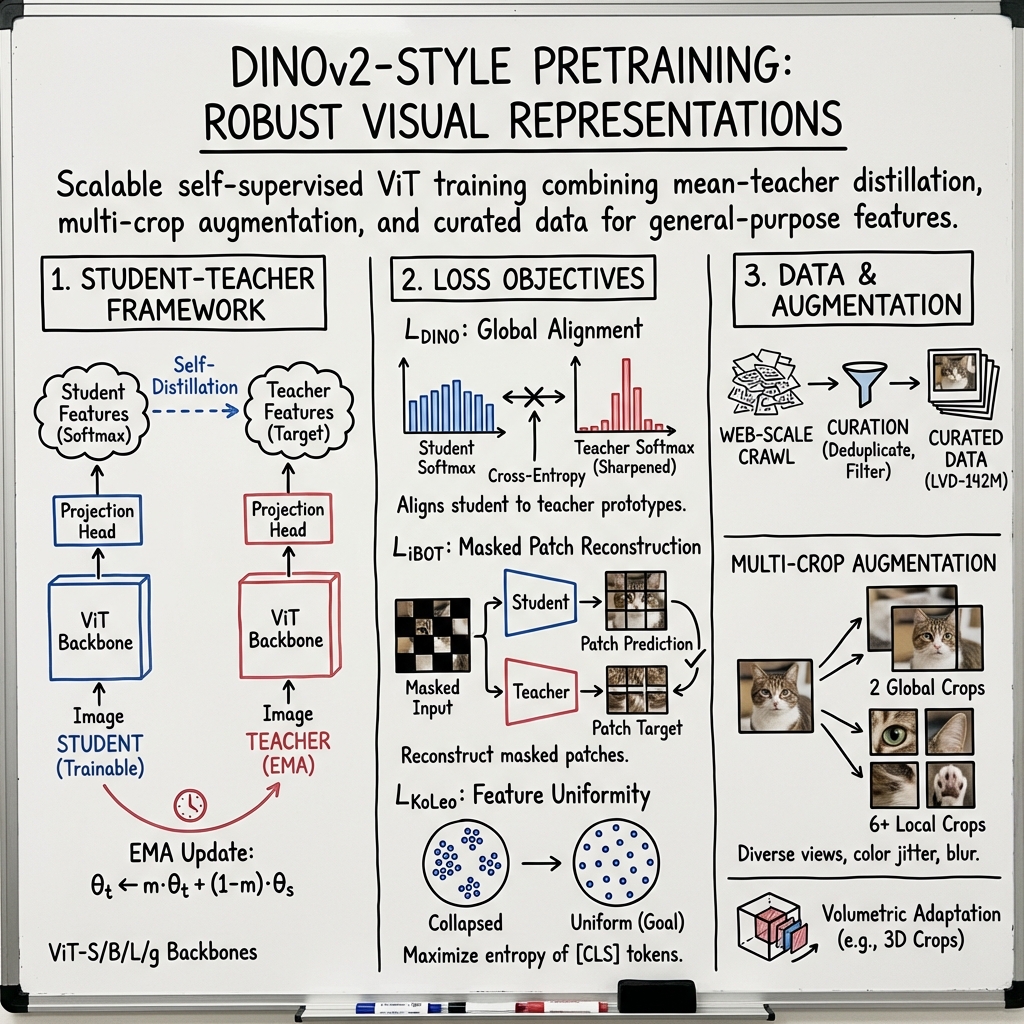
DINOv2 Pretraining for Vision Transformers
- DINOv2-style pretraining is a scalable self-supervised framework that employs joint-embedding self-distillation, multi-crop augmentation, and rigorous data curation to generate robust visual features.
- It integrates a teacher-student architecture with dedicated projection heads and specialized loss functions, such as Sinkhorn normalization and KoLeo regularization, to ensure feature uniformity and transferability.
- Empirical results show that DINOv2-trained models excel in tasks like ImageNet linear evaluation and dense prediction, surpassing weakly-supervised methods on diverse benchmarks.
DINOv2-style pretraining refers to a family of scalable self-supervised training methodologies for Vision Transformers (ViTs), in which joint-embedding, mean-teacher self-distillation, and multi-crop data augmentations are combined with large-scale curated data and architectural enhancements to produce robust, general-purpose visual representations. DINOv2, introduced by Oquab et al., is distinguished from its predecessors by innovations in loss design, patch masking, feature uniformity regularization, and a rigorous data curation pipeline, which together enable models to surpass weakly-supervised CLIP/VLM representations on a suite of transfer and dense-prediction tasks (Oquab et al., 2023, Scardecchia, 4 Oct 2025).
1. Architectural Overview: Backbone, Projector, and Teacher-Student Framework
The backbone in DINOv2-style pretraining is a standard ViT with non-overlapping patchifying, learnable [CLS] token, fixed or learned positional embeddings, and a multi-layer transformer body with stochastic depth and, for the largest models, LayerScale initialization for stability. Canonical configurations are ViT-S/14 (D=384, L=12, H=6), ViT-B/14 (D=768, L=18, H=12), ViT-L/14 (D=1024, L=24, H=16), and ViT-g/14 (D=1536, L=40, H=24).
Each model is split into a student (trainable) and a teacher (EMA, not backpropped), both with identical architecture and separate image-level ([CLS] token) and patch-level (patch tokens) projection heads—each a multi-layer perceptron (e.g., three layers for DINOv2), untied for stability at scale (Oquab et al., 2023, Lavoie et al., 29 Mar 2025, Scardecchia, 4 Oct 2025). The teacher network weights are updated as an exponential moving average (EMA):
where follows a cosine ramp (typically from 0.994 up to 1.0).
Projector heads ("DINO heads") are MLPs mapping the backbone embedding dimension to a high-dimensional prototype space (e.g., for DINOv2; in DINO-MX (Gokmen et al., 3 Nov 2025)) used for classification-like self-distillation.
2. Loss Functions and Training Objectives
DINOv2 pretraining employs a joint-embedding self-distillation loss that aligns the student’s softmax-projected features to those of the teacher. For global (image-level) supervision, given multiple crops of the same image, the cross-entropy loss between the teacher’s (sharpened, centered) softmax and the student’s softmax, over the prototype space, is computed across (global teacher, all student) pairs:
where is the teacher's prototype assignment after entropy sharpening (teacher temperature –0.07) and small-batch Sinkhorn normalization for centering/uniformity (Oquab et al., 2023, Scardecchia, 4 Oct 2025). The student probabilities are , with .
An iBOT patch-level masked prediction objective is typically included: the student is tasked with reconstructing teacher patch representations for a random mask (mask ratio 0.4–0.5, patch masking probability 0), with separate heads for the patch loss, and the formulation analogous to the DINO loss (Veenboer et al., 30 Nov 2025, Gokmen et al., 3 Nov 2025, Oquab et al., 2023).
A differentiable entropy maximization (KoLeo) regularizer is also applied to the normalized [CLS] features to encourage isotropy and prevent representational collapse (Oquab et al., 2023, Scardecchia, 4 Oct 2025).
The total objective is:
1
with 2.
3. Data Curation, Augmentation, and Curriculum
DINOv2-style pretraining is predicated on large, high-quality, domain-diverse data, obtained through a multi-stage curation pipeline:
- A web-scale crawl is deduplicated, filtered (NSFW, blur faces), and cross-dataset cleaned, yielding a subset (LVD-142M) with 3142M images that balance concept coverage, quality, and domain diversity through seed dataset retrieval and cluster-based sampling (Oquab et al., 2023).
- For each image, multi-crop augmentation is applied:
- Two global crops (e.g., 2244224 px, scale 0.4–1.0 of area);
- Six (or more) local crops (e.g., 96596 px, scale 0.05–0.4);
- Per-crop augmentations include color jitter, blur, solarization, horizontal flip, and, optionally, RandAugment (Scardecchia, 4 Oct 2025, Gokmen et al., 3 Nov 2025).
- In volumetric (3D) contexts, such as TAP-CT, the data pipeline introduces 3D random crop, 3D mask blocks, axial intensity augmentation, and 3D rotations (Veenboer et al., 30 Nov 2025), leveraging Conv3D patch embeddings and depth-aware 3D positional encodings.
Curriculum strategies, such as spectral filtering (low-frequency-descending) followed by high-frequency/noise exposure, further accelerate training and enhance robustness as in FastDINOv2 (Zhang et al., 4 Jul 2025).
4. Optimization, Scheduling, and Efficiency Mechanisms
Training is conducted with AdamW, large batch sizes (up to 8192 images, thousands of crops per batch), cosine learning rate decay, and warmup schedules (Oquab et al., 2023, Gokmen et al., 3 Nov 2025, Scardecchia, 4 Oct 2025). Teacher momentum 6 is ramped from 70.994 up to 1.0; teacher temperature 8 is similarly ramped. Learning rates for full training are typically 9, decaying to 0, with weight decay schedule from 0.04 to 0.2.
Key efficiency contributions include:
- FlashAttention for transformer memory/speed (Oquab et al., 2023)
- Sequence-packing, grouping variable-length crops in block-diagonal attention
- Fully-Sharded Data Parallelism (FSDP) with mixed-precision (parameters fp32, gradients fp16)
- Stochastic depth that drops blocks at minimal computational cost
For distilled models, smaller ViTs are trained with frozen ViT-g ("giant") teachers, skipping some loss terms, with EMA on student weights for the final checkpoint.
The table below summarizes core architectural and training details, as found in DINOv2 and its principal directly-related adaptations:
| Model Variant | Patch Size | Layers (L) | Dim (D) | Proj. Head Dim | Self-Supv. Loss | Crop Numbers |
|---|---|---|---|---|---|---|
| ViT-S/14 | 14 | 12 | 384 | 128k | DINO v2 + iBOT | 2 global, 6 local |
| ViT-B/14 | 14 | 18 | 768 | 128k | DINO v2 + iBOT | 2 global, 6 local |
| ViT-L/14 | 14 | 24 | 1024 | 128k | DINO v2 + iBOT | 2 global, 6 local |
| ViT-g/14 | 14 | 40 | 1536 | 128k | (Teacher only) | 2 global, 6 local |
Details for extensions: Volumetric adaptation (TAP-CT) swaps in Conv3D, depth-aware positional encoding, and 3D crops/masks (Veenboer et al., 30 Nov 2025). DINO-MX directly exposes configuration for output dimension, temperatures, LoRA rank, and more (Gokmen et al., 3 Nov 2025).
5. Empirical Performance and Transfer Properties
DINOv2-trained features yield strong out-of-the-box performance for:
- Linear evaluation on ImageNet-1k: ViT-L/14 achieves 86.3% top-1, exceeding iBOT-trained models and matching OpenCLIP-G/14, with superior out-of-distribution generalization (Oquab et al., 2023).
- Strong transfer on dense prediction: ADE20k linear segmentation 49.0% mIoU (vs iBOT-L 44.6%), zero-shot depth estimation, and fine-grained natural domain recognition (Oquab et al., 2023).
- State-of-the-art results in domain adaptive object detection, where frozen DINOv2 backbones as pseudo-labelers outperform Mean Teacher-based pipelines by 2-10 mAP points; feature alignment loss (cosine distance to DINOv2 features) further reduces domain gap (Lavoie et al., 29 Mar 2025).
- Volumetric DINOv2 (TAP-B-3D) achieves higher average dice scores across multi-organ CT segmentation tasks versus DINOv2-slice and contrastive baselines, with best AUCs 0.855–0.876 in 3D lung/trauma classification (Veenboer et al., 30 Nov 2025).
- In medical classification, DINOv2 as a frozen backbone outperforms ImageNet backbones on public X-ray, fundus, and dermoscopy datasets, but not on highly non-photographic domains such as clinical MRI, where supervised ImageNet models are marginally better (Huang et al., 2024).
Empirical ablations demonstrate the incremental value of data curation, Sinkhorn centering, masking, and KoLeo regularization; feature alignment, as in DINO-Teacher, confers additional transfer robustness (Oquab et al., 2023, Lavoie et al., 29 Mar 2025).
6. Frameworks and Algorithmic Extensions
Recent modular systems (e.g., DINO-MX (Gokmen et al., 3 Nov 2025)) abstract DINOv2-style pretraining as a configurable, extensible pipeline:
- All settings, including backbone, crop sizes, number, projection head, LoRA modules, distillation, and distributed strategy, are centrally configured.
- Training loop pseudocode explicitly alternates student and teacher forward passes, computes the joint-embedding loss, applies mixed-precision optimizations, and updates teacher weights and centering buffers per iteration.
- PEFT (parameter-efficient tuning), LoRA, layer freezing, and cross-domain augmentations are available for resource-constrained adaptation.
- Volumetric or non-RGB domains require minimal architectural adjustments: replace 2D patchification with 3D, interpolate positional encodings in 1, and swap color jitter for domain-relevant transforms (Veenboer et al., 30 Nov 2025).
- Spectral-domain curriculum (FastDINOv2) reduces training time to 62% of baseline, with matched or improved robustness to image corruptions (Zhang et al., 4 Jul 2025).
7. Limitations, Impact, and Future Research Directions
Despite its strong performance in natural image domains, DINOv2 does not universally surpass supervised ImageNet backbones on data with radically different statistics, such as certain MRIs (Huang et al., 2024). Empirical findings suggest that feature invariances learned by DINOv2 are highly transferable for 'photo-like' data or volumetric medical domains where 3D adaptation is sufficient (Veenboer et al., 30 Nov 2025).
Scalability and reproducibility have improved via released libraries (e.g., DINO-MX), modularization, and public weights, but full distributed scaling and 3D domain-specific tuning remain active research directions (Gokmen et al., 3 Nov 2025).
Research continues into optimization speed (curriculum, spectral augmentation), improved domain transfer (feature alignment, label-guided augmentation), and further efficiency gains. A plausible implication is that minimal ViT architectural modifications, if partnered with carefully designed DINOv2-style pretraining, can generalize to new imaging modalities with low-resource requirements (Veenboer et al., 30 Nov 2025).
In summary, DINOv2-style pretraining integrates mean-teacher self-distillation, multi-crop augmentation, prototype matching, entropy maximization, and scalable vision transformers with systematic data curation, establishing a transferable, robust foundation for both 2D and 3D visual representation learning across natural and non-natural image domains (Oquab et al., 2023, Scardecchia, 4 Oct 2025, Gokmen et al., 3 Nov 2025, Veenboer et al., 30 Nov 2025, Lavoie et al., 29 Mar 2025).