Deep Persona Alignment (DPA)
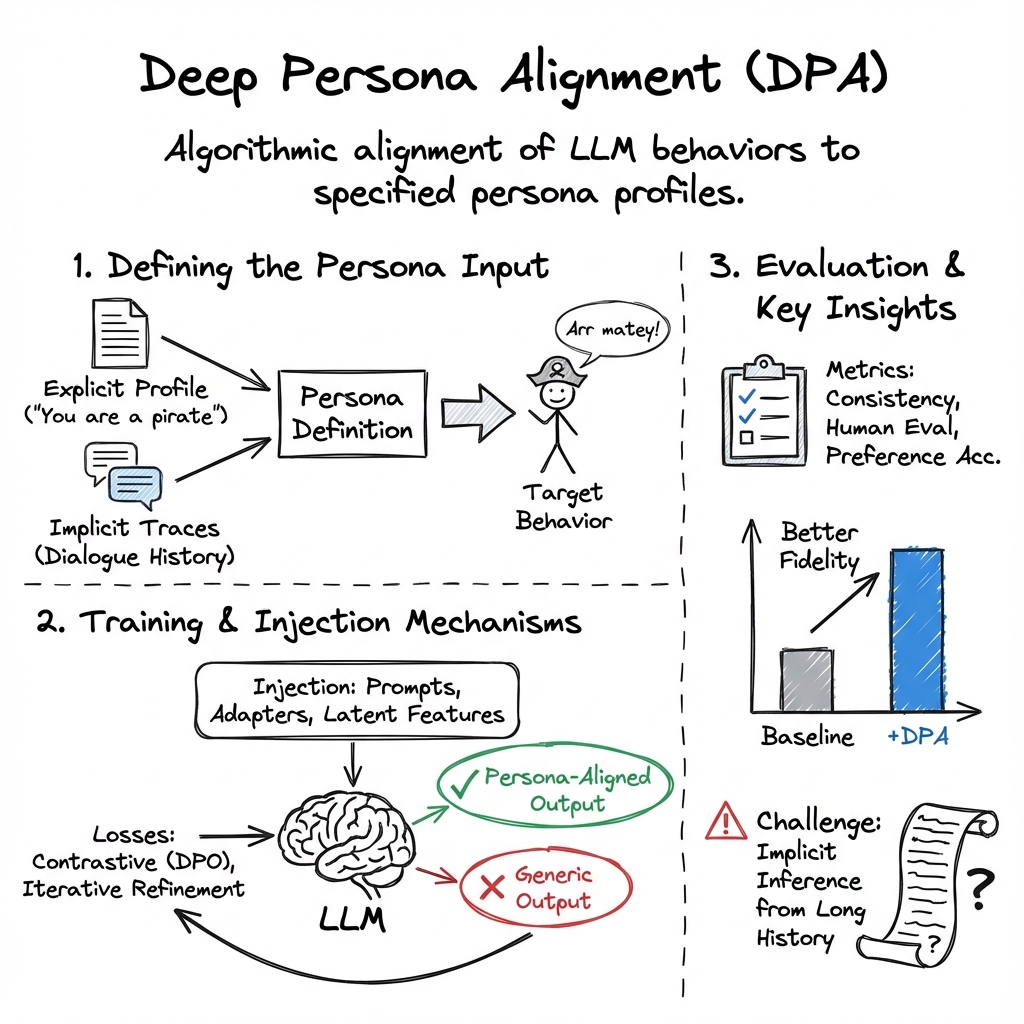
- The paper introduces DPA as a method to align LLM behaviors with defined persona profiles using combined supervised and reinforcement learning objectives.
- It employs techniques such as contrastive learning, prompt engineering, and latent feature extraction to ensure semantic and pragmatic fidelity to persona attributes.
- DPA enhances applications like personalized dialogue, role-play simulation, and moral alignment while addressing bias amplification and adaptive persona challenges.
Deep Persona Alignment (DPA) denotes the explicit, algorithmic alignment of LLMs’ (LLMs) behaviors, responses, and internal representations to specified persona profiles or latent human attributes. DPA techniques target the systematic encoding, selection, evaluation, and continual correction of persona-dependent behavior, aiming for semantic, pragmatic, and distributional fidelity to both explicit and implicit user or character attributes—far surpassing surface-level prompt conditioning. Current DPA systems span personalized dialogue generation, social simulation, role-play, memory-augmented chat, moral alignment, and population-scale preference adaptation.
1. Formalization and Training Objectives
DPA formalizes persona as a set of discrete or continuous variables, either explicitly provided (natural language profiles, preference vectors) or inferred (latent features, behavioral traces). The core training objective is to maximize the alignment between model outputs and intended persona-conditioned behaviors, typically via one or more of:
- Supervised Next-Token Prediction (NTP): Uses persona-conditioned data for conventional token-level prediction, but with mixed or contrastive prompts to ensure persona salience.
- Contrastive or Preference-Based Losses (DPO, RLHF): Employs direct preference optimization or reinforcement learning from preference pairs (persona-aligned vs. persona-agnostic outputs), often with a reference model KL penalty.
- Iterative Persona Refinement: Adapts persona profiles via diagnostic feedback—free-form or structured (theory-of-mind)—and updates model or profile until minimizing the alignment error with human ground truth behaviors.
Losses are typically of the form: where handles combined supervised tasks (e.g., selection + generation), and is a DPO-style preference or reward loss (Li et al., 13 Nov 2025, Yao et al., 16 Oct 2025, Li et al., 19 Mar 2025).
2. Model Architectures and Persona Injection
Approaches to persona injection vary with application domain and scale.
- Prompt Engineering: Unified or task-specific prompts template persona, history, and user queries:
- “The user’s persona is: <personas>. Dialogue: <history>. Preferred persona: <mask>.”
- Persona is injected in every turn via context window serialization (Li et al., 13 Nov 2025, Li et al., 19 Mar 2025).
- Encoder/Decoder Modification: Soft prompts, adapter layers (e.g., LoRA), or dedicated embeddings prepended or fused with input tokens enable persona conditioning without full retraining (Huang et al., 8 Dec 2025, Jiang et al., 7 Dec 2025).
- Latent Feature Alignment: Extracted persona directions in hidden space via sparse autoencoder dictionaries enable not just selection but direct manipulation (intervention, suppression) of behavioral features (Wang et al., 24 Jun 2025).
- External Memory or Retrieval-Augmented Models: Agentic memory frameworks condense multi-session dialogue histories to concise, persona-relevant summaries, supporting implicit alignment from long contexts without ballooning context windows (Jiang et al., 7 Dec 2025).
3. Data Curation, Persona Construction, and Benchmarks
DPA research leverages increasingly sophisticated persona datasets, ranging from synthetic, richly annotated testbeds to large-scale naturalistic corpora.
- Synthetic Persona Generation: Grammar-based, census-derived, or multi-attribute sampled personas (e.g., 1,586 intersected profiles from ACS PUMS with 33 attributes, then filtered and enriched) (Castricato et al., 2024).
- Narrative Persona Mining: Social media authorship corpora and LLM summarization extract realistic personas, then globally aligned via importance sampling and entropic optimal transport to psychometric trait distributions (e.g., Big Five) (Hu et al., 12 Sep 2025).
- Preference Space Construction: Psychological/behavioral/interest dimensions (90 in AlignX) with {-1,0,1} values enable precise alignment and controllability (Li et al., 19 Mar 2025).
- Implicit Persona Inference: Extended multi-turn conversations with latent preferences, requiring agentic memory and RL-based reward shaping for correct alignment (Jiang et al., 7 Dec 2025).
- Evaluation Testbeds: PERSONA Bench, CharacterEval, and moral judgment paradigms (e.g., trolley problem with AMCE scoring) provide systematic test inputs and robust pluralistic or moral alignment audits (Castricato et al., 2024, Kim et al., 15 Apr 2025, Ji et al., 22 Mar 2025).
| Dataset/Benchmark | Persona Construction | Notable Metrics |
|---|---|---|
| PERSONA Bench (Castricato et al., 2024) | Synthetic, intersectional, census-based | Preference accuracy, Cohen's κ |
| AlignX (Li et al., 19 Mar 2025) | Preference vector/UGC/description | Alignment ACC, Flip-Rate |
| PersonaMem-v2 (Jiang et al., 7 Dec 2025) | 1k synthetic, implicit prefs, long ctx | MCQ/Open-end accuracy |
| CharacterEval (Ji et al., 22 Mar 2025) | 77 profiles, role-play dialogue | Consistency, Attractiveness |
4. Alignment Algorithms: Selection, Optimization, and Inference
State-of-the-art DPA systems employ layered, multi-stage algorithms:
A. Persona Selection and Generation (PAL Framework):
- Task 1: Identify the single most relevant persona to history by learned similarity in embedding space:
- Task 2: Next-token generation conditioned on selected persona:
- Mixed prompt-based loss aggregates both subgoals (Li et al., 13 Nov 2025).
- Direct Preference Optimization loss using positive (persona-included) and negative (persona-absent) response pairs, with reference model normalization:
where
(Li et al., 13 Nov 2025, Li et al., 19 Mar 2025, Ji et al., 22 Mar 2025).
- Persona-aware contrastive learning (PCL) further contrasts role-conditioned versus unconditioned generations for self-play alignment without external annotation (Ji et al., 22 Mar 2025).
C. Dynamic Persona Refinement:
- Iterative update of persona profile based on behavioral divergence between current model outputs and human ground-truth, leveraging both free-form and structured ToM analysis:
D. Reinforcement Fine-Tuning and Data-Free RL:
- Self-generated contrastive examples (in/out-of-character) enable RL training using GRPO (Group Relative Proximal Optimization), with rewards constructed from semantic + surface-form similarity to positive exemplars (Huang et al., 8 Dec 2025, Jiang et al., 7 Dec 2025).
5. Evaluation, Empirical Results, and Ablation Analysis
DPA evaluation relies on specialized metrics and controlled experiments:
- Automatic metrics: BLEU, ROUGE-L, entropy, and persona-consistency (C.score, NLI-based). Persona-alignment lifts BLEU-1 from 13.10 (fine-tuned GPT-2) to 17.05 (+PAL), and C.score from .173 to .811 on PERSONA-CHAT (Li et al., 13 Nov 2025).
- Human evaluations: Fluency, coherence, persona consistency, behavioral fidelity, and task-specific measures (e.g., immersion, emotional expression).
- Pluralistic/Consistency Metrics: Preference accuracy, Cohen’s κ (improving from 0.15 in zero-shot to 0.62 in summarization-CoT), precision/recall@K (Castricato et al., 2024).
- Robustness/Control: Flip-rate under reversed persona, adaptation to unseen preference dimensions, precise controllability of outputs (Li et al., 19 Mar 2025).
- Ablation Studies: Removal of individual alignment stages or contrastive negative pairs yields drastic drops in persona fidelity (e.g., w/o persona pretraining or alignment loss, C.score falls by half or more), highlighting necessity of multi-stage approaches (Li et al., 13 Nov 2025, Ji et al., 22 Mar 2025).
6. Interpretability, Diagnosis, and Intervention
Recent DPA methods focus on interpretable, mechanistically grounded alignment:
- Persona Feature Extraction: Sparse autoencoder model-diffing reveals latent “persona features” (linear directions in activation space) controlling specific behavioral tendencies such as toxicity or sycophancy. Shifts along these directions correlate (0) with emergent misalignment post-fine-tune (Wang et al., 24 Jun 2025).
- Predictive Intervention: Activation of identified persona features predicts downstream misaligned outputs with AUC>0.95. Intervening (projection-subtraction) in these latents can reduce misalignment rates by 80% with minimal degradation in coherence (Wang et al., 24 Jun 2025).
- Efficient Mitigation: Benign fine-tuning on a few hundred aligned samples restores safe behavior in misaligned models by repressing shifted persona features, offering a low-cost repair mechanism (Wang et al., 24 Jun 2025).
7. Limitations, Open Problems, and Future Directions
Several persistent challenges shape the DPA research agenda:
- Complexity of Human Persona: Binary or single-instruction personas are insufficient; real identities are highly intersectional, context-sensitive, and dynamic, requiring richer embedding and meta-learning frameworks (Kim et al., 15 Apr 2025, Hu et al., 12 Sep 2025, Castricato et al., 2024).
- Implicit Persona Inference: Reasoning over long, implicitly revealed histories remains a key bottleneck. Even strong LLMs achieve only 37–48% on implicit preference tasks, with agentic memory alleviating but not eliminating the challenge (Jiang et al., 7 Dec 2025).
- Bias Amplification and Safety: Conditioning on persona can induce “partisan sorting” or context-sensitive bias amplification, especially in moral dilemmas or high-impact scenarios (Kim et al., 15 Apr 2025). Robust DPA must constrain excessive persona-induced drift.
- Data Diversity and Transferability: Models still over-rely on population priors; anti-stereotypical and dynamic adaptations are harder (33–35% accuracy). Ensuring out-of-distribution generalization and adapting to real user evolution are open problems (Jiang et al., 7 Dec 2025, Yao et al., 16 Oct 2025).
Future systems are likely to require:
- Explicitly learned persona embeddings with regularization,
- Active elicitation or interaction at inference,
- Memory-augmented, efficient adaptation to evolving user histories,
- Hierarchical or graph-structured persona and memory representations,
- Meta-evaluation across a broader behavioral and ethical landscape.
Key References:
- (Li et al., 13 Nov 2025) Persona-Aware Alignment Framework for Personalized Dialogue Generation
- (Castricato et al., 2024) PERSONA: A Reproducible Testbed for Pluralistic Alignment
- (Wang et al., 24 Jun 2025) Persona Features Control Emergent Misalignment
- (Hu et al., 12 Sep 2025) Population-Aligned Persona Generation for LLM-based Social Simulation
- (Kim et al., 15 Apr 2025) Exploring Persona-dependent LLM Alignment for the Moral Machine Experiment
- (Yao et al., 16 Oct 2025) DPRF: A Generalizable Dynamic Persona Refinement Framework for Optimizing Behavior Alignment Between Personalized LLM Role-Playing Agents and Humans
- (Li et al., 19 Mar 2025) From 1,000,000 Users to Every User: Scaling Up Personalized Preference for User-level Alignment
- (Huang et al., 8 Dec 2025) Living the Novel: A System for Generating Self-Training Timeline-Aware Conversational Agents from Novels
- (Jiang et al., 7 Dec 2025) PersonaMem-v2: Towards Personalized Intelligence via Learning Implicit User Personas and Agentic Memory
- (Ji et al., 22 Mar 2025) Enhancing Persona Consistency for LLMs' Role-Playing using Persona-Aware Contrastive Learning