Authorship Attribution Models
- Authorship attribution models are computational frameworks that discern text authors by analyzing stylistic signals such as n-grams, lexical markers, and writing patterns.
- They integrate classical stylometry, neural language models, and probabilistic methods to achieve robust performance across literary, forensic, and code provenance applications.
- Emerging challenges such as fairness, topic shift resilience, and explainability are driving future research toward ensemble methods and interpretable attribution pipelines.
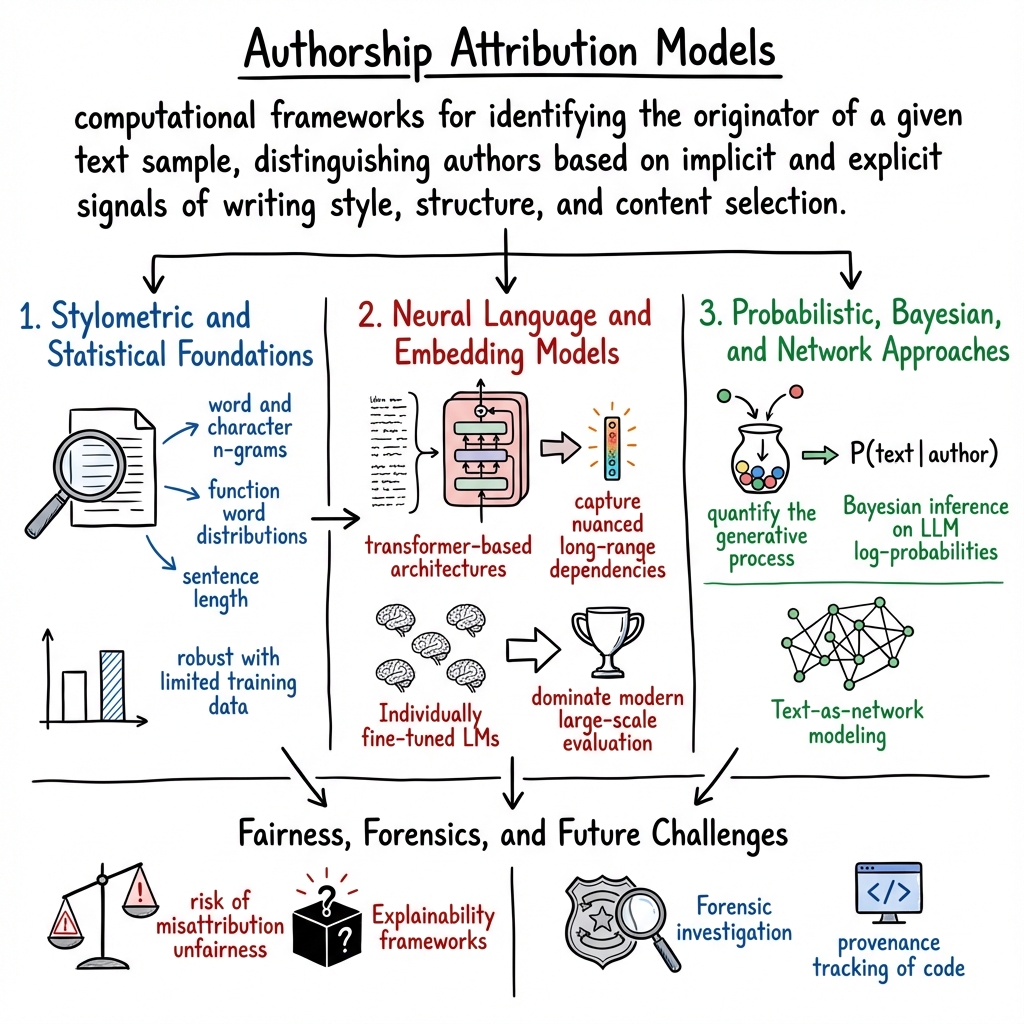
Authorship attribution models are computational frameworks for identifying the originator of a given text sample, distinguishing authors based on implicit and explicit signals of writing style, structure, and content selection. The field encompasses methodologies ranging from classical stylometry and probabilistic modeling to advanced neural architectures and ensemble systems. Authorship attribution is relevant in literary analysis, forensic investigation, provenance tracking of code and text, and in the analysis of AI-generated content.
1. Stylometric and Statistical Foundations
Early authorship attribution methodologies rely on quantification of stylistic features—word and character n-grams, function word distributions, part-of-speech sequences, lexical richness metrics, and structural measures like sentence length and punctuation usage. Ngram models with logistic regression, and compression-based approaches (e.g., Prediction by Partial Match, cross-entropy scoring) achieve robust performance on tasks with moderate candidate set sizes and medium-length texts. Macro-accuracy rates of 76–77% on standard datasets (CCAT50, Blogs50) for ngram+LogReg systems remain competitive, especially under domain shift (cross-topic or cross-genre) (Tyo et al., 2022).
These models are effective as baselines, robust with limited training data per author, and resistant to overfitting, but are susceptible to manipulation and confounding signals from content or genre. They underpin many contemporary ensemble systems and are also used as components in feature fusion and interpretability analysis.
2. Neural Language and Embedding Models
Advances in neural network LLMs (NNLMs), including feed-forward NNLMs and transformer-based architectures, enable the learning of distributed representations that capture nuanced long-range dependencies, author-specific inflection patterns, and higher-level syntactic structures (Ge et al., 2016, Jafariakinabad et al., 2019). Closed-set per-author NNLMs yield 2–3% relative reductions in perplexity compared to traditional baselines, and accuracy improvements exceeding 3% with five-sentence test samples. Hierarchical attention neural networks (Style-HAN) further refine author discrimination by fusing lexical, syntactic (POS), and sentence-level structural signals, outperforming earlier POS-tree and ngram CNN baselines (+2–8% accuracy gain) (Jafariakinabad et al., 2019).
Transformers (BERT, RoBERTa, T5, GPT-2, Llama) dominate modern large-scale evaluation. Individually fine-tuned LMs for each candidate author, as in the Authorial LLM (ALM) approach, identify authors by minimum perplexity on the questioned text, achieving macro-average accuracy of 83.6% on Blogs50 and 74.9% on CCAT50 (Huang et al., 2024). Ensemble fusion of PLM-based and feature-based models in low-resource contexts further enhances scores, as demonstrated by Japanese BERT+AdaBoost/Random Forest integrations which advance Macro-F1 by up to 14 points on out-of-pretrain corpora (Kanda et al., 11 Apr 2025).
Multi-task embedding paradigms, such as figurative language modeling (MFLM), augment attribution by modeling stylistically distinctive signals (metaphor, sarcasm, irony, etc.) and result in F1 improvements of 2–4 points over stylometric, SBERT, and raw ngram baselines (Katsios et al., 2024).
3. Probabilistic, Bayesian, and Urn-Model Approaches
Probabilistic authorship models formalize attribution as likelihood-based or Bayesian inference problems. The Poisson-Dirichlet (PD) urn model and Dirichlet process representations quantify the generative process of textual innovation, modeling the emergence of type distributions and their recurrence patterns (Raffaelli et al., 2023). Given reference texts, parameters are estimated per author to define predictive probabilities for observed and novel tokens. Attribution is performed by maximizing joint or voting-based conditional likelihoods across candidate reference sets using token sequences such as space-free n-grams or LZ77 phrases, yielding attribution accuracies that meet or surpass topic-model baselines in both literary and informal corpora (up to 0.93 for Italian texts).
Bayesian inference on LLM log-probabilities ("Logprob" method) enables one-shot closed-set identification without fine-tuning, by conditioning the LLM on reference texts and computing , with accuracies up to 85% on 10-way IMDB samples using Llama-3-70B (Hu et al., 2024).
Student- mixture VAEs generalize beyond Gaussian priors in latent space, allowing independent control over tail heaviness; these improve robustness to outlier stylistic patterns and outperform both Gaussian-VAE and SVM baselines on Amazon review attribution (error rates down to 3.53%) (Boenninghoff et al., 2020).
4. Network and Dynamical Systems Approaches
Text-as-network modeling encodes unique features of co-occurrence and structural usage. In Life-Like Network Automata (LLNA), raw text is mapped to a word adjacency graph; dynamical patterns of node state (live/dead) under cellular automaton rules (e.g., B3-S23 and B024678-S4) uncover spatio-temporal fingerprints with a ≈15% accuracy gain over pure topological features and a 5–6% gain relative to n-gram baselines (Machicao et al., 2016). Dynamical measures such as Shannon entropy, Lempel–Ziv complexity, and pairwise temporal distances provide author-discriminative signals. Preprocessing—especially partial lemmatization—impacts node counts and accuracy, with noun-only lemmatization preferred for maximizing author-specific cues.
5. Authorship Attribution in Source Code
Source Code Authorship Attribution (SCAA) involves extracting lexical, syntactic, semantic, and graph-based features from code samples, frequently via ASTs, n-grams, and identifier statistics. Ensemble learning models (Random Forest, Gradient Boosting, XGBoost), as deployed in AuthAttLyzer-V2, exploit feature orthogonality and model non-linear interactions, yielding up to 81.2% accuracy on balanced 3,000-author C++ datasets and providing sensitivity to interpretable coding style dimensions via SHAP value analysis (Joshi et al., 2024).
Language-agnostic, path-context–based representations (PbRF, PbNN) deliver state-of-the-art results (≈95% PbRF on traditional C++/Python/Java benchmarks), but accuracy degrades linearly with context or temporal separation in realistic, Git-based corpora (down to ≈20–25%). The field recommends context-independent feature engineering, regular retraining, and careful evaluation design to mitigate project and time confounds (Bogomolov et al., 2020).
6. Fairness, Verification, Explainability, and Forensic Applications
Authorship attribution systems face major challenges in forensic and high-stakes environments, notably the risk of misattribution unfairness. Misattribution Unfairness Index (MAUIₖ) quantifies the excess exposure of individual authors to false-positive inclusion in top- predictions; unfairness correlates with centrality in latent embedding space and is nontrivial in all modern models, with some authors ranked as much as 40× above random expectation (Alipoormolabashi et al., 2 Jun 2025). Fairness-aware design calls for per-author risk reporting, embedding dispersion regularization, and domain-user communication.
Authorship verification reformulates attribution as binary same/different classification, with Siamese or contrastive BERT architectures and hard-negative mining yielding competitive accuracy and strong AUCs. Cross-task baselines show that verification-trained models transfer robustly to attribution in data-rich regimes (Tyo et al., 2022, Aggazzotti et al., 2023). In speaker attribution from speech transcripts, performance depends on feature choice (filler words, backchannels, pause rates) and fine-tuning; classical written text models perform well only under strong topic variation (Aggazzotti et al., 2023).
Explainability frameworks such as IXAM/XAM allow users to interactively explore embedding spaces, extract multi-granularity style features (Gram2Vec, LLM-derived), and visualize highlighted spans, substantially increasing confidence calibration and convergent evidence construction in evaluating model outputs (Alshomary et al., 7 Dec 2025).
Forensic and privacy-sensitive attribution applications benefit from Bayesian reasoning, robust log-prob evidence, prompt-calibrated LLM inference, and an explicit understanding of the tradeoffs between topic, style, computational cost, and bias potential. The deployment of such systems demands comprehensive validation under real-world operating conditions, including adversarial perturbations, domain shifts, and confounder analysis (Hu et al., 2024, Ruggiero et al., 2020).
7. Contemporary Challenges and Future Research Directions
Authorship attribution models continue to face limitations in scalability (computational cost for per-author LMs), fairness, explainability, resistance to topical confounds, and robustness under context or genre shift. Pre-training bias in LLMs (e.g., Shakespeare’s dominance in pretraining corpora affecting attribution) and semantic confounding are open problems, often uncovered only via detailed calibration and error diagnostics (Hicke et al., 2023, Schmidt et al., 2024).
The integration of stylometric, neural, and Bayesian methodologies—often via ensemble fusion—sets the current state of the art. Future research is focused on developing context- and topic-independent features; fairness-aware embedding dispersion; hybrid urn/Bayesian/topic models; causal and adversarial validation of stylometric signals; and more interpretable attribution pipelines suited to forensic linguistic, software engineering, and AI-generated-text tracing (Raffaelli et al., 2023, Joshi et al., 2024, Alshomary et al., 7 Dec 2025).