A Face Robot which Imitates Human Musculoskeletal Skin System and Its Evaluation on Basic Movement of Facial Expression
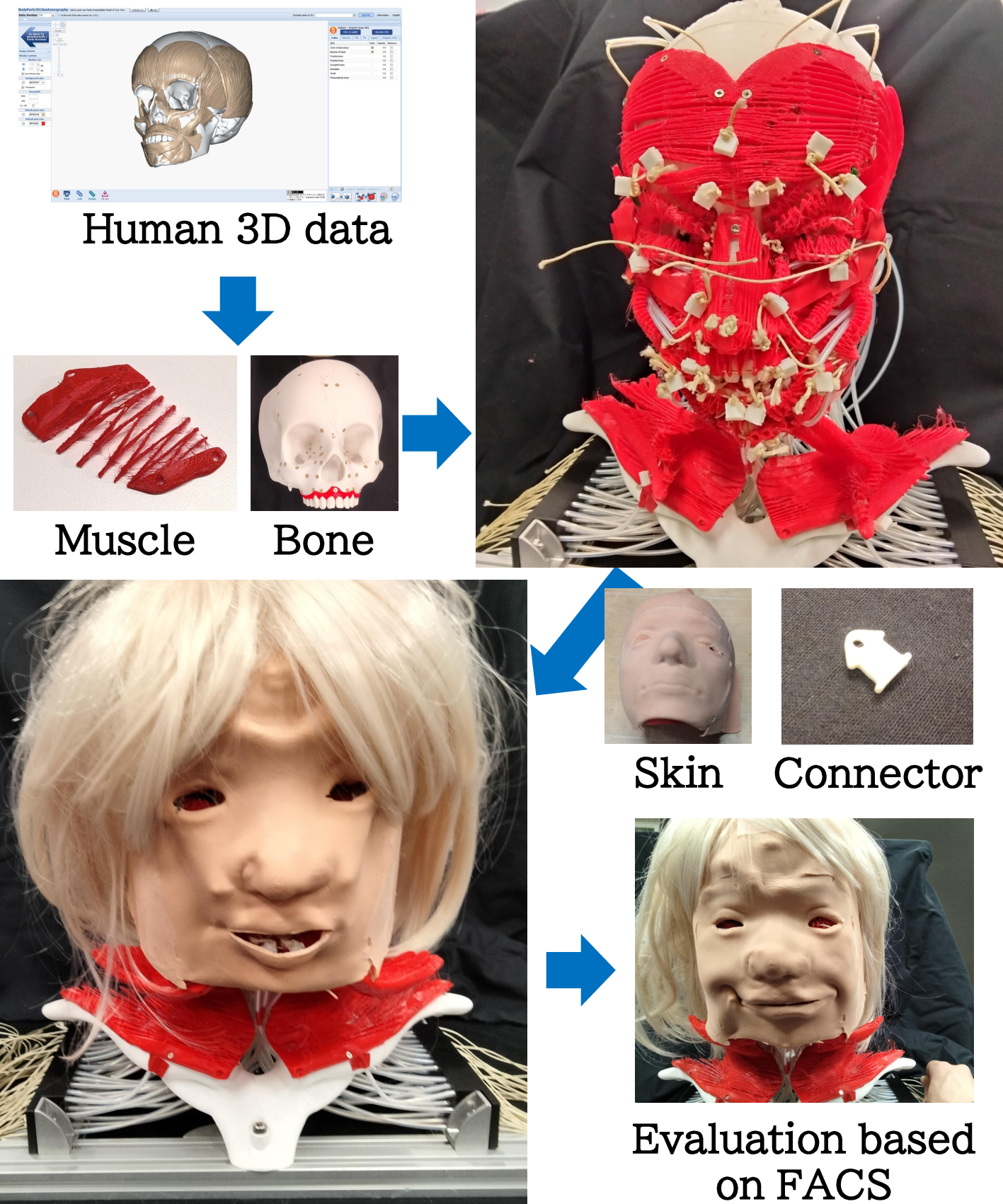
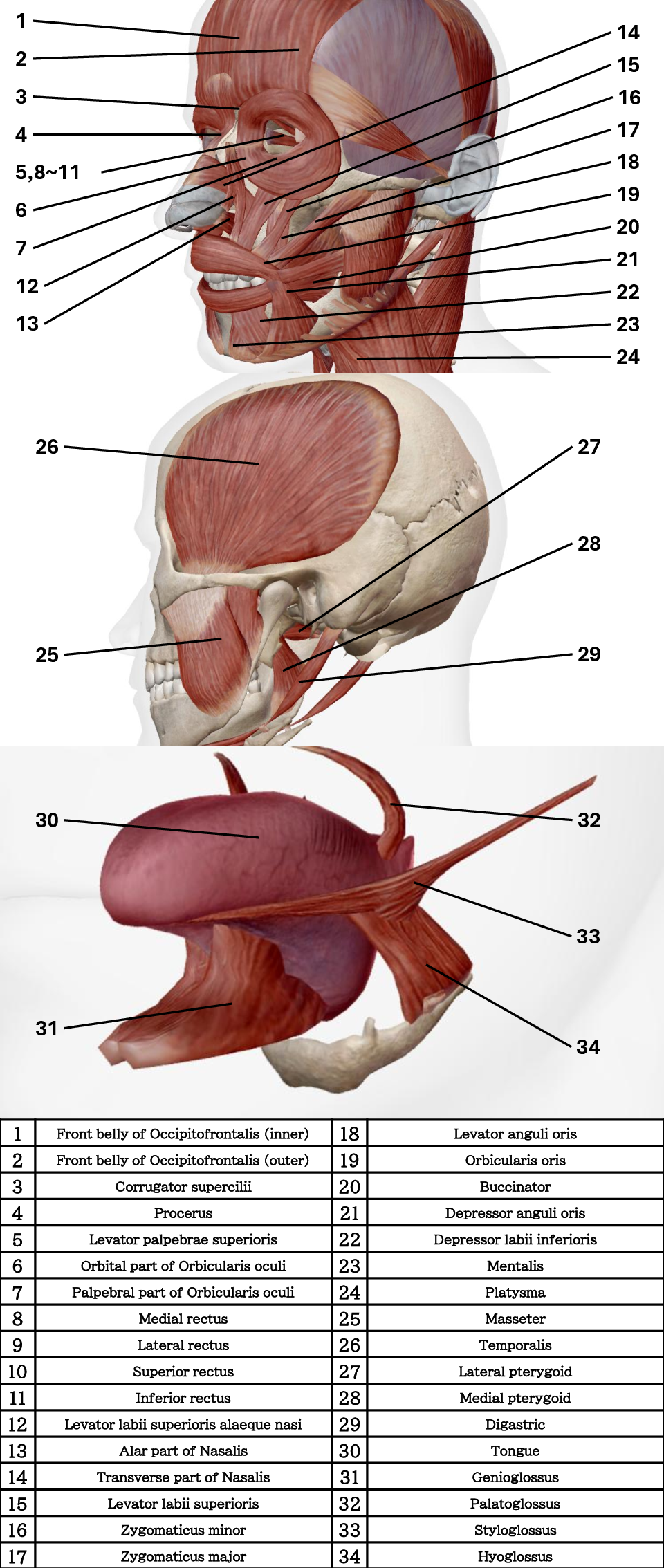
Abstract: Facial robots require many coordinated, smallamplitude motions, but accommodating these motions in a compact face remains difficult. This paper presents an anatomically inspired facial-robot platform that reproduces the layered organization of the human facial musculoskeletal system. The platform comprises bone, muscle, and skin components whose geometry, shape, and attachment locations are derived from three-dimensional anatomical data. Wire-driven, compliant muscle components are routed through PTFE tubes, allowing actuation to be placed away from the face. We describe the selection and fabrication of 65 muscles (34 muscle types) required to reproduce the 47 target action units (AUs) in the Facial Action Coding System (FACS). We then evaluate the reproducibility of individual AUs in two stages: muscle actuation without skin and actuation after the silicone skin is attached. Forty of the 47 target AUs were reproduced with the muscle components, and 30 were reproduced after skin attachment. These results demonstrate the feasibility of reproducing a broad range of FACS facial expressions using an anatomically inspired musculoskeletal structure. The proposed platform provides a foundation for the systematic development and evaluation of future anatomically inspired facial robots
Paper Prompts
Sign up for free to create and run prompts on this paper.
Explain it Like I'm 14
1. What is this paper about?
This paper describes a robot face designed to move more like a real human face.
Many robot faces use motors, gears, and stiff mechanical parts. These can make certain movements accurately, but they take up a lot of space. A human face, however, makes many tiny movements using muscles underneath flexible skin.
The researchers built a robot face that copies this arrangement:
- Bone-like parts provide structure.
- Artificial muscles pull on the face using wires.
- Soft silicone skin covers the muscles.
- The shapes and positions of these parts are based on three-dimensional data from real human anatomy.
The main goal was to see how many human facial movements this robot could reproduce.
2. What questions did the researchers ask?
The researchers wanted to answer questions such as:
- Can a robot face built like a human face make many different facial movements?
- Can its artificial muscles reproduce the movements listed in the Facial Action Coding System, or FACS?
- Which movements work before the robot is covered with skin?
- Which movements still work after the skin is attached?
- Can the robot create natural-looking effects such as wrinkles, raised eyebrows, and a bulging chin?
FACS is a standard system for describing facial movements. For example, it includes movements such as raising the eyebrows, closing the eyes, smiling, wrinkling the nose, or moving the jaw sideways. Each movement is called an Action Unit, or AU.
The researchers focused on 47 Action Units.
3. How did they build and test the robot?
Building the robot
The team created a face with three main layers, similar to a human face.
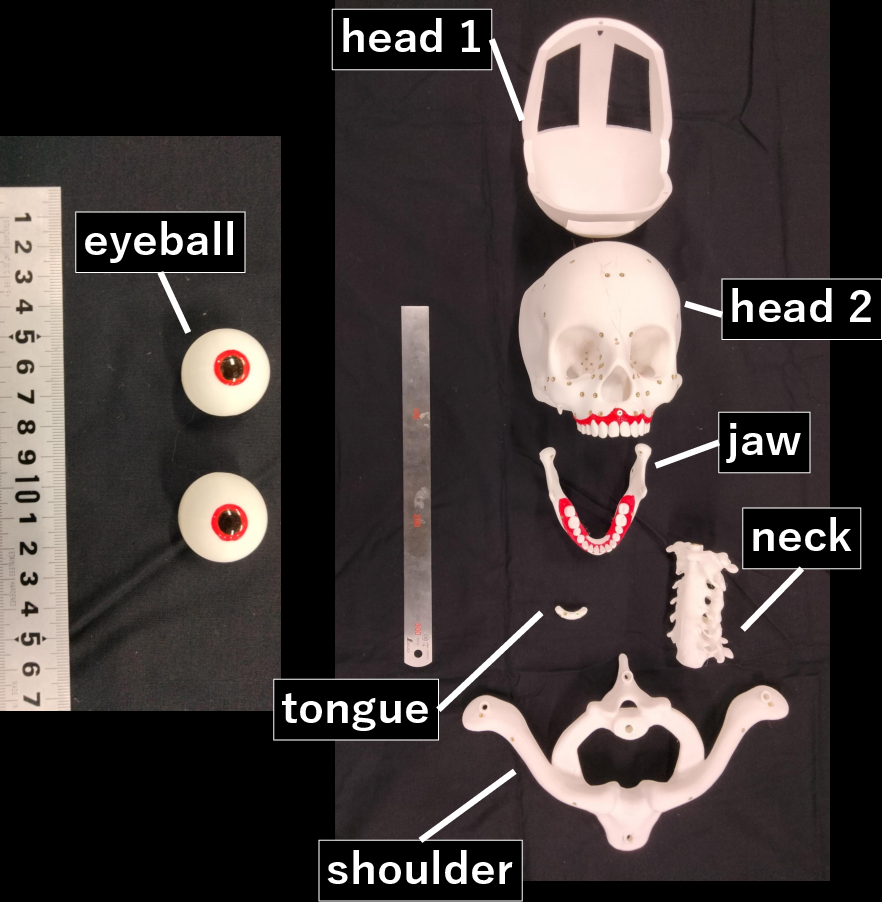
Bone-like structure
The robot included printed parts representing areas such as:
- The skull and jaw
- The neck and shoulders
- The tongue
- The teeth and gums
- The eyeballs
Most of these parts were made using 3D printers. The bone-like parts acted like the robot’s framework.
Artificial muscles
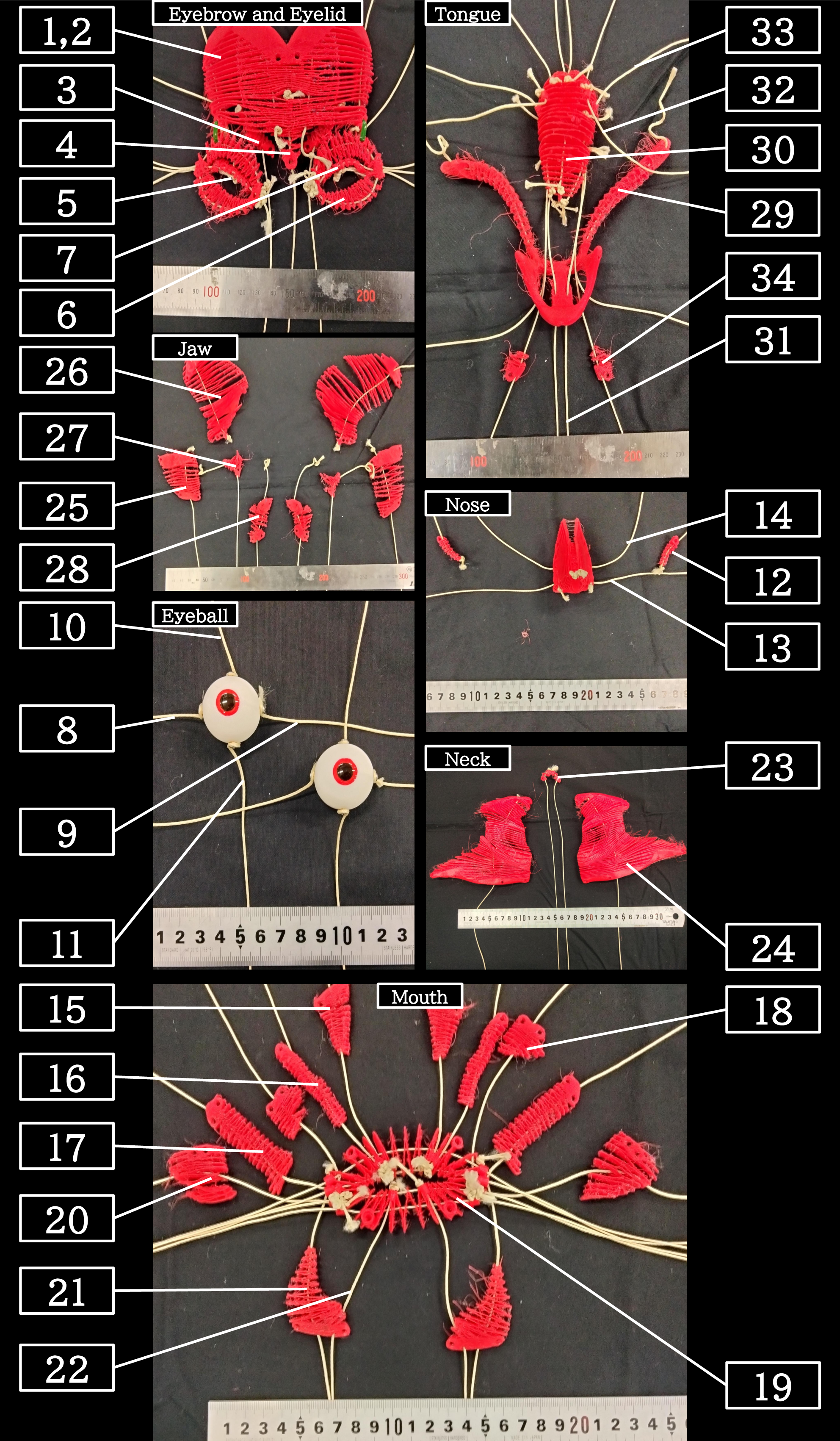
The researchers made 65 individual muscle parts, representing 34 different types of facial muscles.
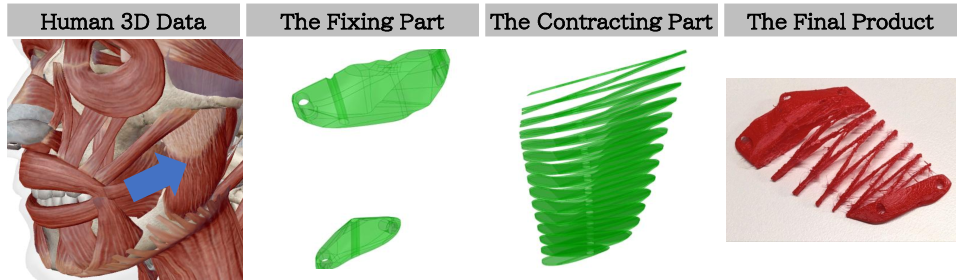
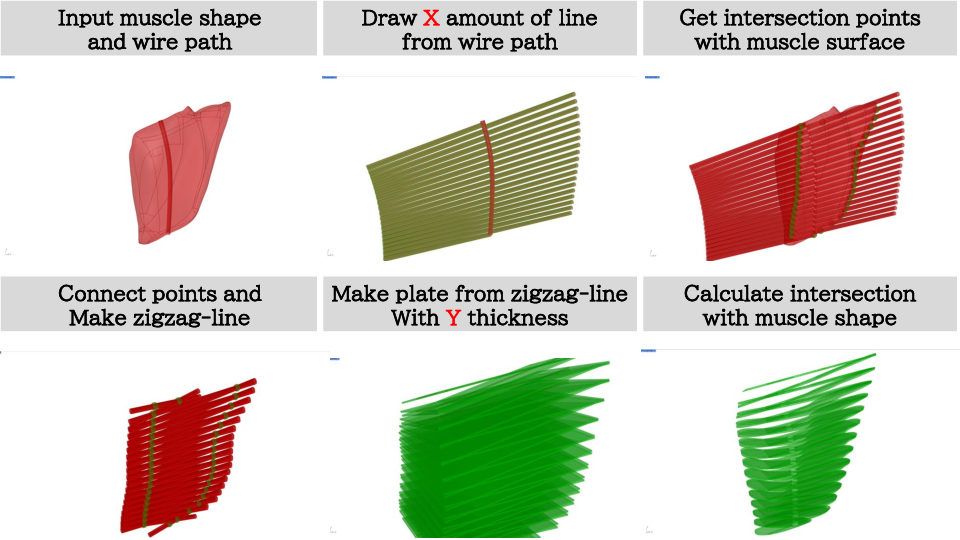
These muscles were made from flexible TPU, a rubber-like 3D-printing material. Each muscle had a zigzag shape. A wire passed through the muscle, and pulling the wire shortened the muscle.
This works somewhat like pulling a string through a flexible spring: the spring contracts when the string is pulled.
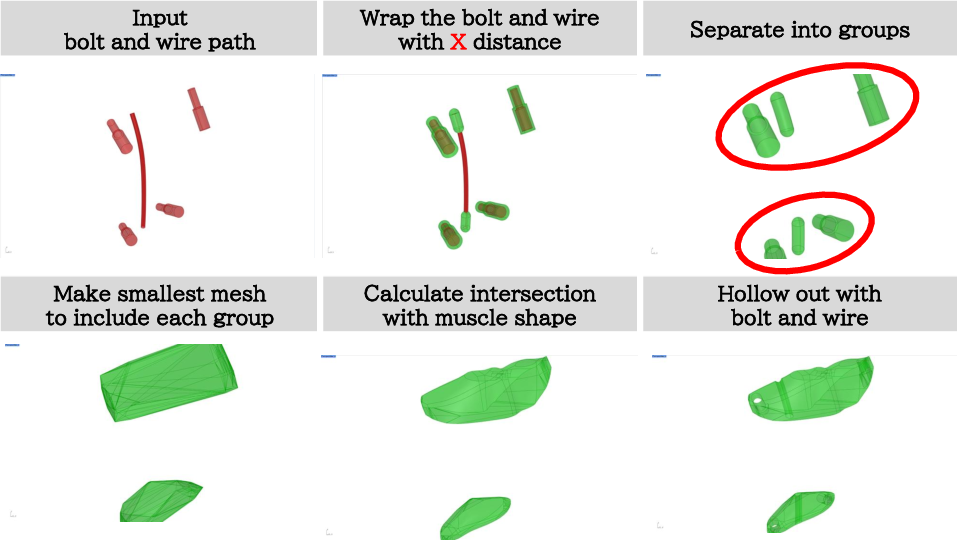
The wires passed through small tubes made of PTFE, a smooth plastic. This allowed the researchers to place the motors or pulling mechanisms away from the face. That is useful because there is not much room inside a human-sized head.
Silicone skin
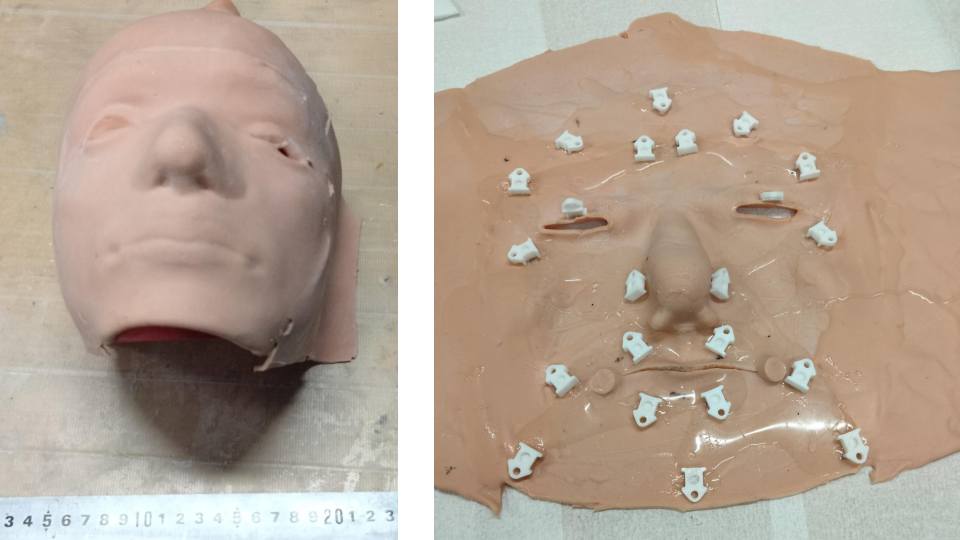
The outer skin was made from soft silicone. It was designed to bend and stretch when the artificial muscles moved underneath it.
Small connectors joined the skin to the muscle wires, allowing the muscles to pull the skin in different directions.
Testing the robot
The researchers tested the robot in two stages:
- Muscle-only test: They moved the wires while the muscles were exposed, without the silicone skin.
- Skin test: They attached the silicone skin and repeated the same movements.
A movement counted as successful if the intended motion could clearly be seen.
This was mainly a qualitative test, meaning the researchers judged whether a movement was visibly present. They did not yet measure every movement with precise cameras or instruments.
4. What did they discover?
The main results are shown below.
| Test condition | Successful Action Units |
|---|---|
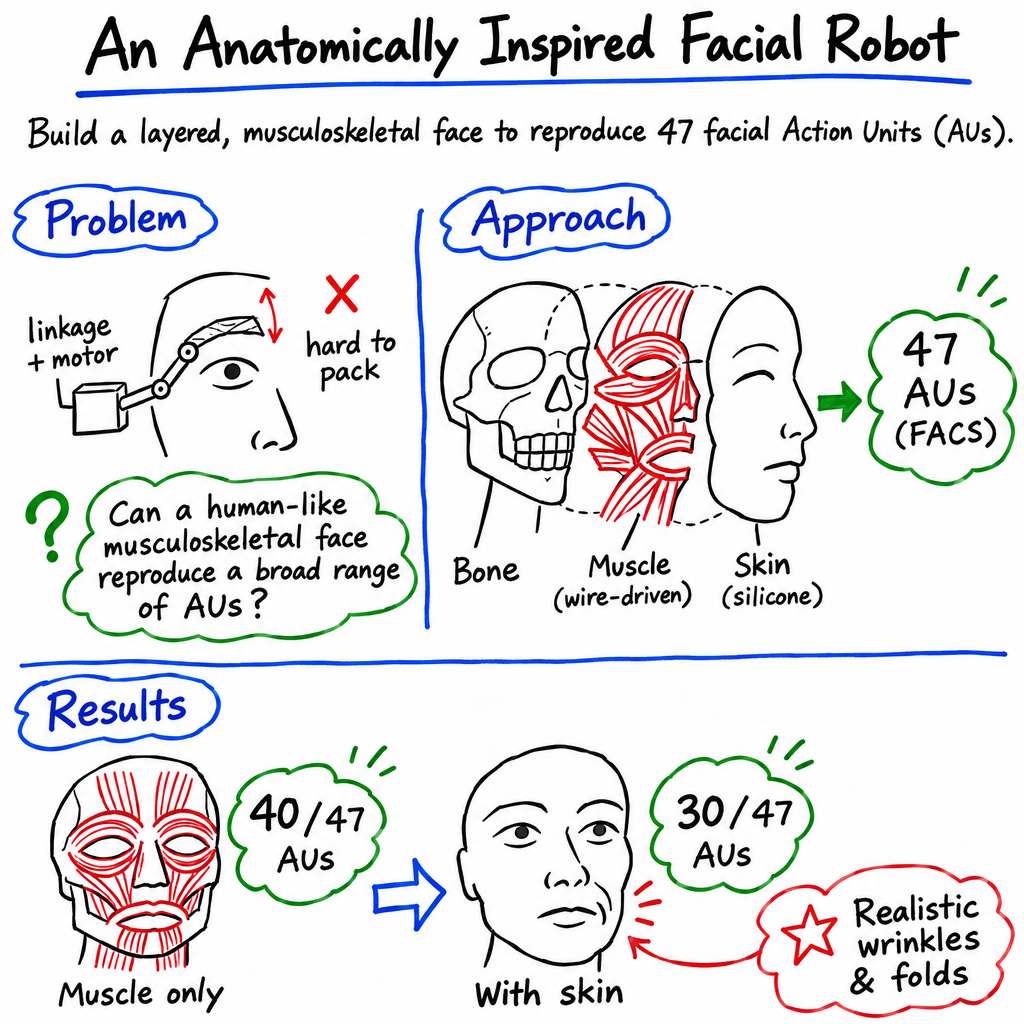
| Artificial muscles without skin | 40 out of 47 |
| Complete robot with silicone skin | 30 out of 47 |
Results without skin
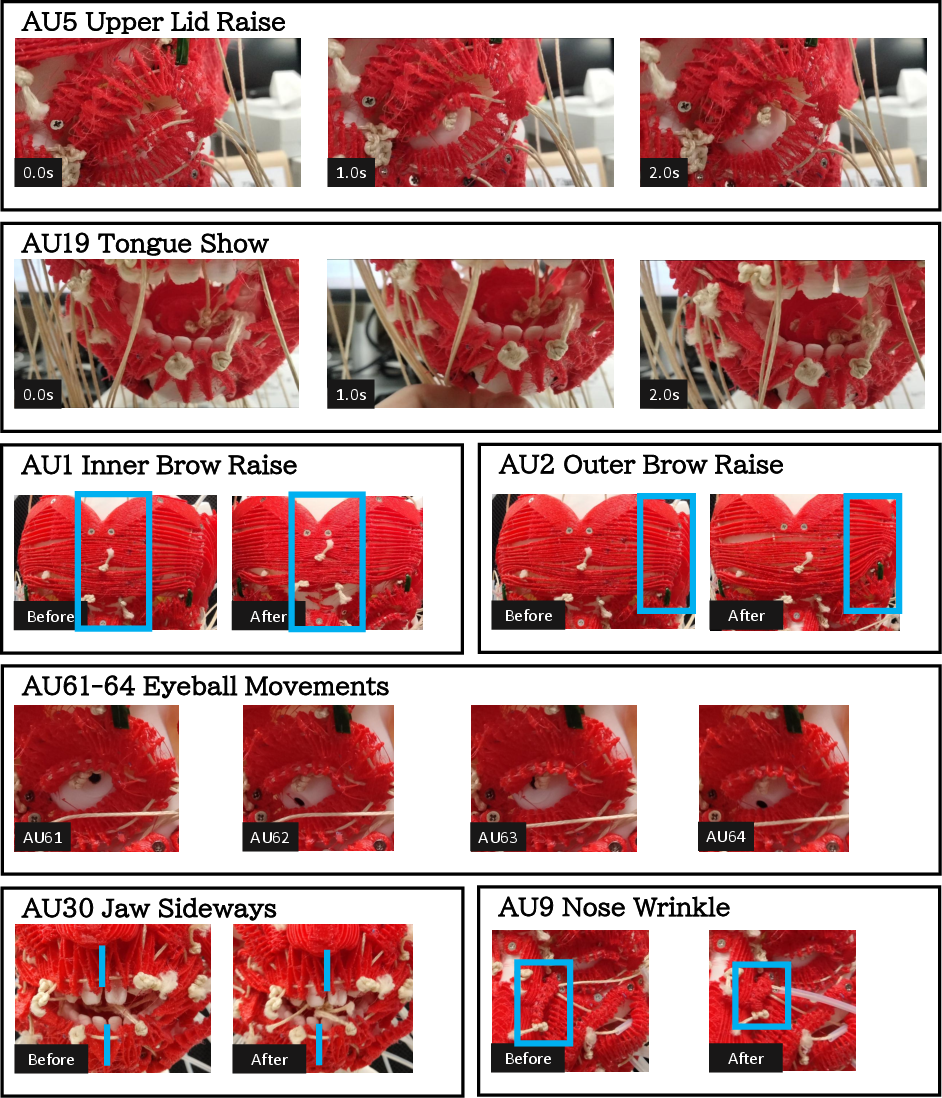
The muscles alone reproduced most of the targeted movements. Examples included:
- Raising the inner or outer eyebrows
- Moving the jaw sideways
- Moving the eyes
- Showing the tongue
- Raising the chin
- Pulling the corners of the mouth
This showed that the robot’s muscle arrangement could produce many different movements in a way similar to human facial muscles.
Results with skin
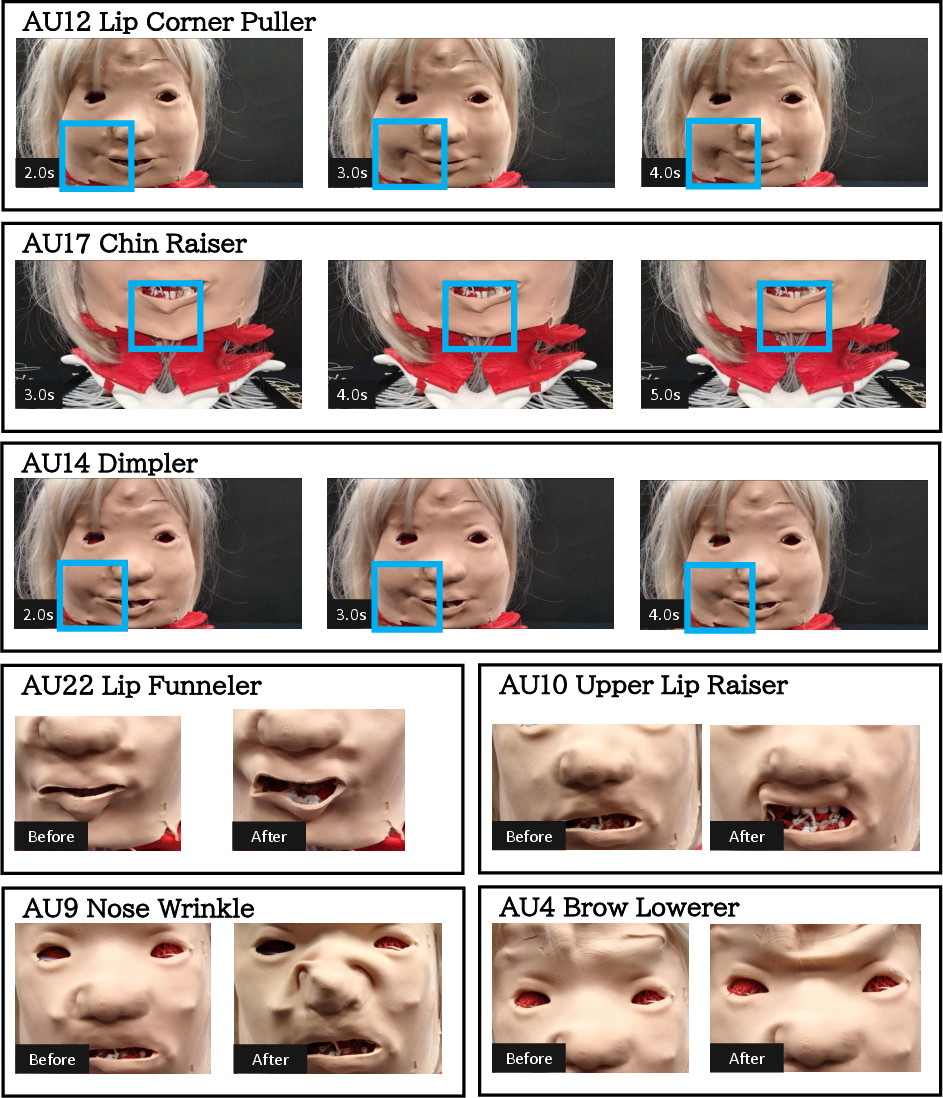
After the silicone skin was added, 30 movements still worked clearly.
The robot produced several realistic-looking facial effects, including:
- A bulging chin when the chin muscle moved
- A fold beside the nose when the upper lip was raised
- Wrinkles around the nose
- Wrinkles near the corners of the mouth when the robot made a smile-like movement
These effects were important because the robot did not simply move its skin using large mechanical pieces. Instead, the skin changed shape because the muscles underneath pulled on it, more like a real human face.
Why did some movements fail?
Some movements were difficult for specific technical reasons:
- The robot could not puff out its cheeks because this would require air pressure inside the mouth.
- Some nose movements were limited because the researchers could not copy the muscle attachment exactly.
- Some lip movements needed the artificial muscles to bend inward more easily.
- The eyelids did not connect strongly enough to the muscles.
- The tongue was too short to extend far enough.
- Some jaw movements were blocked by the tubes carrying the wires.
- Neck movements were not fully included in the robot’s design.
The drop from 40 successful movements to 30 after adding skin shows that the skin can make movement harder. It may add resistance, become attached imperfectly, or interfere with nearby parts.
5. Why is this research important?
This paper shows that copying the basic structure of a human face is a promising way to build expressive robots.
Traditional robot faces often move the skin directly with motors and rigid mechanisms. The approach in this paper is different: it tries to recreate the relationship between bones, muscles, and skin. Because of this, some natural-looking wrinkles and bulges appear automatically.
The robot is not yet a complete copy of a human face. Its movements were tested one at a time, and many wires were moved manually. The researchers also need to measure the movements more precisely and test combinations of expressions, such as smiling while blinking and raising the eyebrows.
Still, the project provides a useful foundation for future work. Improvements could lead to robots that:
- Communicate emotions more naturally
- Interact more comfortably with people
- Help researchers study how human facial expressions work
- Test new artificial muscles and flexible robot skins
- Produce more realistic faces without filling the head with bulky motors and gears
In simple terms, the paper shows that a robot face can become more lifelike by being built less like a machine with hinges and more like a human face with bones, muscles, and flexible skin.
Practical Applications
Immediate Applications
The paper demonstrates a functional, anatomically inspired facial-robot platform: 40 of 47 target FACS Action Units (AUs) were achieved with the muscle system, and 30 remained visibly reproducible after silicone skin was attached. The following applications are therefore feasible now as prototypes, research tools, or controlled demonstrations, although not necessarily as fully commercial products.
- Facial-robot prototyping and benchmarking — Robotics industry and academia
- Use the platform as a reference architecture for developing expressive humanoid heads, social robots, androids, and telepresence systems.
- Engineers can evaluate facial designs using a standardized set of FACS AUs rather than relying only on subjective demonstrations.
- The two-stage protocol—muscles without skin, followed by skin attachment—can be adopted as a diagnostic workflow to distinguish actuator, structural, routing, and skin-coupling failures.
- Dependencies: Current actuation is manual, and the evaluation is qualitative. Repeatable motorized actuation, force sensing, and displacement measurement would be needed for production-grade benchmarking.
- Research testbed for anatomically realistic facial motion — Robotics, biomechanics, and human–robot interaction
- The layered bone–muscle–skin construction can serve as an experimental platform for studying how muscle placement, contraction, and skin compliance affect facial appearance.
- Researchers can systematically modify individual components—such as TPU muscle thickness, zigzag geometry, wire routing, or silicone stiffness—and measure their effects on specific AUs.
- The platform is particularly suitable for investigating naturally emerging facial features such as chin protrusion, nasolabial folds, nasal wrinkles, and mouth-corner wrinkles.
- Dependencies: Quantitative motion capture and deformation measurement are still required to compare robot movements with human facial kinematics.
- FACS-based facial-expression control software — Robotics software and AI
- A control layer can map FACS AU commands to individual wire actuators, enabling commands such as
AU12 = Lip Corner Pulleror coordinated AU combinations for smiles, frowns, surprise, and other expressions. - FACS can provide a shared interface between perception systems, expression planners, and the robot’s low-level actuation controller.
- Potential tools include an AU library, a muscle-to-AU configuration file, a calibration dashboard, and an expression playback system.
- Dependencies: The paper evaluates individual AUs, not coordinated multi-AU expressions. Actuator calibration and compensation for mechanical coupling will be necessary.
- A control layer can map FACS AU commands to individual wire actuators, enabling commands such as
- Training and demonstration platform for anatomy and robotics education — Education and medicine
- The printed bones, artificial muscles, and silicone skin can be used to demonstrate relationships among facial anatomy, muscle activation, and visible expression.
- Medical, physiotherapy, dentistry, anatomy, and robotics courses could use the platform to illustrate facial muscle function more interactively than static models.
- An instructor could activate selected muscles and show how the same underlying mechanism produces surface deformation.
- Dependencies: The robot is an approximation of human anatomy; it should not be treated as a clinically accurate simulator without validation against anatomical and physiological data.
- Development of expressive interfaces for human–robot interaction — Service robotics and social robotics
- The platform can support experiments in robots that communicate affect, attention, acknowledgement, or uncertainty through facial motion.
- Applications include reception robots, museum or educational robots, research platforms for conversational interaction, and telepresence heads.
- Eye movements, eyebrow movements, lip movements, jaw motion, and several wrinkles are already supported, offering more anatomically grounded signals than a simple screen-based face.
- Dependencies: Expression readability must be tested with human participants. The current platform does not establish that observers reliably interpret its expressions as intended.
- Rapid fabrication workflow for customized facial robots — Hardware development and maker engineering
- The Rhino/Python geometry-generation workflow, anatomical 3D data, 3D-printed PLA/TPU components, PTFE wire routing, and cast silicone skin provide a reproducible starting point for customized facial mechanisms.
- Designers can vary parameters such as fixing-part thickness, zigzag-plate count, plate thickness, muscle path, and skin geometry without redesigning the entire system manually.
- This may enable small-batch research prototypes or application-specific robot faces.
- Dependencies: Fabrication quality, TPU durability, silicone mold accuracy, wire friction, assembly tolerances, and maintenance requirements will affect repeatability and service life.
- Evaluation of artificial skin and compliant materials — Materials and soft robotics
- The platform can be used to compare silicone formulations, skin thicknesses, attachment methods, and muscle materials according to their ability to transmit facial motion.
- The drop from 40 reproducible AUs without skin to 30 with skin provides a practical demonstration that skin coupling is a major design variable.
- Dependencies: The reported results are specific to the chosen skin, connectors, tape attachment, and muscle geometry. Material comparisons require controlled experiments and standardized deformation metrics.
- Policy and standards development for expressive robots — Standards bodies and public-sector research
- FACS-based evaluation can inform future reporting standards for facially expressive robots, including minimum AU coverage, expression repeatability, skin deformation quality, and human-perceived recognizability.
- Procurement specifications for educational, social, or public-facing robots could require documented performance on a defined set of facial actions rather than relying on marketing demonstrations.
- Dependencies: FACS describes visible human facial actions but does not by itself establish emotional authenticity, cultural appropriateness, safety, or ethical acceptability.
- Daily-life communication aids and accessible interfaces — Assistive technology
- In a controlled prototype, the robot could provide visual communication cues for users who benefit from embodied, non-screen-based feedback, such as attention signals, confirmations, or simple affective responses.
- It could also serve as a physical demonstration interface for teaching facial expressions or communication skills.
- Dependencies: There is no evidence in the paper concerning accessibility, user benefit, safety, or long-term reliability. User-centered studies and robust control would be required before deployment.
Long-Term Applications
The following opportunities require additional research, scaling, or engineering beyond the current demonstration. They depend especially on motorized actuation, quantitative validation, coordinated expression control, improved skin coupling, and solutions to the unreproduced AUs.
- Commercially deployable android and social-robot faces — Robotics industry
- A refined version could provide compact, highly expressive faces for receptionists, tutors, elder-care robots, entertainment robots, and human–robot interaction research.
- Remote placement of actuators through PTFE tubes could reduce the need to package conventional motors inside the face, potentially increasing the number of independently controlled facial motions.
- Dependencies: The current system lacks automated actuation, long-term durability testing, quiet operation, thermal management, safety mechanisms, and quantitative control. Commercial systems would also need to address maintenance of wires, connectors, silicone skin, and molded parts.
- Real-time facial-expression teleoperation and telepresence — Communications and healthcare
- Human facial motion could be captured using cameras, facial electromyography, or wearable sensors and translated into FACS AUs that drive the robot remotely.
- This could support telepresence in hazardous, distant, or socially sensitive settings, including remote education, clinical consultation, customer service, or interpersonal communication.
- The anatomical actuator structure may make transferred expressions appear more natural than direct rigid-surface deformation.
- Dependencies: The paper does not evaluate latency, synchronization, expression recognition, privacy, or cross-person facial differences. A robust human-motion-to-AU mapping and fail-safe remote control system would be necessary.
- Closed-loop facial control using vision and tactile sensing — AI and robotics
- Cameras could measure skin deformation and compare it with the desired AU configuration, while force or tension sensors could detect wire overload, obstruction, or skin-coupling failure.
- A controller could automatically compensate for changes in silicone properties, wire friction, assembly variation, or actuator aging.
- Possible products include automated calibration tools, digital twins, and model-predictive controllers for soft facial mechanisms.
- Dependencies: The paper provides no quantitative deformation model or sensor integration. Building a reliable closed-loop controller will require calibration data, sensing hardware, and models of nonlinear skin and muscle behavior.
- Full multi-AU expression synthesis — Social interaction and affective computing
- Future systems could combine multiple AUs to generate temporally coherent expressions rather than isolated motions, including speech-related lip movements, gaze shifts, surprise, confusion, happiness, and sadness.
- FACS could serve as an intermediate representation between emotion or dialogue models and physical actuation.
- The robot could be evaluated for timing, intensity, symmetry, naturalness, and perceptual similarity to human expressions.
- Dependencies: Individual-AU reachability does not guarantee successful simultaneous expressions. Mechanical interference, actuator cross-talk, skin deformation, and human interpretation must be studied experimentally.
- More complete physiological facial simulation — Biomechanics and medical research
- Adding pneumatic pressure control could enable cheek puffing and sucking actions that were not possible with the wire-only design.
- Improved nasalis attachments, a longer tongue, better orbicularis-oculi coupling, redesigned jaw routing, and neck skin components could address the unreproduced AUs.
- The resulting system could support research into facial biomechanics, surgical planning concepts, speech-related facial motion, or the mechanical consequences of altered muscle function.
- Dependencies: Medical applications would require validation against human imaging, motion capture, tissue mechanics, and clinical workflows. The current platform should not be used for diagnosis or treatment planning without substantial evidence.
- Speech-capable robotic faces and embodied conversational agents — AI, education, and accessibility
- Integrating the facial mechanism with speech synthesis could produce coordinated mouth, jaw, tongue, eye, and brow movements during conversation.
- A longer and more controllable tongue, improved lip inversion, and pressure-based oral mechanisms could support more realistic articulation and nonverbal communication.
- Such systems could be used in language-learning tutors, pronunciation demonstrators, public information robots, or multimodal conversational agents.
- Dependencies: The current platform does not demonstrate phoneme production, lip-reading relevance, acoustic improvement, or speech synchronization. These would require high-speed actuation and validation with speech and perception datasets.
- Personalized facial robots generated from individual anatomy — Healthcare, entertainment, and digital manufacturing
- Anatomical data and parametric design could be used to create robot faces reflecting particular body proportions, fictional characters, historical reconstructions, or user-specific facial geometry.
- A digital pipeline could transform anatomical scans into bone, muscle, wire-routing, mold, and skin components.
- Dependencies: Personalized designs would require high-quality scans, consistent anatomical segmentation, protection of biometric data, and manufacturing methods capable of producing reliable custom silicone skins.
- Standardized certification and procurement benchmarks for expressive robots — Policy and industry governance
- A future standard could report AU coverage in three categories: muscle reachability, visible skin expression, and human-perceived recognizability.
- Certification could also include repeatability, response time, noise, safety, durability, and expression bias across different observers and cultures.
- This would make expressive capability more comparable across robot platforms and reduce reliance on anecdotal demonstrations.
- Dependencies: A consensus test suite, objective metrics, representative human studies, and clear distinctions between mechanical expressiveness and emotional or social competence are still needed.
- Human-like embodied interfaces in everyday environments — Daily life
- Mature versions could provide subtle visual feedback in homes, classrooms, vehicles, or public spaces—for example, gaze direction, acknowledgement, attention, confusion, or turn-taking cues.
- Unlike a flat display, an anatomically inspired face could communicate through changing gaze, wrinkles, skin deformation, and coordinated facial movement.
- Dependencies: Everyday deployment would require low cost, low noise, safe contact behavior, resistance to environmental conditions, accessible maintenance, and careful study of anthropomorphism, user trust, and possible discomfort or deception.
Glossary
- Action Unit (AU): A standardized unit representing a specific observable facial movement in FACS. “FACS describes facial movements as combinations of Action Units (AUs)”
- Anatomical attachment: The physical location where a muscle connects to a bone or other structure. “whose geometry, shape, and attachment locations are derived from three-dimensional anatomical data”
- Anatomical data: Digitized information describing the structures and geometry of the human body. “The platform comprises of anatomically derived bone, muscle, and skin components whose geometries and attachment locations are based on BodyParts3D anatomical data”
- Anatomical scope: The set of biological structures included in a model or study. “To define both the anatomical scope of the proposed platform and its evaluation target”
- Anatomically inspired: Designed using the organization or mechanisms of biological anatomy as a model. “This paper presents an anatomically inspired facial-robot platform”
- Anisotropic: Having different mechanical or physical properties in different directions. “Patterned structure muscle : Arbitrary shaped wire-driven artificial muscle utilizing anisotropic flexible structure for musculoskeletal robots.”
- BodyParts3D: A database containing three-dimensional anatomical structures and their associated concepts. “whose geometries and attachment locations are based on BodyParts3D anatomical data”
- Compliant: Capable of deforming elastically or flexibly under applied forces. “Wire-driven, compliant muscle components are routed through PTFE tubes”
- Contraction: The shortening or deformation of a muscle-like component when actuated. “The contracting part is made of a thin, zigzag-shaped plate with a wire hole.”
- Coupling: Mechanical or physical interaction that transfers motion or force between components. “The two-stage design separates failures in muscle actuation from failures introduced by skin coupling or interactions in the assembled face.”
- Craniofacial: Relating to the skull and face. “These examples demonstrate that the proposed platform reproduces not only superficial facial deformations”
- Demolding: Removing a molded part from the mold in which it was fabricated. “Because the molds have concave and convex features, each skin piece must be produced in several sections corresponding to allowable demolding directions”
- Extraocular muscles: Muscles located around the eye that control eyeball movement. “Eye movements (AU61--64) were reproduced by actuating the extraocular muscles surrounding the eyeballs”
- Facial Action Coding System (FACS): A standardized system for describing visible facial movements using Action Units. “FACS is used both to determine the muscles required for facial expression reproduction and to assess the reproducibility of individual Action Units (AUs).”
- Facial expression: A visible configuration or movement of facial features that communicates an affective or social state. “Facial expressions play a central role in communication between humans and humanoid robots.”
- Gingiva: The anatomical term for gum tissue surrounding the teeth. “Although the maxillary and mandibular gingiva are soft tissues, we include them here for convenience.”
- Intraoral pressure: Air pressure within the mouth. “AU33--35 require changes in intraoral pressure for cheek puffing and sucking”
- Mandible: The lower jawbone. “AU30 (Jaw Sideways) was achieved through coordinated actuation of the masticatory muscles, enabling lateral movement of the mandible.”
- Masticatory muscles: Muscles involved in chewing and movement of the jaw. “AU30 (Jaw Sideways) was achieved through coordinated actuation of the masticatory muscles”
- Maxilla: The upper jawbone, which forms part of the facial skeleton. “Head & Maxillary teeth, maxillary gingiva, nasal bone, maxillae, zygomatic bone”
- Medial: Situated closer to the middle or central plane of a structure. “AU1 (Inner Brow Raiser) and AU2 (Outer Brow Raiser) were reproduced by independently actuating the medial and lateral portions of the frontalis muscle”
- Mentalis muscle: A facial muscle that elevates and protrudes the lower lip and contributes to chin movement. “AU19 (Tongue Show) was reproduced by protruding the tongue through coordinated actuation of the tongue muscles together with the mentalis muscle.”
- Musculoskeletal system: An integrated system of bones, muscles, and connective structures that produces movement. “The platform comprises bone, muscle, and skin components whose geometry, shape, and attachment locations are derived from three-dimensional anatomical data.”
- Nasolabial fold: A facial crease extending from the side of the nose toward the corner of the mouth. “AU10 (Upper Lip Raiser) generated a distinct nasolabial fold”
- Nasalis muscle: A muscle of the nose that contributes to nostril movement and nasal expression. “AU38--39 depend on the nasalis muscle”
- Orbicularis oculi: A circular muscle surrounding the eye that controls eyelid closure. “AU43 and AU45--46 were affected by insufficient coupling between the orbicularis oculi component and the silicone skin”
- Orbicularis oris: A circular muscle surrounding the mouth that controls movements of the lips. “the current zigzag TPU orbicularis oris component provides insufficient compliance in that direction.”
- Pneumatic pressure: Pressure generated or controlled by compressed air or another gas. “cheek puffing requires pneumatic pressure that is not provided by the current wire-driven system.”
- PTFE (polytetrafluoroethylene): A low-friction fluoropolymer commonly used for tubing and mechanical guides. “Wire-driven, compliant muscle components are routed through PTFE tubes”
- Reachability: The ability of a mechanical system to achieve a specified position or motion. “Summary of the two-stage reachability evaluation for the 47 target AUs.”
- Silicone elastomer: A flexible polymer material that can undergo substantial deformation and is often used for artificial skin. “Accordingly, we cast the skin components from silicone”
- Surface morphology: The shape and structural characteristics of an outer surface. “reconstructing the underlying musculoskeletal structure also reproduced the associated surface morphology.”
- TPU (thermoplastic polyurethane): A flexible, abrasion-resistant polymer that can be shaped by heating and used in additive manufacturing. “Flexible sections such as the gingiva are printed in TPU.”
- Wire-driven actuation: A mechanism in which tensioned wires transmit force to move or deform a component. “Facial muscles are implemented as compliant wire-driven components actuated through PTFE tubes”
- Zigzag polyline: A connected sequence of straight line segments arranged in a repeated angular pattern. “Intersection points of these lines with the muscle surface are computed and connected to form a zigzag polyline.”
- Zygomatic bone: A facial bone that forms the cheek and part of the eye socket. “Head & Maxillary teeth, maxillary gingiva, nasal bone, maxillae, zygomatic bone”