- The paper presents a finite element framework integrating anatomical realism and viscoelastic material models to simulate contact-induced wrinkle patterns.
- It employs high-order prismatic solid-shell elements and a continuum-based ligament formulation to capture through-thickness stress gradients and dynamic wrinkling.
- Numerical results reveal that variations in ligament stiffness and epidermal-to-substrate ratios significantly affect wrinkle frequency and amplitude, aligning with real-world observations.
Overview and Contributions
The paper "Physics-Based Simulation of Contact-Induced Facial Wrinkling" (2607.04768) addresses the simulation of fine-scale wrinkling patterns in facial skin due to contact phenomena, presenting a comprehensive finite element framework that integrates anatomical realism, high-order geometric discretization, and viscoelastic material modeling. The approach models skin as a layered, nonlinear viscoelastic material with spatially varied attachment (ligament) constraints, capturing dynamic mechanical instabilities induced by compression and shear during contact events (e.g., a fingertip brushing or pressing against the face). The system utilizes high-order prismatic solid-shell elements and introduces an anatomically inspired continuum-based ligament formulation, allowing simulation of region-specific and temporally coherent wrinkle patterns.
Anatomical Modeling and Discretization
Human facial skin is characterized by structural and mechanical anisotropy, multi-layered architecture (epidermis, dermis, hypodermis), and spatially heterogeneous attachment to the underlying bone via fibrous ligaments. The paper simplifies the anatomy by aggregating the dermis and hypodermis and focusing on two layers: the stiff epidermis and a softer substrate, augmented with ligament constraints.
The finite element discretization leverages high-order prismatic solid-shell elements constructed by extruding quartic triangular bases with quadratic through-thickness interpolation, yielding 45 nodes per element and enabling accurate resolution of high-frequency deformation modes. This volumetric formulation is critical for capturing through-thickness stress gradients necessary for wrinkling mechanics.
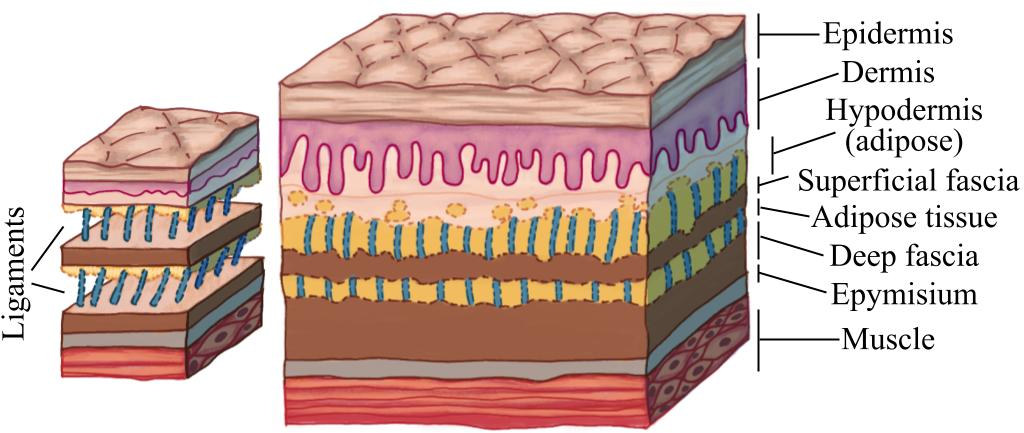
Figure 1: Skin structure and anatomical relationships, showing layered architecture and ligamentous attachments traversing the adipose tissue.
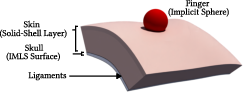
Figure 2: Computational model: a single layer of solid-shell elements discretizes the skin; implicit surfaces represent contact (finger) and skull, with zero-length spring layers modeling ligament attachments.
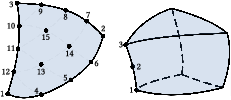
Figure 3: Solid-shell element configuration, comprising a 15-node triangular base and quadratic interpolation through the thickness for a total of 45 nodes.
The viscoelastic response of skin is realized with a Generalized Maxwell model, comprising a steady elastic spring (Fung-type energy), a dissipative spring-and-damper network (Saint Venant–Kirchhoff energy), and a volumetric penalty term enforcing near-incompressibility. The steady elastic term captures nonlinear strain stiffening, while the dissipative component governs time-dependent relaxation and internal friction, reproducing the rate-dependent temporal persistence and damping of wrinkles seen in biological tissues.
Contact interactions are formulated via penalty energies against C2-continuous implicit geometries (sphere for finger, Implicit Moving Least Squares surface for the skull), ensuring regular tangential force distribution and stable contact mechanics. Frictional forces are implemented with a dissipative potential that smoothly transitions between sticking and slipping, based on the lagged normal force and relative tangential velocity, guaranteeing C2-continuity in the solver.
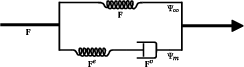
Figure 4: Spring-and-damper schematic for the viscoelastic tissue model — a steady spring sets long-term stiffness, while the paired spring/damper models resistance that fades over time.
The anatomical attachment of facial skin is governed by spatially varying ligament stiffness, modeled as zero-length Fung-type springs. Each ligament’s stiffness is parameterized by an empirically derived heat map, constructed via variational diffusion (Vector Heat Method) over the mesh, enabling precise spatial control of skin mobility and pinning points. High ligamental stiffness restricts tissue displacement, while lower values permit sliding over the underlying bone.
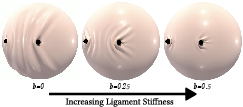
Figure 5: Impact of ligament stiffness parameter b on wrinkle morphology: increasing stiffness restricts mobility, transitioning from long-wavelength to high-frequency, localized wrinkle patterns.
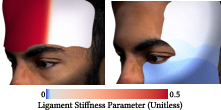
Figure 6: Spatial heat maps of ligament stiffness parameter b, showing higher values (red) for dense anchoring and lower values (blue) where skin is mobile on forehead and temple/cheek regions.
Numerical Results and Analysis
The framework is benchmarked through synthetic simulations and comparisons with real-world video footage. Parameter sweeps demonstrate:
- Ligament stiffness directly regulates wrinkle amplitude and frequency; high stiffness localizes and diminishes wrinkles.
- The epidermal-to-substrate stiffness ratio amplifies wrinkle frequency: increasing ratio produces finer, more numerous wrinkles (consistent with mechanical instability theory).
- Viscoelasticity is essential for temporal coherence, preventing instantaneous redistribution of stresses; wrinkles persist as contact moves, mimicking real tissue memory effects.
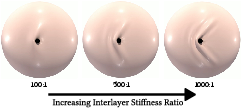
Figure 7: Sensitivity to interlayer stiffness ratio — increasing ratio generates finer, high-frequency wrinkling patterns.
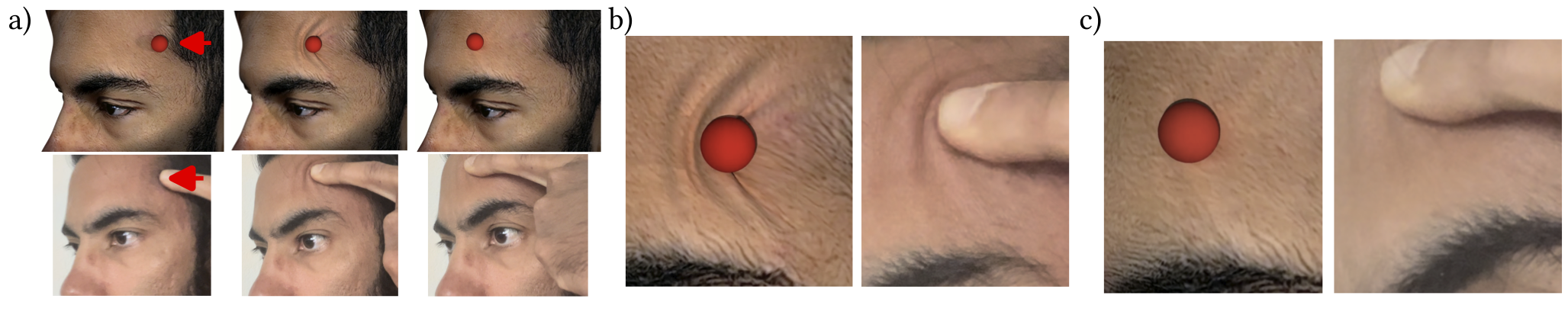
Figure 8: Comparison of simulated forehead wrinkling to video reference: localized buckling and wrinkle accumulation are faithfully reproduced, with spatial transitions dictated by ligament density.
The use of high-order solid-shell elements (quartic in-plane, quadratic through-thickness) is validated by convergence experiments replicating established buckling setups. Linear and low-order elements fail to resolve the requisite wrinkle frequency within reasonable simulation times. Cubic and quartic elements converge rapidly to the expected high-frequency wrinkling, with quartic formulations achieving efficient and accurate results within the same computational budget.
The quasi-Newton L-BFGS solver is shown to outperform classical Newton’s method, offering consistent convergence rates and avoiding repeated expensive Hessian factorizations — particularly crucial for high-order element configurations with dense system matrices.
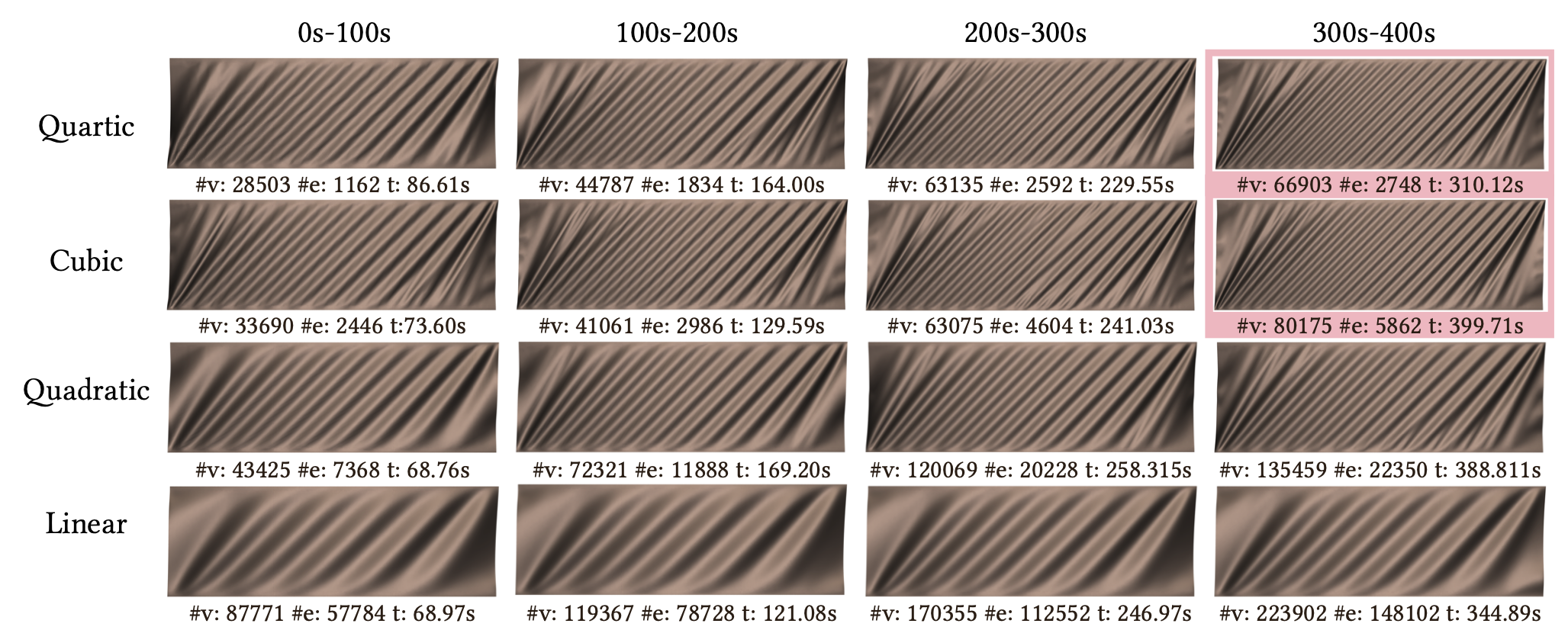
Figure 9: Temporal evolution of wrinkling across interpolation orders; cubic and quartic elements yield stable, high-frequency morphologies faster than linear/quadratic.
Practical and Theoretical Implications
This framework advances the state of physics-based facial simulation by accurately reproducing contact-induced wrinkling in anatomically plausible regions, supporting realistic visual and biomechanical rendering for digital humans. The model’s fidelity addresses key limitations in prior shell-based or mass-spring approaches, particularly with regard to through-thickness stress transmission and anatomically inspired attachment constraints.
Practically, these results have implications for high-fidelity digital human avatars, surgical simulation, forensic modeling, and personalized face synthesis for VR/AR. Theoretical implications extend to multiscale modeling of soft tissues with nonlinear, anisotropic, and history-dependent behavior, and provide a computational substrate for further exploration of inverse modeling and parameter estimation from video or imaging data.
Limitations and Future Directions
The computational expense of high-frequency wrinkling restricts simulations to localized regions rather than full-face or full-head cases. The anatomical approximation via a single solid-shell layer precludes full modeling of inter-layer sliding and gradient mechanics. Ligament and material parameter fields are empirically determined, lacking personalized anatomical data.
Future work may pursue multilayered shell formulations, integration of non-invasive imaging for individualized anchor mapping, and leveraging synthetic data for digital twin training with advanced AI techniques.
Conclusion
The paper introduces a robust, anatomically faithful, and computationally efficient framework for simulating contact-induced facial wrinkling, combining high-order solid-shell elements, nonlinear viscoelastic material modeling, and spatially varying ligament constraints. The framework achieves qualitative match with real-world skin dynamics, demonstrating modulation of wrinkle morphologies via key mechanical parameters and algorithmic choices. The approach paves the way for next-generation digital human models and opens avenues for personalized simulation, advanced AI-driven parameter estimation, and new biomechanical research.

