SpecR: Recovering Emergent Properties in Supervised Vision Transformers
Abstract: Vision Transformers (ViTs) have achieved strong performance across computer vision tasks, but the quality of their learned representations differs drastically depending on the training paradigm. While self-supervised ViTs often demonstrate emergent properties, such as object-aligned patch representations and attention maps, supervised ViTs typically lack these properties, even when trained with strong data augmentations. Understanding the origin of this difference is important for explaining and controlling the object-level structure. To investigate it, we perform a spectral analysis of supervised and self-supervised models, and identify a key distinction: MLP layers in supervised ViTs introduce high-frequency variations into patch representations, disrupting their spatial organization. Motivated by this finding, we propose SpecR, a lightweight spectral regularization method that fine-tunes the MLP layers of pretrained supervised ViTs. SpecR recovers object-aligned patch representations and attention maps, while improving adversarial robustness and preserving competitive classification accuracy.
Paper Prompts
Sign up for free to create and run prompts on this paper.
Explain it Like I'm 14
1. What is this paper about?
This paper studies how Vision Transformers (ViTs) understand images.
A Vision Transformer breaks an image into many small square pieces, called patches. For example, a picture of a dog might be divided into dozens of small squares. The model then tries to combine information from these patches to recognize the dog.
Some Vision Transformers learn to organize patches in a useful way: patches belonging to the dog are grouped together, while background patches are treated differently. This is called object alignment.
The paper compares two kinds of models:
- Supervised models, trained with image labels such as “dog” or “car.”
- Self-supervised models, trained without ordinary labels, such as DINO.
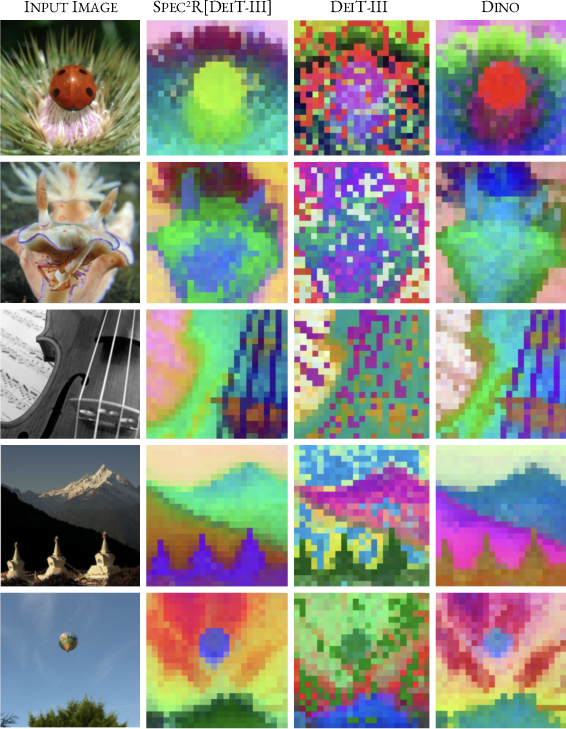
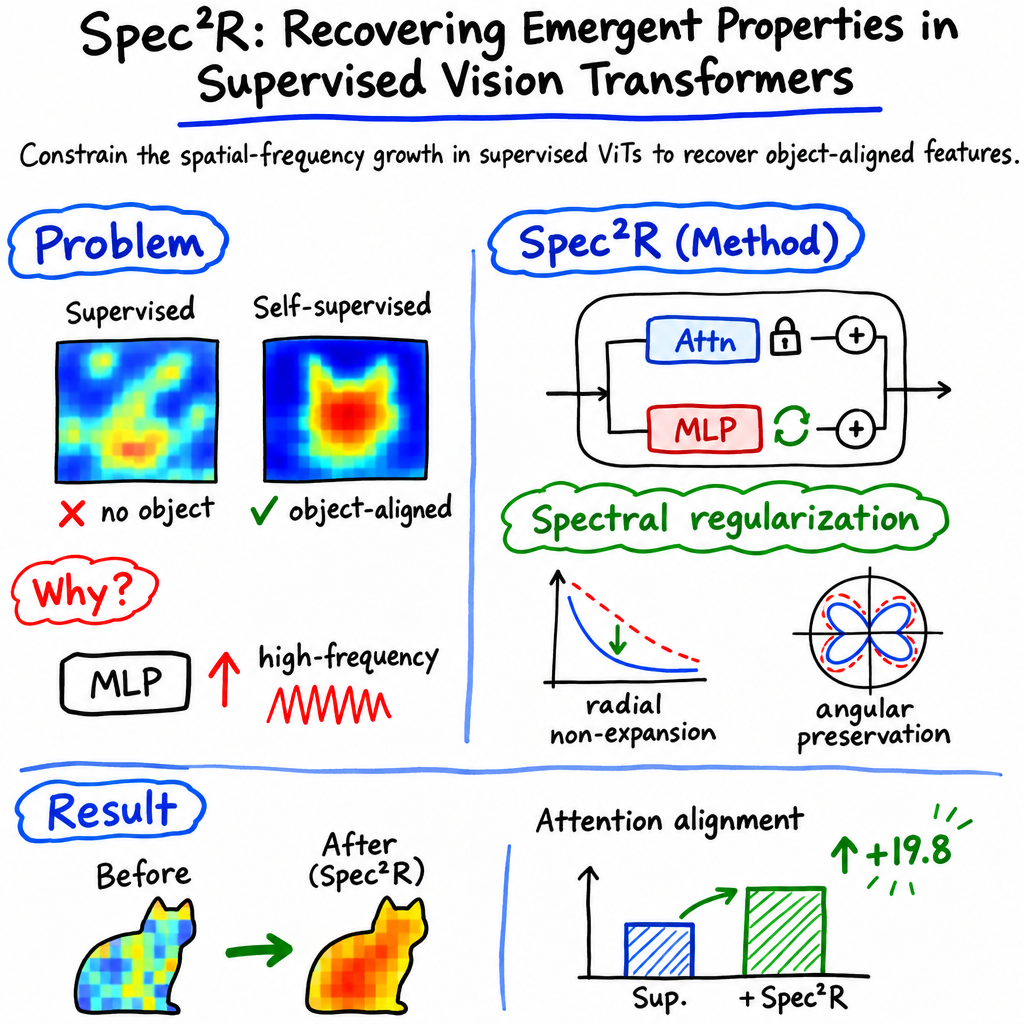
The authors found that supervised models often recognize the correct overall object but have “messier” internal representations. They then introduce a method called Spec²R to make these representations cleaner and more object-focused.
2. What questions did the researchers ask?
The paper focuses on three main questions:
- Why do self-supervised Vision Transformers often learn clearer object shapes than supervised ones?
- Which part of a Vision Transformer causes the supervised model’s internal representations to become noisy?
- Can a supervised model be improved without retraining the whole model from the beginning?
The researchers were especially interested in whether a model could learn better patch representations while still keeping its strong ability to classify whole images.
3. How did the researchers investigate this?
Comparing image patterns
The researchers examined how information changed as it moved through the different layers of the models.
They used a mathematical tool called Fourier analysis. Although this sounds complicated, the basic idea is similar to analyzing music:
- A musical sound can contain low notes and high notes.
- An image can contain large, smooth patterns and small, sharp changes.
In images:
- Low spatial frequencies represent large, smooth areas, such as the broad shape of an animal.
- High spatial frequencies represent tiny, quick changes, such as speckles, edges, or noisy patterns.
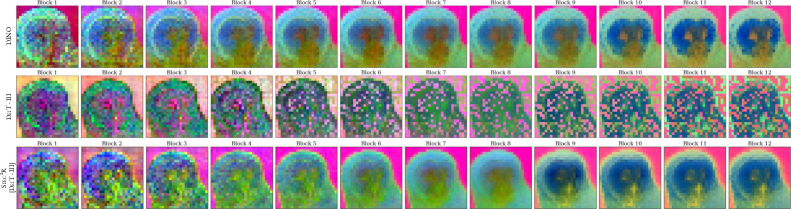
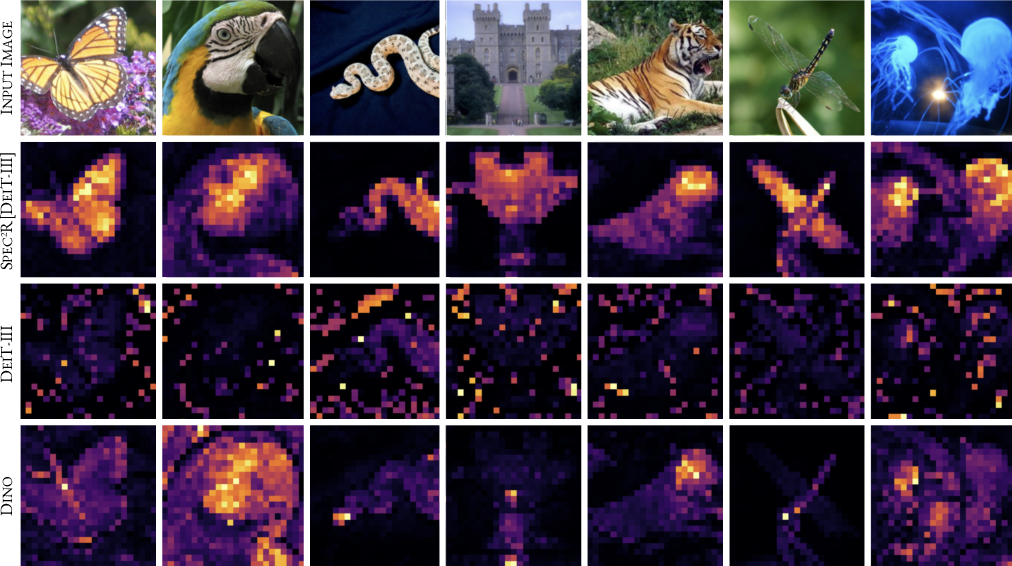
The researchers discovered that supervised models gradually added too many high-frequency patterns. These patterns made the patch information look noisy and less connected to the actual objects.
Studying different parts of the model
A Vision Transformer mainly contains two important parts:
- An attention layer, which lets image patches communicate with one another.
- An MLP layer, which processes the information inside each patch.
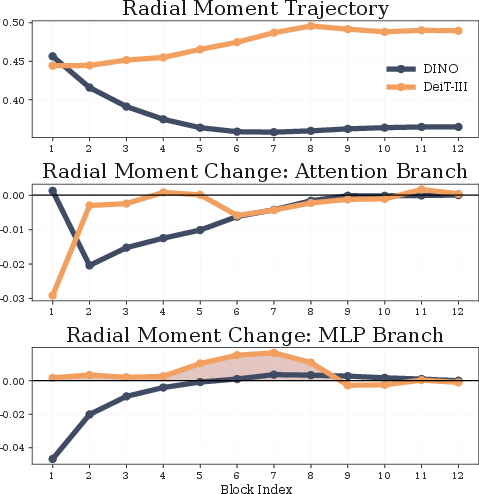
The researchers measured how much each part changed the image information. They found that the MLP layers in supervised models were mainly responsible for adding the unwanted high-frequency details.
Creating Spec²R
The authors designed Spec²R, a small fine-tuning method. Fine-tuning means making a few careful changes to an already trained model instead of training a completely new one.
Spec²R does three things:
- It discourages the model from adding more high-frequency noise as information passes through the layers.
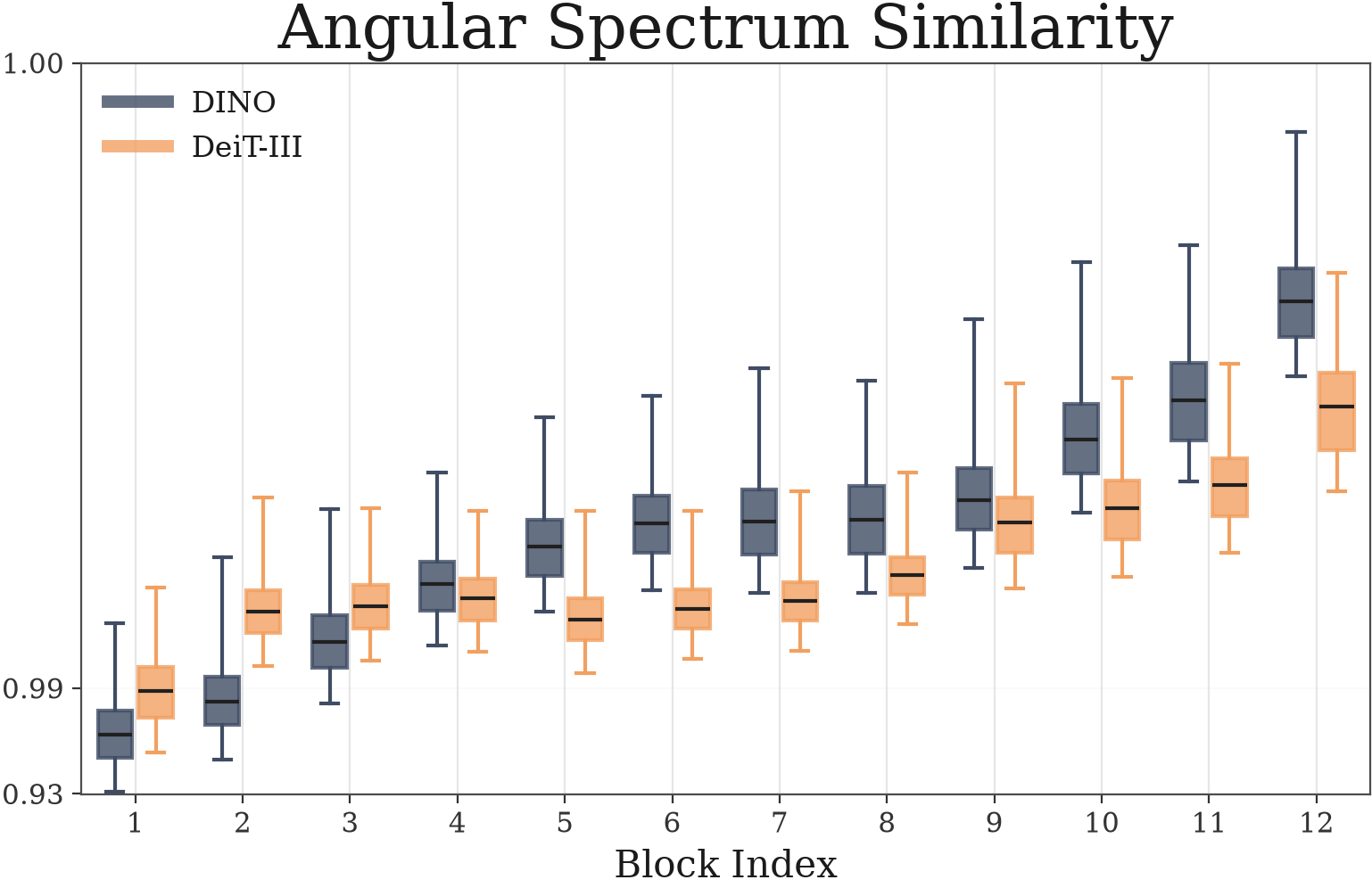
- It encourages the model to keep the overall direction and structure of its image patterns stable.
- It tries to preserve the model’s original classification behavior.
Importantly, the researchers changed only:
- The MLP layers.
- The final classification layer.
They left the attention layers frozen, meaning those layers were not changed.
Testing the models
The researchers tested three supervised Vision Transformers:
- DeiT-III
- DeiT-Distilled
- FlexiViT
They compared them with the self-supervised DINO model.
They tested several abilities, including:
- Whether the model’s attention focused on the correct object.
- Whether patches representing similar object parts matched across different images.
- Whether objects could be followed in videos.
- Whether the model could separate objects from backgrounds.
- Whether the model remained accurate at image classification.
- Whether it became more resistant to small attacks designed to fool it.
4. What did the researchers find?
Supervised models developed noisy patterns
The first major finding was that supervised Vision Transformers and DINO behaved differently inside their layers.
DINO gradually created smoother, more organized representations. Its patches tended to follow object boundaries.
The supervised models, however, increasingly added high-frequency variations. These acted like visual noise and disrupted the object structure.
The researchers traced much of this problem to the MLP layers.
Spec²R improved object-focused attention
After applying Spec²R, the supervised models’ attention maps became much better aligned with the actual objects in an image.
For example, instead of looking at many unrelated parts of the background, the model was more likely to focus on the animal, vehicle, or other main object.
For DeiT-III, the final-layer attention score improved by about:
- 19.75 percentage points on one ImageNet attention test.
- 23.12 percentage points on a PASCAL VOC object-segmentation test.
In some cases, the improved supervised models performed better than DINO on these attention tests.
Patch representations became more useful
Spec²R also helped the patch representations perform better in several tasks.
The improvements included:
- Better matching of similar object parts in different images.
- Better tracking of objects across video frames.
- Better discovery of objects without being explicitly told where they were.
The largest improvements were often seen in object discovery. For example, the DeiT-III model improved by approximately:
- 14.45 points on one PASCAL VOC test.
- 17.81 points on another PASCAL VOC test.
- 13.65 points on a COCO test.
FlexiViT also made very large gains in object discovery.
Classification accuracy was mostly preserved
A possible problem was that making the internal representations cleaner might damage the model’s original classification skill.
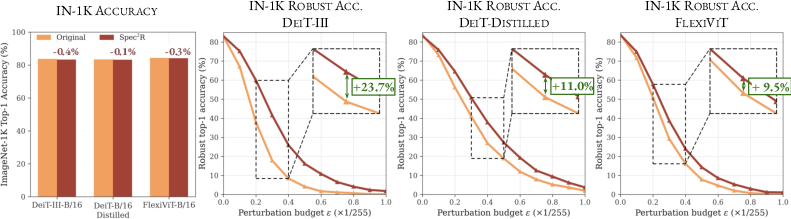
However, classification accuracy decreased by only about:
- 0.4 percentage points for DeiT-III.
- 0.1 percentage points for DeiT-Distilled.
- 0.3 percentage points for FlexiViT.
This means the models became better at understanding object structure without losing much ability to answer, “What is in this image?”
The models became more resistant to attacks
The researchers also tested adversarial robustness. An adversarial attack makes tiny changes to an image that humans may not notice but that can trick an AI model.
Spec²R made the models more resistant to these attacks. The largest improvements were:
- Up to 23.7 percentage points for DeiT-III.
- Up to 11.0 percentage points for DeiT-Distilled.
- Up to 9.5 percentage points for FlexiViT.
This suggests that cleaner, more organized representations may also help models avoid being fooled.
5. Why are these findings important?
The paper challenges the idea that strong object-level understanding is something only self-supervised models can develop.
It shows that supervised Vision Transformers may already contain useful object information, but that this information is partly hidden by noisy patterns added during processing. By limiting this noise, Spec²R can reveal and improve the model’s existing abilities.
The method is also practical because it does not require:
- Training a completely new model.
- Changing the attention layers.
- Adding a large extra network.
- Using a lengthy training process.
6. Simple conclusion and possible impact
In simple terms, the paper says:
Supervised Vision Transformers may understand objects better than they appear to, but their internal signals can become too noisy. Spec²R cleans up these signals so that the model’s patch representations and attention focus more clearly on objects.
This could make Vision Transformers more useful for tasks beyond ordinary image classification, such as:
- Finding objects in pictures.
- Matching objects across different images.
- Tracking objects in videos.
- Working reliably when images contain small disturbances or attacks.
The research may also help scientists understand how neural networks develop useful visual concepts. However, the method currently focuses on a particular type of noise in pretrained supervised models. Future research will need to test whether Spec²R works on more kinds of models and whether the regularization can be included during the original training process.
Practical Applications
Immediate Applications
- Retrofit supervised Vision Transformers for dense vision tasks — Sector: software, computer vision, enterprise AI. Apply Spec²R as a lightweight post-training procedure to existing supervised ViT models. Because only the MLP layers and classification head are fine-tuned while attention parameters remain frozen, organizations can improve patch-level representations without retraining the entire model. This can support semantic correspondence, image matching, object localization, and dense feature extraction. Potential product/workflow: a model-conversion utility that takes a pretrained DeiT, FlexiViT, or similar checkpoint and outputs a Spec²R-enhanced checkpoint. Dependencies: access to representative fine-tuning data, compatible ViT architecture, and validation on the target domain. The reported evidence is strongest for ViT-B/16 models and ImageNet-like natural images.
- Improve unsupervised object discovery and segmentation initialization — Sector: computer vision, media, robotics, retail analytics. Spec²R-enhanced patch features can be used with methods such as TokenCut to generate object proposals or foreground masks without additional pixel-level labels. The paper reports especially large gains for DeiT-III and FlexiViT on VOC and COCO object-discovery benchmarks. Potential tools: automatic foreground extraction, image catalog segmentation, visual search indexing, and proposal generation for downstream segmentation systems. Dependencies: object-discovery quality may vary with domain shift, clutter, multiple objects, or scenes unlike the evaluated datasets; masks should be treated as proposals rather than production-grade segmentation without further testing.
- Strengthen visual tracking and video object segmentation pipelines — Sector: video analytics, surveillance, sports, robotics. Use Spec²R patch embeddings as appearance features for frame-to-frame association, region propagation, and video object segmentation. The reported improvements on DAVIS and MOSE indicate better region and contour consistency. Potential workflow: replace the feature extractor in an existing tracker or segmentation system with a Spec²R-adjusted ViT while leaving the tracking head unchanged. Dependencies: temporal stability was evaluated on benchmark datasets, not all real-world conditions. Occlusion, motion blur, camera cuts, and domain-specific objects require separate validation.
- Improve semantic correspondence and image matching — Sector: robotics, augmented reality, e-commerce, cultural heritage. More object-aligned patch representations can support keypoint transfer, correspondence between different instances, pose estimation, image alignment, and visual retrieval. This is directly supported by the gains on SPair-71k and PF-PASCAL. Potential products: object-aware image search, AR anchoring, product-part matching, and correspondence-based robot perception. Dependencies: performance depends on the downstream matching algorithm, image resolution, viewpoint changes, and whether the target objects resemble the training distribution.
- Increase adversarial robustness of deployed image classifiers — Sector: cybersecurity, safety-critical computer vision, trustworthiness. Spec²R can be used as a low-cost hardening step for supervised ViT classifiers. The paper reports substantial improvements under APGD-CE attacks, with maximum gains of 23.7 percentage points for DeiT-III, while clean top-1 accuracy decreases by approximately 0.1–0.4 points. Potential workflow: apply Spec²R during model certification or before deployment in image moderation, industrial inspection, access control, or autonomous systems. Dependencies: the reported robustness applies to the tested attack family and perturbation budgets. It should not be interpreted as universal robustness; adaptive, physical-world, distribution-shift, and other attack types require evaluation.
- Create interpretable attention-based diagnostics — Sector: model debugging, compliance, human–AI interaction. Improved object alignment in CLS-token attention maps can make attention visualizations more useful for diagnosing whether a model focuses on relevant image regions. This may support error analysis, dataset auditing, and human review. Potential tools: attention-map dashboards, object-focused explanations, and automated checks for background reliance. Dependencies: attention alignment is not equivalent to causal explanation. These maps should supplement, not replace, attribution and reliability analyses.
- Use spectral analysis as a model-auditing workflow — Sector: academia, ML engineering, governance. The paper’s Fourier-based radial and angular measurements can be implemented to identify whether intermediate ViT representations accumulate high-frequency spatial variation. Teams can use these diagnostics when comparing architectures, checkpoints, or fine-tuning recipes. Potential workflow: monitor radial moment trajectories across blocks and flag models whose MLP branches introduce excessive high-frequency content. Dependencies: the analysis requires spatially arranged patch tokens, a meaningful reference representation, and careful normalization. Thresholds for “excessive” frequency growth are not established universally.
- Reduce the cost of domain adaptation for pretrained vision models — Sector: edge AI, industrial inspection, healthcare imaging. Since Spec²R updates only a subset of parameters, it may provide a parameter-efficient alternative to full fine-tuning when a pretrained supervised ViT has adequate classification behavior but poor spatial features. Potential product: a low-memory adaptation service or adapter checkpoint distributed separately from the base model. Dependencies: the paper does not directly evaluate medical, industrial, or other specialized domains. Data privacy, calibration, class imbalance, and domain-specific safety testing remain necessary.
- Support teaching and research on emergent visual representations — Sector: academia and education. The method provides a compact experimental setting for studying how MLP and attention branches shape spatial frequency, object alignment, robustness, and transfer. Researchers can reproduce the comparison between supervised and self-supervised ViTs without training large models from scratch. Potential outputs: laboratory exercises, visualization notebooks, and reproducible benchmarks for representation analysis. Dependencies: the malformed portions of the supplied LaTeX and incomplete reference material would need correction before direct reproduction; code, exact hyperparameters, and pretrained checkpoints are also required.
Long-Term Applications
- Object-centric perception for autonomous robots and vehicles — Sector: robotics, autonomous systems. Spec²R-like representations could improve object discovery, correspondence, tracking, and attention localization in navigation and manipulation systems. A robot could use object-aligned patch tokens to maintain object identity across viewpoints or to initialize grasping and interaction modules. Dependencies: deployment requires testing under 3D viewpoint changes, illumination variation, occlusion, sensor noise, and real-time constraints. The reported 2D benchmark improvements do not yet establish safety or reliability for autonomous control.
- Dense perception in healthcare imaging — Sector: healthcare. Better spatial organization of patch features could assist weakly supervised lesion localization, anatomical correspondence, surgical-video tracking, and region proposal generation when pixel-level labels are scarce. Dependencies: this is a prospective use rather than a demonstrated clinical result. Medical images differ substantially from ImageNet; clinical validation, subgroup analysis, calibration, regulatory review, and protection against missed or spurious lesions are essential.
- Safety-enhanced visual inspection in critical infrastructure — Sector: manufacturing, energy, transportation. Robust and object-aligned ViTs could be used for defect localization, equipment monitoring, infrastructure inspection, and anomaly triage. Improved representations may help distinguish defects from background texture while adversarial robustness may reduce vulnerability to manipulated imagery. Dependencies: industrial defects can be high-frequency by nature, so indiscriminately suppressing high-frequency components could remove useful information. The regularizer must therefore be adapted and validated for each inspection domain.
- Integrate spectral regularization into end-to-end pretraining — Sector: foundation models and ML infrastructure. Instead of post-hoc fine-tuning, future systems could include radial non-expansion and angular-preservation objectives during supervised ViT training. This could produce models with strong classification accuracy and dense features from the outset. Dependencies: joint training may alter optimization dynamics, increase computational cost, and create conflicts between useful high-frequency detail and object-level smoothness. The appropriate loss weights and layer-specific schedules remain open research questions.
- Develop architecture-agnostic spectral adapters — Sector: software platforms, model compression, edge deployment. The central idea could be generalized to hierarchical vision transformers, hybrid CNN–ViT models, multimodal encoders, and variable-resolution architectures. Lightweight spectral adapters could be stored and applied per task or domain without changing the base model. Dependencies: the method currently assumes a regular spatial patch grid and transformer residual blocks. Convolutional features, irregular tokens, multi-scale pyramids, and multimodal token spaces require new definitions of frequency and spatial correspondence.
- Improve multimodal vision-LLMs — Sector: search, accessibility, document intelligence, generative AI. Object-aligned visual tokens could improve region grounding, referring-expression resolution, visual question answering, image caption grounding, and document-region retrieval. A vision-LLM might benefit from more spatially coherent visual inputs without full multimodal retraining. Dependencies: better visual alignment does not automatically improve language grounding. Evaluation must measure hallucination, fine-grained localization, OCR performance, and alignment between visual tokens and generated text.
- Create standardized representation-quality and robustness certification — Sector: policy, standards, AI governance. The combination of spectral diagnostics, attention alignment, downstream transfer, and adversarial testing could form part of a certification protocol for visual models. Regulators or internal governance teams could require evidence that models do not rely excessively on background artifacts and retain performance under specified perturbations. Dependencies: attention alignment is only a proxy, and benchmark gains may not generalize. Standards would need domain-specific thresholds, adaptive attack testing, demographic and geographic coverage, and independent reproducibility requirements.
- Use spectral trajectories for automated model selection and monitoring — Sector: MLOps and cloud AI. Radial moment trajectories could become monitoring signals during training, fine-tuning, or continual learning. An MLOps system might detect representation drift when high-frequency content grows abnormally and automatically trigger regularization, rollback, or evaluation. Dependencies: a high radial moment is not inherently harmful; fine texture can be semantically important. Operational thresholds must be learned from task-specific baselines, and monitoring must account for data distribution changes.
- Apply the method to privacy-preserving and low-label learning workflows — Sector: public-sector analytics, education, small businesses. Parameter-efficient refinement could make pretrained models more useful when organizations cannot collect large labeled datasets or cannot afford full retraining. Improved object discovery and correspondence may reduce the need for dense annotation. Dependencies: unlabeled or weakly labeled target data must still be available, and pretrained-model licensing, privacy, and memorization risks must be addressed. Gains observed with ImageNet-derived models may not transfer to sensitive or highly specialized data.
Overall, the most immediately practical contribution is a post-training enhancement pipeline for supervised ViTs: diagnose spectral growth, fine-tune MLP layers and the classification head with Spec²R, and then reuse the resulting features for object discovery, correspondence, tracking, and robustness-oriented deployment. The longer-term opportunity is to establish spectral behavior as a controllable design principle for general-purpose visual representation learning.
Glossary
- Adversarial robustness: The ability of a model to maintain performance when inputs are deliberately modified by small perturbations. “while improving adversarial robustness and preserving competitive classification accuracy.”
- Angular spectrum: The distribution of Fourier spectral amplitude across spatial orientations. “The radial and angular spectra are then defined by choosing appropriate interval sets”
- Attention alignment: The degree to which attention maps correspond to relevant object regions or boundaries. “Spec\textsuperscript{2}R improves attention alignment across all three supervised models on both benchmarks.”
- Attention map: A spatial representation showing how strongly an attention mechanism weights different image regions. “object-aligned patch representations and attention maps”
- AUC (area under the curve): A summary measure of performance across a range of operating points, such as perturbation strengths. “These gains are also reflected in higher AUC scores for all three models”
- Cosine distance: A dissimilarity measure derived from the angle between two vectors, commonly defined as one minus cosine similarity. “we minimize the cosine distance between normalized angular spectra”
- Cosine similarity: A measure of similarity between vectors based on the cosine of the angle between them. “we measure the cosine similarity between sum-normalized angular spectra”
- CLS token: A special transformer token whose representation is used to summarize an input for classification. “Qualitative comparison of final-layer CLS-token attention.”
- Correct Localization (CorLoc): The percentage of images for which a predicted object bounding box sufficiently overlaps the ground-truth box. “We report Correct Localization (CorLoc), measuring the percentage of images in which the predicted object bounding box overlaps the ground-truth box with an IoU of at least 0.5.”
- Data augmentation: Transformations applied to training examples to increase variation and improve generalization. “DeiT-III introduced a simplified augmentation-based training recipe.”
- Dense feature map: A spatially organized collection of feature vectors representing many or all image locations. “reducing artifacts in dense feature maps.”
- Distillation: Training a model to reproduce information or predictions generated by another model, called the teacher. “DeiT-Distilled uses knowledge distillation from a CNN teacher through an additional token.”
- Emergent property: A capability or structural characteristic that arises from training without being directly imposed. “While self-supervised ViTs often demonstrate emergent properties”
- Embedding dimension: The number of numerical components used to represent each token or feature vector. “where is the number of patch tokens and is the embedding dimension.”
- Energy Pointing Game (EPG): An evaluation metric measuring the fraction of attention energy located inside a ground-truth object box. “The Energy Pointing Game (EPG)~\cite{wang2020score} on ImageNet-1K~\cite{imagenet} measures the fraction of attention concentrated within ground-truth object bounding boxes”
- Fourier analysis: The analysis of a signal in terms of its frequency components. “we use Fourier analysis to study the spectral dynamics of patch representations”
- Fourier amplitude spectrum: The magnitudes of the coefficients produced by a Fourier transform, indicating the strength of different frequencies. “the two-dimensional Fourier amplitude spectrum.”
- Fourier transform: A mathematical operation that converts a signal from a spatial or temporal representation into a frequency representation. “Let denote the 2D Fourier transform of a spatial representation ”
- Foreground intersection-over-union (IoU): The ratio of the overlap area to the union area between predicted and ground-truth foreground regions. “measuring intersection-over-union (IoU) between attention-based foreground masks and ground-truth segmentation masks.”
- High-frequency variation: Rapid spatial changes in a representation, often associated with fine-grained noise or artifacts. “MLP layers in supervised ViTs introduce high-frequency variations into patch representations”
- Image-level supervision: Training supervision provided for an entire image rather than for individual patches or pixels. “such as object-aligned patch representations and attention maps, while supervised ViTs typically lack these properties”
- Intersection-over-union (IoU): A measure of overlap between two regions, calculated as their intersection divided by their union. “We report Correct Localization (CorLoc), measuring the percentage of images in which the predicted object bounding box overlaps the ground-truth box with an IoU of at least 0.5.”
- Kullback–Leibler divergence: A measure of how one probability distribution differs from another. “we use the Kullback-Leibler divergence~\cite{hinton2015distilling} between the output probability distributions of the fine-tuned and original models”
- Knowledge distillation: A training method in which a student model learns from the outputs or representations of a teacher model. “DeiT-Distilled uses knowledge distillation from a CNN teacher through an additional token.”
- MLP branch: The multilayer-perceptron component of a transformer block that transforms token representations independently or primarily through feature dimensions. “We trace this difference to the MLP layers of supervised ViTs.”
- Object discovery: The task of locating or separating objects without requiring object-level labels during representation learning. “Object discovery assesses the ability to identify structured object regions from patch representations.”
- Object-aligned representation: A feature representation whose spatial organization corresponds closely to the boundaries or regions of objects. “Spec\textsuperscript{2}R recovers object-aligned patch representations and attention maps”
- Patch representation: A learned feature vector associated with an image patch or patch token. “Supervised ViTs are known to produce lower-quality attention maps than their self-supervised counterparts”
- Patch token: A transformer token representing a localized image patch. “ViTs represent images as sequences of patch tokens”
- PCA (principal component analysis): A dimensionality-reduction method that identifies orthogonal directions capturing the greatest variance in data. “For each image, we identify the dominant feature directions of the final-layer patch representations through PCA”
- Percentage of Correct Keypoints (PCK): A metric measuring the proportion of predicted keypoints that fall within a specified distance threshold of their correct locations. “we measure the Percentage of Correct Keypoints (PCK)~\cite{yang2012articulated} on SPair-71k”
- Positional embedding: A learned or fixed vector encoding the spatial position of a token in a transformer input. “Denoising Vision Transformers~\cite{yang2024denoising} attributed grid-like patterns in patch representations to positional embeddings structure.”
- Radial moment: A statistic summarizing the expected radial spatial frequency of a spectral distribution. “We refer to the resulting sequence as the radial moment trajectory”
- Radial spectrum: The distribution of spectral amplitude over spatial-frequency magnitudes. “The radial spectrum quantifies how spectral amplitude is distributed between low and high spatial frequencies”
- Residual branch: A transformer subnetwork whose output is combined with an existing representation through a residual connection. “To identify which components of each ViT block contribute to changes in the radial moment trajectory, we measure the difference in radial moment before and after each residual branch”
- Residual stream: The sequence of intermediate representations passed through successive residual transformer blocks. “We refer to the sequence as the residual stream.”
- Self-attention: A mechanism that computes interactions between tokens using query, key, and value representations. “ViTs represent images as sequences of patch tokens, which interact through self-attention layers”
- Self-distillation: A training strategy in which a model provides supervisory signals for itself, often across augmented views or network branches. “DINO introduced self-distillation for learning visual representations without labels”
- Semantic correspondence: The matching of semantically equivalent parts across different images or object instances. “Semantic correspondence measures the semantic consistency of patch representations across images.”
- Spectral amplitude: The magnitude of a signal’s representation at a given frequency. “The radial and angular spectra are then defined by choosing appropriate interval sets”
- Spectral dynamics: The evolution of a representation’s frequency content across network layers or processing stages. “we use Fourier analysis to study the spectral dynamics of patch representations”
- Spectral regularization: A training penalty that constrains the frequency-domain properties of learned representations. “We introduce Spec\textsuperscript{2}R, a lightweight spectral regularization method”
- Spatial frequency: The rate at which a visual signal changes across spatial coordinates. “Since such noise corresponds to high spatial frequencies”
- Stop-gradient operator: An operation that prevents gradients from propagating through a specified value during backpropagation. “ denotes the stop-gradient operator”
- Temporal tracking: The task of maintaining the identity or location of objects across video frames. “Temporal tracking evaluates instance consistency of patch representations across video frames.”
- TokenCut: An unsupervised object-discovery method that uses transformer token features and normalized cuts to identify object regions. “we evaluate unsupervised object discovery using TokenCut~\cite{wang2022self}”
- Unsupervised object discovery: Identifying object regions without using object-level annotations during discovery. “To assess the ability of patch representations to separate objects from the background, we evaluate unsupervised object discovery”
- Vision Transformer (ViT): A transformer architecture that processes images as sequences of tokenized patches. “Vision Transformers (ViTs) have achieved strong performance across computer vision tasks”
- Visual representation learning: Learning feature representations that encode useful visual information for downstream tasks. “Vision Transformers (ViTs) have become a widely adopted architecture for visual representation learning”
- perturbation budget: A bound on the maximum per-pixel magnitude of an adversarial perturbation. “under an perturbation budget ranging from $0.1/255$ to $1.0/255$.”

