Path-Independent Deleveraging Rules
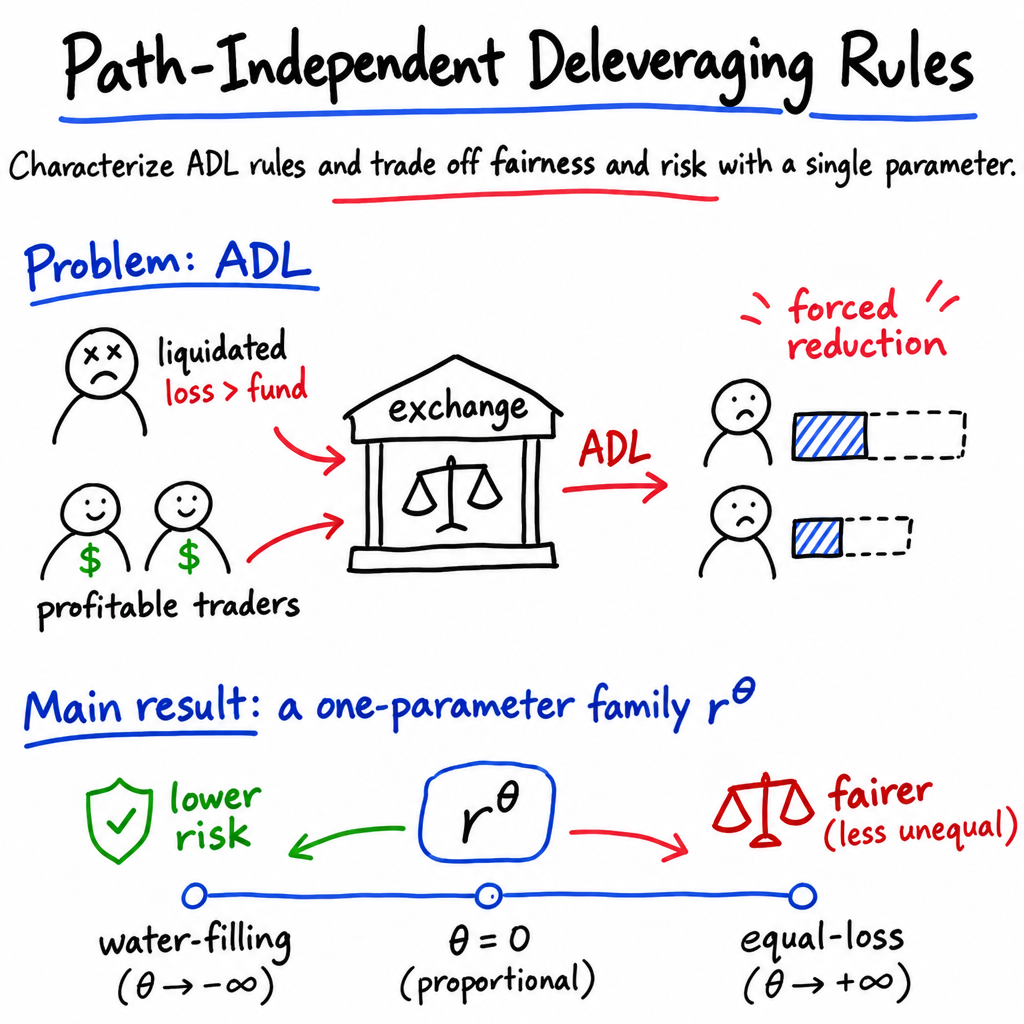
Abstract: We characterise path-independent auto-deleveraging (ADL) rules as an extended log-exponential family. Immunity to account splitting, merging and reopening further restrict the class. Homogeneity (essentially) restricts the class to a one-parameter family ordered by both fairness and platform risk. Its split-proof members continuously interpolate between proportional division and water-filling. Among these rules, decreasing the parameter reduces risk at the cost of increasing inequality in how accounts are treated. This suggests selecting the parameter through an ex-ante calibration to a risk bound on historical data to choose a maximally fair rule subject to that bound. A counterfactual replay of Hyperliquid's ADL episode on 10 October 2025 finds that a range of intermediate parameters significantly improves on the observed allocation in both burden dispersion and subsequent risk statistics.
Paper Prompts
Sign up for free to create and run prompts on this paper.
Explain it Like I'm 14
1. What is this paper about?
This paper studies auto-deleveraging, or ADL, on cryptocurrency trading platforms.
Traders can use leverage, meaning they control a large position with a smaller amount of money. This can create problems when prices move sharply. If a trader loses more money than they have deposited, the platform may need to reduce the positions of profitable traders on the opposite side of the market. This forced reduction is called auto-deleveraging.
The paper asks:
How should a platform decide which traders lose part of their positions, and how much should each trader lose?
The authors compare different rules based on three main ideas:
- Fairness: Are traders treated similarly?
- Safety: Does the rule reduce the platform’s risk?
- Resistance to manipulation: Can traders get better treatment by splitting or merging accounts?
2. Main research questions
The paper focuses on several questions:
- Does the order of ADL events matter? For example, if a position is reduced in several small steps, should the final result be the same as reducing it once?
- Can traders manipulate the system? Could someone improve their treatment by splitting one account into several accounts, merging accounts, or closing and reopening a position?
- What is the fairest way to distribute reductions? Should every trader lose the same percentage of their position?
- What is the safest way for the platform to reduce positions? Should the platform reduce the riskiest, most highly leveraged positions first?
- Can one rule balance fairness and safety?
3. How the researchers approached the problem
Building a mathematical model
The authors describe each trading account using two pieces of information:
- : the size of the trader’s position
- : the trader’s equity, or money supporting that position
They also define a target: the total amount of position that should remain after ADL.
For example, imagine three traders together hold 100 units of a position, but only 70 units are allowed to remain. An ADL rule must decide how many units each trader keeps.
The paper calls the amount kept by trader their residual position, written as .
Testing important rules
The authors require ADL rules to satisfy several conditions.
Equal treatment
If two accounts have exactly the same position and equity, they should receive the same treatment.
Continuity
Small changes in a trader’s position, equity, or the target should not cause a sudden and surprising change in their allocation.
Consistency
If some accounts leave and the remaining accounts are reassessed, the remaining traders should receive the same amounts as before.
This is similar to dividing a cake: if some people leave after receiving their slices, dividing the leftover cake among the remaining people should not suddenly change the slices they already received.
Path independence
The final result should not depend on how the platform reaches it.
For example, suppose the platform first reduces the total position from 100 units to 80, and later from 80 to 60. The result should be the same as reducing it directly from 100 to 60.
This matters because ADL may happen in several batches during a fast-moving market.
Resistance to splitting and merging
The researchers ask whether a trader can improve their total outcome by:
- Splitting one account into multiple smaller accounts
- Merging several accounts into one larger account
A rule that cannot be improved by splitting is called split-proof. A rule that cannot be improved by merging is called merge-proof.
Homogeneity
A rule is homogeneous if it works the same way when everything is scaled up or down.
For example, doubling every trader’s position, equity, and the target should simply double every final allocation. The rule should not secretly depend on fixed dollar amounts.
The mathematical family of rules
The authors prove that rules satisfying their basic requirements belong to a mathematical group called the extended log-exponential family.
This sounds complicated, but the basic idea is simple:
Each account follows a particular schedule showing how much of its position it keeps as the total allowed position changes. A common “clearing level” is then chosen so that all the remaining positions add up to the target.
Within this family, the authors identify a one-parameter group of rules, written as . The parameter controls the balance between fairness and safety.
Two important endpoints are:
- Proportional division: Everyone keeps the same percentage of their position.
- Water-filling: More highly leveraged accounts are reduced more, bringing their remaining leverage closer to a common limit.
A useful analogy is filling containers with water:
- Proportional division lowers every container by the same percentage.
- Water-filling lowers the fullest or riskiest containers until the levels become more similar.
4. Main findings
A. Path independence strongly limits possible rules
The paper shows that if an ADL rule is continuous, consistent, treats equal accounts equally, and is path-independent, then it must belong to the extended log-exponential family.
This is important because it means the platform does not have unlimited freedom if it wants a rule that behaves predictably.
B. Closing and reopening should not change treatment
Some ADL systems may use unrealised profit and loss, which depends partly on a position’s entry price.
However, a trader can sometimes close a position and immediately reopen it. This changes the recorded entry price without changing the trader’s current position or equity.
The paper proves that if this action is not allowed to improve a trader’s future treatment, then the ADL rule must ignore entry prices.
In simple terms:
A trader should not be able to get a better ADL outcome just by changing the bookkeeping history of a position.
C. Proportional division is the fairest under the paper’s fairness measure
Under the paper’s main fairness measure, traders are compared by the percentage of their positions that is reduced.
For example:
- Trader A loses 20 out of 100 units: a 20% reduction
- Trader B loses 10 out of 50 units: also a 20% reduction
Proportional division gives everyone the same percentage reduction. The paper proves that this is the fairest possible allocation under this definition.
Other rules may reduce some accounts by 10% and others by 40%, creating a wider gap in treatment.
D. Water-filling is the safest rule for the platform
The paper finds that water-filling minimizes the platform’s remaining losses in every possible future price situation within the model.
Why? After ADL, the platform is most exposed to accounts that still have high leverage. Water-filling reduces those risky positions more aggressively.
The trade-off is that water-filling can treat traders very differently. A highly leveraged trader may lose a much larger percentage of their position than a less leveraged trader.
E. The parameter creates a fairness–risk trade-off
The one-parameter family between proportional division and water-filling creates a gradual trade-off:
| Rule | Fairness of percentage reductions | Platform risk |
|---|---|---|
| Proportional division | Highest | Highest in general |
| Intermediate rule | Balanced | Lower than proportional division |
| Water-filling | Lowest under this fairness measure | Lowest |
Moving toward proportional division makes percentage reductions more equal, but can leave more risky positions in place.
Moving toward water-filling lowers platform risk, but concentrates more of the burden on highly leveraged traders.
F. Splitting and merging cannot both be prevented except under proportional division
The paper proves that proportional division is the only rule in the studied class that is both:
- Split-proof
- Merge-proof
This means that other rules may create incentives for traders to organize their positions in particular ways.
For example, a rule might prevent profitable splitting but allow profitable merging, or the other way around. This is an important practical problem because traders may try to use multiple accounts strategically.
G. Historical replay suggests intermediate rules may work well
The authors also replay an ADL event from Hyperliquid that occurred on 10 October 2025.
They compare the observed allocation with several alternative rules across 18 markets. According to the paper, a range of intermediate parameter choices improved both:
- The spread in how much traders were reduced
- Later measures of platform risk
This suggests that a platform may not need to choose between the two extreme options. It could select an intermediate rule using historical market data.
The authors suggest choosing the fairest rule that still stays below a chosen risk limit.
5. Why the results matter
ADL affects traders who are usually solvent and may even be making profits. A trader could be using a position as a hedge, so having it suddenly reduced can create serious losses or unwanted exposure.
The paper shows that no single rule is perfect:
- A very fair rule may leave the platform exposed to more risk.
- A very safe rule may place a large burden on a smaller group of traders.
- Rules that depend on account structure may encourage manipulation.
- A rule that works in several ADL stages should produce the same result as one large ADL event.
The main practical lesson is that exchanges should choose ADL rules openly and carefully. They could use historical market data to test different parameters and decide how much platform risk they are willing to accept.
Conclusion
In simple terms, the paper develops a menu of predictable ADL rules and explains what each rule prioritizes.
Proportional division is easiest to understand and fairest when fairness means equal percentage reductions. Water-filling is safest for the platform because it reduces the positions with the greatest remaining leverage. Rules between these two can offer a useful compromise.
The research could help cryptocurrency exchanges design ADL systems that are more predictable, harder to manipulate, and better balanced between protecting the platform and treating traders fairly.
Practical Applications
Immediate Applications
- Deploy a tunable ADL allocation module for crypto-derivatives exchanges (finance/software). Exchanges can implement the homogeneous one-parameter family , which allocates surviving positions by a common clearing level in leverage space:
The exchange can choose for proportional division, a negative to move toward water-filling and reduce platform risk, or a positive for the opposite allocation profile. This can replace ad hoc rules based on rankings, random selection, or unrealised P&L.
Dependencies: reliable equity and mark-price measurements, isolated-margin accounting, a clearly defined target surviving open interest, and an execution engine capable of solving for the clearing level .
- Use water-filling as a risk-minimising emergency policy (crypto markets and clearing). The paper shows that water-filling weakly minimises uncovered losses state by state among feasible residual allocations. In practice, an exchange can reduce highly leveraged positions until surviving leverage is below a common threshold while leaving lower-leverage positions unchanged. This is especially appropriate when insurance-fund depletion and solvency protection take priority over equality of percentage reductions.
Dependencies: the single-asset, isolated-margin loss model must be a reasonable approximation; cross-margining, correlation across assets, liquidity costs, and market impact may change the result.
- Adopt proportional division as a fairness and manipulation-resistant baseline. Proportional division gives every affected account the same percentage reduction and is uniquely fairest under the paper’s position-weighted Lorenz criterion. It is also the only characterised rule that is both split-proof and merge-proof. Exchanges can therefore use it as a transparent default or as a fallback when risk conditions are not severe.
Dependencies: “fairness” is defined as equality of percentage reductions, rather than equality of absolute reductions, reductions per unit of equity, or minimisation of platform loss.
- Calibrate empirically against an explicit risk limit (risk management and quantitative research).
- dispersion of percentage reductions;
- residual leverage;
- uncovered losses;
- insurance-fund drawdowns;
- subsequent loss under historical price paths; and
- concentration of the burden among accounts or traders.
It can then choose the largest-fairness parameter that satisfies a predefined risk bound. This implements the paper’s proposed workflow: select a maximally fair rule subject to an ex-ante calibrated risk constraint.
Dependencies: historical account-level positions, equity, prices, liquidation targets, and sufficiently realistic counterfactual execution assumptions. Backtests do not guarantee performance under future market regimes.
- Make ADL treatment path-independent across liquidation batches (exchange operations and policy). The DPI and UPI properties provide a design specification for liquidation engines that adjust their target over several batches. Reapplying the rule after a further deterioration, or restoring positions after a partial recovery, should produce the same final allocation as applying the rule directly to the final target. This prevents traders’ treatment from depending on arbitrary batch size or liquidation sequencing.
Dependencies: positions and equity must be updated consistently at the ADL mark price, and the same rule must be applied across all batches.
- Remove entry price and unrealised P&L from ADL eligibility when manipulation resistance is required. The reopening result implies that a rule satisfying consistency, downward path independence, and reopening-proofness must ignore entry prices. Exchanges can therefore base ADL solely on current position, current equity, mark price, and the target. This prevents traders from improving treatment by closing and immediately reopening positions to reset their entry price.
Dependencies: the venue must be able to measure current equity independently of historical entry records and must account for fees, funding, and realised P&L consistently.
- Publish an interpretable ADL policy and risk dashboard (transparency and consumer protection).
- the selected ;
- the target surviving open interest;
- each account’s pre- and post-ADL leverage;
- the clearing threshold;
- expected percentage reductions under representative scenarios; and
- historical stress-test results.
The one-parameter structure makes the fairness–risk trade-off easier to communicate than a proprietary score or opaque ranking.
Dependencies: disclosure must avoid revealing sensitive trader information and must explain that the parameter optimises a policy objective rather than guaranteeing a particular individual outcome.
- Build compliance and adversarial-testing tools for account restructuring (software and market surveillance). Before deployment, an exchange can test whether splitting one account into multiple accounts, merging accounts, or reopening a position changes the trader’s aggregate residual position. The superadditivity and subadditivity conditions in the paper provide mathematical tests for split-proofness and merge-proofness.
Dependencies: the test must include partial account restructurings, heterogeneous equity levels, zero or near-zero positions, and numerical tolerance in the clearing algorithm.
- Use the framework to compare existing exchange policies (academia, regulators, and industry benchmarking).
- path independence;
- resistance to splitting, merging, and reopening; and
- fairness versus residual platform risk.
This produces a common benchmark for comparing crypto exchanges and potentially traditional clearing arrangements involving partial tear-up.
Dependencies: the venue must disclose enough information to reconstruct its allocation rule; black-box or discretionary procedures may not fit the characterised class.
- Apply the fairness criteria to operational burden allocation beyond ADL (clearing and risk-sharing). The Lorenz approach can be used to assess how losses, position reductions, or recovery obligations are distributed in insurance-fund depletion, partial tear-up, or other emergency clearing procedures. The appropriate fairness conclusion depends on whether the burden is measured as a percentage, an absolute position reduction, or a reduction per unit of equity.
Dependencies: stakeholders must agree in advance on the burden metric; changing the metric can reverse which rule is considered fairest.
Long-Term Applications
- Develop multi-asset and cross-margin ADL algorithms (derivatives infrastructure). The current model concerns one side of a single-asset market. A natural extension is a vector-valued rule for portfolios, where reducing one position can alter risk through hedges, correlations, and margin offsets. A future system could choose reductions by minimising portfolio-level spectral risk rather than individual surviving leverage.
Dependencies: a validated portfolio-loss model, reliable covariance or stress scenarios, computationally tractable clearing, and safeguards against manipulating correlations or margin classifications.
- Integrate market impact and liquidity into the allocation rule (market microstructure). The paper treats execution at the ADL mark price and abstracts from transaction costs and price impact. Future rules could minimise a combined objective involving uncovered loss, liquidation slippage, order-book depth, and contagion to other markets. This could produce an “impact-aware water-filling” rule rather than equalising leverage alone.
Dependencies: high-quality order-book data, a robust market-impact model, and mechanisms to prevent the risk model from becoming procyclical during rapidly deteriorating markets.
- Create adaptive, regime-dependent parameter selection (automated risk management). Instead of fixing permanently, an exchange could select it based on insurance-fund coverage, volatility, market depth, concentration, and liquidation intensity. For example, it could move toward negative or water-filling during acute stress and toward proportional division during normal conditions.
Dependencies: adaptive rules must preserve or approximate path independence. If changes arbitrarily between batches, traders’ outcomes may again depend on liquidation sequencing. A future theory is needed for time-varying parameters.
- Design mechanism-level guarantees for account-identity and Sybil resistance (policy and protocol design). The paper shows that proportional division is uniquely both split-proof and merge-proof within the characterised class, while other rules are resistant to only one type of restructuring under specified conditions. This could inform exchange rules on subaccounts, institutional omnibus accounts, and wallet-level identity.
Dependencies: practical Sybil resistance also requires identity, custody, and account-linking controls. Mathematical split-proofness alone cannot prevent a trader from creating economically independent accounts if the rule legitimately treats them separately.
- Extend ADL design to on-chain smart contracts and decentralized exchanges (blockchain infrastructure). The log-exponential schedules and clearing-level formulation could be implemented in smart contracts or verifiable off-chain computation. A protocol could publish account states, compute the common clearing level, and produce a proof that allocations satisfy budget balance and the selected rule.
Dependencies: gas costs, oracle reliability, privacy of equity data, front-running resistance, numerical precision, and emergency governance. On-chain execution must also handle rapidly changing targets without making the process exploitable.
- Develop formal regulation and disclosure standards for ADL (financial policy). Regulators could require venues to disclose their ADL allocation rule, treatment of account splitting and merging, target-update behaviour, historical stress tests, and the distinction between fairness and solvency objectives. The paper’s axioms could serve as candidate minimum standards for predictable and manipulation-resistant recovery procedures.
Dependencies: regulatory standards would need to accommodate cross-margining, multiple assets, insurance funds, bankruptcy law, and differences between decentralized venues and centrally cleared markets.
- Apply the axiomatic framework to traditional CCP recovery and partial tear-up (financial market infrastructure). The same ideas could guide the allocation of involuntary position reductions after default resources, auctions, or assessments are exhausted. Path independence could make recovery outcomes less sensitive to the sequence of interventions, while Lorenz and risk orders could formalise the trade-off between member fairness and CCP solvency.
Dependencies: traditional CCPs involve legal agreements, clearing members, collateral waterfalls, and portfolio netting that are not represented in the single-asset isolated-margin model.
- Construct fairness-aware liquidation systems for lending and margin platforms (fintech and decentralized finance). The framework could be adapted to allocate forced reductions in crypto lending, leveraged token, or structured-product platforms. A platform might use proportional reductions for predictable customer treatment while switching to risk-sensitive allocation when collateral shortfalls threaten solvency.
Dependencies: lending protocols often have heterogeneous collateral, liquidation bonuses, interest accrual, oracle risk, and non-linear collateral rules. These features require extensions beyond position size and equity.
- Use the model in academic experiments on distributional objectives in automated finance (economics and operations research). The one-parameter family provides a controlled experimental environment for studying how fairness definitions, manipulation resistance, and risk objectives conflict. Researchers can compare percentage-reduction fairness, absolute-reduction fairness, and spectral risk minimisation under simulated market stress.
Dependencies: conclusions depend on the chosen risk distribution, price process, account heterogeneity, and calibration sample. The paper’s Hyperliquid replay is illustrative rather than evidence of universal superiority for any single parameter.
- Develop robust and adversarial calibration methods (quantitative finance). Historical calibration can be extended using stress scenarios, distributionally robust optimisation, and adversarial simulations. Rather than selecting from one replay, an exchange could choose the most fairness-preserving rule whose risk remains below a bound across multiple volatility, correlation, liquidity, and account-concentration regimes.
Dependencies: robust calibration may produce more conservative allocations and requires a defensible definition of the scenario set, tail risk, and acceptable insurance-fund loss.
Glossary
- Auto-deleveraging (ADL): A mechanism that forcibly reduces profitable positions to cover losses when liquidation and insurance resources are insufficient. “auto-deleveraging (ADL) forcibly reduces profitable positions on the opposite side.”
- Bankruptcy price: The price at which an account’s collateral is insufficient to cover its losses. “If a losing account is liquidated only after the market has moved through its bankruptcy price, its collateral no longer covers the loss.”
- Budget balance: The requirement that the residual positions allocated by a rule sum exactly to the target. “Unaffected accounts receive weakly less, so budget balance gives the merged account at least the original pair's total.”
- Clearing level: A common auxiliary parameter selected so that individual residual schedules meet the aggregate target. “For a given problem, this level is chosen to satisfy the target.”
- Conditional value at risk (CVaR): A risk measure representing the expected loss in a specified worst-case tail of a loss distribution. “CVaR (conditional value at risk), the average loss over a specified upper tail, can have a continuum of minimisers.”
- Constrained equal awards (CEA): A division rule that equalizes awards, subject to each claimant’s maximum allowable award. “Weighted CEA equalises residual positions per unit of weight, subject to the original position caps.”
- Constrained equal losses (CEL): A division rule that equalizes losses, subject to residual positions remaining nonnegative. “Weighted CEL equalises reductions per unit of weight, subject to nonnegative residuals.”
- Consistency: An allocation axiom requiring the rule to produce the same allocation when a surviving subpopulation is reassessed independently. “Consistency requires”
- Convex order: A comparison of distributions or weighted vectors based on their values under all convex functions, often measuring dispersion. “The same comparison can be expressed through position-weighted convex order.”
- Counterfactual replay: An empirical reconstruction of an event under an alternative rule or set of assumptions. “We illustrate the trade-off with a counterfactual replay of Hyperliquid's ADL episode on 10 October 2025”
- Division rule: A formal procedure for distributing a resource or residual estate among claimants. “Proportional division, CEA and constrained equal losses (CEL) are classical claims rules.”
- Downward path independence (DPI): The requirement that successive reductions of the target yield the same result as applying the final target directly. “If the target is tightened from to , applying the rule again to the surviving positions gives the same final allocation as applying the tighter target directly.”
- Entry-price independence: The property that allocations do not depend on the price at which a position was opened. “Under consistency, DPI and equal treatment, it forces the rule to ignore entry prices altogether.”
- Equal treatment of equals: An axiom requiring accounts with identical characteristics to receive identical treatment. “Accounts with the same type receive the same residual position.”
- Extended log-exponential family: The class of allocation rules generated by residual schedules based on exponential transformations, including proportional and boundary rules. “These boundary rules and the finite rules form the extended log-exponential family”
- Fairness–risk trade-off: The tension between distributing reductions equally and minimizing the platform’s residual exposure to loss. “The rules between proportional division and water-filling ... offer a trade-off between fairness and risk.”
- Forced buyback: The compulsory repurchase of a short position when that position is reduced through ADL. “For shorts, this is a forced buyback.”
- Forced reduction: The amount by which an account’s original position is decreased. “The forced reduction of account is .”
- Homogeneity: The property that scaling positions, equities, and the target by the same factor scales allocations by that factor. “Homogeneity requires allocations to scale when positions, equities and the target are scaled by a common factor.”
- Insurance fund: A pool of resources used to absorb losses from liquidated accounts that cannot be fully covered by their collateral. “Insurance funds absorb ordinary shortfalls”
- Isolated-margin model: A trading model in which each position or account’s collateral is considered separately when determining solvency and losses. “In the single-asset isolated-margin model of \citet{campbell}”
- Lorenz order: A partial order comparing the dispersion or inequality of weighted vectors. “We compare these percentage reductions in the (position-weighted) Lorenz order.”
- Mark price: The reference market price used to value positions and equity for liquidation or ADL purposes. “its equity in dollars, valued at the mark price at which ADL executes”
- Monotone risk measure: A risk measure that assigns no greater risk to a loss that is no greater in every possible state. “We assume that is monotone: a loss that is no greater in any state cannot have higher risk.”
- Partial tear-up: The involuntary termination or reduction of matched futures positions to restore a clearing system’s balance. “Partial tear-up is especially close to ADL because it involuntarily terminates positions to restore a matched book”
- Path independence: The property that applying an allocation rule through successive target changes produces the same result as applying it directly to the final target. “A rule is path independent if it satisfies both DPI and UPI.”
- Perpetual futures: Futures contracts without a fixed expiration date that maintain exposure through funding or related mechanisms. “Perpetual futures are widely used to take and hedge directional exposure to cryptoassets.”
- Position-weighted Lorenz order: A Lorenz comparison in which each account is weighted by its position size. “Proportional division uniquely gives the fairest allocation in the position-weighted Lorenz order on percentage reductions”
- Proportional division: An allocation rule under which every account retains the same fraction of its original position. “Under proportional division, every account with a positive position retains the same percentage of that position.”
- Residual map: A function that specifies an account’s retained position at a given clearing level. “Within the extended log-exponential family, a rule is split-proof if and only if every residual map is superadditive in the type”
- Residual position: The portion of an account’s original position that remains after ADL. “A rule is defined for every finite population and assigns to each problem ... a vector of residual positions”
- Spectral risk measure: A risk measure formed as a weighted mixture of tail-risk measures such as CVaR. “For spectral risk measures ... represented below as mixtures of upper-tail CVaRs of losses”
- Split-proofness: The property that dividing one account into multiple accounts cannot increase the trader’s total retained position. “A rule is split-proof if replacing one account by any finite collection of accounts whose positions and equities sum to those of the original account can never increase the sum of their residual positions.”
- Subadditivity: The property that the residual allocation for a combined type is no greater than the sum of allocations for its separate components. “it is merge-proof if and only if every is subadditive in the type”
- Superadditivity: The property that the residual allocation for a combined type is at least as great as the sum of allocations for its separate components. “a rule is split-proof if and only if every residual map is superadditive in the type”
- Target surviving open interest: The aggregate amount of position that is intended to remain after ADL. “an ADL problem consists of a type-profile and a target surviving open interest ”
- Uncovered loss: The portion of a position’s loss that exceeds the account’s available equity. “For , uncovered loss begins when the price increase exceeds ”
- Upward path independence (UPI): The requirement that increasing a target in stages produces the same allocation as restoring directly to the larger target. “If the target increases from to , restoring of open interest from the positions reduced at should give the allocation at .”
- Water-filling: A rule that reduces positions with excessive leverage to a common leverage threshold while leaving lower-leverage positions unchanged. “Water-filling reduces positions whose leverage exceeds a common threshold to that threshold and leaves the others unchanged”
- Weighted constrained equal awards: A CEA rule in which awards are equalized relative to account-specific weights. “We also define the weighted constrained equal awards (CEA) and weighted constrained equal losses (CEL) rules.”
- Weighted constrained equal losses: A CEL rule in which reductions are equalized relative to account-specific weights. “Weighted CEL equalises reductions per unit of weight, subject to nonnegative residuals.”

