- The paper leverages a self-evolving agentic memory combined with preflective reasoning to enhance zero-shot object-goal navigation.
- It employs UCB-based rule selection for dynamic adaptation, reducing risky actions and optimizing decision-making during exploration.
- Empirical results demonstrate significant improvements in success rate and path efficiency on challenging benchmarks like HM3D and MP3D.
EvolveNav: Self-Evolving Agentic Memory and Preflective Reasoning for Zero-Shot Object Goal Navigation
Introduction
Zero-shot Object-Goal Navigation (ZS-OGN) remains a critical benchmark in embodied AI, evaluating the capacity of agents to locate target objects in novel environments without domain-specific training. Despite the proliferation of LLMs and vision-LLMs (VLMs) serving as zero-shot planners, state-of-the-art frameworks such as ASCENT and ApexNav have exhibited limited online adaptivity, predominantly due to their reliance on static priors and an absence of actionable agentic memory. EvolveNav directly addresses these deficiencies by coupling a continuous, self-evolving agentic rule memory with a memory-guided preflection mechanism, resulting in compelling performance improvements and notable behavioral adaptivity.
Framework Overview
EvolveNav reframes navigation as a cycle of interactive experience collection and rule-driven adaptation. The architecture integrates two core components: intra-episode preflective exploration for test-time anticipation and inter-episode rule self-evolution supporting continual behavioral refinement.
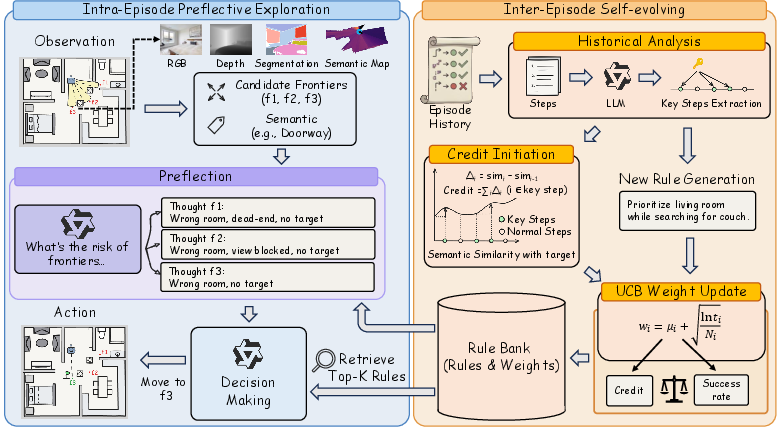
Figure 1: The EvolveNav framework comprises intra-episode preflective frontier evaluation for proactive risk avoidance and inter-episode UCB-driven rule bank self-evolution for continual knowledge accumulation and selection.
Intra-Episode Preflective Exploration leverages LLM-driven preflection to evaluate all actionable frontiers before physical traversal. The agent retrieves a set of top-K contextualized navigation rules—selected based on a UCB criterion combining semantic relevance and historical success rate—from its self-evolving rule memory. These rules are injected into the reasoning prompt, enabling the LLM to anticipate the outcome probabilities and latent risks associated with each candidate action. This process minimizes low-reward trial and error, particularly in environments characterized by ambiguous affordances or visually deceptive cues.
Inter-Episode Rule Self-Evolution distills structured experiential knowledge post-episode. Using a two-stage pipeline, the LLM reviews the executed trajectory, isolates high-impact reasoning steps through a semantic-driven credit assignment mechanism, and synthesizes reusable, generalizable navigation rules reflecting both successes and critical failures. Newly formulated rules are dynamically scored and managed via a UCB-based bandit algorithm, which appropriately balances rule exploitation and continued exploration as the memory bank expands.
Core Technical Contributions
Semantic-Grounded Memory Architecture
Unlike purely prompt-optimization-centric agent frameworks, EvolveNav constructs its agentic rule memory by explicit credit assignment, quantifying the marginal semantic information gain at each decision step. This enables the framework to weight trajectory segments by their causal contribution to task success or failure, resulting in a rule set with high behavioral impact rather than superficial observation correlations.
Upper Confidence Bound (UCB)-Based Rule Management
EvolveNav employs a UCB retrieval strategy to dynamically prioritize contextual rules that maximize expected navigation utility. Each rule’s score fuses historical effectiveness with usage recency, while initial exploration guarantees are afforded to new rules via infinite initialization when untested. This method prevents premature overfitting to early experiences and ensures robust adaptive generalization across diverse environments.
Memory-Guided Preflection
Departing from standard reliance on static procedural priors or single-shot predictions, the preflection module operationalizes a dual-context prompt: one capturing the geometric and semantic specifics of candidate frontiers, and the other encoding self-distilled episodic rules most pertinent to the current context. The LLM is tasked with explicit risk assessment and failure prediction for each possible action, enforcing a deliberate, introspective reasoning step prior to movement. This results in effective avoidance of systemic missteps and unnecessary exploration loops.
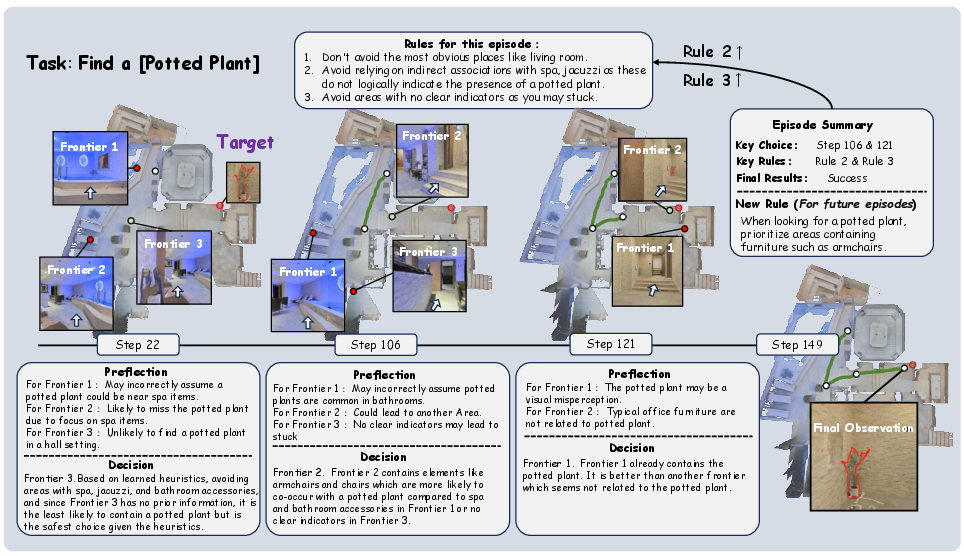
Figure 2: Visualization of an EvolveNav episode, illustrating dynamic trajectory selection, online preflection-based avoidance of high-risk frontiers, and post-episode rule distillation and weighting in the cumulative memory bank.
Empirical Validation
Benchmark Results
EvolveNav surpasses all contemporary zero-shot approaches on both the HM3D and MP3D benchmarks, setting new state-of-the-art records for both Success Rate (SR) and Success weighted by Path Length (SPL). On MP3D—known for challenging multi-floor spatial structure and visual ambiguity—the method yields an absolute SR gain of 4.5% and SPL improvement of 3.8% over previous bests (e.g., ASCENT), achieving 49.0% SR and 19.1% SPL (2606.18235). These results establish EvolveNav as the first zero-shot object navigation system to demonstrate such high generalization in structurally nontrivial indoor environments, with minimal redundant step cost.
Ablation Analysis
Comprehensive ablations confirm the unique and complementary value of the preflection and memory-evolution modules. Exclusion of the preflection module results in marked SR/SPL degradation (up to −3.5% SR on MP3D), affirming its necessity for efficient, risk-sensitive reasoning. Similarly, disabling rule memory self-evolution significantly hampers generalization on complex benchmarks, highlighting the importance of continuous experiential learning even in test-only settings.
Model Backbone Sensitivity
Switching LLM backbones within the Qwen family (Qwen2.5-7B, Qwen3-8B, Qwen3.5-9B) yields negligible SR and SPL variance (≤0.3%), underscoring that EvolveNav’s behavioral gains critically arise from architectural innovations (memory/selection/preflection), not from increased LM parameter count.
Qualitative Decision Process Analysis
Case studies on the MP3D dataset reveal EvolveNav’s robust proactive avoidance of dead-end or low-value regions, achieved through anticipatory reasoning and rule injection. For example, the agent systematically bypasses rooms and frontiers with high predicted distraction or failure potential—unlike ASCENT, which frequently exhausts step budgets in loops or by examining visually similar but irrelevant rooms. Instead, EvolveNav adaptively focuses its search in semantically promising areas, grounded by its evolving knowledge base.
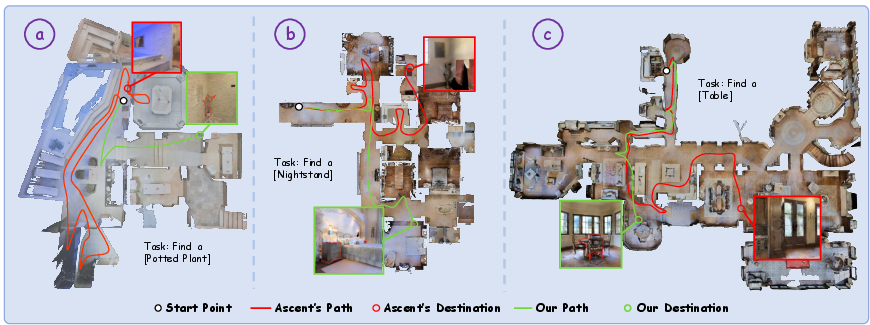
Figure 3: Qualitative trajectory comparison between EvolveNav (blue) and ASCENT (red); EvolveNav maintains efficient, direct paths while competitors are distracted by semantically irrelevant frontiers.
Implications and Future Directions
EvolveNav’s paradigm—memory-based online adaptation without environment-specific parameter updates—demonstrates that embodied agents can achieve robust, efficient zero-shot navigation via continual integration of procedural rules and proactive introspective reasoning. This framework introduces new principles for integrating long-term experiential memory structures with LLM planning in embodied AI and suggests a pathway toward scalable self-improving agents. The UCB-based rule selection and the explicit preflection step generalize to other agentic tasks requiring risk-sensitive deliberation, memory consolidation, and behavioral correction.
Potential extensions include:
- Collaborative Multi-Agent Navigation: Sharing and transferring distilled rule memory across agents for distributed task-solving and efficient team exploration.
- Multi-Modal and Active Perception Integration: Enhancing robustness against 2D perceptual errors via active, multi-view verification, and extension to 3D scene understanding.
- Adaptation to Outlier Environments: Further algorithmic work to address failure modes when confronted with highly anomalous layouts or intentional adversarial scene design.
Conclusion
EvolveNav establishes a new standard for zero-shot object-goal navigation by leveraging self-evolving rule memory, principled credit assignment, UCB-based rule selection, and a preflection-guided deliberation process. Empirical results on both standard and challenging benchmarks confirm its superior efficiency and adaptivity compared to static-prior and conventional zero-shot frameworks. The architecture exemplifies how closed-loop memory and introspective prediction modules can together drive continual self-improvement and robust reasoning in embodied agents, offering a foundation for future lifelong learning systems in open-world navigation and beyond.

