Hierarchical Diffusion Transformer for End-to-End Image Generation
Abstract: Pixel-space diffusion learns visual representations and image generation jointly in a single end-to-end training stage, without a separately pretrained visual encoder. However, plain pixel-space Transformers still trail leading two-stage latent diffusion models in generation quality and training efficiency. We hypothesize that part of this gap arises from retaining one token per patch throughout the backbone, which does not explicitly encourage a visual hierarchy that summarizes related content at progressively coarser levels. To address this, we introduce Hierarchical Diffusion Transformers (HiT), which progressively group related tokens and represent each group with a single token. The main Transformer bottleneck processes these compact group tokens, and ungrouping restores features to their original image positions. A compression budget regulates the average compression ratio across the batch, allowing group memberships and counts to vary across images and diffusion timesteps during both training and generation. The model exhibits emergent semantic structure, learning to group coherent objects and object parts without segmentation labels. In text-to-image generation, HiT further learns to group caption words with image patches depicting the same concepts, without region annotations. HiT achieves 1.48 FID on ImageNet and reaches comparable generation quality to JiT using approximately 40\% of its cumulative training FLOPs. For text-to-image generation, HiT exceeds UniLiP's average score across five benchmarks with roughly fewer denoiser parameters and fewer forward FLOPs. These results suggest that learning a visual hierarchy within the generator breaks down the barrier to stronger image generation without external visual pretraining.

Paper Prompts
Sign up for free to create and run prompts on this paper.
Explain it Like I'm 14
1. What is this paper about?
This paper introduces a new AI system called HiT, short for Hierarchical Diffusion Transformer. HiT is designed to create images from:
- random noise,
- category labels, such as “dog” or “car,” and
- written descriptions, such as “a boy holding a banana.”
The main idea is to help the AI understand images in layers, much like people do. We first notice tiny details, then combine them into parts, objects, and finally a whole scene.
Many modern image generators already use this kind of layered understanding, but they often need a separate image encoder trained beforehand. HiT tries to learn the visual organization while learning to generate images, all in one training process.
2. What questions are the researchers asking?
The researchers focus on several main questions:
- Can an image generator learn to organize visual information by itself?
- Can it group related parts of an image together, even when they are far apart?
- Can grouping make the model faster and less expensive to train?
- Can the same idea help connect words with the correct parts of an image?
- Can HiT produce images that are as good as or better than other strong image generators?
For example, if an image contains two bananas, HiT might place both bananas in the same group, even if they are in different parts of the picture. It might also connect the word “banana” in a caption to those image regions.
3. How does the method work?
Diffusion models in simple terms
A diffusion model learns to create images by starting with random noise and gradually removing the noise.
Imagine taking a clear photograph and covering it with more and more static. The model learns the reverse process: starting with static, it repeatedly cleans the image until a picture appears.
Transformers and tokens
HiT divides an image into many small square pieces called patches. Each patch is represented by a smaller piece of information called a token.
A Transformer examines these tokens and learns how they relate to one another. For example, it may learn that several patches belong to the same object.
HiT’s special grouping system
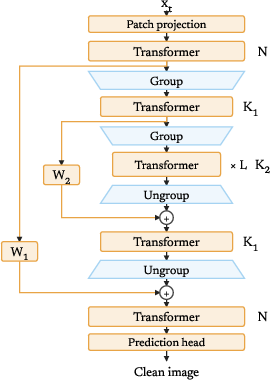
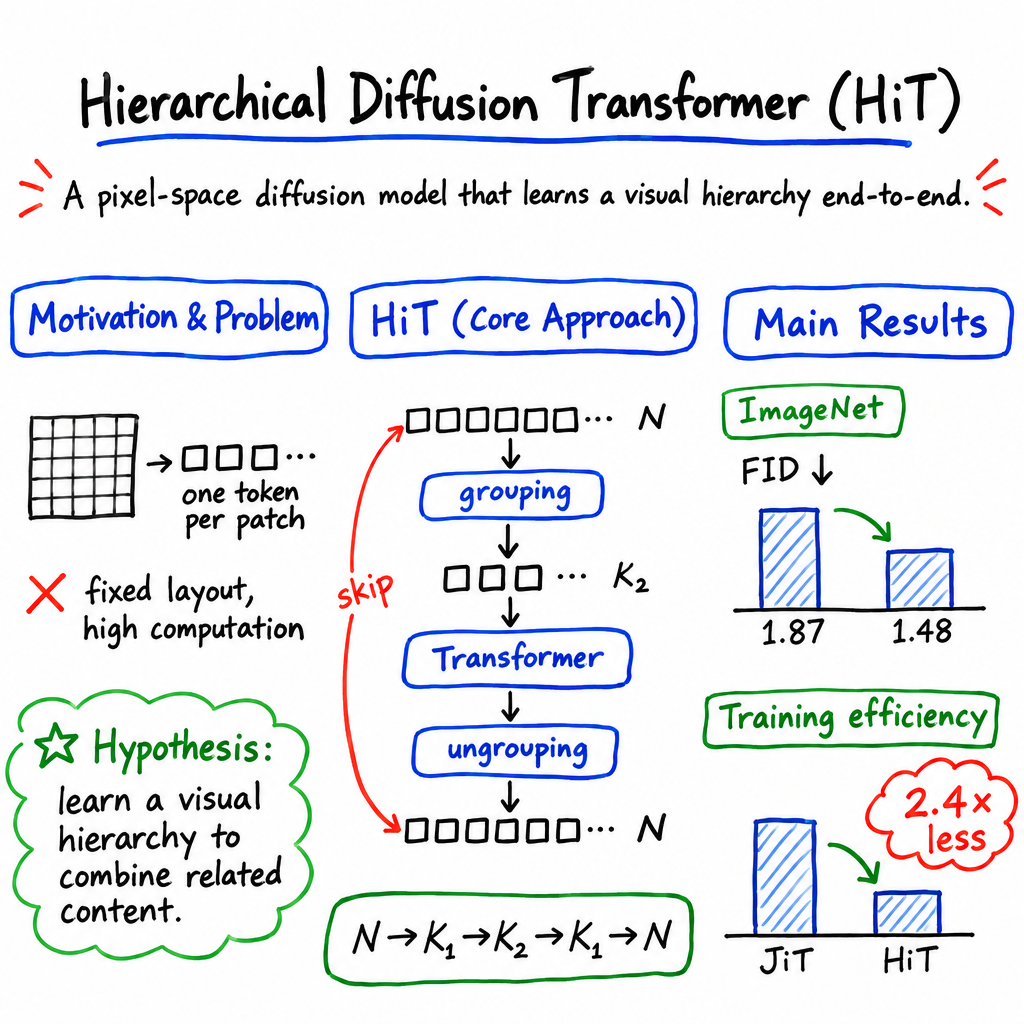
A normal image generator keeps the same number of tokens throughout much of its network. HiT works differently:
- It begins with many small image tokens.
- It looks for tokens that seem related.
- It combines related tokens into larger groups.
- It processes these fewer group tokens in the middle of the network.
- It expands the information back to the original image locations.
This is similar to making a summary of a long story. Instead of repeatedly reading every sentence, you first combine related sentences into paragraphs and then work with the shorter summary.
HiT uses several levels of grouping. The number of tokens might change like this:
This means that 256 small pieces become 128 groups, and then 64 larger groups.
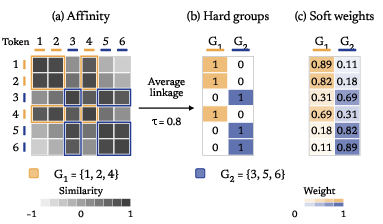
Soft grouping
The model does not always make completely strict decisions. A patch can partly belong to more than one group. This is called soft grouping.
For example, a patch near the edge of a dog and its background might be connected partly to the dog group and partly to the background group. This gives the model more flexibility and helps it avoid losing useful information.
Adaptive compression
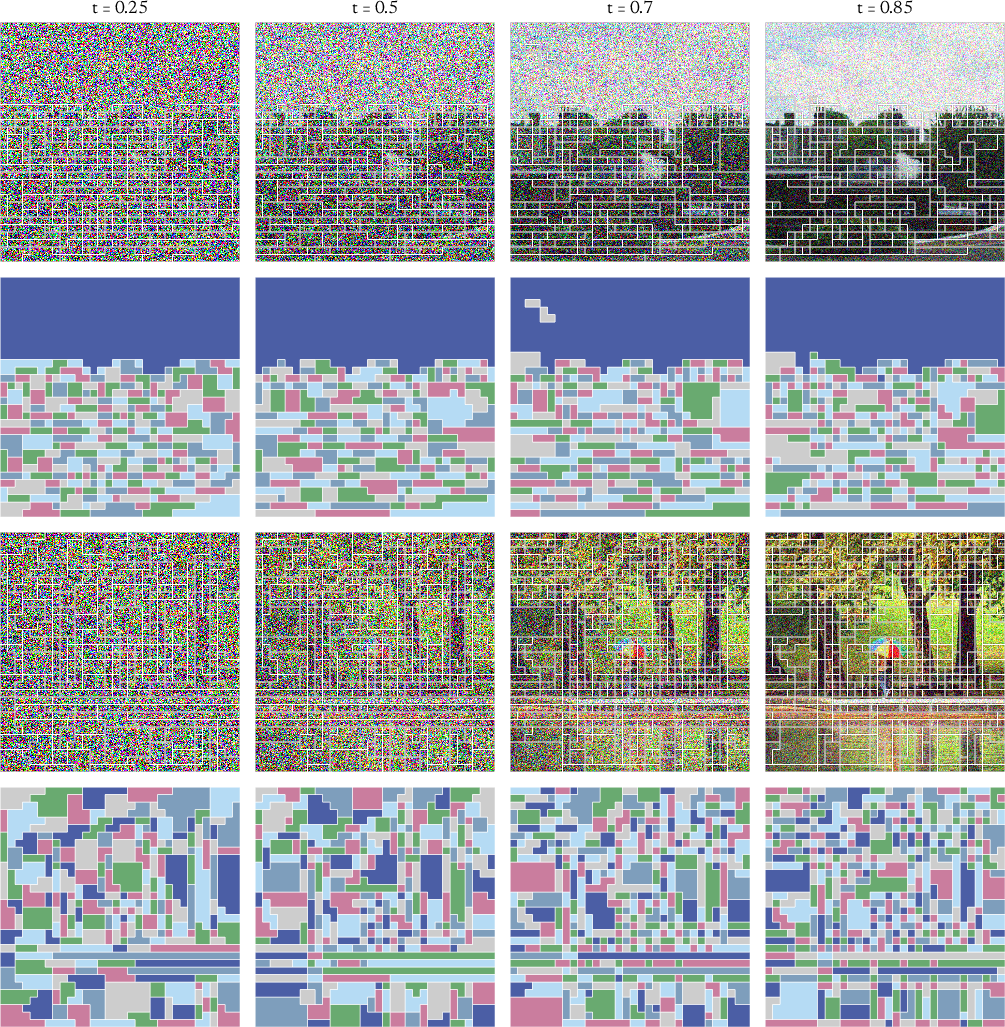
HiT does not force every image to have exactly the same groups. A simple image with a large plain sky may need only a few groups for that area. A complicated image with many objects may need more.
The system uses a compression budget to control how much information is combined on average. This is like telling a student, “Summarize this chapter in about ten sentences,” while allowing some chapters to need nine sentences and others eleven.
4. What did the researchers find?
Better image generation
The researchers tested HiT on ImageNet, a large collection of labeled images.
They measured image quality using FID, or Fréchet Inception Distance. Lower FID generally means that generated images look more like real images.
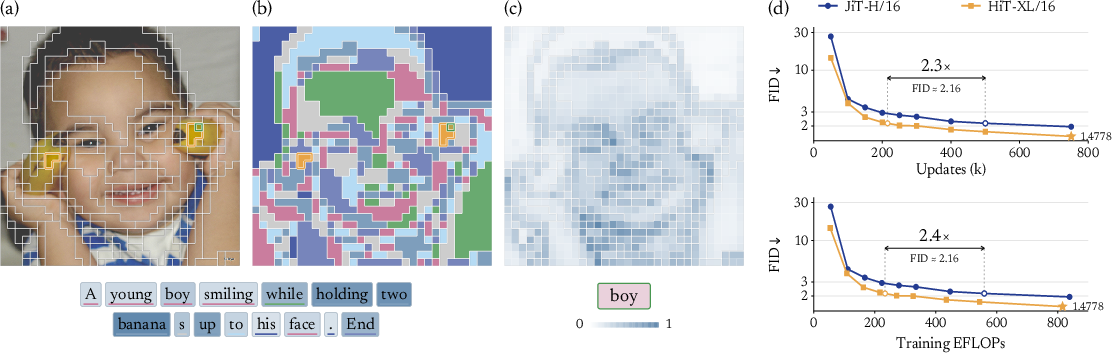
HiT achieved a FID of 1.48 on ImageNet images after 600 training epochs. This was better than the compared JiT model, which achieved 1.86.
The results also showed that HiT could reach similar quality to JiT while using about:
- 40% of the total training computation, and
- fewer training updates.
This is important because training large AI systems can require enormous amounts of time, electricity, and computer hardware.
Better use of image structure
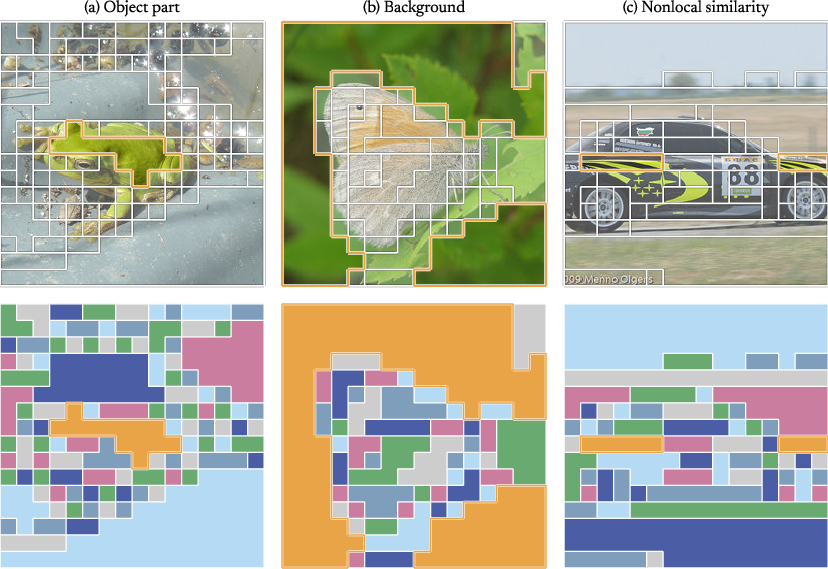
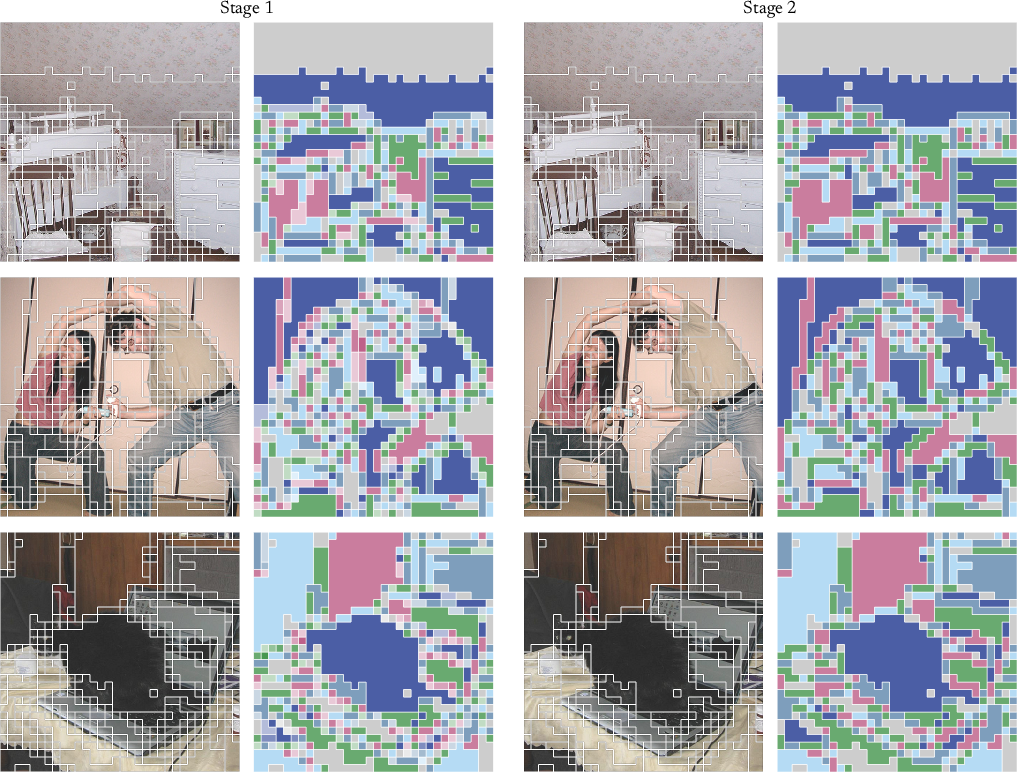
HiT learned meaningful groups without being given labels showing where objects were located.
It often grouped:
- parts of the same object,
- similar background areas,
- repeated patterns, such as foliage,
- separate parts of an object that were far apart, and
- similar objects in different image locations.
For example, distant patches showing similar car markings could be placed in the same group.
The researchers describe this as an emergent behavior. That means the model learned the behavior on its own rather than being directly instructed to do it.
Stronger text-to-image generation
The researchers also tested HiT on text-to-image generation using captions.
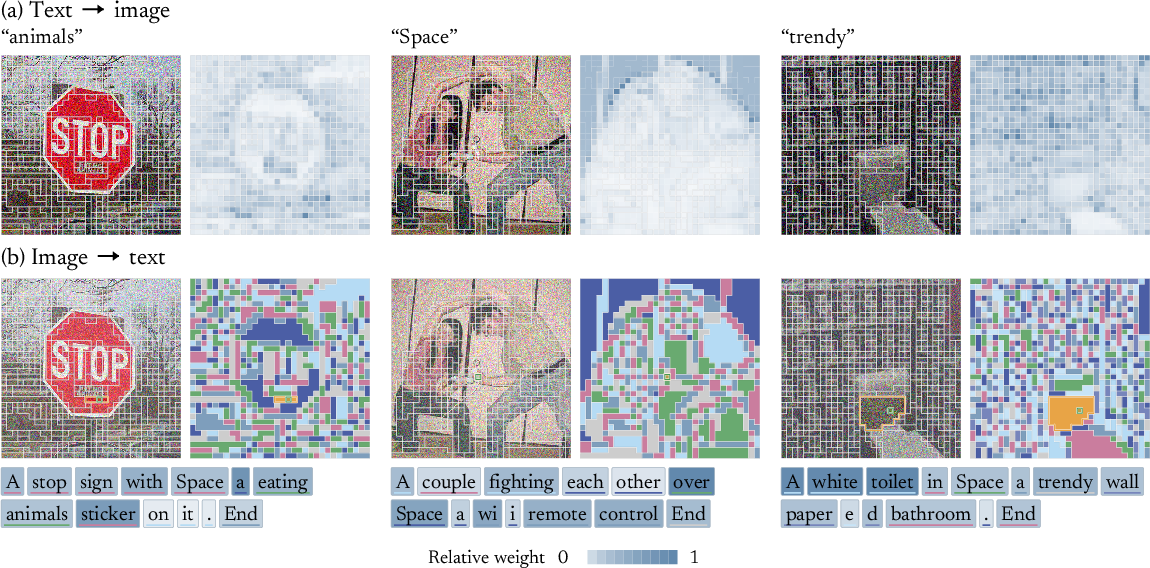
HiT learned connections between words and image regions without being told exactly which word matched which part of the image. For example:
- the word “banana” became connected to banana-shaped image regions;
- the word “boy” became connected to the boy’s face and upper body.
On five text-to-image tests, HiT achieved an average score of 65.93. This was slightly higher than MiniT2I’s 64.64 and UniLiP-3B’s 65.76.
HiT also used fewer resources:
- about six times fewer denoiser parameters than UniLiP-3B,
- about three times fewer forward-computation operations than UniLiP-3B, and
- about 31% fewer forward FLOPs than MiniT2I.
A parameter is a learned value inside the model. More parameters can make a model more powerful, but they also make it larger and more expensive to run. FLOPs are a rough measure of how many mathematical operations the model performs.
The design choices mattered
The researchers performed smaller experiments called ablation studies. In these tests, they changed one part of HiT at a time to see what mattered.
They found that:
- gradual, moderate grouping worked better than grouping too aggressively;
- soft grouping and soft restoration worked better than strict, all-or-nothing grouping;
- learned groups worked better than fixed groups based only on nearby image patches;
- processing information at both detailed and compressed levels was useful.
These tests support the claim that HiT’s improvement comes from its learned hierarchy, not simply from using a different model size.
5. Why is this research important?
HiT suggests that an image generator does not always need a separately trained visual encoder to understand image structure. Instead, it may learn a useful hierarchy while learning to generate pictures.
This could lead to image-generation systems that are:
- more efficient, because they process fewer tokens in the most expensive part of the network;
- better at understanding objects and scenes, because related information is grouped together;
- better at connecting text with images, even without detailed word-to-region labels;
- simpler to train, because image organization and image generation happen together.
The broader lesson is that the way an AI organizes information may be just as important as how large the AI is. HiT shows that a model can become faster and more capable by learning when details should be combined and when they should remain separate.
However, the results do not mean that HiT is perfect. The experiments focus on particular datasets, image sizes, and evaluation tests. More research would be needed to determine how well it works for unusual images, very detailed scenes, video, or real-world applications.
Overall, the paper presents HiT as a promising step toward faster, more capable image generators that learn visual structure on their own.
Practical Applications
Immediate Applications
The paper provides an implementation-ready architecture and publicly referenced code and model checkpoints, so the most immediate uses are in image-generation systems, research workflows, and compute optimization rather than safety-critical deployment.
- More efficient text-to-image generation for creative software and media production
- Sector: Software, advertising, film, game development, design.
- HiT can serve as a lower-compute text-to-image backend for concept art, storyboards, product mockups, thumbnails, social-media assets, and marketing variations.
- Its text-to-image model achieves a higher average benchmark score than MiniT2I while using approximately 31% fewer forward FLOPs, and it exceeds UniLiP’s average score with substantially fewer denoiser parameters.
- Potential product/workflow: Integrate HiT into an image-generation API or desktop design tool, using prompt generation, batch variation, inpainting or editing modules built around the HiT denoiser.
- Dependencies: The reported results use a frozen FLAN-T5-Large text encoder, CC12M-style training data, 100-step Euler sampling, and benchmark-oriented settings. Commercial quality, latency, licensing, and prompt-safety performance require separate validation.
- Compute-cost reduction in image-generation services
- Sector: Cloud computing, machine-learning infrastructure, GPU optimization.
- The learned hierarchy reduces the number of tokens processed by deeper Transformer blocks, lowering training and inference costs relative to comparable fixed-token pixel-space models.
- HiT reaches ImageNet generation quality comparable to JiT with roughly 40% of cumulative training FLOPs and fewer training updates.
- Potential tool: A cost-aware serving system that selects compression budgets according to GPU memory, latency targets, image resolution, or batch size.
- Dependencies: Actual FLOPs vary with the input-dependent group count and diffusion timestep. Hardware-level speedups may be smaller than nominal GFLOP reductions because routing, affinity computation, clustering, and memory movement introduce overhead.
- End-to-end pixel-space generation without a separately pretrained visual encoder
- Sector: Generative-AI platforms, privacy-sensitive organizations, domain-specific imaging.
- Organizations can train a generator directly on their own image data without first building or licensing a separate latent autoencoder or visual representation model.
- This may simplify pipelines for specialized domains such as industrial design, scientific visualization, cultural archives, or proprietary product imagery.
- Potential workflow: Train a domain-specific HiT model directly on paired or unpaired images, then expose it through a controlled generation interface.
- Dependencies: The paper demonstrates ImageNet and CC12M settings, not specialized domains. Sufficient data, high-quality captions where text conditioning is used, substantial GPU resources, and careful evaluation of reconstruction and generation fidelity remain necessary.
- Adaptive inference under variable hardware or latency constraints
- Sector: Mobile computing, edge AI, cloud serving, interactive applications.
- HiT’s compression budget and input-dependent group counts can potentially support different computational modes for the same model. A deployment could increase compression for fast previews and retain more groups for high-quality final renders.
- Potential product: A “draft/standard/quality” generation mode in a design application or API, with routing thresholds calibrated to latency and memory budgets.
- Dependencies: The paper establishes adaptive grouping but does not report mobile benchmarks, real-time latency, energy consumption, or a formally controllable quality-latency curve. Thresholds would need to be calibrated for each hardware platform.
- Research tooling for inspecting emergent visual organization
- Sector: Academia, computer vision research, explainable AI.
- HiT’s group assignments and soft routing matrices can be visualized to inspect which patches are processed together and which caption words are associated with image regions.
- Researchers can use these maps to study object parts, repeated textures, spatially disconnected regions, and the evolution of visual organization over diffusion timesteps.
- Potential tool: A model-debugging dashboard that overlays hard groups, soft pooling weights, token counts, and timestep-dependent routing on generated or training images.
- Dependencies: Group membership is an internal computational representation, not guaranteed to be a human-interpretable segmentation or explanation. Its stability across prompts, random seeds, model versions, and datasets must be tested.
- Benchmarking adaptive token-compression strategies
- Sector: Academia and ML systems research.
- The architecture offers a reproducible baseline for comparing learned grouping, fixed spatial hierarchies, token merging, latent diffusion, and other dynamic-computation methods.
- The paper’s ablations suggest that moderate progressive compression, soft aggregation, and soft ungrouping are important design choices.
- Potential workflow: Evaluate models using quality, FLOPs, wall-clock latency, memory, energy, group-count variance, and robustness rather than FID alone.
- Dependencies: Reported FID and text-to-image benchmark scores depend on sampling schedules, guidance scales, datasets, and model sizes. Independent replication is needed before drawing broad conclusions.
- Lower-cost educational and prototyping environments for generative vision
- Sector: Education, research training, open-source development.
- Smaller HiT variants can be used to teach diffusion models, adaptive computation, Transformer design, clustering, multimodal alignment, and model scaling.
- Because the method removes the need for a separately pretrained visual encoder, students can study the full image-generation pipeline in one training framework.
- Dependencies: Even the smaller models may require substantial GPU time, and simplified classroom versions may not reproduce the reported generation quality.
- Prompt-to-image assistance in daily creative tasks
- Individuals could use a HiT-based application for visual brainstorming, presentation illustrations, personalized posters, educational diagrams, mood boards, and rapid iteration on design ideas.
- Its learned image–text associations may improve alignment between objects mentioned in prompts and the corresponding generated regions.
- Dependencies: Outputs remain probabilistic and may contain factual, cultural, copyright, bias, or representation errors. Human review is required, especially for professional, public-facing, or sensitive content.
Long-Term Applications
The following opportunities depend on further validation, larger-scale training, domain adaptation, or integration with downstream systems. They are plausible extensions of the paper rather than demonstrated capabilities.
- Adaptive high-resolution generation for professional visual production
- Sector: Film, games, architecture, product design, virtual and augmented reality.
- HiT could allocate more tokens to visually complex objects and fewer to uniform backgrounds, potentially making high-resolution generation more affordable than uniform-token pixel-space Transformers.
- Potential product: A multi-stage renderer that uses coarse groups for scene composition and selectively increases capacity around faces, text, mechanical details, or other high-value regions.
- Dependencies: The paper evaluates up to text-to-image generation. High-resolution images create much larger token populations, and the current grouping mechanism may require optimization to prevent routing overhead or loss of fine detail.
- Region-aware image editing without explicit segmentation labels
- Sector: Photo editing, e-commerce, digital content creation.
- Since HiT groups coherent objects and object parts and can associate caption words with image patches, its routing structure could support editing instructions such as “change the color of the car” or “remove the background foliage.”
- Potential workflow: Use word-to-group associations to identify candidate regions, then apply localized diffusion updates while preserving unrelated groups.
- Dependencies: The paper shows associations and visualizations but does not demonstrate reliable editing, object identity preservation, or precise segmentation. Additional region supervision, consistency losses, or post-processing may be required.
- Controllable computation for energy-efficient generative AI
- Sector: Sustainable computing, data centers, edge devices, energy management.
- Dynamic group counts could become an energy-management mechanism: simple images or late denoising steps could use fewer groups, while complex stages receive more computation.
- Potential system: A scheduler that selects compression targets based on carbon intensity, battery level, thermal limits, or user-specified quality.
- Dependencies: Token reduction must translate into measured energy savings, not merely lower theoretical FLOPs. Routing overhead, memory bandwidth, hardware utilization, and repeated diffusion steps must be profiled end to end.
- Robotics and embodied vision generation
- Sector: Robotics, simulation, autonomous systems.
- A hierarchical pixel-space generator could produce synthetic observations, task scenes, object arrangements, or visual rollouts for robot training. Grouping spatially disconnected but semantically related regions may help model repeated objects or environmental structures.
- Potential tool: A simulation-data generator conditioned on natural-language task descriptions, robot state, or scene constraints.
- Dependencies: The paper does not evaluate temporal consistency, 3D geometry, physical plausibility, or action conditioning. Robotics use would require video or 3D extensions and strong safety validation.
- Synthetic data generation for healthcare and scientific imaging
- Sector: Healthcare, biomedical research, materials science, remote sensing.
- HiT could potentially generate privacy-preserving or data-augmentation images while learning hierarchical structure directly from domain-specific pixels.
- Potential workflow: Generate rare-condition examples, microscopy variations, or controlled imaging artifacts for training classifiers and segmentation systems.
- Dependencies: Medical deployment requires clinically representative distributions, calibrated uncertainty, privacy analysis, expert validation, and regulatory review. The paper provides no evidence that HiT preserves medically relevant features or avoids generating clinically misleading artifacts.
- Multimodal content generation with implicit word–region alignment
- Sector: Accessibility, multimedia search, education, content management.
- The shared image–text grouping mechanism could support systems that connect phrases to visual regions without manually annotated bounding boxes.
- Potential tools: Caption-grounded image search, automatic visual explanations, region-specific alt-text generation, slide illustration systems, or query-driven image organization.
- Dependencies: Emergent alignment may be incomplete or biased, particularly for small objects, relations, negation, counting, and ambiguous language. Explicit alignment evaluation and possibly light supervision would be needed.
- Adaptive visual tokenization for video and 3D generation
- Sector: Video production, game engines, digital twins, autonomous perception.
- The grouping principle could be extended across frames, views, or spatial volumes so that temporally persistent objects share compact representations.
- Potential architecture: A hierarchical diffusion model that dynamically groups patches across space and time, allocating computation to motion boundaries and changing objects.
- Dependencies: Independent per-image grouping would cause temporal flicker. Video and 3D versions need motion-aware grouping, persistent identities, memory management, and guarantees of temporal or geometric consistency.
- Policy and governance tools for auditing generative models
- Sector: Public policy, AI governance, model auditing.
- Routing maps and group-count statistics could become diagnostic signals for auditing whether a model attends to relevant objects, handles prompts consistently, or allocates disproportionate computation to particular visual categories.
- Potential workflow: Record routing behavior during red-team prompts and compare group assignments across demographic attributes, prompt paraphrases, image contexts, and diffusion timesteps.
- Dependencies: Internal routing is not a definitive measure of attention, causality, fairness, or model reasoning. Audits would require behavioral tests, human review, dataset documentation, and safeguards against treating visualizations as proof of compliance.
- Privacy-preserving domain-specific training
- Sector: Enterprise AI, government, legal and financial organizations.
- End-to-end training without an externally pretrained visual encoder could reduce the number of outside models and data-processing stages involved when building generators on confidential imagery.
- Potential deployment: Train an internal model on proprietary product, infrastructure, or document images while keeping data within the organization.
- Dependencies: Removing a visual encoder does not itself provide privacy. Differential privacy, access controls, memorization testing, licensing review, and secure training infrastructure would still be required.
- Interactive quality–cost optimization in generative applications
- HiT could support a controller that predicts the minimum group capacity needed for a prompt, image complexity, or denoising timestep, thereby balancing quality, latency, and cost on a per-request basis.
- This could be useful for consumer applications, large-scale API providers, and batch content generation.
- Dependencies: The paper uses a batch-level compression loss and calibrated thresholds; reliable per-request control would require new quality predictors, stability guarantees, and extensive testing across prompts and distributions.
- New training paradigms for hierarchical multimodal models
- Sector: Academia and foundational-model research.
- The paper’s central innovation—learning a hierarchy jointly with generation—could be adapted to multimodal LLMs, image understanding, audio generation, and cross-modal retrieval.
- Researchers could investigate whether adaptive grouping reduces the need for large fixed context windows or enables content-dependent computation in other modalities.
- Dependencies: The demonstrated gains are specific to pixel-space diffusion and the evaluated datasets. Transfer to language, audio, video, or understanding tasks is an open research question and may require modality-specific routing objectives.
Glossary
- Adaptive grouping: A grouping process whose memberships or number of groups changes according to the input. “HiT learns which image features to group and how many group tokens each input needs.”
- Affinity: A numerical measure of similarity or association between two token features. “We compute the symmetric affinity”
- Average linkage: A hierarchical clustering method that merges groups based on the mean similarity between their members. “This average linkage procedure defines a hierarchy.”
- Backpropagation: The process of computing gradients through a neural network to update its parameters. “We treat as a constant during backpropagation”
- Bottleneck: A computationally smaller intermediate representation through which information must pass. “The main Transformer bottleneck processes these compact group tokens”
- Classifier-free guidance (CFG): A diffusion-sampling method that strengthens conditioning by combining conditional and unconditional predictions. “classifier-free guidance (CFG) at a fixed scale of $2.9$”
- Compact representation: A reduced representation that preserves important information while using fewer tokens or dimensions. “Latent diffusion learns with compact representations supplied by pretrained autoencoders”
- Conditioning: The use of additional information, such as class labels, text, or timesteps, to control generation. “We further extend HiT to text-to-image generation”
- Contextualized token features: Token representations that incorporate information from other tokens through preceding network layers. “let denote the contextualized token features produced by the preceding Transformer blocks”
- Convergence: The process by which training reaches stable or high-quality model performance. “matching leading latent-space models in generation quality and convergence speed remains challenging.”
- Cumulative training FLOPs: The total number of floating-point operations performed during model training. “with approximately half as many optimizer updates and 40\% of the cumulative training FLOPs.”
- Denoiser: The component of a diffusion model that predicts a less noisy or clean sample from a noisy one. “with roughly fewer denoiser parameters”
- Diffusion timestep: A position in the sequence of noise levels used during diffusion training or sampling. “the memberships and group count change with the features at each denoising step.”
- Emergent behavior: A capability that arises from training without being explicitly programmed or directly supervised. “This architecture leads to several striking emergent behaviors.”
- End-to-end training: Training a complete processing pipeline jointly rather than training separate components independently. “Pixel-space diffusion removes this separate stage by learning to generate images directly through end-to-end training”
- Entropy-based segmentation: A segmentation strategy that uses information-theoretic uncertainty to determine boundaries in a sequence. “BLT and H-Net form adaptive chunks through entropy-based segmentation and learned boundary prediction, respectively”
- FID (Fréchet Inception Distance): A metric comparing the distributions of generated and real images; lower values generally indicate better quality. “HiT achieves 1.48 FID”
- Forward FLOPs: The number of floating-point operations required for one forward pass through a model. “For HiT, we report nominal costs computed using the target group count at each stage”
- Hard grouping: A discrete assignment in which each token belongs to one particular group. “Average linkage produces one hard membership per token.”
- Hard partition: A discrete division of tokens into non-overlapping groups. “During backpropagation, we treat the hard partition as constant”
- Heun sampling: A second-order numerical integration method used to approximate the reverse diffusion process. “with 50-step Heun sampling and a final Euler step.”
- Hierarchical clustering: A clustering method that constructs nested groups by repeatedly merging or splitting existing groups. “This average linkage procedure defines a hierarchy.”
- Hierarchical sequence model: A model that processes representations at multiple levels of granularity or sequence length. “Hierarchical sequence models concentrate computation on compact representations.”
- Latent diffusion: Diffusion-based generation performed in a learned compressed feature space rather than directly in pixel space. “Latent diffusion models exploit a hierarchy between pixels and compact visual representations”
- Learned router: A neural module that determines how tokens should be assigned or weighted among groups. “To realize this design, we use a learned router to group these features”
- Mean affinity: The average similarity between one token or group and the members of another group. “For each token, we compute its mean affinity to the members of each hard group.”
- Multimodal: Involving or combining more than one type of data, such as images and text. “allowing compact representations to combine information across modalities.”
- Nominal cost: An estimated computational cost based on planned or target dimensions rather than realized input-dependent values. “we report nominal costs computed using the target group count at each stage”
- Pixel-space diffusion: Diffusion generation that operates directly on image pixels instead of compressed latent representations. “Pixel-space diffusion removes this separate stage”
- Pooling matrix: A matrix of weights used to combine multiple token features into fewer aggregate representations. “The resulting pooling matrix therefore forms each compact token as a weighted average of the input features.”
- Progressive compression: Gradually reducing the number of representations across successive processing stages. “These results favor moderate, progressive compression”
- Region annotation: A label identifying the image region associated with an object, word, or semantic concept. “These associations emerge even without explicit word--region annotations.”
- Representation alignment: Training representations so that they correspond to an external or semantically meaningful representation space. “without visual pretraining or representation alignment.”
- Skip connection: A pathway that transfers earlier features directly to a later layer, helping preserve information. “A skip connection also carries features from before grouping”
- Soft aggregation: Combining features using learned continuous weights rather than discrete assignments. “we use soft weights to aggregate features during grouping”
- Softmax: A function that converts a set of scores into nonnegative values summing to one. “Applying a softmax over groups with temperature gives the weights”
- Soft pooling: Weighted aggregation in which tokens contribute continuously to one or more groups. “input-dependent soft pooling and ungrouping”
- Soft routing: Continuous assignment of tokens to groups using learned weights. “Darker blue caption words indicate stronger soft routing connections”
- Text-to-image generation: The synthesis of images conditioned on textual descriptions. “For text-to-image generation, HiT exceeds UniLiP's average score”
- Token embedding: A vector representation used as the input feature for a token. “We use linear patch embedding”
- Token reduction: Decreasing the number of tokens to lower computational cost. “In vision, token reduction groups features directly across image positions.”
- Ungrouping: Expanding group-level representations back to the original token positions. “We then use ungrouping to return processed group features to finer positions”
- Visual hierarchy: A multi-level organization in which fine-grained visual information is progressively combined into broader representations. “We hypothesize that part of this gap arises from retaining one token per patch throughout the backbone, which does not explicitly encourage a visual hierarchy”
- Visual pretraining: Training a visual encoder or representation before using it in a generative model. “without external visual pretraining.”

