Hello Again: Exploiting Replay Protected Monotonic Counters to Brute-Force Windows Hello PINs
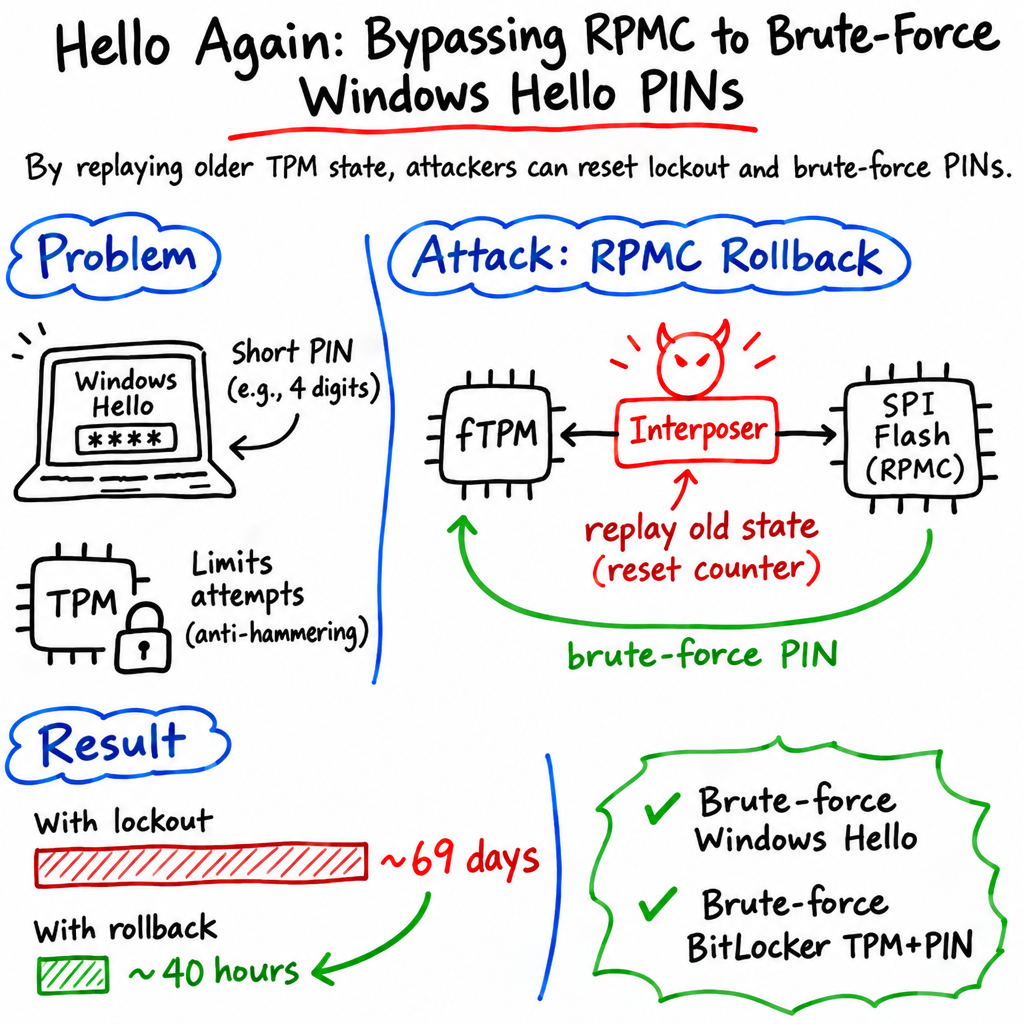
Abstract: Windows Hello is the primary authentication mechanism on over one billion Windows 11 devices, supporting PINs as short as four digits. Such low-entropy PINs are viable only because the TPM's anti-hammering protection mitigates brute-force attacks. Most modern x86 platforms rely on firmware TPMs (fTPMs) that persist their non-volatile (NV) state, including the lockout state, to SPI flash. On newer platforms, rollback prevention of this state is delegated to the flash chip via Replay Protected Monotonic Counters (RPMCs), a JEDEC-standardized mechanism operating over a physically accessible bus. We present the first practical security analysis of RPMC in shipping x86 systems. Using low-cost interposer hardware, we identify multiple implementation flaws, two of which fundamentally undermine RPMC's security model: First, Winbond SPI flash - the leading NOR flash vendor with over 25% market share - leaks its HMAC key under voltage glitching, enabling arbitrary counter forgery. Second, AMD's NV controller does not verify RPMC increments, so an interposer can suppress them unnoticed. Moreover, AMD platforms without RPMC flash appear to lack NV rollback protection altogether: on two AMD desktops, reflashing an old image resets the fTPM's lockout counters. Both flaws enable rollbacks of the fTPM's NV state (AMD, Intel, or Pluton), including its lockout counters. We demonstrate this end-to-end on locked, encrypted hardware: our setup finds a 4-digit Windows Hello PIN in 40 hours instead of 69 days. A compromised PIN also grants access to device-bound keys and Hello-based enterprise SSO. The same primitive defeats BitLocker's TPM+PIN pre-boot protector, reducing the worst-case time for a default-length 6-digit PIN from 19 years to 20 days.
Paper Prompts
Sign up for free to create and run prompts on this paper.
Explain it Like I'm 14
1. What is this paper about?
This paper studies the security of Windows Hello PINs and the hardware designed to protect them.
Windows Hello allows people to unlock Windows using a short PIN, sometimes only four numbers long. A four-digit PIN has just 10,000 possible combinations, so someone could eventually guess it by trying many combinations. To stop this, Windows uses a security chip called a TPM. The TPM counts failed attempts and makes the attacker wait longer after too many wrong guesses.
The researchers found that some computer hardware can be manipulated so the TPM “forgets” that wrong PINs were already tried. This allows an attacker with physical access to the computer to keep guessing almost without limits.
2. What questions did the researchers ask?
The researchers mainly wanted to know:
- Does the hardware that protects TPM data really prevent attackers from restoring an older version of the data?
- Can attackers interfere with Replay Protected Monotonic Counters, or RPMCs, which are supposed to stop old data from being reused?
- Can weaknesses in this hardware allow someone to defeat Windows Hello’s PIN lockout system?
- Could the same attack affect other security features, such as BitLocker disk encryption?
In simple terms, they were checking whether a computer’s security system could be tricked into going back in time.
3. How did they investigate?
TPMs and failed-attempt protection
A TPM is a security component built into modern computers. It can store secret information and enforce rules about when that information may be used.
For example, after too many incorrect PINs, the TPM can enter a lockout state. By default, it may allow only a limited number of attempts and then require long waits between new attempts.
The TPM stores this information even when the computer is turned off. This is called non-volatile storage, meaning the information does not disappear when power is removed.
Flash memory and RPMCs
The TPM’s saved data is often stored in the computer’s SPI flash chip. This chip stores important low-level information, such as firmware and security settings.
The data is encrypted, but encryption alone is not enough. An attacker might save an old copy of the encrypted data and later put it back. This is called a rollback attack or replay attack.
An RPMC is supposed to prevent this. It acts like a one-way counter:
- The counter can increase.
- It should never decrease.
- The computer checks the counter to make sure it is using the newest data.
An everyday analogy is a numbered receipt book. Every new receipt must have a higher number than the previous one. If someone tries to replace the book with an older copy, the number gives them away.
Hardware experiments
The researchers tested flash chips from three manufacturers: Winbond, Macronix, and GigaDevice. They also tested computers using AMD and Intel security systems.
They built a small device called an interposer. It was placed between the computer and its flash chip, allowing the researchers to watch and alter messages traveling between them.
They also used voltage glitching. This means briefly changing the power supplied to a chip at carefully chosen moments. It is similar to flicking a light switch extremely quickly while a machine is performing an important operation. The goal is to make the chip behave incorrectly.
Finally, they tested whether they could:
- Save an earlier version of the computer’s security data.
- Cause failed PIN attempts.
- Restore the old security data.
- Make the computer forget some or all of those failed attempts.
- Repeat the process while guessing the PIN.
4. What did they find?
A serious flaw in some Winbond flash chips
The researchers discovered that voltage glitching could cause certain Winbond chips to reveal a secret authentication key.
This key is normally used to prove that messages about the RPMC counter are genuine. Once the researchers obtained it, they could create false messages and pretend that the counter had a different value.
This allowed them to make the computer accept an older version of its saved TPM data.
In effect, the attacker could turn back the security system’s clock.
A serious flaw in AMD’s counter handling
The researchers also found that some AMD systems did not properly check whether the flash chip had successfully increased its RPMC counter.
An attacker could block the increase, and the AMD controller would not notice. This also allowed older TPM data to be restored.
This attack worked even when the flash chip itself did not have the Winbond key-leaking problem.
Some AMD computers had little or no rollback protection
On two AMD desktop computers without suitable RPMC flash memory, the researchers simply wrote an older copy of the flash data back to the computer. The TPM’s failed-attempt counter was reset to its older value.
This suggests that some AMD systems may not have had effective protection against this kind of rollback.
Windows Hello PINs could be guessed much faster
The researchers demonstrated a complete attack on a real AMD laptop.
A four-digit Windows Hello PIN would normally have a worst-case search time of about 69 days if the attacker could try one PIN every 10 minutes. Using the rollback attacks, the researchers reduced this to about 40 hours.
The attack did not magically discover the PIN. Instead, it removed the waiting period after wrong guesses, allowing the attacker to try many more combinations.
A successful PIN could provide access to:
- The Windows account
- Keys tied to the computer
- Windows Hello-based enterprise login systems
- Other services that trust Windows Hello
BitLocker PINs were also affected
The same general weakness could affect BitLocker when it uses a startup PIN.
The researchers estimated that a normal six-digit BitLocker PIN could take up to 19 years to guess under the usual lockout rules. Their attack reduced the worst-case time to about 20 days.
This is important because BitLocker is used to protect files if a laptop is lost or stolen.
Other weaknesses
The researchers also found smaller problems, including:
- Some counters returned to zero after reaching their maximum value. This is called an integer overflow.
- One chip could sometimes be made to report an incorrect counter value.
- Intel systems reused some authentication information in a way that weakened the design, although the researchers described this as a less serious issue.
The researchers reported their findings to Winbond, Macronix, GigaDevice, JEDEC, Intel, AMD, and Microsoft. According to the paper, the companies had not committed to fixing all of the underlying hardware problems. Microsoft did recommend increasing the minimum Windows Hello PIN length from four digits to six.
5. Why are these findings important?
The main lesson is that security protections can fail even when the computer uses strong encryption and a TPM.
The TPM itself may correctly count failed attempts. However, if an attacker can replace the TPM’s saved information with an older copy, the TPM may believe that fewer attempts have happened. This weakens the protection without directly breaking the PIN’s encryption.
The attack requires significant physical access and technical skill. An attacker would generally need to open the computer, connect special hardware, and interfere with the flash chip. Therefore, this is not an easy attack for an ordinary person to perform remotely.
However, it could matter when:
- A laptop is stolen.
- An attacker has extended access to a computer.
- A high-value business or government device is targeted.
- A device is sent away for repair.
- A company depends on short PINs for employee authentication.
Conclusion: What could happen next?
This research shows that hardware-based security systems must protect not only secret data, but also the history of how that data changes over time.
The researchers suggest that manufacturers need to:
- Fix the flawed flash-chip designs.
- Properly verify that security counters really increase.
- Add rollback protection to systems that currently lack it.
- Test RPMC implementations more carefully against physical attacks.
- Encourage users and organizations to choose longer PINs.
For everyday users, a longer PIN is a useful improvement, although it does not repair the hardware flaws. For manufacturers, the paper is a warning that a security system is only as strong as every part supporting it—including small memory chips and the connections between them.
Practical Applications
The paper’s findings primarily support defensive applications in hardware security, endpoint management, secure authentication, and standards development. The attacks require physical access, SPI-flash manipulation, specialized interposer hardware, and—depending on the path—voltage fault injection; therefore, they are most relevant to high-value endpoints, enterprise fleets, forensic testing, and supply-chain assurance rather than ordinary remote attacks.
Immediate Applications
- Enterprise risk assessment for Windows endpoints — Industry / IT security
- Organizations can inventory laptops and desktops according to:
- CPU and security processor vendor;
- fTPM, Pluton, or discrete TPM usage;
- SPI-flash manufacturer and model;
- presence or absence of RPMC or equivalent rollback protection;
- use of Windows Hello, Windows Hello for Business, BitLocker TPM+PIN, or device-bound credentials.
- Systems matching the affected configurations should be classified as vulnerable to physical-access attacks that reset or bypass TPM anti-hammering state.
- Potential workflow: combine Microsoft Intune, Configuration Manager, firmware inventory, SMBIOS data, and vendor hardware databases to create a fleet-level exposure report.
- Dependencies: reliable identification of the flash component and the platform’s actual NV-state implementation; the paper shows that branding alone does not establish whether rollback protection is present.
- Immediate hardening of Windows Hello and BitLocker policies — Industry / Endpoint security
- Raise the minimum Windows Hello PIN length above the four-digit default, preferably using longer numeric or alphanumeric credentials.
- Require biometrics or an additional authentication factor where practical, rather than treating a short PIN as the sole protection for enterprise SSO or device-bound keys.
- For BitLocker, retain TPM+PIN protection but enforce stronger PIN policies and consider recovery procedures that do not rely exclusively on a short startup PIN.
- Apply Microsoft and OEM firmware updates where available, while recognizing that software changes cannot fully repair a vulnerable flash-chip implementation.
- Dependencies: longer PINs increase brute-force cost but do not eliminate the hardware flaw; organizations must also consider usability, recovery-key management, and whether the attacker can maintain physical access for an extended period.
- Security testing of laptop and motherboard designs — Industry / Hardware assurance
- OEMs and independent laboratories can use the paper’s attack model as a test case for validating:
- RPMC command verification;
- counter-increment confirmation;
- resistance to voltage fault injection;
- protection of HMAC and root-key material;
- correct rejection of stale NV images;
- behavior at counter exhaustion;
- rollback handling for fTPM state and sensitive EFI variables.
- Testing should cover integrated combinations of SoC, NV controller, flash chip, firmware, and operating system, not just isolated components.
- Potential product: a hardware-security validation suite for laptop platforms, including SPI-bus monitoring, fault-injection testing, and automated rollback-state verification.
- Dependencies: test laboratories need specialized equipment and vendor cooperation; results may not generalize across board revisions, firmware versions, or flash variants.
- Firmware and platform procurement requirements — Industry / Supply chain
- Enterprises and public-sector buyers can add requirements that vendors disclose:
- the mechanism protecting fTPM NV state;
- whether RPMC is used and how it is integrated;
- the flash vendor and exact part number;
- behavior when counters reach their maximum value;
- independent fault-injection test results;
- patch and replacement commitments for vulnerable components.
- Procurement contracts can require secure firmware-update support and documented mitigation paths for systems that cannot be repaired through software.
- Dependencies: vendors may not disclose detailed platform architecture, and component substitutions during manufacturing can invalidate an earlier assessment.
- Incident-response and forensic procedures for physically accessed devices — Industry / Digital forensics
- A suspected device compromise should be treated differently from a normal failed-login event when an attacker had access to the motherboard, SPI flash, or storage.
- Response teams should consider:
- invalidating Windows Hello and Windows Hello for Business credentials;
- revoking device-bound certificates and FIDO2 credentials;
- rotating enterprise SSO credentials and recovery secrets;
- requiring BitLocker recovery-key revalidation;
- preserving firmware, flash, and TPM-related evidence before reimaging.
- Dependencies: evidence collection may alter volatile or persistent platform state; organizations need OEM-specific forensic procedures and must distinguish a genuine compromise from an ordinary TPM reset.
- Defensive research and classroom laboratories — Academia / Security education
- The low-cost interposer architecture and the paper’s experimental methodology can support controlled research into:
- hardware fault injection;
- trusted-computing failure modes;
- secure-counter design;
- firmware supply-chain security;
- validation of anti-hammering mechanisms.
- A safe laboratory exercise could use sacrificial development boards or simulated RPMC devices rather than production laptops and real authentication secrets.
- Dependencies: experiments require authorization, electrical safety controls, non-production hardware, and careful handling of dual-use attack artifacts.
- Standards and vendor review of RPMC implementations — Policy / Standards
- JEDEC and platform vendors can immediately review implementation requirements for:
- counter overflow behavior;
- mandatory verification of increment success;
- fault-aware state transitions;
- separation and clearing of cryptographic intermediate values;
- uniqueness and lifecycle management of HMAC keys;
- authenticated error and status reporting.
- Certification programs can add negative tests requiring devices to reject forged, stale, corrupted, or overflowed counter states.
- Dependencies: standards changes will not repair deployed silicon; they must be accompanied by component redesign, firmware updates, and conformance testing.
- User-level precautions for high-risk devices — Daily life
- People who face theft, seizure, or prolonged physical access to their laptop should:
- use a longer Windows Hello PIN or an alphanumeric credential;
- enable BitLocker with a strong startup PIN when appropriate;
- keep recovery keys protected separately from the device;
- avoid relying solely on a short PIN for access to password managers, corporate SSO, or cryptographic keys;
- promptly report and rotate credentials after unexplained firmware, TPM, or Windows Hello resets.
- Dependencies: these measures reduce practical exposure but cannot prevent a determined hardware attacker from exploiting a vulnerable platform.
Long-Term Applications
- RPMC 2.0 or successor designs with hardware fault resistance — Industry / Semiconductor engineering
- The findings motivate redesigned secure-counter hardware with:
- explicit saturation rather than wraparound;
- atomic, verifiable increments;
- voltage and clock fault detection;
- protected internal registers;
- zeroization of HMAC outputs and intermediate values;
- independent authentication keys for separate counters and sessions;
- tamper-evident failure states.
- Potential products: secure flash chips, embedded security controllers, or TPM storage modules certified for physical fault-injection resistance.
- Dependencies: redesign requires new silicon, qualification, supply-chain replacement, and compatibility testing with existing SoCs and firmware.
- On-chip or physically isolated NV storage for fTPMs — Industry / Hardware architecture
- Future platforms could avoid placing critical fTPM state on externally accessible SPI flash by using:
- secure on-die non-volatile memory;
- a dedicated secure element;
- an authenticated RPMB-like storage subsystem;
- a security processor with an isolated persistent-memory controller.
- This would reduce dependence on the motherboard flash bus and limit the consequences of flash-chip implementation flaws.
- Dependencies: cost, endurance, manufacturing complexity, recovery semantics, and secure migration between security processors must be solved.
- Cryptographically independent anti-hammering designs — Software and platform security
- Windows and other operating systems could supplement TPM counters with additional mechanisms that do not depend solely on rollback-protected external NV state, such as:
- server-side risk controls for enterprise authentication;
- hardware-backed rate limits in an independent security component;
- secure monotonic time or external attestation;
- permanent or administrator-controlled lockout policies for high-risk credentials;
- mandatory secondary factors after suspicious reboot or firmware events.
- Dependencies: these mechanisms must preserve offline usability, avoid denial-of-service abuse, protect privacy, and remain functional when a device is disconnected from enterprise services.
- Remote attestation of rollback-protection health — Industry / Cloud and enterprise management
- Endpoint-management systems could attest not only to boot measurements but also to:
- the platform’s rollback-protection mechanism;
- RPMC availability and status;
- firmware and flash-component identity;
- successful counter progression;
- recent TPM or credential resets.
- Access-control systems could then restrict enterprise SSO, VPN, cloud-console, or sensitive application access from devices whose rollback defenses are absent or unverifiable.
- Dependencies: attestation must measure the actual hardware path rather than trusting a software-reported configuration, and enterprises need interoperable evidence formats.
- Hardware-backed security labels for consumer and enterprise devices — Policy / Procurement
- Regulators or certification bodies could establish device ratings covering resistance to:
- flash rollback;
- voltage glitching;
- counter overflow;
- TPM-state replay;
- physical extraction of authentication secrets.
- Such labels could guide public procurement and help consumers distinguish ordinary TPM presence from stronger physical-attack resistance.
- Dependencies: evaluation criteria must be transparent, affordable, regularly updated, and applicable across diverse architectures.
- Secure firmware anti-rollback systems beyond authentication — Embedded systems / Automotive / Robotics / Energy
- The paper’s counter-overflow and authentication findings apply to any design using RPMC to ratchet firmware versions or configuration states. Potential affected sectors include:
- automotive control units;
- industrial controllers;
- robotics;
- medical devices;
- smart meters and energy systems;
- network appliances.
- Future products could use formally specified, independently monitored version counters to ensure that a device cannot accept an older firmware image after compromise.
- Dependencies: the security design must address counter exhaustion over the device’s service life, secure recovery from failed updates, field replacement, and emergency rollback procedures.
- Formal verification and automated conformance testing for secure counters — Academia / Industry
- Researchers could develop formal models and test generators for RPMC-like protocols, checking:
- monotonicity invariants;
- atomicity of updates;
- authenticity of status responses;
- resistance to replay and fault-induced state divergence;
- correct behavior under power loss and counter exhaustion.
- Potential tools: symbolic protocol analyzers, hardware-in-the-loop fuzzers, voltage/clock fault test frameworks, and certification-oriented test suites.
- Dependencies: formal models must include analog fault behavior and implementation-specific timing, which are not fully captured by protocol-level verification alone.
- More robust authentication policy for physical-threat environments — Policy / High-security operations
- Organizations such as defense contractors, research laboratories, financial institutions, and critical-infrastructure operators could adopt policies that treat short device PINs as convenience credentials rather than sufficient high-assurance authentication.
- Long-term architectures may combine measured boot, resilient hardware anti-hammering, user presence, smart cards or security keys, and centralized risk evaluation.
- Dependencies: stronger controls increase deployment cost and user friction and require carefully designed recovery and emergency-access processes.
Glossary
- Anti-hammering protection: A mechanism that limits repeated authentication attempts to resist brute-force attacks. “TPM 2.0 makes Windows Hello PINs ‘anti-hammering’ protected”
- Anti-Replay table (AR): A data structure used to detect whether stored state has been replayed from an earlier point in time. “the counter values of the ME File System’s metadata must match a so-called Anti-Replay table (AR)”
- Attestation: A cryptographic process by which a device proves the state or identity of its hardware and software. “including device attestation, certificate-based authentication, and conditional access policies”
- Authentication Flash: A flash-memory implementation that uses RPMC-compatible commands to provide authenticated storage. “Winbond markets the W74M series as Authentication Flash”
- Brute-force attack: An attack that systematically tries many possible credentials until the correct one is found. “The same primitive defeats BitLocker’s TPM+PIN pre-boot protector”
- Code signing: The use of cryptographic signatures to verify that software originates from a trusted source and has not been modified. “NV controllers loading firmware code and data usually employ code-signing mechanisms to provide secure boot”
- Confidentiality: The security property that prevents unauthorized parties from learning protected information. “Confidential & replay-protected storage”
- Counter forgery: The creation of false but apparently authentic security-counter values. “enabling arbitrary counter forgery”
- Counter corruption: The unauthorized alteration of a security counter or of the value returned for it. “Counter Corruption: On GigaDevice flash, voltage glitching allows manipulation of returned RPMC counter values”
- Crowbar circuit: An electronic circuit that rapidly forces a power rail into an abnormal voltage condition, commonly for fault injection. “The setup forms a crowbar circuit on the flash chip’s ”
- Cryptographic digest: A fixed-length value produced by a cryptographic hash function and used to represent data. “Each policy is represented by a cryptographic digest computed offline as the cumulative hash of a sequence of policy assertions.”
- Dictionary Attack Protection: A TPM mechanism that limits exhaustive attempts against passwords or PINs. “The TPM enforces a hardware-level dictionary attack (DA) protection mechanism”
- Discrete TPM (dTPM): A physically separate TPM chip connected to a system through an external communication bus. “TPMs were realized in dedicated chips connected to the SoC via an LPC or SPI bus (discrete TPMs or dTPMs)”
- Device-bound credential: A credential cryptographically associated with a particular device. “Hello is advertised as the central authentication method, beyond unlocking the laptop, that also authenticates the use of other device-bound credentials”
- Electronic fault injection: The deliberate introduction of abnormal electrical conditions to cause a device to behave incorrectly. “standard fault-injection countermeasures”
- Firmware TPM (fTPM): A TPM implemented in firmware and executed by a processor’s secure environment rather than in a separate chip. “A more popular type of TPM implementation now is firmware TPMs (fTPMs).”
- FIDO2: A standard for passwordless authentication using public-key cryptography and hardware-backed credentials. “including the use as a FIDO2 security key”
- Hash function: A function that maps input data to a fixed-size value for integrity and cryptographic operations. “HMAC with SHA256 as the underlying hash function”
- Hardware attack: An attack that exploits a device’s physical components, interfaces, power behavior, or implementation. “The current definition of the Serial Flash does not offer any protection against HW attacks”
- HMAC: A keyed-hash construction used to authenticate messages and verify their integrity. “commands are appended with a Message Authentication Code, also called a signature within the specification, generated using HMAC with SHA256”
- HMAC engine: Hardware or firmware logic that computes keyed-hash message authentication codes. “Winbond seems to reuse the register read by Read Extended Status to store the chip’s HMAC engine output.”
- HMAC key: A secret key used to generate or verify HMAC values. “More critically, when we encountered a similar glitch after an Update HMAC Key Register command, the chip returned the calculated HMAC key”
- HMAC Key Leak: The unintended disclosure of an HMAC key through a vulnerability in a flash chip. “HMAC Key Leak: On Winbond flash, voltage glitching leaks valid RPMC signatures and, more critically, the authentication keys”
- Integrity protection: Mechanisms that detect unauthorized modification of data. “This data is encrypted and integrity protected via device-unique keys”
- Interposer: A hardware device inserted between two components to observe, modify, or inject communications. “our custom-made interposer PCB”
- Integer overflow: A condition in which arithmetic exceeds the maximum representable value and wraps around to a smaller value. “If a counter with a value of PHONE is incremented once more, it returns to 0.”
- JEDEC: An industry standards organization that defines specifications for electronic components and memory devices. “RPMC is a specification of JEDEC for SPI flash devices”
- Lockout mode: A state in which authentication attempts are blocked after too many failures. “after how many failed authorization attempts a Lockout Mode is entered”
- Message Authentication Code (MAC): A keyed cryptographic value used to verify a message’s authenticity and integrity. “applying a Message Authentication Code”
- Monotonic counter: A counter designed to increase without decreasing or repeating earlier values. “Devices supporting this standard are extended with commands enabling the usage of multiple monotonic counters”
- Non-volatile (NV) state: Persistent device data that remains available after power loss or reboot. “To persist their state across reboots, fTPMs store it along with other non-volatile (NV) data on SPI flash.”
- NOR flash: A non-volatile memory technology that supports random access to stored data and is commonly used for firmware storage. “Winbond SPI flash – the leading NOR flash vendor”
- Policy digest: A cryptographic digest representing a TPM authorization policy. “If one of these digests matches the policy digest of, e.g., a sealed storage, it serves as a valid authorization”
- Policy session: A TPM session in which authorization policies and their associated digests are evaluated. “Software interfacing with the TPM always does so in the context of a policy session”
- Power glitching: The deliberate and precisely timed disturbance of a device’s supply voltage to induce faulty behavior. “Winbond SPI flash ... leaks its HMAC key under voltage glitching”
- Replay attack: An attack that resubmits previously recorded valid data or device state to make a system accept outdated information. “they could still save the ciphertexts and replay them”
- Replay Protected Memory Block (RPMB): A storage mechanism that authenticates access and prevents previously used data from being replayed. “It is closely related to one part of another JEDEC specification: the Replay Protected Memory Block (RPMB) of eMMC.”
- Replay Protected Monotonic Counter (RPMC): A flash-memory security mechanism that uses authenticated counters to detect rollback of stored state. “RPMC is a specification of JEDEC for SPI flash devices that builds on top of the SPI bus protocol”
- Rollback attack: An attack that restores a system or stored data to an older state in order to bypass newer security restrictions. “Otherwise, features such as the fTPM Dictionary Attack Protection ... are vulnerable to rollback attacks.”
- Root Key: A persistent pre-shared secret used to authenticate access to an RPMC counter. “The Root Key serves as the persistent pre-shared secret that authenticates users of a counter”
- Secure Boot: A boot process that executes only software verified as trusted through cryptographic signatures. “loading and executing only trusted software”
- Sealed storage: TPM-protected storage whose contents can be accessed only by the originating TPM under specified conditions. “TPM sealed storage allows the TPM to encrypt and integrity-protect an arbitrary data blob.”
- Single Sign-On (SSO): An authentication arrangement in which one authentication event grants access to multiple applications or services. “serves as a Single Sign-On (SSO) provider for enterprises”
- SPI flash: Serial Peripheral Interface flash memory used to store firmware and persistent system data. “fTPMs store it along with other non-volatile (NV) data on SPI flash.”
- Threat model: A formal description of an attacker’s capabilities, access, and objectives. “the main threat model for these chips are attackers that already have physical access to a device”
- Trusted Execution Environment (TEE): An isolated execution environment designed to protect code and data from the normal operating system. “These run in Trusted Execution Environments (TEEs)”
- Trusted Platform Module (TPM): A hardware or firmware security module that provides cryptographic services, protected storage, and platform integrity functions. “Trusted Platform Modules, as defined by the TPM 2.0. Library Specification”
- Voltage-fault injection: An attack that manipulates a device’s supply voltage to induce exploitable computation errors. “KeywordsTrusted Platform Modules, Rollback Prevention, Voltage Fault Injection, Brute-Force Attacks, Interposer Attacks”
- Zero-knowledge proof: A cryptographic method for proving knowledge of information without revealing the information itself. “a TPM object created with tpm2-tools on Linux”

