Interpretable weight-space programming builds transparent transformers and brain encoding models
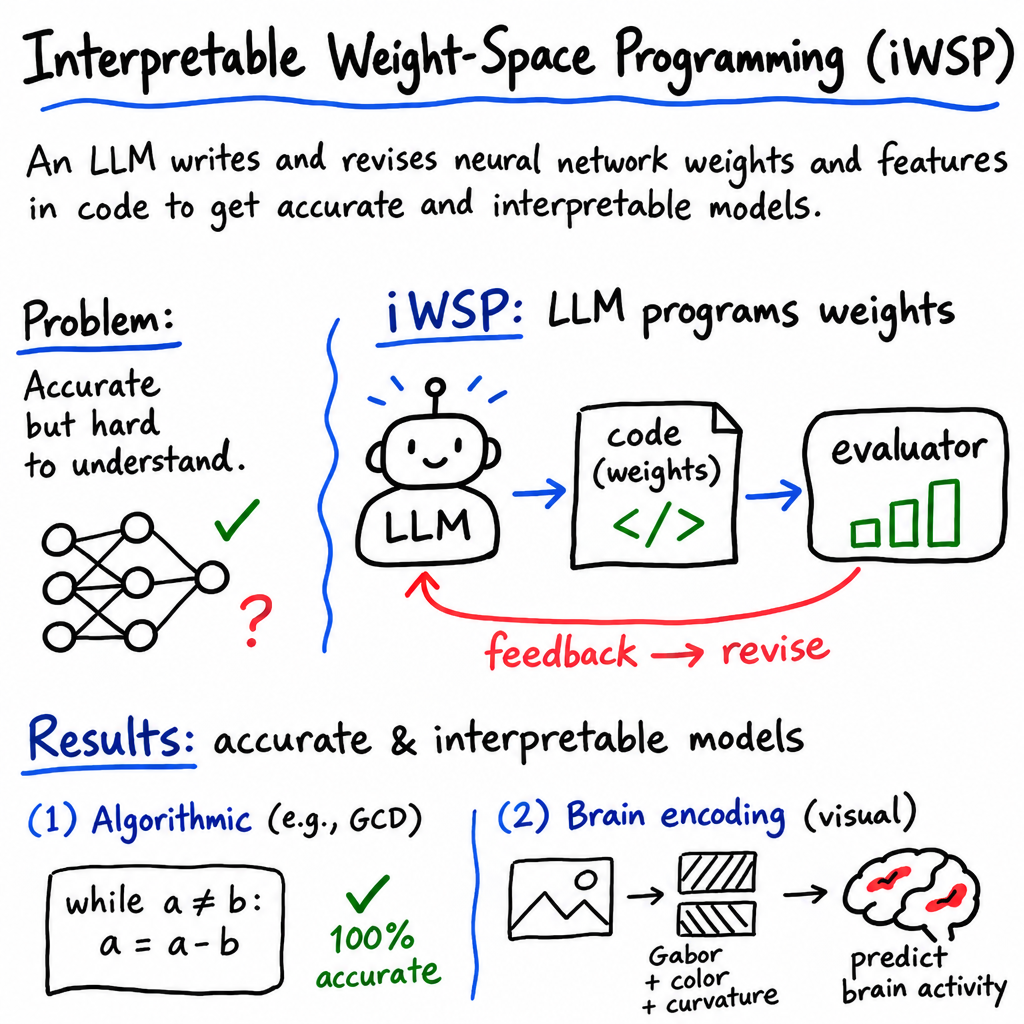
Abstract: Neural networks are powerful predictors, yet their opacity limits their usefulness in science, where the goal is explanation rather than mere prediction. In neuroscience, for example, deep encoding models accurately predict brain activity in response to natural stimuli, but struggle to reveal which stimulus features drive those predictions. Here we introduce interpretable weight-space programming (iWSP), a method in which an LLM agent iteratively builds interpretable models by explicitly programming their weights and features in code, without gradient-based training (backpropagation). Without backpropagation to tune parameters, the agent must draw on its prior knowledge and reason over previous trials to hypothesize, hand-craft, and refine human-interpretable computations mirroring the workflow of a human scientist. LLM audits confirm the interpretability of the hand-crafted models. We first validate iWSP by tasking it with constructing transformers for canonical benchmarks such as arithmetic and sentiment classification, finding that LLM agents can successfully craft compact, accurate networks directly. Next, we apply iWSP to build neural encoding models across vision, language, and audition. In the visual cortex, iWSP outpredicts existing interpretable baselines, uncovers distinct computations across early/higher visual areas, and generalizes to unseen data. In language fMRI, iWSP surfaces a confound in the data and in auditory ECoG, it systematically discovers interpretable acoustic features that predict neural activity. Together, these results establish iWSP as a general paradigm for aligning high predictive performance with human-interpretable scientific discovery.
Paper Prompts
Sign up for free to create and run prompts on this paper.
Explain it Like I'm 14
1. Paper overview
This paper introduces a method called interpretable weight-space programming, or iWSP.
The main idea is to ask an AI LLM to build a neural network by writing its settings directly, instead of training it in the usual way. The AI is also asked to make the network understandable to humans.
The researchers use iWSP for two main purposes:
- Solving computer tasks, such as arithmetic and language classification.
- Building models that predict activity in the human brain from images, words, or sounds.
The paper’s larger goal is to combine the accuracy of modern AI with the clear explanations needed in science.
2. What questions did the researchers ask?
The researchers wanted to know:
- Can an AI write a useful neural network without training it? Instead of changing millions of numbers through a training process, can the AI write the numbers and rules itself?
- Can these written models be understandable? Could a person read a description of the model and understand what it does?
- Can iWSP solve ordinary computer and language problems? For example, can it sort numbers, multiply numbers, or identify whether a sentence is positive or negative?
- Can iWSP make useful models of brain activity? Can it discover which parts of an image, word, or sound are connected to activity in different brain areas?
- Can the models reveal new scientific information? For example, can they show which visual features different brain regions use, or identify problems in a brain-data set?
3. How did the researchers do it?
The iWSP process
The researchers gave an AI coding agent:
- A description of the task.
- A starting computer program.
- A way to measure how well the model worked.
- Rules forbidding normal training methods such as backpropagation and gradient descent.
The AI then repeated this process:
- Write or edit a model.
- Test how well it performs.
- Look at the score.
- Change the model to improve the score.
- Repeat.
This is similar to a student solving a difficult problem, checking the answer, and revising their work. However, instead of changing an essay or a solution by hand, the AI changes the model’s weights and features.
What are weights?
A neural network contains many numbers called weights. These numbers control how strongly different pieces of information affect the final answer.
In ordinary AI training, an algorithm changes these numbers automatically many times. In iWSP, the AI writes the numbers directly into the code. This makes the changes easier to inspect because the AI must describe what it is doing.
Testing computer and language tasks
The researchers tested iWSP on 17 tasks, including:
- Multiplication.
- Sorting.
- Finding edit distance between words.
- Date formatting.
- Sentiment classification.
- Question classification.
- Paraphrase detection.
- Understanding relationships between sentences.
The models were first tested on examples they could see. They were then tested on new examples they had not seen before. This checked whether the models had learned a general rule rather than simply memorizing answers.
Testing brain models
For brain experiments, the AI created features from stimuli:
- From images, it created features such as edges, colors, shapes, surface patterns, and curves.
- From words, it created features related to word meaning and word position.
- From sounds, it created features related to pitch, loudness, frequencies, and changes over time.
A separate mathematical model called ridge regression then connected these features to recorded brain activity.
Ridge regression can be thought of as a careful matching system. It asks: Which combination of these features best predicts the brain’s response?
The researchers used several kinds of brain recordings:
- fMRI, which measures changes in blood flow linked to brain activity.
- ECoG, which records electrical activity directly from electrodes placed on the brain.
- Brain responses to pictures, stories, and speech.
Checking interpretability
The researchers used several tests to see whether the models were truly understandable:
- Other AI systems inspected the code for rule violations.
- The models were tested to make sure they had not secretly trained on the data.
- A LLM summarized each model in fewer than 200 words.
- A new AI session was given only that summary and asked to rebuild the model.
If the rebuilt model worked almost as well as the original, this suggested that the original model had a clear and understandable structure.
4. Main findings
iWSP solved many algorithmic tasks
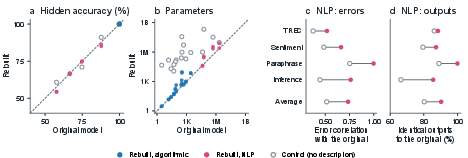
For the 13 algorithmic tasks, the models reached 100% accuracy on both the examples used during development and new hidden examples.
The AI often rediscovered familiar methods. For example, when finding the greatest common divisor, it used a version of the Euclidean algorithm, a well-known mathematical procedure.
The models also became much smaller over time. After making a model accurate, the AI often removed unnecessary parts. Some successful models used only a few hundred important parameters.
This is important because smaller models are usually easier to understand and inspect.
iWSP performed reasonably well on language tasks
The method worked well on three of the four language tasks. It struggled with paraphrase detection, which is more difficult because two sentences can have the same meaning even when they use very different words.
For sentiment classification, the model used understandable rules. It looked for positive and negative word patterns and included a simple rule for words such as “not,” which can reverse the meaning of a phrase.
For example, it could treat:
- “This movie is good” as positive.
- “This movie is not good” as negative.
These rules were not perfect, but they were easy to describe.
The models could be rebuilt from short explanations
The researchers found that a description of about 200 words was often enough for a new AI session to rebuild a similar model.
For the algorithmic tasks, the rebuilt models achieved 100% accuracy on hidden examples. The rebuilt LLMs were also close to the originals.
This suggests that the models were not just mysterious collections of numbers. Their important ideas could be explained in ordinary language.
iWSP built strong and understandable visual-brain models
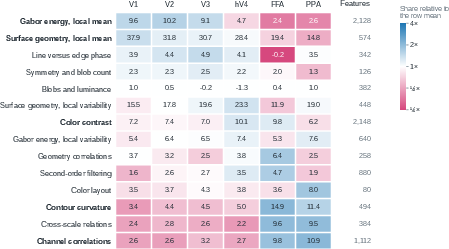
For visual brain activity, iWSP created a model containing 14 clear types of image computations.
These included:
- Gabor filters, which detect edges and lines at different angles and sizes.
- Color contrasts, such as red versus green or blue versus yellow.
- Surface geometry, such as bumps, valleys, ridges, and pits.
- Contour curvature, which measures how shapes bend.
- Relationships between different visual features.
The model predicted activity in the visual cortex better than other interpretable models. It also worked on a different brain-data set that it had never seen before.
It performed almost as well as a powerful black-box model in early visual areas, while remaining much easier to understand.
The model also showed that different brain areas rely on different image information:
- Early visual areas paid more attention to edges, brightness, and local surface details.
- Higher-level areas involved in recognizing objects and categories relied more on curves, color combinations, and larger visual structures.
iWSP found a problem in a language-brain data set
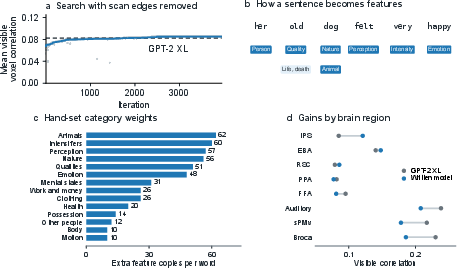
When modeling brain activity during story listening, iWSP suddenly improved its score after adding features based on where a word appeared in the scan.
At first, this seemed surprising because the model was supposed to learn about word meaning. The researchers investigated and found that the beginning and end of each brain scan had unusual activity unrelated to the story.
This means that a model could appear to understand language simply because it noticed the timing of the scan.
The researchers called this a data confound. A confound is a misleading clue that appears related to the answer even though it is not the real cause.
This finding is important because it warns scientists that some impressive results in brain-language studies might partly come from scan timing rather than language understanding.
iWSP discovered useful sound features
For brain responses to speech, iWSP created understandable audio features involving:
- Frequency patterns.
- Pitch and loudness.
- Changes in sound over time.
- Information from the previous few seconds.
- Spectro-temporal patterns, meaning how frequencies change across time.
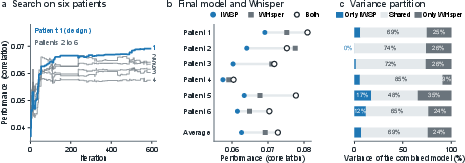
The iWSP model performed slightly worse than the large speech model Whisper by itself. However, the two models captured partly different information.
When researchers combined them, predictions became better than using Whisper alone. This means that the simple, understandable features found by iWSP contained useful information that Whisper missed.
5. Why is this research important?
Modern neural networks can be very accurate, but they often work like black boxes. They may give the right answer without showing why.
This is a serious problem in science. Scientists do not only want predictions; they want to understand the reasons behind those predictions.
iWSP offers a different approach:
- It begins with understandable rules and features.
- It changes those features directly rather than hiding them inside a training process.
- It tests whether the changes improve performance.
- It allows researchers to read and question the resulting model.
The method could help scientists discover clearer explanations in areas such as neuroscience, medicine, psychology, and social science.
It could also help researchers find mistakes in their data, as it did with the story-listening brain scans.
However, the method has limits. It can be expensive to run, and its success depends on the abilities of the AI agent. A model that gets 100% on a test set might still fail on unusual examples. Also, an AI-generated explanation should still be checked carefully by human experts.
Conclusion
The paper shows that an AI agent can write useful neural networks directly, without ordinary training, and can make the networks relatively easy to understand.
iWSP successfully solved many mathematical tasks, built accurate models of brain activity, identified different visual computations in different brain areas, discovered a problem in brain-language data, and found sound features that added information beyond a powerful speech model.
The main message is simple: AI models do not always have to choose between being accurate and being understandable. With careful design, an AI agent may be able to build models that are both powerful enough to make good predictions and clear enough to help humans learn something new.
Practical Applications
Immediate Applications
- Interpretable neuroscience encoding models — Sector: neuroscience, healthcare research, brain–computer interfaces
- Deploy the released iWSP workflow to construct explicit feature models for fMRI, ECoG, and other neural recordings.
- Researchers can compare interpretable computations—such as Gabor energy, surface geometry, color contrast, spectro-temporal modulation, and slow temporal context—with black-box embeddings.
- The resulting features can be mapped to brain regions through ridge-regression weights, supporting hypotheses about which stimulus properties drive activity in early visual, category-selective, language, or auditory areas.
- Dependencies: access to sufficiently large, well-preprocessed neural datasets; fixed evaluation pipelines; careful separation of training, validation, and hidden test data; and human or automated audits of the generated code.
- Automated discovery of dataset confounds — Sector: scientific computing, medical imaging, research methodology
- Apply iWSP as a diagnostic model alongside conventional encoding analyses. Because the system optimizes predictive performance using explicit features, sudden improvements can reveal suspicious predictors.
- The paper demonstrates a concrete workflow: interpretable position features exposed scan-edge artifacts in language fMRI that were unrelated to story semantics.
- Similar checks could identify scanner drift, acquisition timing effects, session boundaries, subject-motion artifacts, electrode noise, or stimulus-order leakage.
- Potential tool: a “confound search” module that logs every feature added during the agentic search and flags features based on timing, location, or metadata rather than stimulus content.
- Dependencies: interpretable feature definitions, access to scan or trial metadata, and follow-up validation showing that the feature persists across subjects and held-out sessions.
- Improved preprocessing standards for naturalistic fMRI — Sector: neuroimaging, clinical research
- Incorporate scan-edge diagnostics into preprocessing pipelines for story-listening and other long-duration fMRI experiments.
- The paper suggests trimming substantially more data from scan boundaries—approximately 40 TRs in the studied setting—when analyses are sensitive to story position or long contexts.
- This can be added to quality-control workflows before comparing LLMs or semantic encoding methods.
- Dependencies: the recommended trimming interval is dataset-specific and should not be treated as universal. It requires replication across scanners, preprocessing pipelines, acquisition protocols, and subjects.
- Hybrid black-box/interpretable brain encoding systems — Sector: neuroscience, clinical neurotechnology
- Combine iWSP-generated features with pretrained representations such as Whisper or vision networks in a single regression model.
- For auditory ECoG, the combination of interpretable acoustic features and Whisper embeddings improved prediction over Whisper alone because iWSP captured complementary variance.
- A practical workflow is to use a pretrained model for broad predictive coverage and iWSP features for transparent residual modeling and scientific interpretation.
- Potential products: hybrid encoding toolkits, electrode-level feature dashboards, and residual-analysis systems for identifying what a foundation model misses.
- Dependencies: complementary features must be validated on hidden recordings and across patients; correlated features can make individual feature attribution unstable.
- Readable feature libraries for auditory and visual analysis — Sector: speech technology, computer vision, neuroscience
- Package the discovered operations into reusable libraries: multiscale Gabor filters, divisive normalization, color-opponent channels, surface-geometry operators, contour-curvature measures, cochleagrams, spectral flatness, modulation filters, wavelet scattering, and multisecond temporal context.
- These libraries can serve as transparent alternatives or complements to pretrained vision and speech embeddings.
- Researchers can use them for exploratory analyses, baseline construction, electrode or voxel prediction, and model ablations.
- Dependencies: the current features were optimized for specific datasets and may require recalibration or extension for other modalities, sampling rates, image distributions, or neural targets.
- Compact exact-solution models for constrained algorithmic tasks — Sector: software engineering, education, embedded systems
- Use iWSP to generate small, inspectable transformer-like networks for bounded tasks such as arithmetic, sorting, edit distance, date normalization, and greatest-common-divisor computation.
- These models can be useful where predictable behavior, low memory use, and auditability matter more than broad generalization.
- The paper reports that some accurate algorithmic models were compressed to roughly hundreds of parameters and could be reconstructed from short textual descriptions.
- Potential products: educational demonstrations of neural circuits, formally inspectable micro-models, and lightweight embedded components for fixed-format data transformation.
- Dependencies: correctness is guaranteed only over tested input ranges. Adversarial, larger, or structurally different inputs may cause failure, so formal verification and exhaustive testing are required before deployment.
- Transparent educational demonstrations of neural computation — Sector: education, academic training
- Use the hand-written transformer circuits as teaching materials for attention, ReLU computation, algorithmic reasoning, and model compression.
- Students can inspect the weights, modify individual operations, and compare performance changes without the opacity of gradient-trained models.
- The 200-word reconstruction test provides a practical exercise in translating between natural-language explanations and executable model structure.
- Dependencies: the examples are primarily pedagogical and bounded; they should not be presented as evidence that the same approach scales reliably to open-ended language understanding.
- Reproducible scientific model specifications — Sector: academia, research software
- Store models as readable programs plus concise descriptions rather than only binary checkpoints.
- A lab could maintain an experiment record containing the prompt, code revisions, evaluation metrics, feature formulas, audit results, and hidden-set performance.
- This supports independent rebuilding, peer review, ablation studies, and clearer transfer of models between laboratories.
- Dependencies: reproducibility depends on fixed package versions, deterministic evaluation, preservation of agent logs, and protection against hidden data access or accidental training.
- Auditable agentic model-development workflows — Sector: AI engineering, regulated software
- Adopt the iWSP loop as a controlled alternative to unrestricted automated model search:
- 1. provide a restricted coding environment;
- 2. prohibit training or external data access;
- 3. expose only fixed evaluation metrics;
- 4. record every model revision;
- 5. run independent compliance and interpretability audits;
- 6. test on hidden data.
- This can improve traceability in research software and high-assurance development.
- Dependencies: prompt-level prohibitions are insufficient on their own. The paper notes that the harness cannot fully prevent all prohibited behavior inside arbitrary Python code, so sandboxing, static analysis, and independent verification are necessary.
Long-Term Applications
- Scientific discovery assistants that generate and test explicit hypotheses — Sector: academia, biomedical research, social science
- Extend iWSP from hand-crafted feature searches to domain-specific scientific workflows in which an agent proposes measurable mechanisms, implements them, evaluates them, and records interpretable revisions.
- In neuroscience, this could produce competing hypotheses about sensory processing. In biology or social science, analogous workflows could search over interpretable transformations, interaction terms, or mechanistic models.
- Dependencies: stronger causal validation is needed. Predictive improvement alone can reward confounds, dataset artifacts, or noncausal correlations, as demonstrated by the story-position finding.
- Clinically interpretable neural biomarkers — Sector: healthcare, neurology, psychiatry
- iWSP could eventually discover readable stimulus or physiological features associated with disease, treatment response, seizure activity, speech impairment, or cognitive state.
- A clinician-facing system might report not only a prediction but also the explicit feature families responsible—for example, temporal modulation, spectral structure, or visual geometry.
- Dependencies: clinical deployment requires multi-site validation, robustness to demographic and equipment variation, prospective studies, uncertainty estimates, privacy protections, and regulatory approval. The current evidence is from small or specialized neuroscience datasets and does not establish clinical validity.
- Interpretable brain–computer interfaces and neuroprostheses — Sector: neurotechnology, rehabilitation, robotics
- Auditory or visual features discovered by iWSP could support transparent decoders for speech, environmental sounds, visual categories, or user intent.
- Feature-level models may make it easier to diagnose failures, personalize systems to individual electrodes, and distinguish meaningful neural activity from recording artifacts.
- Dependencies: real-time latency, electrode drift, patient variability, closed-loop safety, and stable performance under changing neural states must be addressed. The ECoG results currently involve one primary patient and offline prediction.
- Transparent multimodal foundation-model adapters — Sector: AI software, robotics, assistive technology
- Use iWSP-generated feature modules as interpretable adapters around large vision, speech, or LLMs.
- For example, a robotics system could combine a black-box visual encoder with explicit edge, shape, curvature, and surface-geometry channels; a speech system could combine Whisper with interpretable modulation and spectral features.
- Such adapters could support debugging, safety review, domain transfer, and residual analysis without replacing high-capacity foundation models.
- Dependencies: integration methods must preserve calibration and avoid feature redundancy. More research is needed on how to interpret interactions between explicit features and deep representations.
- Safety- and compliance-oriented neural systems — Sector: finance, healthcare, public policy, critical infrastructure
- Compact, auditable networks could be used for bounded decisions or transformations where regulators require traceability, such as document routing, eligibility checks, anomaly triage, or sensor preprocessing.
- The model’s direct weight-writing history and textual reconstruction test could become part of an audit package.
- Dependencies: interpretability does not guarantee fairness, causality, or correctness. Deployment would require formal specification, fairness testing, adversarial evaluation, monitoring, and legally meaningful explanations.
- Automated program synthesis for efficient edge and embedded models — Sector: robotics, IoT, energy systems, mobile computing
- iWSP could generate small hand-structured models for low-power devices performing bounded signal-processing tasks, such as sensor calibration, acoustic event detection, motor-control preprocessing, or power-quality classification.
- Its tendency to compress accurate algorithmic solutions could reduce memory and energy requirements.
- Dependencies: the current search is expensive—approximately $17,500 for the reported experiments—and agent inference costs may outweigh deployment savings. Hardware-aware search, formal verification, and guarantees outside the visible input range are needed.
- Model debugging and data-quality monitoring at scale — Sector: enterprise analytics, finance, public policy
- An iWSP-style system could search for simple, human-readable predictors that explain unexpected gains in a production model or identify leakage from timestamps, user IDs, workflow stages, or collection artifacts.
- It could function as a “why did validation improve?” diagnostic layer for credit scoring, fraud detection, demand forecasting, or public-sector analytics.
- Dependencies: production datasets are high-dimensional and nonstationary; feature discovery must be separated from sensitive attributes, and any discovered explanation requires causal and fairness audits.
- Interpretable adaptive robotics and control — Sector: robotics, autonomous systems
- Agents could write explicit feature-processing networks for perception and control, such as shape, motion, texture, or acoustic localization modules, and iteratively improve them against simulator or hardware metrics.
- Readable computations would make it easier to inspect failures and certify restricted behaviors.
- Dependencies: the paper evaluates mainly static prediction and offline encoding. Robotics introduces distribution shift, feedback loops, safety-critical exploration, real-time constraints, and sim-to-real transfer, none of which are established here.
- Policy and standards for auditable agent-generated models — Sector: public policy, standards, AI governance
- The paper supports a governance pattern in which automated model creation requires: immutable evaluation harnesses, hidden test sets, provenance logs, independent audits, textual reconstruction tests, and explicit checks for data leakage.
- Standards bodies could use these components to define minimum documentation for agent-generated models in regulated or scientific settings.
- Dependencies: LLM-based judges can themselves make errors or accept superficially interpretable explanations. Independent human review, executable verification, and domain-specific compliance tests remain necessary.
Glossary
- Adversarial inputs: Inputs deliberately designed or selected to expose failures in a model. “there could be adversarial inputs not considered in the task”
- Attention heads: Components of transformer layers that selectively aggregate information from different positions in a sequence. “A shift register made of attention heads”
- Autoresearch: Automated iterative experimentation in which an agent searches for effective programs or solutions. “recent work uses autoresearch to discover effective programs to solve hard problems”
- Backpropagation: An algorithm for computing gradients used to optimize neural-network parameters. “without gradient-based training (backpropagation)”
- Black-box model: A model whose internal computations are difficult to interpret, even when its inputs and outputs are observable. “a black-box AlexNet baseline”
- Bootstrap: A resampling method used to estimate statistical uncertainty from observed data. “from a bootstrap over electrodes”
- Canonical benchmark: A widely used standard task or dataset for evaluating methods. “canonical benchmarks such as arithmetic and sentiment classification”
- Cepstral coefficients: Audio features derived from the spectrum of a signal and commonly used to characterize speech acoustics. “spectrograms, cepstral coefficients, pitch and loudness”
- Channel correlations: Statistical relationships between corresponding feature maps or signal channels. “channel correlations average pairwise products of feature maps to capture co-occurrence”
- Closed form: A direct mathematical expression for a result that does not require iterative optimization. “The model parameters must be set in closed form.”
- Cochleagram: A time–frequency representation designed to approximate processing performed by the auditory cochlea. “a plain gammatone cochleagram”
- Confound: An unintended variable associated with both a measured predictor and outcome that can produce misleading conclusions. “we identify a data confound at the edge of each fMRI scan”
- Convolutional layer: A neural-network layer that applies localized filters across structured data such as images or audio. “match the original's predictions more closely than AlexNet conv2”
- Cross-validation: A procedure that evaluates or selects a model by repeatedly partitioning data into training and validation subsets. “chosen via cross-validation over the layers 12, 24, and 36”
- Divisive normalization: A neural and computational operation that scales responses by a measure of pooled activity. “classical models built from explicit operations such as Gabor filters, divisive normalization”
- Domain-specific language: A programming language designed for a particular application area. “Such programs can be translated into neural networks using a domain-specific language”
- Dynamic programming: An algorithmic technique that solves problems by combining solutions to overlapping subproblems. “the edit distance task uses one block per row of the dynamic-programming table”
- ECoG: Electrocorticography, a method that records electrical activity directly from electrodes placed on or near the cerebral cortex. “in electrocorticography (ECoG) responses to audio”
- Encoding model: A model that predicts neural responses from properties of an external stimulus. “large neural-network based ``encoding models'' that predict brain responses to natural stimuli”
- Feature space: The multidimensional representation formed by the features used as model inputs or predictors. “Whisper, a standard, pretrained speech model, which is established as a highly performant feature space for encoding”
- Functional magnetic resonance imaging (fMRI): A neuroimaging technique that estimates brain activity from blood-oxygenation changes. “functional magnetic resonance imaging (fMRI) dataset”
- Gabor filter: A localized, orientation-sensitive filter commonly used to model early visual processing. “the agents recover a classical V1 front end of multi-scale oriented Gabor filters”
- Gammatone cochleagram: An auditory representation produced by filtering sound with filters that approximate cochlear frequency selectivity. “iWSP starts at 0.039 with a plain gammatone cochleagram”
- Gradient descent: An optimization procedure that updates parameters in the direction that reduces an objective function. “Run any kind of training, gradient descent, optimizer step”
- Hemodynamic response: The delayed change in blood flow and oxygenation measured in response to neural activity. “adds delays of one to four TRs for the slow hemodynamic response”
- Hidden set: Data withheld from the iterative search and used for final evaluation. “the models are reevaluated on a ``hidden set'' that they never saw during the iterative loop”
- Hypernetwork: A neural network that generates the weights of another neural network. “Hypernetworks are networks that write the weights of other networks”
- HyperNEAT: An evolutionary neural-network method in which a compact network generates the weights of a larger network. “HyperNEAT evolves a compact network whose outputs encode the weights of a much larger one”
- Intracranial electrode: An electrode placed inside the skull to record neural activity directly. “from 166 intracranial electrodes in one patient”
- Interpretability audit: A systematic examination of a model or model-building process to determine whether its computations are understandable and rule-compliant. “Each saved model (and the agent's corresponding logs) is audited by a separate agent”
- Latent representation: An internal representation that encodes information in a model but is not directly observed in the original data. “by sampling from learned representations of model zoos”
- Mechanistic interpretability: The analysis of a model’s internal components and computations to explain how it produces outputs. “guided by mechanistic interpretability approaches”
- Modulation filter: A filter that detects changes in amplitude or frequency over time within an acoustic signal. “spectro-temporal modulation filters”
- Naturalistic stimulus: A complex, real-world-like stimulus such as a story, image collection, or natural audio recording. “predict brain responses to naturalistic stimuli”
- Neural encoding: The relationship between stimulus properties and neural responses, often modeled by predicting brain activity from stimuli. “brain encoding models”
- Neural network weights: Numerical parameters that determine how signals are transformed within a neural network. “the agent instead reads and edits the weights itself”
- N-gram: A contiguous sequence of tokens, characters, or words used as a textual feature. “simple words/ngrams fail to”
- Out-of-distribution generalization: Performance on data that differ in some relevant way from the data used to construct or select a model. “test it zero-shot on NSD”
- Post-hoc interpretability: Explanation of a model after it has already been trained or constructed. “the related field of post-hoc interpretability explains models that are already trained”
- Pretrained model: A model whose parameters were learned previously, typically on a large dataset, before being applied to a new task. “pretrained AlexNet”
- Ridge regression: A linear regression method that penalizes large parameter values to reduce overfitting. “the evaluator fits a ridge regression from those features to recorded responses”
- Self-supervised learning: A learning paradigm in which training targets are derived from the input data rather than manually provided labels. “deep networks trained for object recognition, self-supervised learning”
- Spectro-temporal modulation: Variation in the spectral and temporal structure of an acoustic signal. “spectro-temporal modulation filters”
- Spectrogram: A representation showing how the frequency content of a signal changes over time. “standard acoustic features (spectrograms, cepstral coefficients, pitch and loudness)”
- Statistical confound: A systematic data property that creates an apparent association unrelated to the phenomenon of interest. “This signal is potentially problematic because it follows scan timing rather than story content”
- Token: A discrete unit of text processed by a LLM, such as a word, subword, or symbol. “the final token at layer 24 out of 48”
- Transformer: A neural-network architecture based primarily on attention mechanisms for processing sequences. “iWSP writes transformers from scratch”
- Transfer learning: Applying a model, representation, or features developed in one dataset or task to another. “they transfer across datasets and subjects”
- TR (repetition time): The time interval between successive measurements in an fMRI sequence. “one volume per 2\,s (one TR)”
- Ventral visual cortex: A region of the visual system associated particularly with object and category-related processing. “ventral visual cortex”
- Voxel: A three-dimensional measurement unit in volumetric medical imaging. “Each scan covers 95{,}556 voxels”
- Wavelet scattering: A signal-representation method that uses cascaded wavelet transforms and nonlinearities to produce stable features. “wavelet scattering”
- Weight-space programming: Constructing or modifying a neural network by directly specifying its parameters rather than learning them through gradient-based training. “In weight-space programming#1{takehi2026weightspace}, the agent instead reads and edits the weights itself”
- Zero-shot evaluation: Evaluation on a dataset or task without additional training or adaptation on that target data. “test it zero-shot on NSD”

