Pyrite: Building and Benchmarking Protein-Ligand Pose Ranking Agents
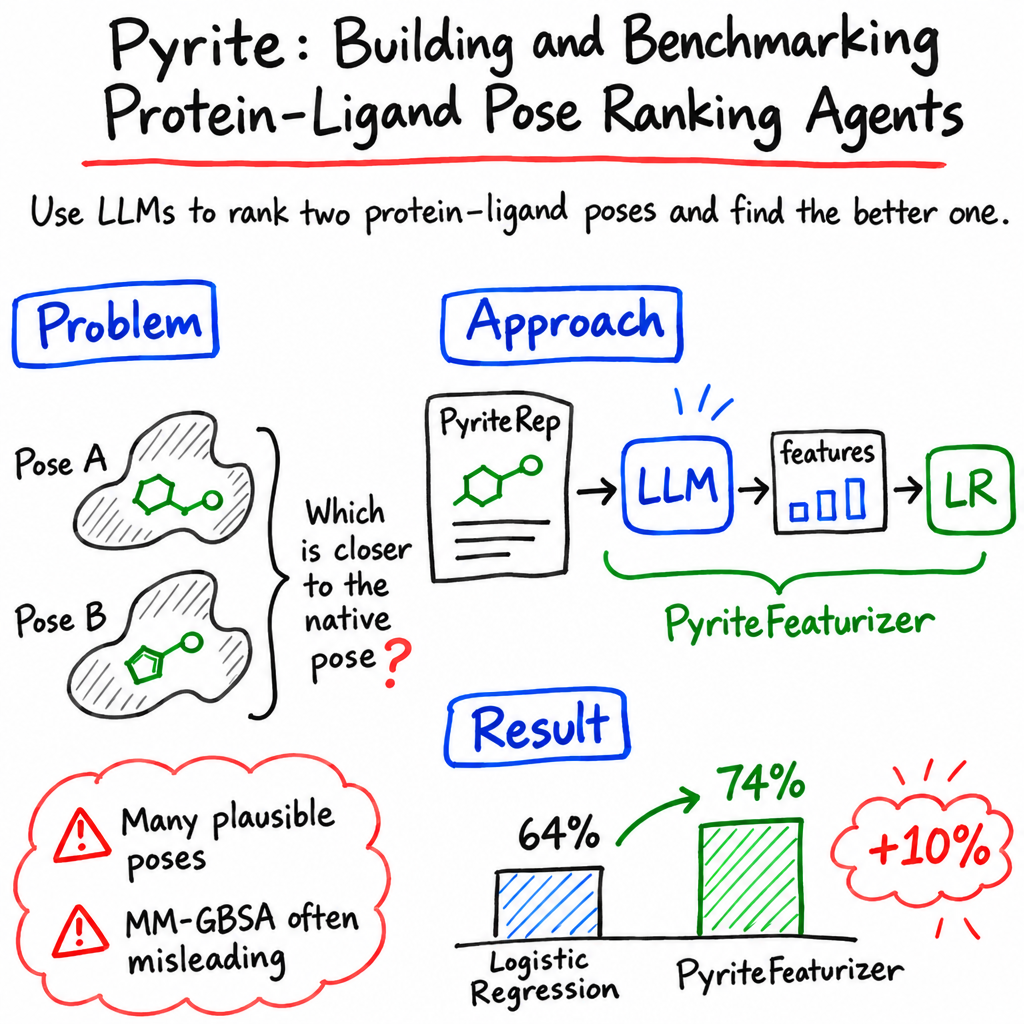
Abstract: Predicting how a ligand binds to its target is central to small-molecule drug discovery. Modern cofolding models can generate diverse candidate poses, but reliably ranking these candidates remains challenging. We introduce Pyrite, a pairwise pose-ranking benchmark comprising 1,500 pose pairs across diverse protein-ligand complexes. Expert chemists equipped with 3D visualization tools and physics-based scores perform near chance, highlighting the difficulty of interpreting available chemical signals. To investigate automated ranking, we introduce PyriteRep, a structured representation of molecular geometry, protein-ligand interactions, and physicochemical scores, and develop two LLM-based agents: PyriteReasoner, which directly compares poses through text-based reasoning, and PyriteFeaturizer, which generates executable code to construct features for logistic regression, optionally incorporating features derived from LLM subcalls. These agents achieve up to 67% and 74% accuracy, respectively, exceeding observed expert performance. LLM-guided feature discovery generally outperforms direct reasoning, while Group Relative Policy Optimization (GRPO) improves open-weight models, enabling them to match or surpass closed-source frontier models in our evaluations. These results establish Pyrite as a challenging test of pose-ranking ability and highlight LLM-guided feature discovery as a promising approach to interpret and combine the outputs of computational chemistry tools.
Paper Prompts
Sign up for free to create and run prompts on this paper.
Explain it Like I'm 14
1. What is this paper about?
This paper studies how to choose the best binding pose for a drug molecule.
A protein is like a tiny machine in the body, and a drug molecule, called a ligand, needs to fit into a particular area on that protein. This is similar to finding the best key for a lock. The exact way the molecule sits in the protein is called its pose.
Computer programs can now suggest many possible poses. The problem is deciding which pose is most likely to be correct. The researchers created a test called Pyrite to measure how well humans, ordinary computer programs, and artificial intelligence can make this choice.
2. What questions did the researchers ask?
The researchers mainly wanted to know:
- Can expert chemists correctly choose the better pose?
- Can simple physics-based scores identify the correct pose?
- Can LLMs, or LLMs, make better choices?
- Is it better for an AI to explain its decision directly, or to discover useful measurements and let a simpler statistical model make the final decision?
- Can training an AI with rewards, a process called reinforcement learning, improve its performance?
The researchers compared two AI systems:
- PyriteReasoner: an AI that directly compares two poses and explains which one it thinks is better.
- PyriteFeaturizer: an AI that creates useful measurements, or features, from the poses. A simpler machine-learning model then uses those measurements to choose the better pose.
3. How was the research carried out?
Creating the Pyrite test
The researchers used a computer model to generate many possible poses for protein–ligand pairs. They selected poses that were often quite realistic and sometimes very similar to one another.
They then created pairs of poses. In each pair, one pose was closer to the real pose found through laboratory experiments. The challenge was to decide which one was better without being shown the answer.
The final benchmark contained:
- 1,500 pose comparisons
- 285 different protein structures
- 1,799 unique poses
The task was like a multiple-choice quiz with two answers: choose Pose A or Pose B.
Measuring pose quality
The researchers used several measurements to compare predicted poses with the experimentally known pose. These included:
- RMSD: how far the atoms moved compared with the correct pose. This is like measuring how much two shapes need to be shifted to line up.
- Interactions: whether the ligand formed useful contacts with the protein, such as hydrogen bonds.
- Torsional strain: whether parts of the molecule were twisted into unusual or uncomfortable shapes.
- MM-GBSA: a physics-based estimate of how strongly the ligand might bind to the protein.
- Mogul measurements: checks for unusual bond angles and twists based on known molecules.
The researchers combined these measurements into a structured description called PyriteRep. Instead of giving an AI a long list of raw atom coordinates, PyriteRep also explained important facts about the molecule and its interactions.
Testing human experts
Five experienced chemists compared many pose pairs using 3D images, contact maps, and physics-based scores. They also explained their reasoning.
Testing AI systems
The researchers tested LLMs in two different ways:
- The AI directly read information about two poses and selected the better one.
- The AI wrote computer code to create useful features. A model called logistic regression then used those features to make the choice.
Logistic regression is a simple statistical method. It can be imagined as a scorecard that gives different amounts of importance to different clues.
The researchers also used GRPO, a type of reinforcement learning. In this process, the AI receives better rewards when its choices are correct or when its generated code helps make accurate predictions.
4. What were the main findings?
Human experts struggled
The expert chemists were correct about 42–45% of the time when all answers were counted. Since there were two choices, random guessing would give about 50% accuracy.
Even when uncertain answers were removed, the experts were only slightly better than random guessing. This was surprising because the chemists had many years of experience.
The experts often agreed with one another, but they sometimes agreed on the wrong pose. This suggests that common chemical intuition can be misleading when two poses are both fairly realistic.
Physics scores were not always reliable
Measurements that seem as though they should help did not always identify the correct pose.
For example, MM-GBSA usually assumes that a lower score means a more stable and better pose. However, on this difficult test, choosing the pose with the lower MM-GBSA score often led to the wrong answer.
This happened because the test contained many high-quality poses. The usual scores could not easily tell apart two poses that were both reasonable.
Giving the AI structured information helped
LLMs performed poorly when they were given only raw atom coordinates. Coordinates are just long lists of numbers, so they are difficult for a LLM to understand directly.
Their performance improved when they were given:
- Lists of protein–ligand interactions
- Information about hydrogen bonds and other contacts
- Molecular shape measurements
- Torsion and strain information
- Other PyriteRep features
The best direct-reasoning system reached about 67% accuracy, clearly better than the human experts in this benchmark.
Feature discovery worked even better
PyriteFeaturizer performed better than direct AI reasoning. It used an LLM to create useful features and then allowed logistic regression to make the final decision.
Its best version reached about 74% accuracy.
Some of the features it discovered were complicated combinations of clues. For example, it might decide that a certain measurement mattered more for one type of protein than another. It could also reduce the influence of unusually extreme scores instead of blindly trusting them.
Reinforcement learning improved open models
GRPO improved the performance of the open-weight AI model.
After training:
- PyriteReasoner improved to about 67% accuracy in its best setting.
- PyriteFeaturizer improved to about 74% accuracy in its best setting.
This allowed the open model to match or even outperform some larger, closed-source models in these experiments.
5. Why are these results important?
The study shows that choosing the correct drug-binding pose is harder than it may seem. Even experienced chemists and familiar physics-based scores can be confused when the possible poses are all fairly realistic.
The paper also suggests that AI should not always be asked to make a final decision directly. A better approach may be:
- Let the AI discover useful clues.
- Turn those clues into measurable features.
- Let a simpler statistical model combine them.
This is similar to asking a student to find the important information in a difficult problem and then using a clear scoring system to reach the final answer.
6. Possible impact and limitations
If these methods become reliable, they could help scientists examine large numbers of predicted drug poses more quickly. This could save time and money during drug development and help researchers focus on the most promising molecules.
However, the results should not yet be treated as proof that these AI systems will always work in real drug discovery. The benchmark was created by one research group and used poses from its own computer model. The test may also differ from poses produced by other systems.
The AI achieved 74% accuracy, which is promising but still leaves many mistakes. Future research should test the methods on larger and more varied datasets and determine whether success on this pairwise test leads to better real-world drug design.
In simple terms, the paper’s main message is: modern computers can create many possible ways for a drug molecule to fit into a protein, but choosing the best fit is difficult. AI systems can help, especially when they learn which clues matter instead of trusting one score or relying only on human-like intuition.
Practical Applications
Immediate Applications
The paper’s publicly released benchmark, structured representation, and executable feature-engineering approach support several applications that could be deployed now, provided they are used as decision-support systems rather than replacements for experimental validation.
- Automated pose triage in structure-based drug discovery — Healthcare/pharmaceutical R&D
- Integrate
PyriteRep-style descriptors with docking or cofolding pipelines to compare candidate poses pairwise and prioritize the most plausible structures for medicinal-chemistry review. - A practical workflow would generate multiple poses, compute geometry, interaction, torsion, strain, and validity features, then apply a logistic-regression model or an LLM-generated featurizer to rank candidates.
- The reported
PyriteFeaturizerperformance of up to 74% pairwise accuracy suggests that this could reduce the number of poses requiring manual inspection. - Dependencies: Performance may depend strongly on the pose-generation model, protein family, ligand chemistry, and similarity to the training distribution. Predictions should be calibrated and experimentally checked.
- Integrate
- Second-opinion systems for computational chemists — Pharmaceutical software
- Deploy
PyriteReasoneror an equivalent hybrid model as a review layer that identifies disagreements between MM-GBSA, torsional strain, interaction counts, and geometric descriptors. - The system could produce a ranked comparison such as: “Pose B has better interaction conservation, while Pose A has lower MM-GBSA but higher strain,” making conflicting evidence explicit.
- This is particularly useful because the paper finds that individual physics-based scores can be misleading or anti-correlated with pose correctness among high-quality decoys.
- Dependencies: The system should not simply invert MM-GBSA or other scores. Its behavior must be validated on prospective targets and monitored for systematic biases.
- Deploy
- Batch screening and prioritization of docking outputs — Drug-discovery operations
- Use pairwise ranking to construct an overall ordering of dozens or hundreds of generated poses through tournament ranking, sorting, or graph-based aggregation.
- The immediate product could be a plugin for docking platforms or molecular viewers that highlights the top-ranked pose, uncertainty, conflicting features, and reasons for selection.
- Dependencies: The paper evaluates pairwise comparisons rather than full ranking. Additional benchmarking is needed to determine whether pairwise accuracy translates reliably to top-1 or top- enrichment.
- Structured molecular-data standardization — Academia and software engineering
- Adopt
PyriteRepas a schema for storing protein–ligand pose information, including atom identities, coordinates, contacts, hydrogen bonds, strain, validity checks, and energy estimates. - Such a schema can improve interoperability between RDKit, OpenMM, PoseBusters, Mogul, docking tools, visualization software, and machine-learning pipelines.
- It can also support reproducible computational notebooks and standardized pose-comparison reports.
- Dependencies: Tool versions, residue definitions, interaction-detection rules, units, coordinate conventions, and missing-data handling must be standardized.
- Adopt
- Benchmarking AI systems for 3D chemical reasoning — AI research and computational chemistry
- Use the public Pyrite dataset to evaluate LLMs, multimodal models, coding agents, and classical machine-learning methods on a verifiable scientific task.
- Researchers can compare direct reasoning against structured feature engineering, test zero-shot versus fine-tuned models, and measure whether models rely excessively on misleading scores.
- The benchmark can also be used for model regression testing when updating drug-discovery systems.
- Dependencies: Results may be affected by leakage from training data, overlap with known protein structures, prompt design, and the benchmark’s proprietary pose-generation distribution.
- Executable feature-engineering assistants — Data science and scientific programming
- Use an LLM to generate Python feature programs from structured molecular records, then evaluate those programs using cross-validation and a simple downstream classifier.
- A practical tool could automatically propose features such as interaction differences, bounded energy terms, residue-family indicators, contact density, strain gates, or ligand-packing descriptors.
- This provides a reproducible alternative to accepting opaque natural-language chemical explanations.
- Dependencies: Generated code requires sandboxing, runtime limits, unit tests, leakage checks, and human review. The paper’s reward design penalizes non-executable or constant features, but production systems need stronger security controls.
- Training and education for computational chemistry — Universities and professional training
- Use difficult Pyrite pose pairs to teach students that common heuristics—such as “lower MM-GBSA is always better”—can fail when comparing strong decoys.
- An interactive educational tool could display two poses, their contact maps and descriptors, and then compare a student’s reasoning with model predictions and experimentally defined labels.
- Dependencies: The benchmark labels are based on closeness to crystallographic structures, which is not identical to biological binding affinity or functional activity.
- Policy and evaluation standards for scientific AI — Research governance
- Use Pyrite-like evaluations as part of qualification protocols for AI systems used in drug discovery.
- Organizations could require reporting of out-of-distribution performance, confidence intervals, abstention behavior, data provenance, and performance against adversarially conflicting tool outputs.
- Dependencies: A single benchmark is insufficient for regulatory or clinical claims. Evaluation should include prospective experiments, multiple pose generators, and diverse targets.
- Improved human review workflows — Daily professional use
- Replace unstructured visual inspection with a standardized review form that presents pose differences, interaction preservation, torsional geometry, close contacts, validity results, and model uncertainty.
- Since the paper reports that experts can perform near chance and may overuse misleading scores, structured comparison can reduce cognitive bias and improve consistency.
- Dependencies: The interface must preserve expert override capabilities and avoid presenting model output as ground truth.
Long-Term Applications
These applications require larger datasets, broader validation, improved calibration, or integration with experimental and commercial systems.
- End-to-end autonomous pose-selection agents — Pharmaceutical discovery
- Build agents that sample poses, run physical validation, calculate descriptors, generate candidate features, rank poses, identify uncertainty, and decide when additional docking or molecular-dynamics simulations are needed.
- Such an agent could prioritize compounds for synthesis or experimental structural biology.
- Dependencies: Pairwise benchmark performance must first be shown to improve prospective hit rates, crystallographic success, binding affinity prediction, and downstream medicinal-chemistry decisions.
- General-purpose protein–ligand scoring systems across generative models — Drug-discovery platforms
- Train models on poses produced by multiple cofolding and docking systems rather than a single proprietary generator.
- This could yield a scoring layer that is less dependent on the inductive biases of one sampler and more robust to different protein flexibility assumptions.
- Dependencies: The current benchmark may contain distribution-specific patterns. Cross-model and cross-laboratory validation is essential.
- Adaptive, protein-family-aware pose ranking — Precision drug discovery
- Extend the feature-discovery approach to learn conditional ranking rules for GPCRs, kinases, proteases, nuclear receptors, and other target families.
- The paper gives an example in which close-contact differences are weighted differently for a GPCR, suggesting that context-dependent scoring could outperform universal rules.
- Dependencies: Family-specific models require sufficient examples, careful leave-target-out validation, and safeguards against memorizing protein-family identifiers.
- Multimodal 3D foundation models for molecular reasoning — AI and computational biology
- Combine structured records, raw coordinates, molecular graphs, protein sequences, 3D visualizations, and textual biological context in a unified model.
- The result could reason over spatial patterns that text-only models and raw-coordinate prompts currently handle poorly.
- Dependencies: Large, high-quality multimodal datasets and geometrically faithful architectures are required. The paper shows that raw coordinates alone are inadequate for the tested LLMs, not that coordinates are intrinsically uninformative.
- Reinforcement learning for scientific feature discovery — Machine learning research
- Generalize GRPO-style optimization beyond pose ranking to docking-score correction, protein-pocket assessment, molecular-property prediction, and experimental-condition selection.
- Rewards could combine predictive accuracy, code execution, interpretability, computational cost, and robustness to distribution shift.
- Dependencies: Reward hacking is a major risk. Cross-validation accuracy alone may encourage features that exploit benchmark artifacts or protein-specific leakage.
- Active-learning systems for experimental structure determination — Structural biology
- Use pose-ranking uncertainty to select which protein–ligand complexes should receive crystallography, cryo-EM, NMR, or other structural characterization.
- Experiments could be chosen where candidate poses disagree most strongly or where ranking errors would have the greatest impact on lead optimization.
- Dependencies: The approach requires calibrated uncertainty and a demonstrated connection between computational uncertainty and experimental value.
- Integration with molecular dynamics and free-energy workflows — Computational chemistry
- Use the ranker to select representative poses for molecular-dynamics relaxation, alchemical free-energy calculations, or enhanced-sampling simulations.
- Rather than simulating every generated pose, the system could select diverse, high-confidence, and high-uncertainty candidates.
- Dependencies: Pose ranking does not establish thermodynamic stability or binding affinity. Protein flexibility, water mediation, protonation, tautomerism, and kinetic effects must be modeled separately.
- Prospective medicinal-chemistry design loops — Pharmaceutical product development
- Connect pose-ranking agents with generative molecular design tools so that structural hypotheses guide the creation of analogues intended to preserve key interactions while reducing strain or improving packing.
- A potential workflow would be: generate analogues, cofold poses, rank poses, identify interaction changes, and propose synthesis candidates.
- Dependencies: Improvements in pose ranking must translate into better compound selection. Synthesis feasibility, off-target activity, solubility, permeability, toxicity, and pharmacokinetics remain separate constraints.
- Open-weight scientific agents for regulated or confidential environments — Enterprise AI
- GRPO results suggest that open-weight models could eventually match or exceed frontier models for specialized scientific tasks.
- Organizations could fine-tune private pose-ranking agents locally, avoiding transmission of confidential targets, ligands, or proprietary assay data to external model providers.
- Dependencies: Reproducibility, licensing, hardware costs, model security, data privacy, and robust evaluation must be addressed before deployment in regulated drug-development workflows.
- Decision-support systems for regulatory and quality documentation — Pharmaceutical quality systems
- Mature versions could automatically generate auditable pose-selection reports containing input structures, software versions, descriptors, model decisions, alternative hypotheses, uncertainty, and human approvals.
- This would support reproducibility and documentation in research and potentially in regulated submissions.
- Dependencies: Regulatory acceptance would require validated software, traceable datasets, version control, formal change management, and evidence that the system is fit for its intended use.
- General scientific reasoning benchmarks beyond chemistry — Academia and AI evaluation
- The paper’s central design—structured scientific inputs, conflicting computational signals, executable feature discovery, and verifiable outcomes—could be adapted to materials science, protein engineering, robotics, energy systems, and finance.
- For example, agents could rank competing catalyst geometries, protein conformations, robot trajectories, or energy-system designs while learning when individual simulators are unreliable.
- Dependencies: Each domain needs objective labels, realistic hard negatives, protection against benchmark leakage, and evaluation of real-world outcomes rather than only retrospective accuracy.
Glossary
- Abstention: A decision to decline choosing between available alternatives; “we treat abstentions (neither choosing Pose A or B) as incorrect across all methods.”
- Anti-correlated: Showing an inverse relationship, where improvement in one variable tends to correspond to deterioration in another; “conventional physics-based scores can be anti-correlated with correctness.”
- Asphericity: A measure of how much a molecular shape deviates from a sphere; “Asphericity: .”
- Binding free energy: The thermodynamic energy change associated with forming a protein–ligand complex; “MM-GBSA, an estimate of binding free energy.”
- Cofolding: Jointly predicting the structures of interacting biomolecules, such as proteins and ligands; “State-of-the-art cofolding models.”
- Conjugated system: A molecular structure containing alternating bonds that allow electrons to delocalize across multiple atoms; “a mostly flat, conjugated system.”
- Cross-validation: A method for estimating model performance by repeatedly training and testing on different subsets of data; “under a 5-fold leave-structure-out cross-validation over the pre-AF3 training pool.”
- Decoy: A plausible but incorrect predicted molecular structure used to test ranking or discrimination methods; “Pyrite draws poses from our proprietary cofolding model and diversity-promoting sampling algorithm, yielding a challenging benchmark.”
- Docking: Computationally predicting how a ligand fits into and binds to a protein target; “the field relies on computational pocket discovery, docking, and scoring.”
- Docking-power benchmark: A benchmark that evaluates whether a docking method can select near-native poses from candidate structures; “The ability to select near-native poses from fixed candidate sets is evaluated explicitly by the docking-power benchmark in CASF-2016.”
- Eigenvalue: A scalar associated with a matrix that characterizes one of its principal directions or modes; “from eigenvalues of .”
- Enrichment factor: A measure of how many desirable items occur among top-ranked results compared with random selection; “EF@k = hits in the top-k over hits expected at random.”
- Feature ablation: An experiment in which selected input features are removed to assess their contribution to model performance; “We evaluate five input ablations to investigate how different representations of structural information affect pose-ranking performance.”
- Feature engineering: The creation or transformation of input variables to improve a predictive model; “using an LLM to discover informative structural features that can be incorporated into a lightweight logistic-regression classifier.”
- Formal charge: The idealized electrical charge assigned to an atom in a molecular structure; “Formal Charges: List of non-zero formal charges per atom.”
- G protein-coupled receptor: A cell-surface receptor that transmits signals through heterotrimeric G proteins; “when the target protein is a G protein-coupled receptor.”
- GRPO (Group Relative Policy Optimization): A reinforcement-learning method that improves language-model outputs by comparing rewards among groups of sampled responses; “Group Relative Policy Optimization (GRPO) improves open-weight models.”
- Gyration tensor: A matrix describing the spatial distribution of atoms around a molecule’s centroid; “with centroid and gyration tensor .”
- Heavy atom: Any atom in a molecule other than hydrogen; “Pose geometry features are computed from the ligand’s heavy-atom 3D coordinates.”
- Hydrogen-bond acceptor: An electronegative atom capable of accepting a hydrogen bond; “type (Hydrogen-bond Donor, Hydrogen-bond Acceptor, Salt Bridge, -stacking, etc.).”
- Hydrogen-bond donor: An electronegative atom bonded to hydrogen that can donate that hydrogen in a hydrogen bond; “Hydrogen-bond Donor.”
- Implicit solvation model: A computational model that represents solvent effects without explicitly modeling individual solvent molecules; “combining molecular mechanics energies with implicit solvation models.”
- Interaction recall: The proportion of reference molecular interactions recovered by a predicted pose; “the interaction recall given the reference crystal's interactions.”
- Interaction IoU: The intersection-over-union measure comparing interactions in two molecular poses; “measured both by the distribution of per-pair RMSD and Interaction IoU.”
- Interatomic distance: The spatial distance between two atoms; “a scoring metric that measures local interatomic distances.”
- Inductive bias: A systematic preference or assumption built into a model or decision rule; “overcome any potential inductive biases.”
- Ligand: A molecule that binds to a larger target molecule, such as a protein; “Predicting how a ligand binds to its target is central to small-molecule drug discovery.”
- lDDT-PLI: A local distance-based score that evaluates the accuracy of protein–ligand interactions; “lDDT-PLI (Local Distance Difference Test for Protein-Ligand Interactions).”
- Leave-structure-out cross-validation: Cross-validation that keeps all examples from a molecular structure in the same training or evaluation partition; “a 5-fold leave-structure-out cross-validation over the pre-AF3 training pool.”
- Logistic regression: A statistical classification model that estimates the probability of a categorical outcome from input features; “These features are subsequently used to train a logistic-regression classifier.”
- Mogul: A software tool that compares molecular torsion angles and ring conformations with distributions from the Cambridge Structural Database; “using Mogul.”
- MM-GBSA: A binding-energy estimation method combining molecular mechanics with a generalized Born solvent model and solvent-accessible surface-area terms; “the MM-GBSA score estimates the binding free energy of a protein-ligand complex.”
- Molecular mechanics: A computational approach that models molecular structures and energies using classical force fields; “combining molecular mechanics energies with implicit solvation models.”
- Molecular visualization: The graphical inspection of molecular structures and interactions in three dimensions; “chemists must triage large sets of predictions.”
- Native pose: The experimentally observed or reference binding orientation of a ligand in a protein; “distance to the native pose.”
- Open-weight model: A machine-learning model whose trained parameters are publicly available; “GRPO improves open-weight models.”
- Pairwise pose ranking: Selecting which of two candidate ligand poses is closer to the reference binding structure; “the first dedicated benchmark for pairwise pose ranking of protein–ligand complexes.”
- Pose-invariant feature: A molecular feature that remains identical across alternative poses of the same ligand; “PyriteRep consists of 29 features, including both pose-invariant (identical for both poses) and pose-dependent features.”
- Pose-dependent feature: A feature whose value changes according to the ligand’s predicted binding pose; “Pose Dependent Features in PyriteRep.”
- PoseBusters: A validation procedure for detecting chemically or geometrically invalid molecular poses; “PoseBusters validity check.”
- Protein–ligand interaction: A physical or chemical contact between a protein and a bound ligand; “a structured representation of molecular geometry, protein–ligand interactions, and physicochemical scores.”
- Radius of gyration: A measure of how far a molecule’s atoms are distributed from its centroid; “Radius of Gyration: $R_{g}=\sqrt{\frac{1}{N}\sum_{i}\|\mathbf{r}_{i}-\bar{\mathbf{r}\|^{2}$.”
- Reinforcement learning: Machine learning in which a model improves by receiving rewards for its actions or outputs; “we investigate whether reinforcement learning (RL) can improve the pose-ranking capabilities of open-weight models.”
- Root-mean-square deviation (RMSD): The square root of the mean squared distance between corresponding atomic positions; “RMSD-to-ground truth crystal over the 3D coordinates for each atom.”
- Salt bridge: An electrostatic interaction between oppositely charged molecular groups; “type (Hydrogen-bond Donor, Hydrogen-bond Acceptor, Salt Bridge, -stacking, etc.).”
- SMILES: A textual notation for representing molecular structures as strings; “Canonical SMILES string.”
- Torsional strain: Energetic or geometric unfavorableness associated with rotation around molecular bonds; “Torsional Strain: Torsion strain for the (i) protein backbone, (ii) sidechain, and (iii) total (kcal/mol).”
- Virtual screening: Computationally evaluating many compounds to identify those likely to bind a biological target; “More broader reviews of virtual screening have documented methodological pitfalls.”
- Zero-shot: Performing a task without task-specific examples or additional supervised training at inference time; “Using PyriteRep improves zero-shot LLM performance.”

