Real-Time Volumetric Light Transport Inference without a Path
Abstract: We present a real-time method for reconstructing fully integrated pixel radiance in rendered volumetric media under direct and ambient environmental illumination, using compact, low-cost scene features and statistics. Unlike Monte Carlo denoising pipelines for volumetric rendering, which depend on computationally expensive path-traced radiance estimates, our approach directly infers the final light-transport solution from inexpensive primary-ray and environment sample evaluations. We show that these features form a near-sufficient representation of the scene, enabling accurate reconstruction at substantially lower computational cost. Using an attention-augmented image-to-image network, we demonstrate that complete pixel radiance can be inferred directly from these auxiliary features, without requiring the original radiance signal. Operating in image space also provides a more stable computational cost as the camera zooms into or out of the volume, with substantially less dependence on volume density than approaches based on explicit multiple-scattering simulation. We demonstrate real-time performance and high reconstruction accuracy in challenging volumetric cloud scenarios.
Paper Prompts
Sign up for free to create and run prompts on this paper.
Explain it Like I'm 14
1. What is this paper about?
This paper presents a new way to make real-time pictures of clouds, smoke, and fog look realistic.
Normally, computers use a method called path tracing to calculate how light moves through a cloud. This can produce very realistic images, but it is extremely slow because light may bounce and scatter many times inside the cloud.
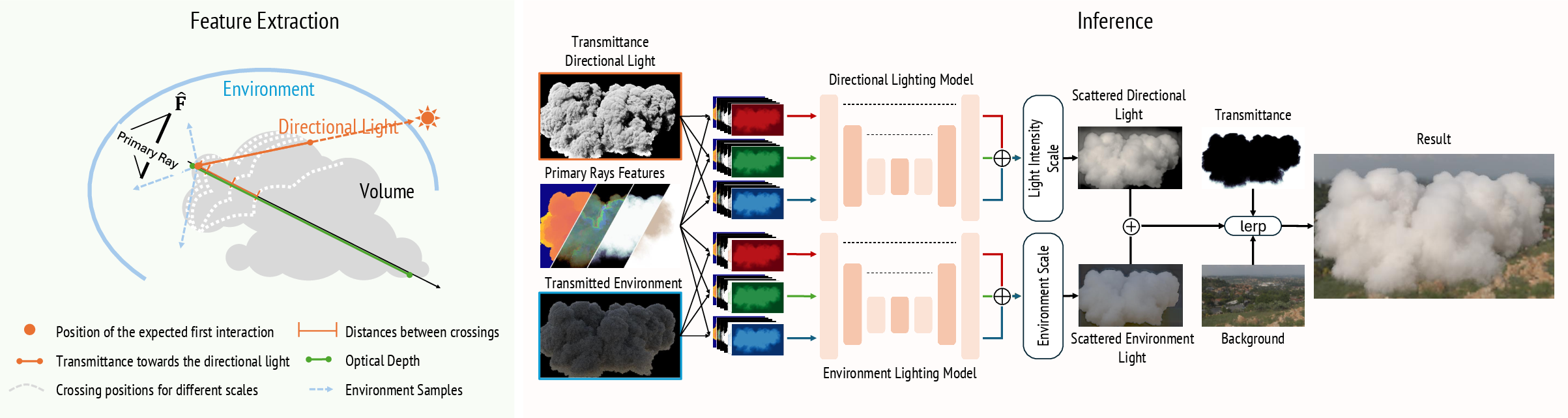
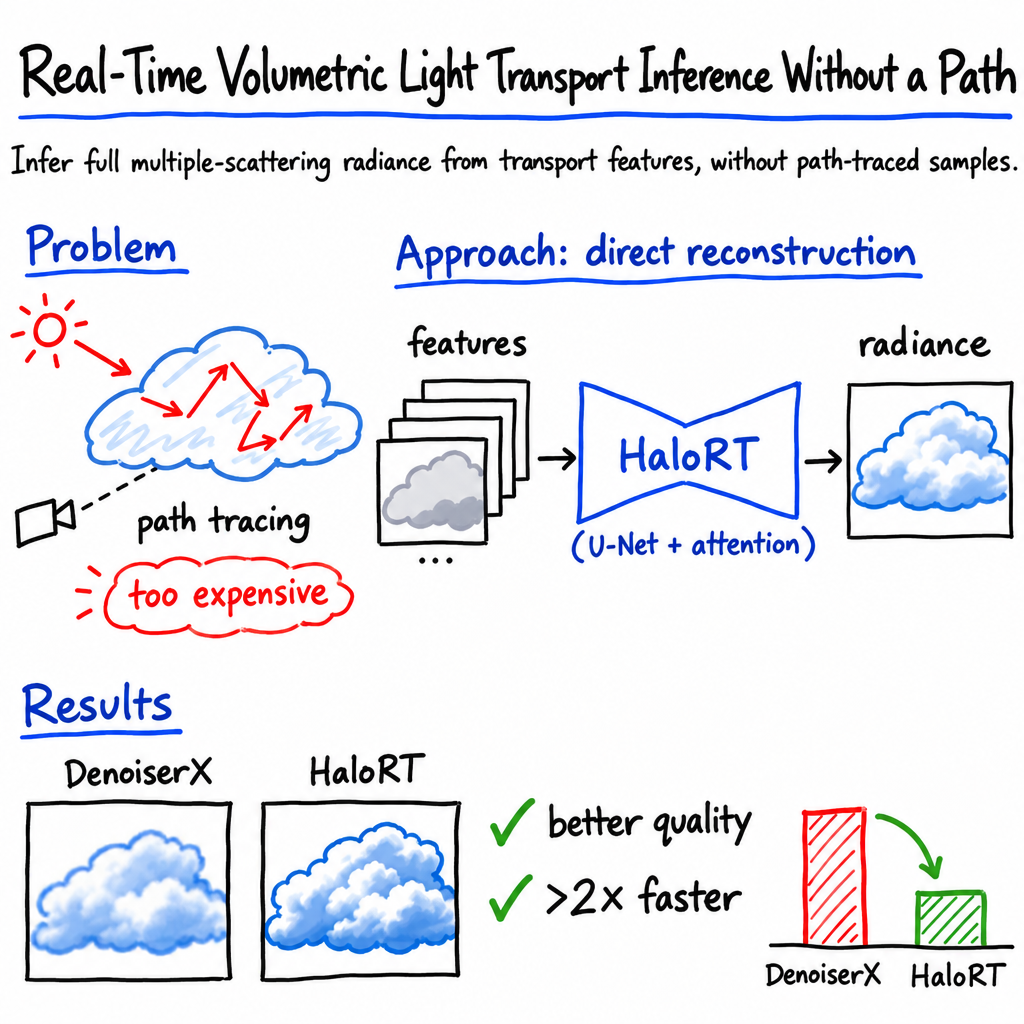
The researchers created a neural network called HaloRT. Instead of tracing many complete light paths, HaloRT looks at simpler information about the cloud and predicts the final image. In other words, it tries to figure out what the cloud should look like without doing all the expensive calculations.
2. What questions did the researchers ask?
The main question was:
Can a computer predict realistic lighting in clouds without calculating expensive light paths?
More specifically, the researchers wanted to know:
- Which simple measurements of a cloud contain enough information to predict its final appearance?
- Can a neural network reconstruct effects caused by light scattering many times?
- Can the method work quickly enough for real-time graphics?
- Will it work on clouds and lighting conditions that were not included in its training data?
- Will the result stay stable instead of changing randomly from one frame to the next?
This is important for video games, flight simulators, virtual reality, and other applications where clouds must look realistic while the scene is moving.
3. How did the researchers do it?
The usual approach: path tracing
Imagine shining a flashlight into a foggy room. Light travels through the fog, bounces and scatters, and eventually reaches your eyes.
A computer can simulate this by following many possible light paths. This is called Monte Carlo path tracing. It is similar to repeating a random experiment thousands of times and averaging the answers.
For clouds, this is especially difficult because light can scatter at many points. A single pixel in the final image may require a large number of complicated calculations.
The new approach: measuring useful clues
Instead of following complete light paths, the researchers measured several cheaper features along the camera’s rays. These features are like clues that describe the cloud:
- Optical depth: how much cloud material the ray passes through.
- Interaction depth: where light is likely to first hit or scatter inside the cloud.
- Crossing layers: information about the cloud’s structure at several different scales.
- Transmittance: how much light can pass through the cloud without being blocked.
- Environment illumination: light arriving from the sky and surrounding environment.
- Medium properties: details such as how strongly the cloud scatters light.
These measurements are similar to describing a forest using its thickness, layers, paths, and sunlight rather than photographing every leaf.
Training the neural network
The researchers created many example scenes containing:
- Different cloud shapes
- Different camera positions
- Different light directions
- Different cloud densities
- Different colors and scattering properties
- Many different environment maps, such as skies and landscapes
For each example, they produced a very high-quality reference image using expensive path tracing. This reference acted as the correct answer during training.
The network then learned to connect the cheaper cloud measurements to the correct final image.
The HaloRT model
HaloRT is an image-to-image neural network. It takes several feature images as input and produces a final colored image.
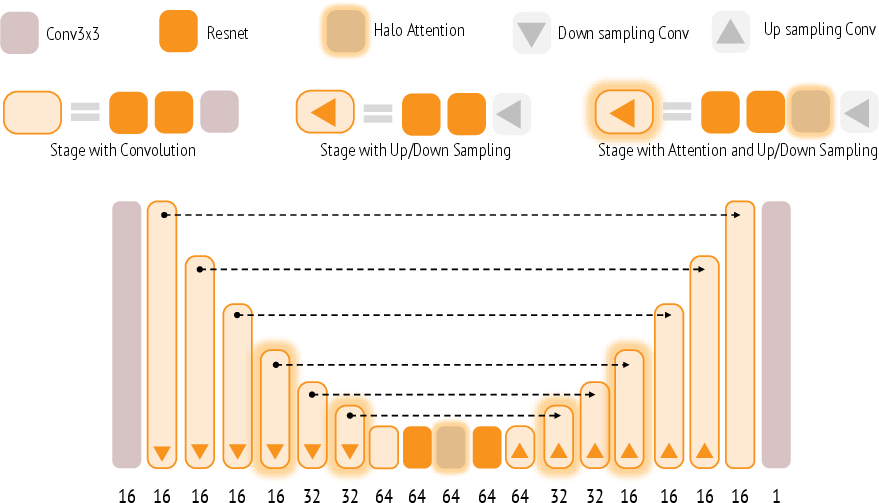
It uses a structure called a U-Net, which first shrinks the image to understand larger patterns and then enlarges it again to restore details.
It also uses local attention. Attention allows the network to decide which nearby parts of the image are most useful when predicting each pixel. This is helpful because light scattering in one part of a cloud can affect what is seen in another part.
The researchers used local attention rather than looking at every pixel at once because looking everywhere would require too much memory and time.
4. What did they find?
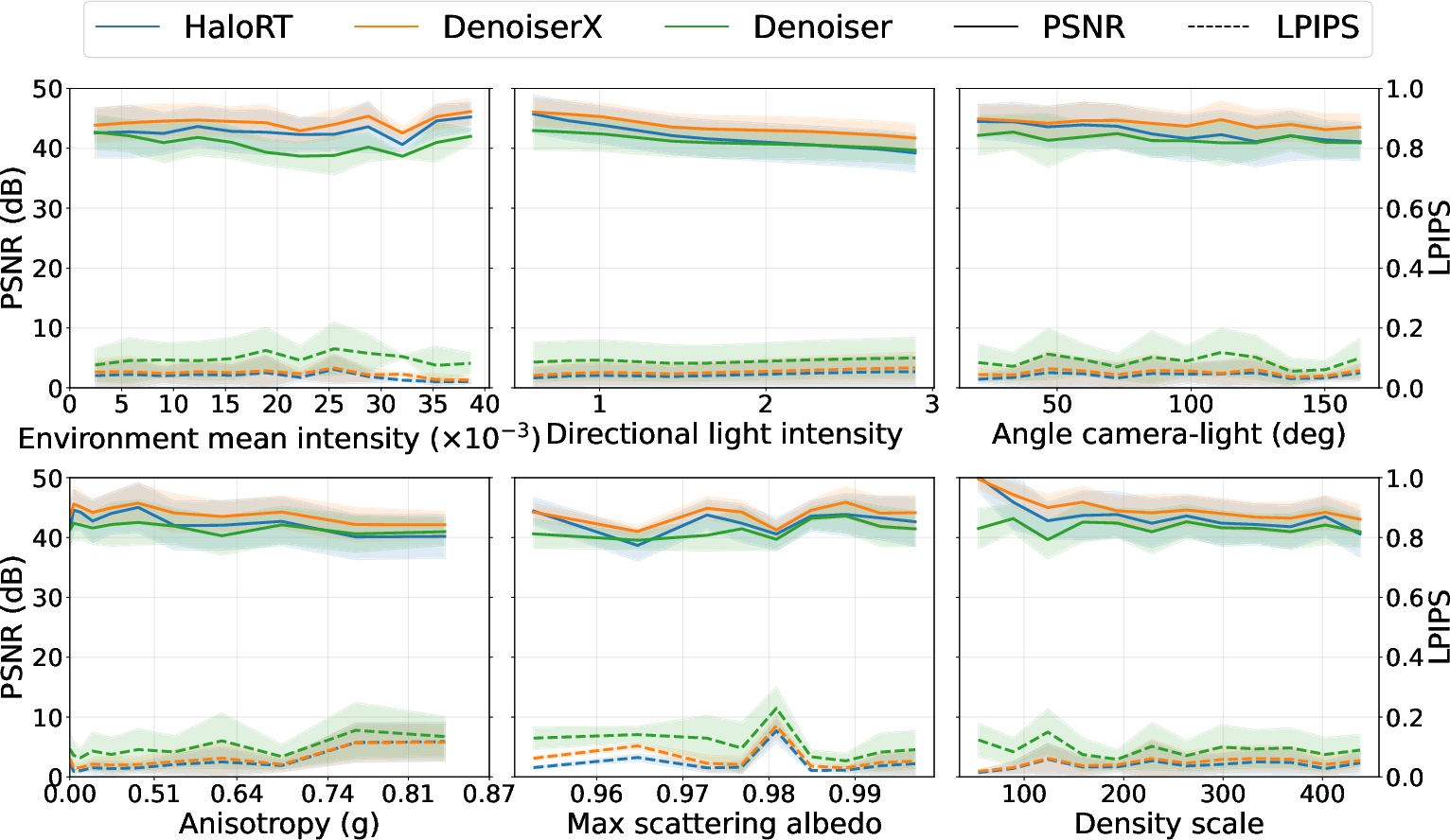
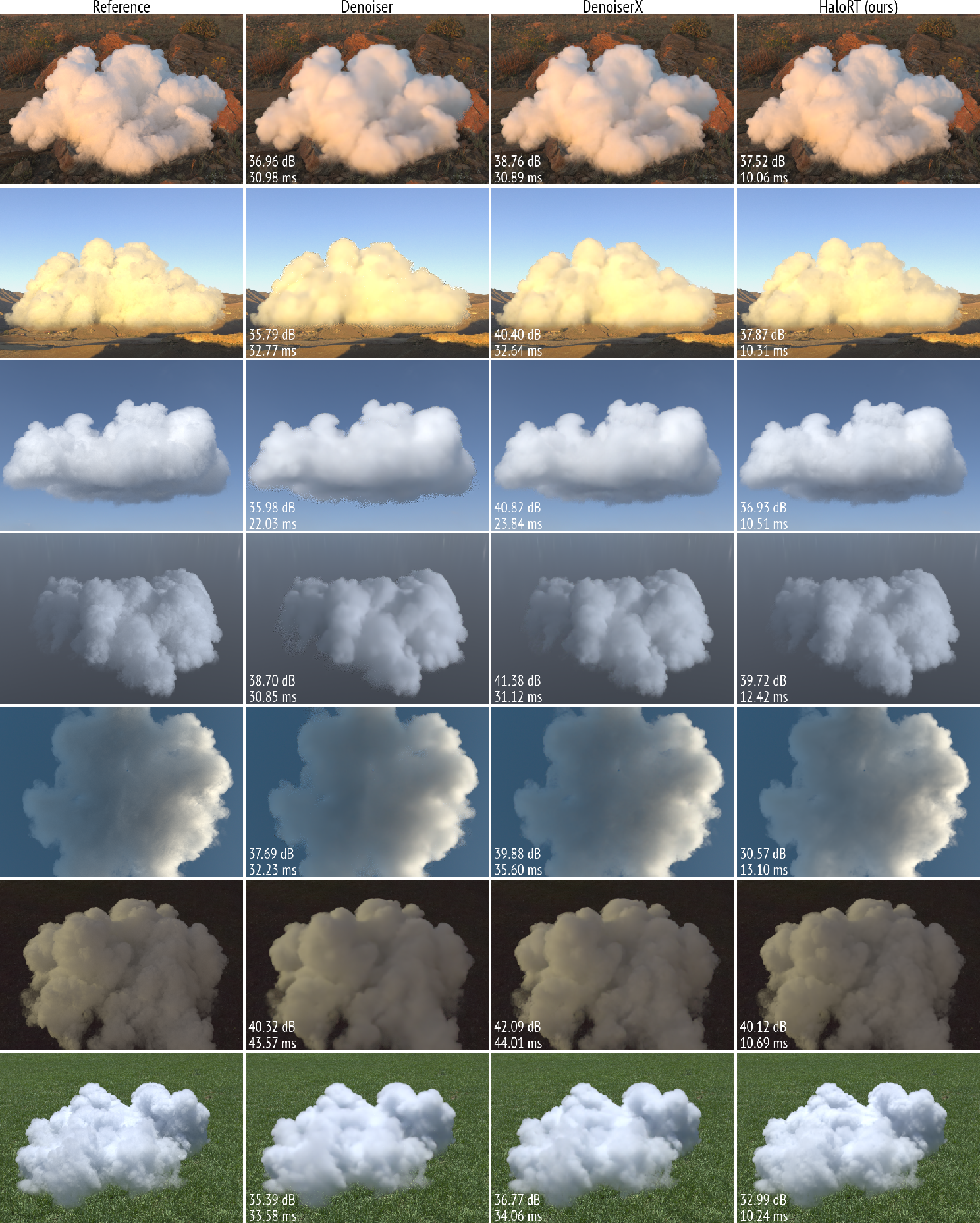
The researchers tested HaloRT on 200 images of 15 clouds that were not used during training.
Their main findings were:
- HaloRT produced realistic cloud lighting without using path-traced radiance samples during prediction.
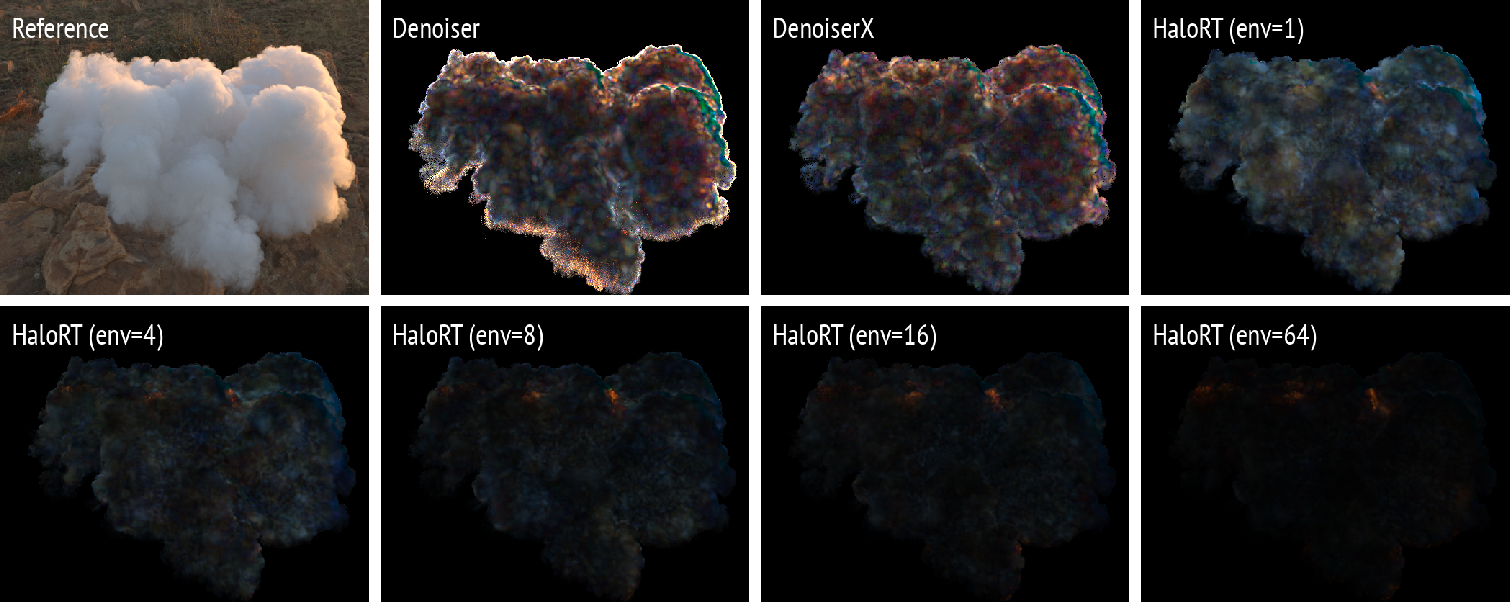
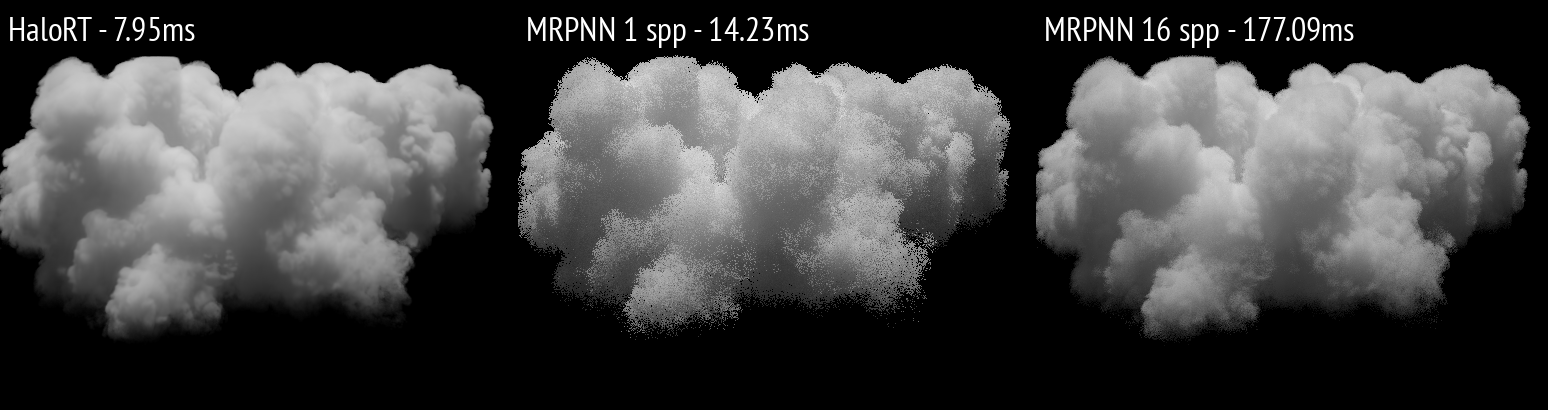
- It preserved fine cloud details better than several competing denoising methods.
- Its results were much more stable. Repeating the calculation with different random samples caused very little visible change.
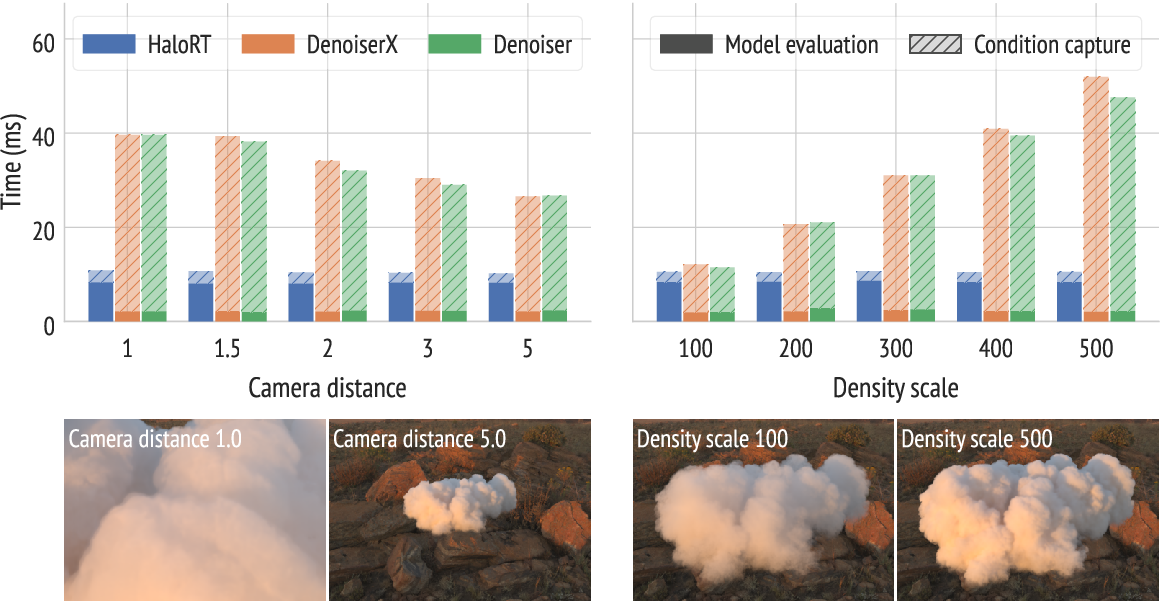
- It ran faster than the tested alternatives in their experiments.
- Its speed was less affected by cloud density or by moving the camera closer to the cloud.
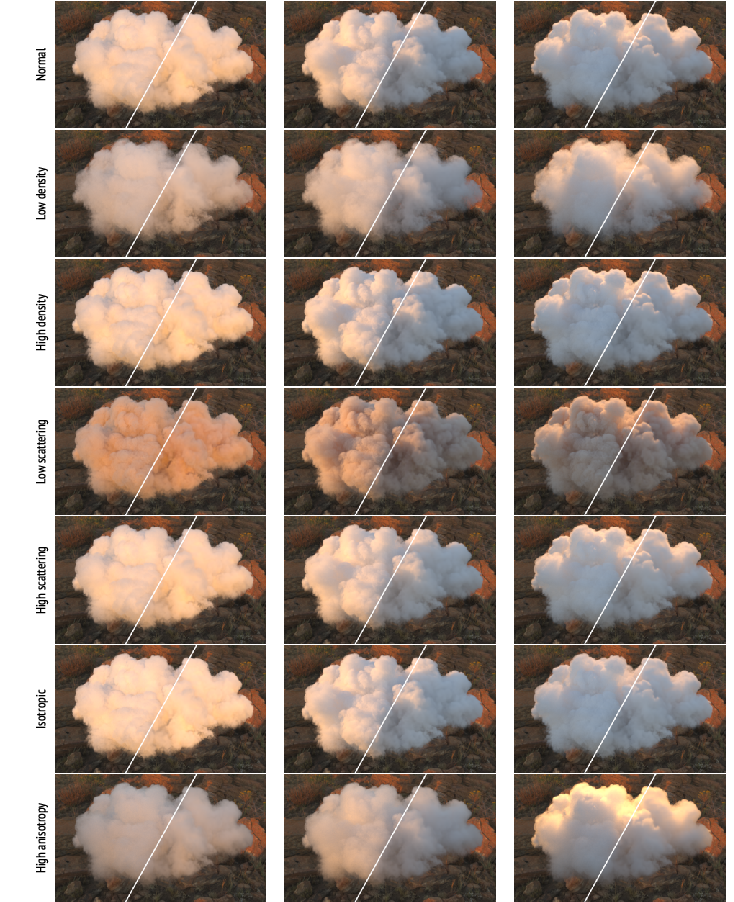
- It continued to work on clouds and lighting environments that it had not seen during training.
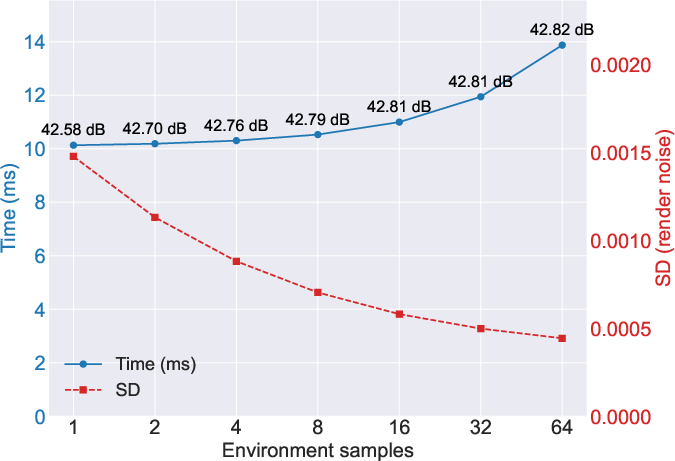
One particularly important result was stability. The researchers measured how much the output changed when the random calculations were repeated. HaloRT had much less variation than the other methods. With only a small number of environment-light samples, the differences became almost impossible to see.
The reported average running time for HaloRT was about 10.66 milliseconds under the main test conditions. This is fast enough to support many real-time graphics applications, although the exact speed depends on the computer and image size.
Comparing image-quality measurements
The method did not achieve the best score in every measurement. For example, another method had a higher PSNR, a score based mainly on the difference between individual pixels.
However, HaloRT achieved better results in several other measures, especially:
- LPIPS, which estimates whether two images look perceptually similar to people.
- SSIM, which measures structural similarity.
- Stability across repeated calculations.
- Running time.
This means that HaloRT sometimes had small overall brightness differences, but it often preserved details and lighting effects that people notice more.
5. Why are these results important?
The paper shows that a computer may not need to calculate every light path to create a convincing image of a cloud.
Instead, a carefully chosen set of physical measurements can provide enough information for a neural network to reconstruct the complicated lighting. This is similar to predicting the weather using important measurements such as temperature, pressure, and wind rather than measuring every molecule in the atmosphere.
The method could make realistic volumetric effects practical in:
- Video games
- Virtual and augmented reality
- Flight and driving simulators
- Animated films
- Interactive scientific visualizations
- Virtual worlds with moving clouds or fog
Because the method does not rely heavily on expensive path tracing, it may also provide smoother frame rates when the camera moves through dense clouds.
Limitations and future possibilities
The method is promising, but it is not ready for every situation. The researchers tested it mainly on cloud-like volumes with:
- A single cloud volume
- One major directional light
- A surrounding environment light
- Non-emitting material
- A particular mathematical model for how light scatters
It does not currently handle all situations, such as:
- Fire or glowing materials
- Local lights inside the cloud
- Surfaces mixed with the volume
- Several separate volumes
- Every possible type of fog or smoke
- Cloud appearances very different from those in the training data
The network may also make mistakes when it sees scenes unlike the examples used during training. More training data, including real captured sky and lighting images, could improve its generalization.
Simple conclusion
The paper introduces a faster way to render realistic clouds. Instead of tracing thousands of complicated light paths, the method measures a few useful properties of the cloud and uses a neural network to predict the final lighting.
The results suggest that this approach can create detailed, stable, and convincing cloud images in real time. If developed further, it could help make interactive digital worlds look more realistic without requiring extremely powerful computers.
Practical Applications
Immediate Applications
The paper demonstrates a practical pipeline for inferring volumetric global illumination from inexpensive primary-ray features, avoiding path-traced radiance samples during inference. The following applications are plausible now, particularly for cloud-like media and distant environmental lighting:
- Real-time cloud rendering in game engines and interactive graphics
- Sector: Games, real-time rendering, virtual production.
- Use case: Integrate the
HaloRTfeature-extraction and neural-decoding pipeline into engines such as Unreal Engine, Unity, or proprietary Vulkan/DirectX renderers to produce detailed, multiply scattered clouds at interactive frame rates. - Potential product/workflow: A neural volumetric-lighting plugin that replaces expensive multi-scattering path tracing with optical-depth features, interaction-depth layers, light transmittance, environment samples, and a trained U-Net decoder.
- Practical benefit: More stable performance as cloud density, camera distance, and screen coverage change; reduced temporal noise; less dependence on accumulation over multiple frames.
- Dependencies: The medium should resemble the cloud distributions represented during training. The current method assumes non-emissive volumes, a single volume, distant illumination, one dominant directional light, and a smooth environment map.
- Interactive weather and sky visualization
- Sector: Meteorology visualization, simulation, digital twins, education.
- Use case: Render changing cloud formations and lighting conditions interactively while users adjust density, albedo, anisotropy, sun direction, or HDR environment lighting.
- Potential tool: A real-time cloud-scene explorer for weather education, atmospheric-science demonstrations, or visualization of simulated weather outputs.
- Practical benefit: The model can infer appearance for unseen cloud volumes and lighting configurations, enabling responsive exploration without repeatedly converging expensive Monte Carlo renders.
- Dependencies: Accuracy may degrade for atmospheric phenomena outside the training distribution, including precipitation, fog banks with different statistics, aerosol layers, emissive effects, or strongly local illumination.
- Virtual production and previsualization
- Sector: Film, television, advertising, animation.
- Use case: Provide rapid previews of cloud, smoke-like, or atmospheric backgrounds during camera blocking, lighting design, and shot composition.
- Potential workflow: Artists use the neural renderer for interactive previews and switch to conventional path tracing for final-quality validation or production rendering.
- Practical benefit: Stable preview rates and low temporal variance can make volumetric lighting easier to judge while moving cameras or changing the environment map.
- Dependencies: The current evidence is strongest for clouds, not arbitrary smoke, fire, dust, or scenes containing nearby geometry and local light sources. A production workflow would also require validation against the final renderer to detect learned biases.
- Low-cost environment-map relighting
- Sector: Computer graphics, digital content creation, asset authoring.
- Use case: Relight cloud assets under different HDR environments and directional-light intensities without recomputing full multiple-scattering paths for every lighting change.
- Potential product: An interactive relighting tool that separates directional and environmental illumination using the two specialized decoders described in the paper.
- Practical benefit: The linearity of transport in illumination allows a single normalized prediction to be rescaled for different environment and directional-light intensities.
- Dependencies: The illumination model is limited to a smooth environment plus one dominant directional source. Multiple local sources, rapidly changing high-frequency lighting, and complex light-volume interactions would require additional features or training.
- Accelerated volumetric denoising and hybrid rendering
- Sector: Rendering software, GPU computing, offline production.
- Use case: Use the proposed transport features as inputs to existing volumetric denoisers, even when path-traced radiance samples remain available.
- Evidence from the paper:
DenoiserX, which replaces conventional noisy auxiliary inputs with the proposed deterministic features, substantially improves perceptual quality and stability relative to the baseline denoiser. - Potential workflow: A hybrid renderer can use a small number of path samples together with optical depth, multi-scale crossings, transmittance, environment illumination, and local phase-function properties.
- Practical benefit: Better preservation of fine volumetric detail and reduced variance without requiring a fully radiance-free deployment.
- Dependencies: The optimal balance between path samples and learned features must be tuned for each renderer, medium type, and target quality level.
- Real-time visualization of medical or scientific volumes, with adaptation
- Sector: Scientific visualization, medical imaging, engineering.
- Use case: Adapt the feature representation to interactively visualize participating media such as tissue, fluid, or material volumes under controlled illumination.
- Potential tool: A neural volume-rendering module that predicts scattering appearance from deterministic optical-depth and interaction-depth features.
- Practical benefit: The method’s emphasis on primary-ray features and stable screen-space inference could reduce the cost of repeatedly changing viewpoints or transfer functions.
- Dependencies: This is not directly validated by the paper. Medical and scientific volumes may contain different phase functions, emission, absorption spectra, sharp structures, or local light sources. New training data and physical validation would be required.
- GPU rendering research and benchmarking
- Sector: Academia, graphics hardware, software engineering.
- Use case: Use the paper’s formulation as a baseline for studying radiance-free neural rendering, deterministic feature design, and local-attention architectures for volumetric transport.
- Potential research workflow: Compare path tracing, volumetric denoising, learned per-point transport, and image-space feature decoding using common metrics such as perceptual similarity, stability across random realizations, and density-dependent runtime.
- Practical benefit: The paper provides testable assumptions—feature sufficiency and noise-invariant decoding—that can structure ablation studies and system validation.
- Dependencies: Reproducibility depends on access to comparable cloud datasets, converged path-traced references, GPU implementations, and training distributions representative of deployment scenes.
- Reduced rendering cost for interactive applications
- Sector: Cloud gaming, VR/AR, simulation, visualization.
- Use case: Deploy a trained decoder on high-end GPUs to reduce the number of costly volumetric path-tracing operations per frame.
- Practical benefit: The reported inference time is largely independent of volume density and scales predictably with image resolution, which is useful for frame-budget planning.
- Dependencies: The neural network itself becomes a major cost, especially at high resolutions and when separate passes are required for illumination components and color channels. Performance on mobile, console, or headset hardware is not established.
Long-Term Applications
The paper’s results suggest broader applications, but these require additional datasets, architectural changes, physical validation, or deployment research:
- General-purpose real-time volumetric global illumination
- Sector: Rendering, games, simulation, robotics visualization.
- Use case: Extend the method beyond clouds to smoke, fog, dust, underwater media, fire-adjacent volumes, biological tissue, and heterogeneous industrial materials.
- Potential product: A general volumetric global-illumination API that accepts arbitrary density fields, phase functions, emission, material properties, and lighting configurations.
- Required development: Training across diverse media types; support for emissive volumes, multiple volumes, local lights, surrounding surfaces, and more general phase functions.
- Key dependency: The near-sufficiency assumption may fail when important light transport arrives through paths far from the primary ray or when unseen media contain structures unlike the training data.
- Neural rendering for local and dynamic light sources
- Sector: Games, robotics, simulation, virtual production.
- Use case: Render smoke or fog illuminated by point lights, area lights, moving vehicles, explosions, indoor fixtures, or other spatially varying sources.
- Potential tool: A decoder conditioned on light position, source shape, visibility, spectrum, and local geometry.
- Required development: Additional light-transport features and explicit conditioning on source geometry and visibility.
- Dependencies: The current directional/environment decomposition does not directly model local emitters, and the network may require substantially more training coverage to preserve physical light behavior.
- Neural rendering of volumes interacting with surfaces
- Sector: Games, film, robotics, architectural visualization.
- Use case: Jointly render clouds, fog, smoke, terrain, buildings, vehicles, and characters with mutual shadows, reflections, and volumetric scattering.
- Potential workflow: Combine surface G-buffers with the proposed volumetric transport features in a multimodal decoder.
- Required development: Features describing surface-to-volume and volume-to-surface transport, occlusion, reflections, and mixed surface/volume visibility.
- Dependencies: The paper evaluates a single volume under distant lighting and does not establish accuracy in scenes with complex surrounding geometry.
- Generalizable neural volumetric assets
- Sector: Asset marketplaces, game engines, digital twins.
- Use case: Create portable cloud or smoke assets that can be relit and viewed from novel cameras without per-asset baking.
- Potential product: A compact asset representation consisting of the volume plus learned or standardized transport features, enabling real-time rendering across scenes.
- Required development: Better cross-volume generalization, asset-specific uncertainty estimates, and standardized interfaces for density, albedo, anisotropy, and environmental lighting.
- Dependencies: The current approach deliberately avoids per-volume training, but its accuracy still depends on the distribution of training clouds. Rare or highly structured assets may require fine-tuning.
- Physics-informed uncertainty and failure detection
- Sector: Safety-critical visualization, scientific computing, production rendering.
- Use case: Estimate when the neural prediction is unreliable and automatically fall back to path tracing, denoising, or higher-sample feature extraction.
- Potential workflow: A confidence head could identify regions affected by out-of-distribution density structures, lighting conditions, or phase-function parameters.
- Required development: Calibration studies, uncertainty-aware training, out-of-distribution benchmarks, and spatially adaptive fallback policies.
- Dependencies: Low variance across feature realizations does not guarantee physical accuracy; a stable prediction can still be systematically biased when assumption (A1) is violated.
- Adaptive quality control for rendering pipelines
- Sector: Cloud rendering services, virtual production, game engines.
- Use case: Dynamically vary environment-sample counts, image resolution, decoder capacity, or fallback path samples according to scene complexity and required perceptual quality.
- Potential tool: A rendering scheduler that allocates more feature samples in difficult regions and uses fewer samples where the decoder is stable.
- Required development: Region-wise error predictors and temporal policies that maintain visual consistency during camera motion and lighting changes.
- Dependencies: The paper shows that a small number of environment samples can be sufficient on its test set, but the best sample count may vary for high-frequency environments, unusual media, or extreme anisotropy.
- Real-time atmospheric simulation for autonomous systems
- Sector: Robotics, autonomous vehicles, aviation, maritime systems.
- Use case: Generate realistic views through fog, dust, smoke, or cloud layers for simulation, sensor testing, and perception-system training.
- Potential product: A GPU-accelerated simulator that produces visually and physically plausible volumetric conditions while vehicles or robots move through them.
- Required development: Sensor-specific rendering for cameras, lidar, radar, and infrared; dynamic temporal media; calibrated scattering and absorption models.
- Dependencies: The paper targets RGB image radiance and distant illumination, whereas autonomous-system simulation requires accurate sensor physics, dynamic volumes, and potentially strict worst-case guarantees.
- Policy and infrastructure visualization
- Sector: Urban planning, climate policy, emergency management, environmental planning.
- Use case: Render smoke plumes, haze, cloud cover, or atmospheric scenarios interactively for evacuation planning, infrastructure assessment, and public communication.
- Potential workflow: Couple a fluid or atmospheric simulator to the neural renderer for fast visual exploration of many scenarios.
- Required development: Validation against measured atmospheric data, support for time-varying volumes, and uncertainty communication so that visually plausible outputs are not mistaken for predictive forecasts.
- Dependencies: The current synthetic training environments and cloud-focused evaluation are insufficient for policy-grade scientific conclusions; the renderer would need domain-specific calibration and validation.
- Learned transport operators for inverse problems
- Sector: Academia, computational imaging, scientific inference.
- Use case: Use the compact feature representation and learned decoder as a differentiable approximation inside optimization or inverse-rendering systems.
- Potential applications: Estimating cloud density, albedo, anisotropy, or illumination from images; fitting volumetric assets to observations; accelerating gradient-based scene reconstruction.
- Required development: Differentiable feature extraction, physically constrained optimization, uncertainty quantification, and tests for identifiability.
- Dependencies: Feature sufficiency for forward rendering does not imply that scene parameters can be uniquely recovered. The paper explicitly allows different scenes to share similar feature distributions and rendered images.
- Energy-efficient rendering hardware and neural accelerators
- Sector: GPU architecture, edge computing, cloud infrastructure.
- Use case: Optimize local-attention neural decoders and feature-extraction kernels for real-time volumetric rendering on dedicated accelerators.
- Potential product: A hardware/software pipeline combining sparse volume traversal, ratio tracking, environment importance sampling, and tiled attention.
- Required development: Benchmarks across GPU generations, memory-bandwidth optimization, quantization, pruning, and deployment on consoles or edge devices.
- Dependencies: The reported timings are tied to specific NVIDIA hardware. Actual energy savings will depend on whether neural inference costs less than the path-tracing work it replaces on the target platform.
Glossary
- Absorption: The process by which a participating medium removes energy from light as it travels through it. “including emission, scattering, and absorption along importance-sampled light paths”
- Albedo: The fraction of incident light scattered rather than absorbed by a medium. “the single-scattering albedo ”
- Anisotropy coefficient: A parameter describing the directional preference of scattering in a medium. “parameterized by an anisotropy coefficient ”
- Attention-augmented image-to-image network: A neural network that transforms input feature images into output images while using attention mechanisms to model spatial relationships. “Using an attention-augmented image-to-image network”
- Bilateral filter: An edge-preserving image filter that considers both spatial distance and intensity similarity. “such as bilateral and edge-avoiding filters”
- Delta-tracking: A stochastic volume-rendering technique that samples potential interaction events using a majorant density. “We render volumetric scenes using delta-tracking combined with next-event estimation”
- Denoising: The reconstruction of a cleaner image from a noisy rendering or set of noisy samples. “many modern rendering systems rely on MC denoising”
- Density field: A spatial representation describing the concentration of participating material throughout a volume. “different density fields, may share the same feature distribution”
- Equirectangular environment map: A panoramic image representation that maps spherical environmental illumination onto a rectangular image. “a quadtree over the equirectangular environment map”
- Extinction coefficient: A measure of the rate at which light is removed from a medium through absorption or scattering. “where is the extinction coefficient”
- Feature sufficiency: The property that a feature representation contains enough information to determine the rendered image. “We formalize this as two testable assumptions, sufficiency and noise invariance”
- Free-flight sampling: Sampling the distance a light particle travels before interacting with a participating medium. “Light transport is simulated through stochastic free-flight sampling”
- Global illumination: The total lighting in a scene, including direct and indirect contributions from light scattering. “full volumetric global illumination”
- G-buffer: A collection of auxiliary image buffers containing geometric or material information used in rendering and denoising. “often called G-buffers in surface graphics”
- Gaussian mixture: A probability distribution represented as a weighted combination of multiple Gaussian distributions. “fit Gaussian mixtures to single-scattered radiance”
- Halo attention: A localized self-attention mechanism that restricts attention to spatial neighborhoods to reduce computational cost. “Local window attention (Halo) is applied instead of full attention”
- Importance sampling: A sampling strategy that preferentially selects statistically important directions or paths to reduce estimator variance. “importance-sampled light paths”
- In-scattered radiance: Light arriving at a point after being scattered into the viewing or propagation direction by the medium. “ is the in-scattered radiance”
- Interaction depth: The distance along a ray at which a scattering or absorption event is estimated to occur. “We define the interaction depth as the minimum distance at which this optical depth is reached”
- Light transport equation: An equation describing the propagation, scattering, absorption, and emission of light through a scene. “corresponds to the solution of the light transport equation”
- Majorant: An upper-bound density used to accelerate stochastic tracking methods in participating media. “a coarse grid of majorants to accelerate delta-/ratio-tracking estimators”
- Monte Carlo integration: Numerical integration using randomly sampled points or paths. “indirect contribution is accumulated through MC integration”
- Multiple scattering: The process in which light undergoes several scattering events before reaching the camera. “full multiple scattering in clouds”
- Next-event estimation: A rendering technique that directly samples illumination from a light source at each scattering event. “with next-event estimation”
- Optical depth: The accumulated extinction along a ray, determining how strongly the medium attenuates light. “We consider the accumulated extinction for each ray”
- Participating medium: A material such as smoke, fog, or clouds that absorbs, emits, and scatters light throughout its volume. “Light transport in participating media is governed by the volume rendering equation”
- Phase function: A function describing the angular distribution of light scattered by a medium. “where is the phase function describing angular scattering”
- Path tracing: A rendering method that simulates light transport by tracing stochastic light paths through a scene. “Monte Carlo (MC) path tracing achieves photorealistic rendering”
- Primary ray: A ray cast from the camera through an image pixel into the scene. “All of them are evaluated along primary rays”
- Ratio tracking: A stochastic estimator for computing transmittance through a heterogeneous volume using a majorant density. “we use deterministic ray marching over a short initial segment of radius , followed by stochastic ratio tracking”
- Radiance: The directional measure of light energy travelling through a point in space. “we reconstruct full multiple scattering from a compact set of auxiliary features”
- Receptive field: The region of an input image that can influence a neural network unit’s output. “features whose receptive fields span the entire input image”
- Reflective shadow map: A rendering representation that stores information about light reflected from surfaces for estimating indirect illumination. “G-buffers have since been combined with reflective shadow maps”
- Reservoir resampling: A sampling method that maintains a compact representative set of weighted samples for reuse. “spatiotemporal reservoir resampling”
- Russian roulette: A randomized termination technique that probabilistically stops low-contribution paths or tracking processes. “along with Russian roulette in ratio tracking”
- Scattering albedo: The proportion of extinction events that result in scattering rather than absorption. “the single-scattering albedo ”
- Self-attention: A neural-network operation that computes relationships between elements of a feature representation. “local spatial self-attention at intermediate resolutions”
- Single scattering: Light that has undergone one scattering event. “the single scattering evaluation along the ray”
- Spatiotemporal filtering: Filtering that combines information across both image space and successive time frames. “spatial and temporal filtering”
- Stochastic estimator: A random-sampling-based computational procedure for approximating a quantity. “We estimate this integral using a low-sample-count Monte Carlo estimator”
- Transmittance: The fraction of light that remains unabsorbed and unscattered while travelling through a medium. “denotes transmittance between two points in the medium”
- U-Net: An encoder–decoder convolutional neural network with skip connections, commonly used for image-to-image prediction. “The reconstruction operator is parametrized using a U-Net backbone”
- Variance: A statistical measure of the spread of repeated estimates around their mean. “violations of (A2) appear as a non-zero variance”
- Volume rendering equation: The integral equation governing radiance formation through absorption, emission, and scattering in a participating medium. “Light transport in participating media is governed by the volume rendering equation”
- Voxel: A volumetric pixel representing a discrete cell in a three-dimensional grid. “ray-march only non-zero voxels”