On the conjecture
Abstract: Using adelic intersection theory and following the method envisioned by Parshin and Moret-Bailly, we prove a conjecture of Vojta for curves of genus two and a weak form of the conjecture
Paper Prompts
Sign up for free to create and run prompts on this paper.
Explain it Like I'm 14
Overview
This paper is about a major problem in number theory called the conjecture. The conjecture studies three whole numbers , , and that satisfy
It says that if , , and do not share any common factor, then usually cannot be much larger than the product of the different prime numbers appearing in .
The paper does not prove the full conjecture. Instead, it proves a related result about points on certain algebraic curves. This result can then be used to obtain a weaker version of the conjecture.
What questions does the paper ask?
The paper mainly asks:
- Can we control how complicated a rational point on a curve can be?
- How is the size of such a point connected to the number field containing it?
- Can information about curves be used to learn something about the conjecture?
- Can the difficult problem be converted into a problem about measuring geometric objects?
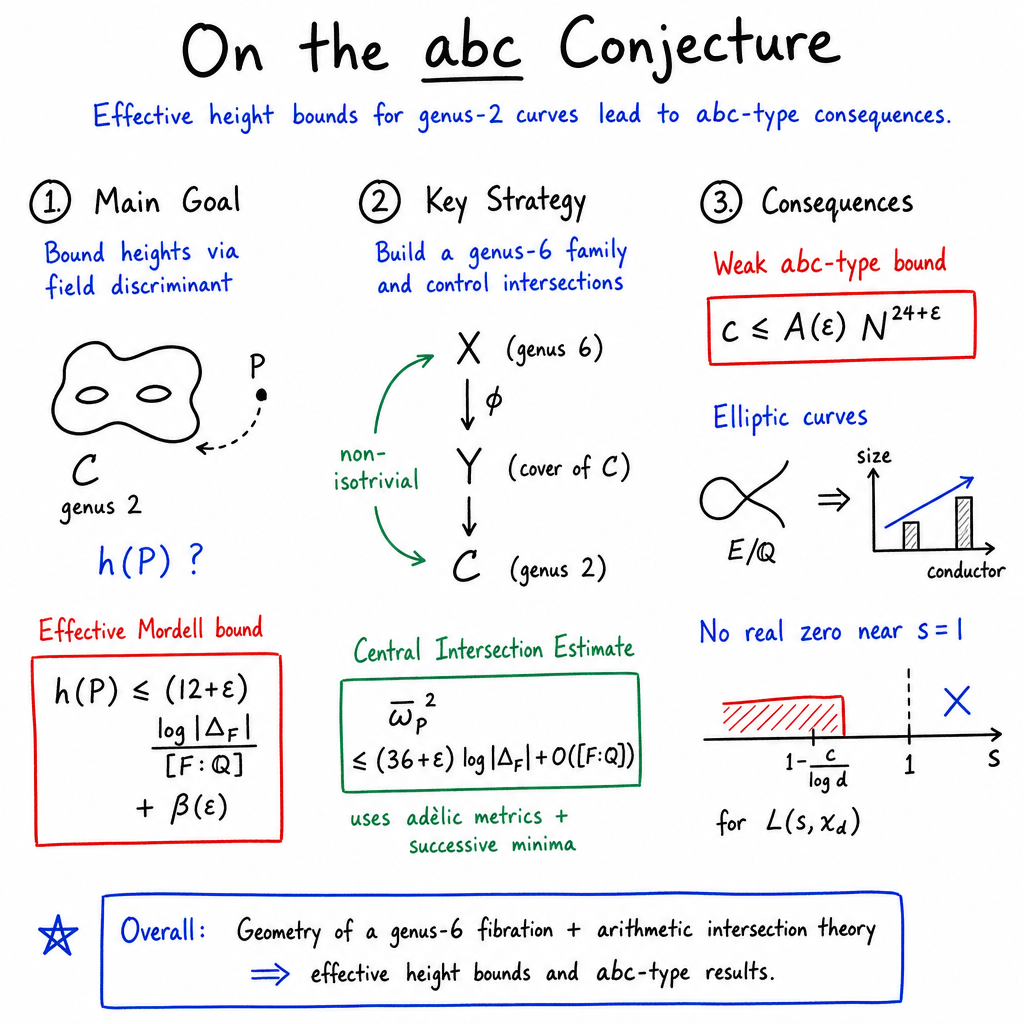
A central goal is to prove a bound for a point on a genus-two curve . In simple terms, a genus-two curve is a special type of curved shape described by polynomial equations.
The paper proves that the height of satisfies an inequality of the form
Here:
- measures the arithmetic “size” or complexity of .
- is the number system in which the coordinates of live.
- measures how arithmetically complicated that number system is.
- is the degree of over the ordinary rational numbers.
- is any small positive number.
- is a constant depending only on .
The exact formula is technical, but the basic meaning is simple: the complexity of a point is controlled by the complexity of the number field containing it.
How did the researchers approach the problem?
The proof uses several connected ideas from algebraic geometry and number theory.
1. Turning points into families of curves
The researchers begin with a genus-two curve . They construct another curve related to , together with a family of genus-six curves above it:
This means that every point of corresponds to one curve inside , called a fiber. You can imagine as a path and as a collection of different loops attached above every point on that path.
The family is called a Kodaira fibration. An important feature is that the curves in the family genuinely change as one moves along ; they are not all copies of exactly the same curve.
2. Measuring curves with heights
The authors use a special mathematical measurement called a height. A height is similar to a score that records how complicated an object is.
They define a height using the relative differential forms of the family. Roughly speaking, differential forms describe how a curve changes locally, much like slope describes how a road changes. The authors use an arithmetic version of intersection theory to calculate how these forms interact with themselves.
This produces a number written approximately as
It is another way of measuring the complexity of the curve corresponding to the point .
3. Using line bundles and metrics
A line bundle can be thought of as a rule that attaches a one-dimensional space to every point of a geometric object. Although this sounds abstract, line bundles are useful because they allow mathematicians to record information about shapes, distances, and equations.
The authors place metrics on these line bundles. A metric is a way of measuring the size of a section at different places, including ordinary real or complex places and the prime-number places.
The collection of all these measurements is called an adelic metric. It is a way to study an arithmetic object from all number systems at once.
The paper proves results about:
- how these metrics behave;
- how large global sections can be;
- how intersection numbers can be bounded;
- how heights change when points are moved to larger number fields.
4. Using sections and intersection numbers
A section is a mathematical object that chooses one value from a bundle at every point. The researchers choose sections whose zeroes do not overlap.
They then relate:
- the sizes of the sections;
- their divisors, meaning the locations where they become zero;
- and arithmetic intersection numbers.
One important inequality has the form
In everyday language, this says that the interaction between two geometric objects can be controlled by measuring the sizes of suitable sections.
5. Studying special curves of genus three and six
The construction uses coverings of curves. A covering is a map from one curve to another, somewhat like a map from a larger, more detailed map to a simpler map.
The paper first makes a degree-two covering of a genus-two curve. This creates a genus-three curve. A second degree-two covering then creates a genus-six curve.
The genus changes according to the Riemann–Hurwitz formula, which is a rule for calculating how the number of holes in a curve changes when one curve covers another.
The authors study special points, called Weierstrass points, and special divisors on these curves. These calculations are necessary for understanding the geometry of the genus-six fibers.
6. Extending curves over the integers
The paper also studies stable pointed curves. These are curves with marked points that are allowed to develop certain controlled singularities.
The authors show that, after changing the base by an appropriate map called an alteration, a family of curves can be extended over the integers of a number field. This is important because working over the integers allows the researchers to track what happens at every prime number.
Main findings
The most important result is Theorem A:
For every positive , there is a constant such that every point on the genus-two curve satisfies
This is an effective version of the Mordell conjecture for the curve. The word effective means that the result gives an actual type of numerical bound, rather than merely saying that only finitely many points exist.
The paper also proves a weaker form of the conjecture. If , , and are positive, have no common factor, and satisfy
then
where is the product of the different prime numbers dividing .
For example, if the only primes appearing in were $2$, $3$, and $5$, then . The theorem says that can be bounded using this number.
The exponent is not as strong as the exponent predicted by the full conjecture, but it is still meaningful. It shows that the size of cannot grow completely independently of the prime numbers dividing .
Why are these results important?
The full conjecture would have consequences across number theory. It would help explain why certain equations have only a small number of solutions and why large powers rarely combine in simple ways.
This paper shows a deep connection:
In other words, a problem about three integers can be studied by examining complicated geometric shapes.
The paper also develops tools for working with arithmetic intersection numbers, adelic metrics, and families of curves. These tools may be useful in other problems involving rational points and Diophantine equations.
Simple conclusion and possible impact
The paper’s main message is that the complexity of solutions to number-theory problems can often be controlled by studying geometry.
The authors do not prove the complete conjecture, but they prove a related theorem that gives a weaker bound. They do this by:
- placing the original curve inside a carefully constructed family of curves;
- measuring the family using heights and intersections;
- bounding those measurements using arithmetic information about number fields;
- translating the result back into a statement about rational points and integers.
For a 14-year-old reader, the big idea is this: mathematicians use the shape and geometry of curves as a powerful measuring tool for understanding numbers. The techniques in the paper could eventually help researchers prove stronger results about equations involving integers, prime numbers, and rational solutions.
Practical Applications
Immediate Applications
The paper is primarily a theoretical contribution in arithmetic geometry. Its results do not directly produce consumer or industrial products, but several methods and conclusions are immediately useful within mathematical research and computational number theory.
- Effective bounds for rational points on genus-2 curves — academia and computational number theory. Theorem A provides an explicit-form inequality
for rational points on a fixed genus-2 curve over extensions . This can be used to restrict the search space in algorithms that enumerate or test rational and algebraic points on curves.
Potential workflow: compute or estimate the discriminant , derive a height cutoff, and then use height-based enumeration, lattice reduction, or algebraic-number software to search for candidate points.
Dependencies: the constant must be known or effectively computable for the bound to support a fully automated implementation. The theorem applies to the specified class of curves and number fields containing the base field .
- Benchmarking and validating arithmetic-geometry software — software and academia. The explicit intersection-theoretic inequalities, sup-norm arguments, and discriminant-dependent estimates can serve as test cases for systems such as SageMath, Magma, PARI/GP, and specialized Arakelov-geometry libraries.
Potential tools: modules for computing heights, discriminants, Arakelov intersection numbers, Jacobians, divisors, and rational points could use the paper’s inequalities as consistency checks.
Dependencies: many quantities in the proof involve adelic metrics and arithmetic intersection theory that are not currently implemented uniformly in general-purpose software.
- Construction of explicit families of curves — algebraic geometry and mathematical research. The paper gives a concrete construction involving étale covers, double covers branched over carefully selected divisors, and a non-isotrivial genus-6 Kodaira fibration. Researchers can reuse this construction when producing examples of families with controlled geometric and arithmetic properties.
Potential outputs: databases of explicit genus-6 fibrations, examples for testing conjectures, and symbolic scripts for calculating branch loci, Jacobians, divisor classes, and intersection numbers.
Dependencies: the construction may require extending the ground number field sufficiently to obtain the relevant covers, square roots of line bundles, level structures, and connected components.
- Use of arithmetic discriminants as complexity indicators — number theory and computational workflows. The results reinforce the role of the normalized discriminant
as a measure controlling the arithmetic complexity of rational points. Researchers can use this quantity to prioritize number fields or algebraic points in computational experiments.
Dependencies: discriminant growth alone does not determine the exact height of a point; the additive constants and the geometry of the underlying curve remain important.
- Research on uniformity in families of number fields — academia and mathematical policy. Theorem B gives a weak, explicit form of an -type inequality:
for coprime positive integers satisfying . This can be used as a conditional-style benchmark for testing conjectural relationships between radical size and arithmetic magnitude.
Dependencies: the exponent is much weaker than the conjectured behavior, so the result is mainly useful as a theoretical bound rather than as a sharp predictive tool.
Long-Term Applications
The following applications require substantial further work, including effective constants, algorithmic implementations, stronger theorems, or validation across broader classes of varieties.
- Automated determination of rational points — software and computational mathematics.
A sufficiently effective version of Theorem A could become part of an end-to-end algorithm for finding all -rational points on genus-2 curves:
- determine a height bound from the field discriminant;
- enumerate points up to that bound;
- certify completeness using Jacobian computations, descent, Chabauty-type methods, or Mordell–Weil information.
Dependencies: one needs computable values of , efficient height evaluation, and practical control of the relevant field extensions. The current theorem statement alone does not establish an immediately executable algorithm.
- Effective Mordell-type algorithms for broader curves — academia and symbolic computation. The Parshin–Moret-Bailly strategy may be generalized to higher-genus curves or other varieties. If successful, it could provide explicit height bounds for rational points in settings where current methods are ineffective.
Potential tools: an “effective Vojta bound” library that accepts a curve, base field, and , then returns certified height bounds.
Dependencies: the construction of suitable non-isotrivial fibrations, effective control of adelic metrics, arithmetic intersection estimates, and explicit versions of the successive-minima arguments.
- Improved -type bounds and Diophantine equation solvers — number theory and cryptographic mathematics. Stronger versions of the paper’s argument could yield better bounds for equations such as , generalized unit equations, and -unit equations. These bounds could reduce the search space for solving exponential and Diophantine equations.
Potential applications: certified solvers for families of integer equations, automated detection of exceptional solutions, and improved complexity estimates for arithmetic algorithms.
Dependencies: major improvements would be needed to approach the conjectural exponent . The current exponent may be too large for many practical computations.
- Arithmetic-risk and integrity checks in computational finance — indirect, long-term application. The discriminant and height framework could eventually support certified arithmetic checks in systems that manipulate algebraic numbers, such as symbolic finance, formal verification, or exact pricing models involving algebraic extensions.
Potential workflow: attach height and discriminant certificates to algebraic quantities and use theorems of this type to bound the size or complexity of exceptional solutions.
Dependencies: this is an indirect application. The paper does not address financial models, numerical stability, probabilistic risk, or real-time computation.
- Formal verification of deep number-theoretic proofs — software and academia. The paper’s decomposition into lemmas about adelic metrics, sup norms, stable models, intersection pairings, and discriminant bounds could guide formalization in Lean, Coq, or Isabelle.
Potential product: a machine-checked library for Arakelov geometry and effective Diophantine geometry.
Dependencies: formal definitions and libraries for number fields, schemes, moduli spaces, adelic metrics, arithmetic intersection theory, and moduli-stack constructions are still technically demanding.
- Testing conjectures about -functions and exceptional zeros — analytic number theory. The paper indicates consequences for zero-free behavior of -functions of quadratic characters with negative discriminant. If the underlying bounds were strengthened and made uniform, they could contribute to explicit analytic estimates involving class numbers, quadratic characters, and prime-distribution questions.
Dependencies: translating the geometric inequalities into sharp analytic estimates requires additional arguments. The stated results should not be interpreted as an immediate numerical zero-free-region algorithm.
- Explicit moduli-space and stable-reduction pipelines — algebraic geometry. The alteration result for stable pointed curves suggests a route toward algorithms that extend families over arithmetic bases after controlled base change.
Potential tools: software for constructing stable models, resolving bad reduction, adding level structures, and tracking families through compactified moduli spaces.
Dependencies: alterations may be non-canonical and computationally expensive; the required level structures and field extensions can substantially increase complexity.
- Educational and research training tools for advanced mathematics — education.
- heights and discriminants;
- adelic metrics and sup norms;
- arithmetic intersection pairings;
- Jacobians and $2$-torsion;
- stable curves and Kodaira fibrations;
- the relation between Mordell-type statements and -type inequalities.
Dependencies: the source text contains formatting corruption and redacted names, so substantial editorial reconstruction would be necessary before direct pedagogical use.
Overall, the strongest realistic applications are in computational and theoretical number theory, especially height-bounded searches, arithmetic-geometry software, explicit curve constructions, and future effective approaches to Diophantine equations. The paper does not provide direct applications to healthcare, energy, robotics, or everyday consumer tasks; any such connection would be indirect and would require substantial additional technological development.
Glossary
- conjecture: A conjecture asserting that relatively prime positive integers satisfying cannot have much larger than the product of the distinct prime divisors of . “The conjecture of [PERSON_NAME] and Oesterl""" e is known to follow from Theorem~A”
- Adelic line bundle: An algebraic line bundle equipped with compatible local norms at every place of a number field. “An {\it adelic line bundle} ”
- Adelic metric: A collection of local metrics satisfying compatibility and finiteness conditions across all places of a number field. “When an adelic metric has been chosen on a line bundle ”
- Adelic vector space: A finite-dimensional vector space over a number field equipped with compatible norms at all of its places. “An adelic vector space [ADDRESS] over is a pair ”
- Admissible metric: A metric whose curvature on each geometric fiber is proportional to a canonical probability measure. “we say that is when is integrable”
- Alteration: A proper, surjective, generically finite morphism used to replace a variety by a better-behaved model. “there exists an alteration ”
- Arithmetic degree: A degree obtained by summing logarithmic contributions from metrized fibers over all places of a number field. “we define as follows the {\it arithmetic degree} morphism”
- Arithmetic intersection number: An intersection pairing for metrized line bundles that includes both algebraic and arithmetic data. “The {\it arithmetic intersection number} of with is”
- Canonical line bundle: The determinant line bundle associated with the cotangent bundle of a variety or curve. “a logarithmic height associated to the canonical line bundle of ”
- Cartier divisor: A divisor locally defined by one non-zero rational function, equivalently associated with an invertible ideal sheaf. “If is Cartier divisor on ”
- Chern form: A differential form representing the first Chern class of a metrized line bundle. “ is the first Chern form”
- Coherent metric: A metric induced by a line bundle on an integral model outside a finite set of places. “One assumes that the collection is ”
- Curvature: A differential-geometric or non-Archimedean measure of the variation of a metric. “the curvature of the restriction of to the geometric fiber”
- Discriminant: An arithmetic invariant measuring the ramification and arithmetic complexity of a number field. “the logarithm of the absolute discriminant of the field of definition of ”
- Etale morphism: A morphism that is flat and unramified, behaving locally like a disjoint union of open embeddings. “a finite etale map ”
- Fubini–Study metric: The standard positively curved metric on the hyperplane bundle over complex projective space. “If $\Vert \cdot \Vert_{\cal O}(1)}$ is the Fubini-Study metric at archimedean places”
- Geometrically irreducible: Remaining irreducible after extending scalars to an algebraic closure. “a smooth, projective, geometrically irreducible curve”
- Geometrically connected: Remaining connected after base change to an algebraic closure. “with geometrically irreducible, one dimensional fibers”
- Height: A numerical measure of the arithmetic complexity of a point, section, or algebraic object. “we denote by a logarithmic height”
- Hyperelliptic curve: A curve admitting a degree-two morphism to the projective line. “The curve is hyperelliptic.”
- Hyperelliptic involution: The order-two automorphism exchanging the two points in a generic fiber of a hyperelliptic map. “the hyperelliptic involution of ”
- Jacobian: An abelian variety parametrizing degree-zero divisor classes on a smooth projective curve. “Let be the jacobian of ”
- Kodaira fibration: A smooth, non-isotrivial family of curves over a curve. “The Kodaira fibration ”
- Line bundle: A locally free sheaf of rank one on a scheme or variety. “We then call ”
- Mordell conjecture: The theorem that a curve of genus greater than one has only finitely many rational points over a number field. “this effective version of the Mordell conjecture”
- Non-Archimedean: Referring to a valuation or analytic geometry in which the ultrametric inequality holds. “One assumes that is non-archimedean when is finite”
- Non-isotrivial: Describing a family of varieties that is not constant after a finite base change. “a non-isotrivial smooth proper morphism”
- Number field: A finite extension of the rational number field . “In the following is a number field.”
- Poincaré line bundle: A universal line bundle on the product of a curve and its Jacobian, encoding divisor classes. “let be a Poincar""" e line bundle on ”
- Picard group: The group of isomorphism classes of line bundles under tensor product. “We denote by the Picard group of .”
- Proper morphism: A morphism satisfying an algebraic analogue of compactness. “a proper surjective morphism of degree two”
- Riemann–Hurwitz formula: A formula relating the genera and ramification of curves under a finite morphism. “by the Riemann-Hurwitz formula, has genus”
- Riemann–Roch theorem: A theorem relating the dimension of sections of a line bundle to its degree and canonical dual. “the [PERSON_NAME]-Roch theorem imply”
- Semi-positive line bundle: A metrized line bundle whose curvature or intersection-theoretic positivity is nonnegative. “an integrable adelic line bundle if it is the quotient of two semi-positive adelic line bundles”
- Specialization map: A map sending points over a valued field to points on the corresponding special fiber. “The specialization map from to is surjective”
- Stable pointed curve: A nodal curve with marked points satisfying finiteness and ampleness conditions. “These data define a stable -pointed curve”
- Successive minima: Quantities measuring the smallest sizes of linearly independent vectors in a metrized lattice or adelic vector space. “[PERSON_NAME]'s theorem on successive minima”
- Theta divisor: The locus in a Jacobian parametrizing effective divisor classes of a specified degree. “Let be the Theta divisor of ”
- Uniformizer: An element generating the maximal ideal of a discrete valuation ring. “ a uniformizer of ”
- Valuative criterion of properness: A criterion characterizing proper morphisms through extension of maps from valuation rings. “By the valuative criterion of properness”
- Weierstrass point: A point on a curve where the gap sequence differs from the generic one, often a ramification point of a canonical map. “Assume is a [ADDRESS] point on ”
- Vojta’s conjecture: A broad conjectural framework relating Diophantine approximation, heights, and discriminants. “a weak form of Vojta's conjecture”
- Zariski closure: The smallest closed algebraic subset containing a given subset. “Let be the [PERSON_NAME] closure of the graph of ”