A Note On Lattice Definition of Gauge Theories With Chiral Fermions
Abstract: Because of the fermion doubling problem, it has been a longstanding challenge to describe a lattice algorithm for studying four-dimensional gauge theories coupled to chiral fermions. Recently, an algorithm to do so has been described by Craig, extending partial results in the previous literature. Here we describe a variant of this algorithm, based on interpolating a lattice gauge field over the continuum (as in Craig's work) and coupling the interpolated gauge field to continuum chiral fermions. The same variant was also proposed recently by Hsu. In any dimension and for any anomaly-free representation, this approach can be implemented on a computer in principle, but not in practice by Monte Carlo methods because the chiral fermion path integral is not positive.
Paper Prompts
Sign up for free to create and run prompts on this paper.
Explain it Like I'm 14
1. What is this paper about?
This paper explains a possible way to study chiral fermions using a computer simulation called lattice gauge theory.
Fermions are tiny particles, such as electrons and quarks. Chiral fermions are special because they come in two types, called left-handed and right-handed. The Standard Model of particle physics uses chiral fermions.
Scientists already have good computer methods for studying many particle theories. However, chiral fermions create a serious problem called the fermion doubling problem. When scientists place particles on a computer grid, extra unwanted copies of the particles often appear. These copies can ruin the theory.
The paper describes a different method that avoids this problem, at least in principle.
2. What questions are the researchers asking?
The paper focuses on several main questions:
- How can we define a chiral fermion theory so that it makes mathematical sense?
- How can we put a gauge theory on a lattice without creating unwanted duplicate fermions?
- How can we make sure the theory has no anomalies?
- Can this method work for many different forces, particle types, and numbers of dimensions?
- Could the method eventually be used in computer calculations?
An anomaly is a problem where a symmetry that seems to exist in the basic equations fails when the theory is treated quantum mechanically. An anomalous theory is usually not consistent: it gives different answers depending on how it is calculated.
An analogy is trying to build a perfectly balanced table. If one leg is slightly wrong, the table may look stable at first, but it wobbles when someone uses it. An anomaly is like that hidden instability in a particle theory.
3. How does the method work?
The lattice idea
In lattice gauge theory, space and time are imagined as a giant grid, similar to graph paper or a three-dimensional Minecraft world. The places where grid lines meet are called sites, and the connections between them are called links.
Instead of describing a smooth force field everywhere, scientists describe the field mainly along these links. This makes calculations possible on a computer.
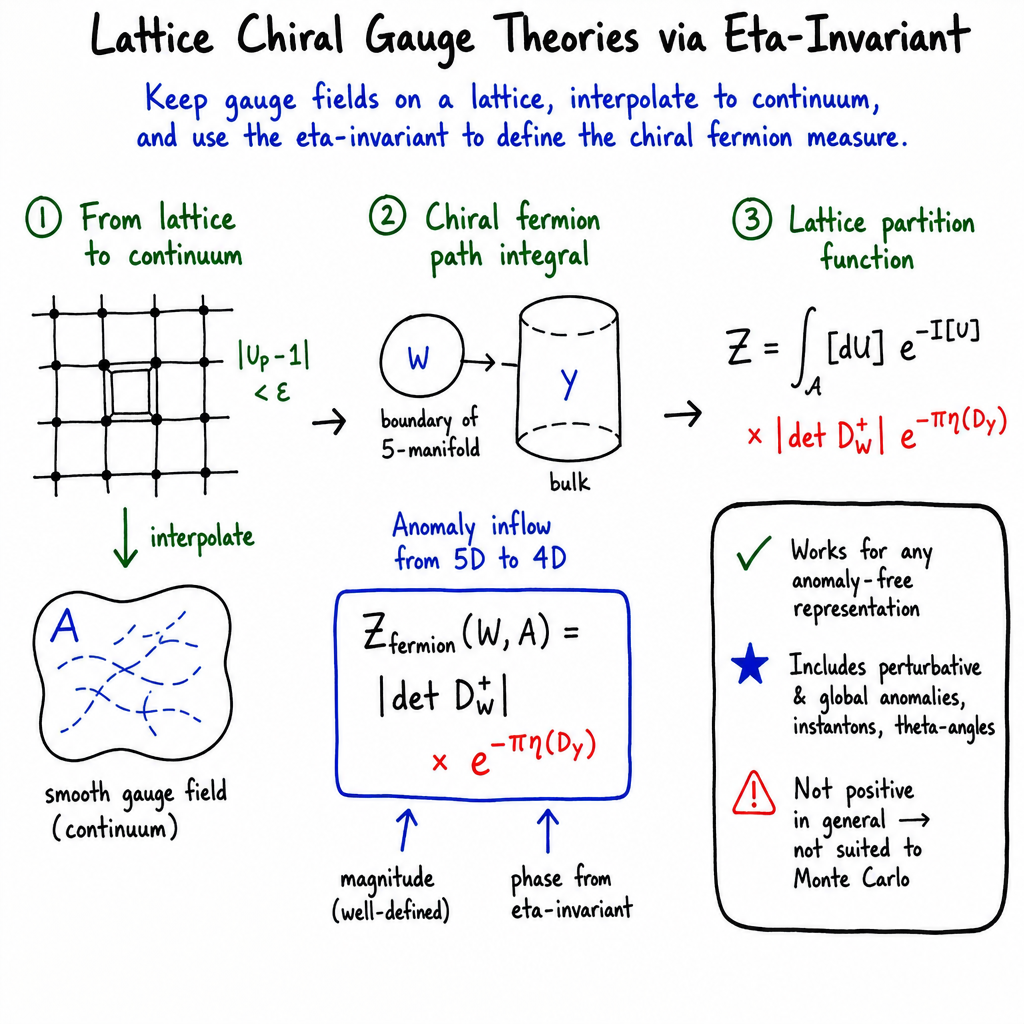
However, an unrestricted lattice can have unwanted particle copies. To avoid other problems, the paper uses only especially well-behaved lattice fields called admissible gauge fields.
These fields have a simple rule: the force must not change too sharply from one small grid square to the next. In technical language, the field around every small square, or plaquette, must be close to the identity.
This is similar to drawing a road on a map and refusing to allow sudden, impossibly sharp turns. The road can still bend, but only smoothly enough.
Turning the lattice field into a smooth field
The next step is called continuum interpolation.
The researchers take the information from the lattice and fill in the spaces between the grid points. This creates a smooth, ordinary gauge field in continuous space.
An analogy would be connecting points in a digital picture with smooth curves. The original data are still determined by the points, but the curves allow scientists to use familiar tools from ordinary calculus and physics.
The paper argues that admissible lattice fields can be smoothly interpolated in this way for many gauge groups and in many dimensions.
Using continuum chiral fermions
Instead of putting chiral fermions directly on the lattice, the method couples the interpolated smooth field to continuum chiral fermions.
This is important because it avoids putting the fermions on the grid in the usual way. Therefore, the unwanted extra fermion copies do not appear in the same way.
The chiral fermion contribution is described by a mathematical quantity called a fermion determinant. Informally, this is a number that summarizes how the possible quantum states of the fermions affect the theory.
The size of this determinant is written as . Its complex phase, which contains important information about the theory, is supplied using a five-dimensional construction involving an eta-invariant.
The extra dimension and anomaly inflow
The paper sometimes imagines the four-dimensional world as the boundary of a five-dimensional space. This extra dimension is a mathematical tool, not necessarily an extra physical dimension.
The five-dimensional space helps define the correct phase of the fermion determinant. The key formula has the basic form
Here:
- describes the size of the fermion effect.
- is a special number that records information about the five-dimensional fermion operator.
- supplies the correct phase.
This is related to anomaly inflow. The idea is that an apparent anomaly on the four-dimensional boundary is cancelled by an effect coming from the five-dimensional bulk.
A useful analogy is a leaking water tank. Water may seem to disappear from one part of the system, but a connected pipe brings in exactly the right amount from somewhere else. The boundary and bulk effects together produce a consistent theory.
4. What are the main findings?
The paper reaches several important conclusions.
The method works for anomaly-free theories
The proposed construction can define chiral gauge theories when the fermion representation is free of both:
- Perturbative anomalies, which can be found using ordinary calculations involving particle interactions.
- Global anomalies, which are more hidden problems that can appear when fields are changed in large or unusual ways.
The paper explains that the eta-invariant can detect both kinds of anomalies.
If the representation is anomaly-free, the final answer does not depend on which five-dimensional space was chosen to help calculate it. This is essential: a physical answer should not depend on an arbitrary mathematical choice.
It avoids the usual fermion doubling problem
The method does not introduce ordinary lattice fermions in the usual way. Instead, it uses continuum chiral fermions coupled to a smooth interpolation of the lattice gauge field.
Because of this, the unwanted duplicate fermions do not return in the construction.
It is very general
The approach is not limited to one particular force or one particular set of particles. According to the paper, it can work:
- For any compact gauge group.
- For any anomaly-free fermion representation.
- In any spacetime dimension.
- On more general curved spaces, not just a simple periodic grid such as a four-dimensional torus.
This includes theories related to the Standard Model, provided their anomalies cancel.
It can be implemented in principle, but not easily
The paper argues that all the ingredients can, in principle, be evaluated by a computer. One can integrate over admissible lattice gauge fields and calculate the fermion contribution for each field.
However, there is a major practical difficulty: the chiral fermion path integral is generally not positive.
In computer simulations, especially Monte Carlo methods, it is helpful if every possible configuration has a nonnegative probability. Then the computer can sample common configurations more often. But if the mathematical weight is complex or has changing signs, it cannot be treated as an ordinary probability.
This is similar to trying to choose raffle tickets when some tickets have negative weight or spinning arrows point in complex-number directions. The calculation may be mathematically meaningful, but it is extremely difficult to turn into an efficient random experiment.
5. Why is the research important?
The Standard Model contains chiral fermions, so a successful lattice description of chiral gauge theories could help scientists study the Standard Model in situations where ordinary calculations do not work well.
For example, it could eventually help investigate:
- Strongly interacting particle theories.
- Effects that cannot be studied using simple approximations.
- The behavior of theories in unusual topological or curved spaces.
- Whether proposed new particle theories are mathematically consistent.
The paper’s main contribution is not a finished, fast computer program. Instead, it provides a clearer mathematical route for defining these theories without the fermion doubling problem.
Conclusion
In simple terms, the paper proposes the following strategy:
- Start with a carefully controlled gauge field on a grid.
- Smoothly fill in the space between grid points.
- Couple this smooth field to continuum chiral fermions.
- Use a five-dimensional mathematical construction to define the fermion phase correctly.
- Require that all particle representations be anomaly-free.
This gives a general and mathematically consistent way to define chiral gauge theories on a lattice. The idea could become useful for studying particle physics beyond easy approximations. However, actually using it in large-scale computer simulations remains difficult because the quantum fermion contribution is not usually a normal positive probability.
Practical Applications
Immediate Applications
The paper is primarily a theoretical and methodological contribution. Its most immediate applications are therefore in anomaly analysis, formal regularization, algorithm design, and software prototyping rather than in production-scale numerical simulation.
- Anomaly certification for candidate chiral gauge theories — particle physics and mathematical physics. The eta-invariant criterion
on all relevant closed -dimensional manifolds provides a concrete test for whether a fermion representation is free of perturbative and global anomalies. Researchers can use it to validate proposed extensions of the Standard Model, unified gauge theories, and lower- or higher-dimensional chiral systems before attempting numerical implementation. Dependencies: The gauge group, fermion representation, spin structure, and relevant cobordism classes must be correctly enumerated. Numerical or symbolic evaluation of eta-invariants may remain difficult for complicated backgrounds.
- Verification of Standard Model consistency in nontrivial backgrounds — high-energy theory and quantum gravity. The framework can be used to check that chiral gauge theories remain well-defined on arbitrary compact Euclidean spin manifolds, not only on a flat four-torus. This supports consistency studies involving curved spacetime, gravitational backgrounds, instantons, and nontrivial topology. Dependencies: The background must admit the required spin or related structure, and mixed gauge-gravitational anomalies must be included in the analysis.
- A reference specification for lattice chiral-fermion implementations — lattice field theory and scientific computing.
The paper gives a concrete workflow for defining a lattice theory:
- restrict link variables to admissible gauge fields;
- interpolate each lattice configuration into a continuum gauge field;
- couple continuum chiral fermions to that interpolation;
- evaluate the fermionic contribution using the determinant magnitude and eta-invariant phase;
- integrate over lattice gauge links. This can serve as a design specification for prototype codes, benchmark implementations, and comparisons with overlap-fermion or domain-wall approaches. Dependencies: The interpolation must preserve gauge covariance and lattice symmetries, and the admissibility bound must be chosen so that topology is stable without distorting the desired continuum limit.
Numerical evaluation of fixed-background fermion observables — computational physics. Even though full Monte Carlo sampling is problematic, the proposed construction can be used to compute fermion determinants, propagators, and correlation functions for selected admissible gauge backgrounds. This is useful for testing instanton sectors, spectral flow, zero modes, and anomaly-related observables. Dependencies: The determinant phase is generally complex, and the continuum Dirac and five-dimensional operators must be discretized or approximated with controlled numerical error.
- Automated anomaly-screening software — research software and formal verification. The paper’s cobordism and eta-invariant perspective can be incorporated into a symbolic or numerical pipeline that takes a gauge group and fermion representation as input and produces anomaly diagnostics. Such a tool could combine representation-theory calculations, perturbative anomaly coefficients, mod-2 zero-mode tests, and databases of relevant cobordism groups. Dependencies: Complete mathematical data for the gauge group and representation are required; a finite set of test manifolds is sufficient only when its completeness has been established.
- Improved interpretation of domain-wall and overlap fermions — lattice QCD and quantum field theory education. The anomaly-inflow explanation clarifies why a higher-dimensional massive fermion can reproduce a chiral boundary theory and why the eta-invariant supplies the missing phase. This can inform lecture materials, benchmark problems, and implementation notes for existing domain-wall and overlap formulations. Dependencies: This is principally a conceptual and methodological application; it does not by itself remove the computational cost of five-dimensional fermion systems.
- Construction of anomaly-aware benchmark datasets — academic and industrial research infrastructure. Researchers can generate collections of admissible lattice gauge fields labeled by topology, instanton number, Dirac zero modes, and eta-invariant phase. These datasets could be used to test lattice algorithms, eigenvalue solvers, gauge-field interpolation schemes, and anomaly-detection software. Dependencies: Reliable topological labeling and high-precision spectral computations are needed, particularly near zero modes.
Long-Term Applications
The most significant applications require further development because the proposed fermion path integral is not positive and therefore cannot be inserted directly into ordinary importance-sampling Monte Carlo methods.
- Nonperturbative numerical simulation of the Standard Model and other chiral gauge theories — high-energy physics. A sufficiently efficient realization could enable lattice studies of genuinely chiral theories, including electroweak dynamics, chiral gauge symmetry breaking, anomaly-mediated effects, and strongly coupled beyond-Standard-Model sectors. The proposed method is especially relevant because it applies, in principle, to arbitrary anomaly-free representations and compact manifolds. Dependencies: A solution is needed for the complex or nonpositive fermion weight. Possible directions include contour deformation, complex Langevin methods, Lefschetz-thimble techniques, reweighting, tensor-network methods, or entirely new sampling strategies. These methods would require stringent validation.
- A general-purpose lattice regulator for anomaly-free chiral theories in arbitrary dimensions — mathematical and computational physics. The construction could become a unified regulator for two-dimensional chiral systems, four-dimensional gauge theories, and more unusual cases involving time-reversal or nonperturbative anomalies in three dimensions. This would support systematic comparisons between continuum anomaly classifications and nonperturbative lattice realizations. Dependencies: Continuum interpolation, boundary-condition, and eta-invariant constructions must be generalized and made computationally scalable in each dimension.
- Curved-space and gravitational lattice gauge theory — quantum gravity and cosmology. Because the method is formulated on arbitrary compact Euclidean spin manifolds, a mature implementation could study chiral matter in curved or topologically nontrivial backgrounds. Potential applications include anomaly constraints in quantum gravity, finite-temperature geometries, compactification spaces, and semiclassical gravitational backgrounds. Dependencies: The gauge-field interpolation must be combined with a reliable discretization or sampling method for geometry and spin structures. Dynamical gravity would introduce substantial additional computational complexity.
- Discovery and classification of viable beyond-Standard-Model matter content — particle-physics model building. Model builders could use anomaly-free lattice realizations as a nonperturbative filter for new fermion representations, hidden-sector gauge groups, composite Higgs models, and grand-unified constructions. Models that pass perturbative tests but possess global anomalies could be rejected before costly dynamical studies. Dependencies: Anomaly freedom is necessary but not sufficient for phenomenological viability; one must also address masses, symmetry breaking, unitarity, ultraviolet behavior, and experimental constraints.
- Nonperturbative study of instanton-induced interactions and zero modes — quantum field theory. The treatment of instanton sectors and fiducial manifolds could eventually allow direct computation of ’t Hooft operators, fermion-number violation, discrete theta-angle effects, and correlation functions that vanish in the ordinary partition function because of zero modes. Dependencies: The generalized measure for nonzero instanton sectors must be implemented consistently, including phase conventions, discrete theta angles, and zero-mode insertions.
- Anomaly-aware quantum simulation and analog emulation — quantum computing and quantum materials. If the eta-invariant phase and admissible gauge-field constraints can be encoded efficiently, quantum algorithms or analog platforms might simulate chiral boundary modes and anomaly inflow without relying on positive classical probability weights. This could provide an alternative route to studying systems inaccessible to classical Monte Carlo. Dependencies: Efficient state preparation, gauge-invariant encoding, measurement of nonlocal phase information, and control of lattice artifacts remain open technical problems.
- Design and analysis of protected chiral boundary states — condensed matter, topological phases, and materials science. The bulk-boundary mechanism discussed in the paper can inform theoretical designs of systems in which higher-dimensional gapped bulk degrees of freedom support anomaly-canceling chiral boundary excitations. Possible targets include topological phases, synthetic dimensions, and engineered fermionic boundary modes. Dependencies: The paper concerns relativistic Euclidean field theory; translating its results to experimentally realizable Hamiltonians requires a microscopic model, control of interactions, and a clear correspondence between eta-invariant phases and measurable observables.
- Certified anomaly handling in symbolic physics and model-generation platforms — software and AI-assisted theory development. Future automated model-building systems could use the paper’s criteria to prevent generation of inconsistent chiral gauge theories. A workflow might calculate local anomaly coefficients, enumerate global anomaly tests, identify required discrete theta angles, and produce a lattice-regularization specification for surviving models. Dependencies: The system would need mathematically complete anomaly databases and robust handling of exceptional groups, disconnected gauge groups, nonorientable manifolds, and representations with subtle global anomalies.
- Practical Monte Carlo algorithms for complex chiral determinants — computational statistics and numerical analysis. The paper identifies a central obstacle rather than solving it: the chiral fermion path integral is not positive. Developing algorithms that can sample the resulting complex measure would have broad consequences for lattice gauge theory and other sign-problem systems. Dependencies: Any proposed algorithm must demonstrate convergence, gauge invariance, correct treatment of topology and zero modes, and favorable scaling with lattice volume and fermion content. Without such advances, the construction remains principally a formal regularization rather than a routine simulation method.
Glossary
- Admissible gauge field: A lattice gauge field whose plaquette holonomies remain sufficiently close to the identity, allowing continuum-like topological properties to be defined. “Lattice gauge fields with this property have been called ‘admissible.’”
- Anomaly inflow: A mechanism in which a bulk theory cancels anomalies occurring in a lower-dimensional boundary theory. “This relation is beautifully expressed in the idea of anomaly inflow from an extra dimension.”
- Atiyah–Patodi–Singer (APS) boundary condition: A nonlocal spectral boundary condition defined using the eigenfunctions of a boundary Dirac operator. “APS boundary conditions are defined by requiring that Ψ, restricted to W = ∂Y, is a linear combination of eigenfunctions of DW with positive eigenvalue.”
- Atiyah–Singer index theorem: A theorem equating the analytical index of an elliptic operator with a topological expression involving characteristic forms. “That claim can be proved by considering the index theorem for the index I of the Dirac operator /DZ on Z.”
- Bismut–Freed connection: A connection on the determinant or ground-state line bundle over a space of background fields, whose holonomy encodes global anomaly information. “The holonomy around a loop in field space of what is nowadays often called the Berry connection, or in this context sometimes the Bismut-Freed connection.”
- Chern–Simons form: A differential form in one higher dimension whose variation is related to gauge and gravitational anomalies. “First of all, perturbative anomalies in d dimensions are related to Chern-Simons forms in d + 1 dimensions.”
- Cobordism invariant: A quantity unchanged under replacing a manifold by another manifold that shares it as a boundary. “In any d-dimensional theory that is free of perturbative anomalies, the d + 1-dimensional invariant exp(−iπη(DY )) that controls global anomalies is a cobordism invariant.”
- Continuum interpolation: A procedure that associates a smooth continuum gauge field with an admissible lattice gauge field while preserving gauge equivalence and topological information. “We will refer to such a procedure as continuum interpolation of admissible lattice gauge fields.”
- Domain wall fermion: A fermionic construction in which chiral modes become localized on the boundary or domain wall of a higher-dimensional system. “Building on the domain wall fermions of Kaplan.”
- Eta-invariant: A spectral invariant obtained from an asymmetric, suitably regularized sum over the signs of an operator’s eigenvalues. “Let η(DY ) be the Atiyah-Patodi-Singer (APS) eta-invariant of this operator.”
- Fermion doubling problem: The appearance of unwanted extra fermion species when naively discretizing chiral fermions on a lattice. “Because of the fermion doubling problem, it has been a longstanding challenge to describe a lattice algorithm for studying four-dimensional gauge theories coupled to chiral fermions.”
- Ginsparg–Wilson relation: A modified lattice chiral-symmetry relation for Dirac operators that permits an exact lattice version of chiral symmetry. “Lattice Dirac operators that satisfy the Ginsparg-Wilson relation.”
- Global anomaly: An obstruction to consistently defining a quantum theory caused by global, rather than infinitesimal, transformations of fields or background structures. “The representation has to be free of both perturbative and nonperturbative (global) anomalies.”
- Gauge holonomy: The group-valued result of parallel transport around a closed loop, such as a lattice plaquette. “Every plaquette holonomy UP is close to the identity.”
- Index theorem: A result relating the difference between the numbers of zero-modes of opposite chirality to topological data. “That claim can be proved by considering the index theorem for the index I of the Dirac operator /DZ on Z.”
- Instanton: A finite-action, topologically nontrivial gauge-field configuration in Euclidean spacetime. “The original goal was to define topological invariants such as instanton number in lattice gauge theory.”
- Instanton number: A topological charge measuring the global winding or sector of a gauge-field configuration. “However, if one constrains the lattice gauge field so that all plaquette holonomies are sufficiently close to the identity, then the instanton number ... can indeed be defined.”
- Lattice gauge theory: A formulation of gauge theory in which spacetime is discretized into a lattice for nonperturbative analysis. “Lattice gauge theory [1] provides a very satisfactory regularization of four-dimensional Yang-Mills theory.”
- Lattice regularization: The replacement of a continuum quantum field theory by a regulated theory defined on a discrete lattice. “Very recently, [PERSON_NAME] overcame the difficulties and, with the aid of several new ideas, finally constructed a lattice regularization of chiral gauge theories.”
- Mixed gauge-gravitational anomaly: An anomaly involving both gauge transformations and spacetime geometry. “The latter anomaly obstructs the ability to define a model on a general four-dimensional spin manifold.”
- Monte Carlo methods: Stochastic numerical techniques used to evaluate path integrals by sampling field configurations. “This approach can be implemented on a computer in principle, but not in practice by Monte Carlo methods because the chiral fermion path integral is not positive.”
- Nielsen–Ninomiya theorem: A no-go theorem stating that under standard assumptions, lattice fermion formulations produce paired fermion species and cannot yield a single chiral fermion. “The fermion doubling problem, which is well characterized by the Nielsen-Ninomiya theorem.”
- Nonperturbative anomaly: An anomaly that cannot be detected through perturbative expansion around a trivial background. “One learns to determine all possible nonperturbative anomalies – that is, anomalies beyond the standard perturbative anomalies.”
- Overlap fermion: A lattice fermion formulation in which the chiral determinant is represented through the overlap of states in a higher-dimensional construction. “[PERSON_NAME] and [PERSON_NAME] interpreted the chiral fermion determinant as an overlap.”
- Pauli–Villars regularization: A regulator scheme that introduces heavy auxiliary fields to render divergent quantum expressions finite. “The absolute value ... can be defined by any standard regularization, such as Pauli-Villars or zeta-function regularization.”
- Perturbative anomaly: An anomaly visible in a local expansion of the quantum effective action under infinitesimal transformations. “The representation has to be free of both perturbative and nonperturbative (global) anomalies.”
- Plaquette curvature: The lattice analogue of field strength associated with the elementary square loops of a lattice. “One important ingredient in this construction was a restriction to ‘admissible’ gauge fields – gauge fields whose plaquette curvatures are small.”
- Pseudoreal representation: A representation equivalent to its complex conjugate through an antisymmetric intertwining structure. “The one fact that we will use about such representations is that they are pseudoreal.”
- Spin manifold: A manifold equipped with a spin structure, enabling the definition of fermionic fields and spinor bundles. “Finally, our discussion applies on an arbitrary compact Euclidean spin manifold, not necessarily a torus.”
- Theta-angle: A parameter weighting topological sectors in a quantum field theory, which may be continuous or discrete. “By specifying the phases of the path integral measure for the fiducial manifolds and gauge fields, one specifies the renormalized values of gauge and gravitational theta-angles.”
- Topological invariant: A quantity associated with a field configuration that remains unchanged under continuous deformations. “The original goal was to define topological invariants such as instanton number in lattice gauge theory.”
- Zeta-function regularization: A method of assigning finite values to divergent spectral products or sums using analytic continuation of a zeta function. “The absolute value ... can be defined by any standard regularization, such as Pauli-Villars or zeta-function regularization.”