- The paper proposes a second-order formulation that circumvents the fermion doubling problem by leveraging real Majorana Grassmann fields and pseudo-Hermitian symmetry.
- The paper demonstrates through rigorous analytical and numerical methods that the lattice discretization preserves accurate dispersion relations and physical quantum numbers.
- The paper highlights computational efficiency gains and direct applicability to quantum simulation architectures by eliminating redundant fermion modes.
Lattice Quantization of Free Fermions without Doublers: A Second-Order, Pseudo-Hermitian Approach
Introduction and Motivation
The persistent challenge in lattice gauge theory of simulating fermions without incurring the fermion doubling problem has inhibited direct lattice formulations of the electroweak sector and quantum simulations of fermions. The canonical approach, discretizing the first-order Dirac equation, leads to unwanted spurious modes—doublers—due to the discretized derivative structure, as made precise by the Nielsen-Ninomiya theorem. Numerous prior schemes, such as Wilson, staggered, domain-wall, and overlap fermions, have not fully eliminated these artefacts without significant computational or theoretical overhead. This work introduces a fundamentally different approach, quantizing fermions via a second-order formulation which, by construction, evades the doubling problem on the lattice for any spatial dimension and even at vanishing mass.
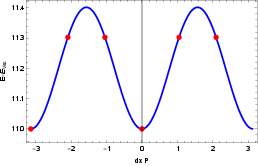
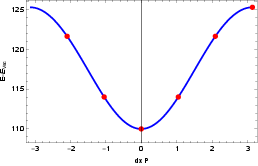
Figure 1: Comparison of dispersion relations: (a) First-order Dirac equation with spectral doubling, (b) Second-order approach matching theoretical dispersions with doublers eliminated.
The analysis combines a real Majorana Grassmann field structure, pseudo-Hermitian quantum mechanics, and an identification of the correct U(1) symmetry for charge assignments. This resolves pathologies and ambiguities in previous second-order approaches, yielding a viable lattice quantum field theory for free fermions that realizes the desired continuum limit while being free of redundant modes.
The transition to a second-order formalism begins with recasting the Dirac equation into a second-order differential form for χ fields, yielding
(DμDμ+SμνFμν−m2)χ=0,
where χ is real, and Sμν represents the spin representation. Unlike the Dirac spinor ψ, χ has twice the Cauchy data, but this is efficiently handled by employing real rather than complex Grassmann variables, corresponding to Majorana rather than Dirac representations. By exploiting a real representation for the gamma matrices, the quantum field theory is constructed without introducing negative norm states or superfluous degrees of freedom.
A key innovation is the rigorous canonical quantization of this system: Grassmann-valued fields χ and their conjugate momenta πχ satisfy canonical anti-commutation relations. The derived Hamiltonian is explicitly non-Hermitian but enjoys pseudo-Hermitian symmetry, i.e., there exists an invertible, positive-definite operator η such that χ0. This ensures real eigenvalues and unitary time evolution when the inner product is defined with respect to χ1. The measure χ2 is constructed analytically in the free theory, depending fundamentally on the energy of each Fourier mode.
The global χ3 symmetry corresponds to charge assignments, implemented as χ4 in the real representation, and ladder operators are constructed accordingly. The states built in this framework correctly reproduce known charge, energy, and momentum assignments, with the pseudo-Hermitian adjoint ensuring correct physical normalization.
Numerical Evidence and Lattice Implementation
To validate the theoretical constructs, the second-order formulation is discretized and solved numerically. The Clifford algebra machinery, closely related to the Jordan-Wigner transformation, is used to represent the Grassmann algebra on a finite lattice, making the approach directly applicable to classical simulations and quantum computing architectures.
Single Mode (χ5D)
For a stationary mode, the χ6 spinor fields at a point generate a χ7-dimensional qubit Hilbert space. The entire spectrum, including vacuum and excited states, is constructed with explicit charge, angular momentum, and energy assignments. The resulting spectrum aligns with the expectations from the continuum Dirac theory but is realized without doublers and with unambiguous quantum numbers.
1+1D Lattice: 6 Points
A comprehensive test is performed on a χ8D circular lattice with six sites, corresponding to a Hilbert space of χ9 dimensions. Here, both the first-order and second-order Hamiltonians are diagonalized, and their spectra compared. The second-order approach shows complete elimination of doublers while maintaining the desired dispersion and increasing computational efficiency due to better energy resolution.
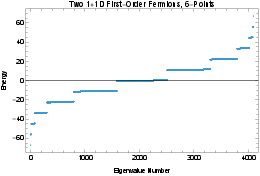
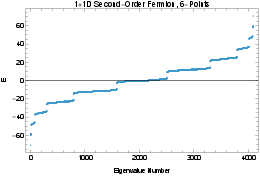
Figure 2: (a) Eigenvalue spectrum for first-order Dirac Hamiltonian (showing doublers), (b) second-order Hamiltonian (no doubling, finer resolution) on a 6-site (DμDμ+SμνFμν−m2)χ=0,0D lattice.
In the second-order case, excitations form clean energy-momentum-charge bands, and observables such as translation (momentum) and charge operators admit proper eigenstate decompositions. The method yields all possible momentum eigenvalues without additional redundant solutions.
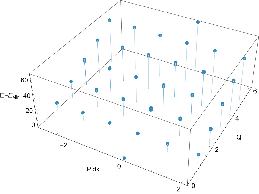
Figure 3: The (DμDμ+SμνFμν−m2)χ=0,1 positive charge states of the (DμDμ+SμνFμν−m2)χ=0,2D, 6-site, second-order fermion model are shown as a function of charge, energy, and momentum relative to the (unique) vacuum.
Significance and Implications
Theoretical Impact
The work demonstrates that a second-order formalism, properly quantized with real Grassmann variables and pseudo-Hermitian symmetry, circumvents the topological restrictions of Nielsen-Ninomiya—they only apply to first-order systems. This restores the possibility of directly formulating relativistic chiral fermions on the lattice across all dimensions and masses, without recourse to ad-hoc doublers-eliminating terms or enlarged state spaces with spurious degrees of freedom.
By enforcing the correct (DμDμ+SμνFμν−m2)χ=0,3 symmetry in the Majorana representation, the degeneracy and negative-norm problems that plagued prior second-order quantizations are avoided. Physical states correspond exactly to the single-particle, multi-particle, and vacuum sectors of the Dirac theory.
Computational and Quantum Simulation Implications
The absence of doublers reduces the effective Hilbert space per physical mode, yielding exponentially improved computational resource efficiency. The method directly conforms to the requirements of quantum simulation platforms, where qubits encode occupation of local fermionic modes. The pseudo-Hermitian structure can be consistently implemented in such discrete, qubit-based settings.
The formalism is robust in the (DμDμ+SμνFμν−m2)χ=0,4 limit (massless fermions), sidestepping complications that arise in Wilson- or staggered-fermion schemes where chiral symmetry becomes awkward. The approach generalizes to arbitrary spatial dimension, as the derivative operators and translation operators are explicitly constructed to respect translational invariance and periodicity across the torus.
Outlook and Open Directions
The paper’s results invite further advances, notably coupling to gauge fields. While the free theory is resolved decisively, accommodating local gauge invariance (e.g., lattice QED or electroweak theory) requires extending the construction for dynamical links and local (DμDμ+SμνFμν−m2)χ=0,5 symmetry. Given that the machinery retains canonical conjugate structure and matches the continuum in the appropriate limits, there is optimism for generalization. The construction of the (DμDμ+SμνFμν−m2)χ=0,6 measure in interacting, non-integrable settings remains as an open challenge, possibly requiring non-perturbative or numerical solutions.
Quantitative resource estimates for implementation on quantum computers remain to be detailed, but the absence of doubling directly suggests potential reductions in the needed number of qubits for given physical volumes and resolutions. The direct mapping to qubit occupation numbers makes the method compatible with existing quantum simulation libraries and hardware.
Conclusion
This work provides an explicit, constructive solution to the lattice fermion doubling problem by combining a second-order differential equation, real (Majorana) Grassmann field quantization, and pseudo-Hermitian symmetry. The resulting theory produces a correct, doubler-free fermion spectrum on the lattice for all spatial dimensions and mass regimes, with computational and theoretical properties highly advantageous for both classical and quantum simulation. It lays the groundwork for future study of lattice gauge theories and quantum field simulations that are both efficient and faithful to their continuum limits.

