Democratizing Robot-Use Agents: A Unified Harness with Open Models
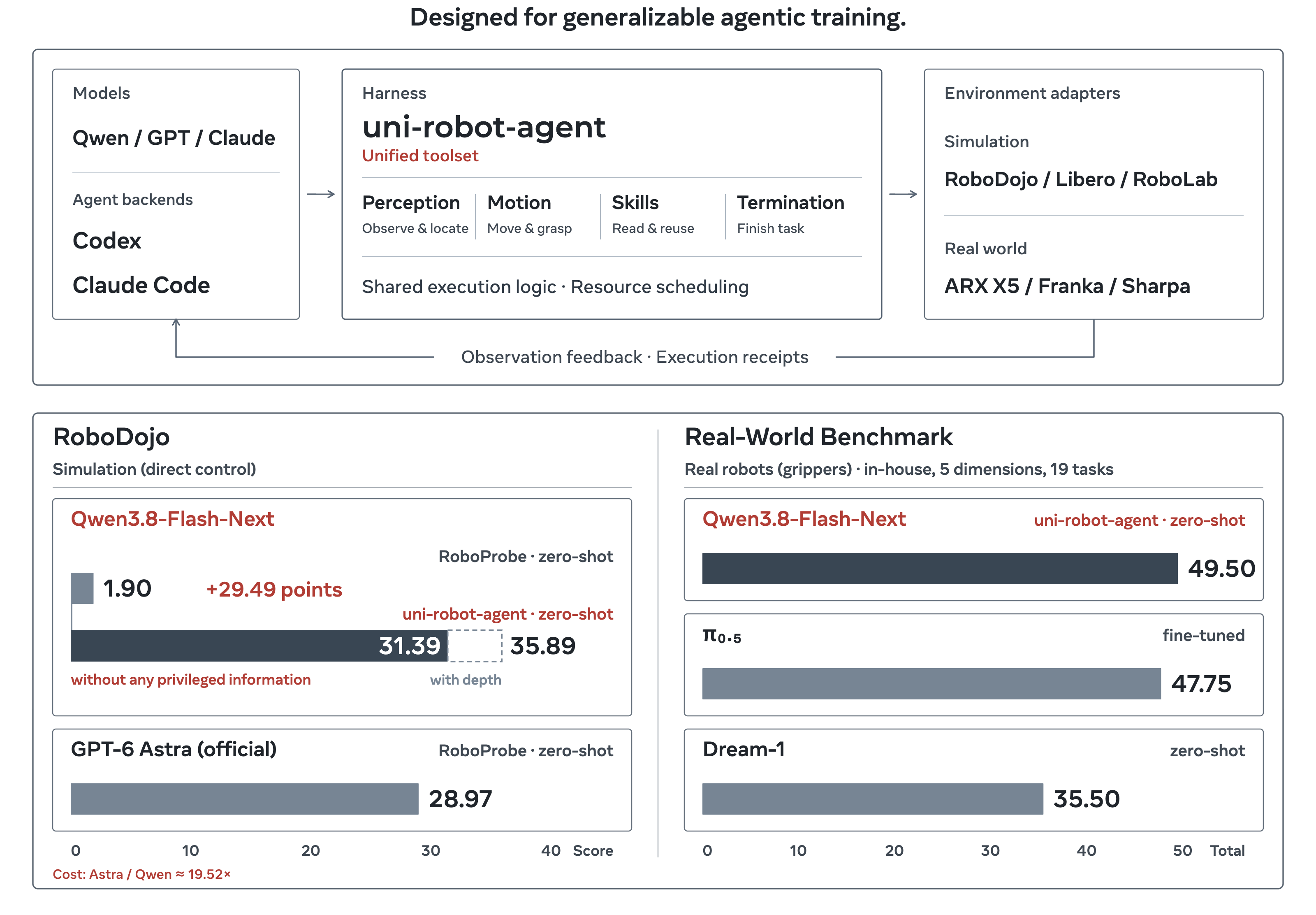
Abstract: Robot-use Agents (RUAs) have shown promising zero-shot manipulation capabilities, but reliance on frontier, proprietary models limits research into further training. To democratize RUA research, we introduce uni-robot-agent, a unified harness for competitive open-weight robot use that supports further training. Without privileged inputs, an out-of-the-box Qwen3.8-Flash-Next achieves a RoboDojo Score of 31.39, surpassing the published GPT-6 Astra-RoboProbe result of 28.97 and many VLA/WAM baselines, and performs competitively on 19 real-world tasks. Our analysis across model generations, families, and sizes links effective robot use to four general capabilities, suggesting that future RUA training should develop them jointly.

Paper Prompts
Sign up for free to create and run prompts on this paper.
Explain it Like I'm 14
1. What is this paper about?
This paper introduces uni-robot-agent, a system that helps artificial intelligence models control robots.
Usually, advanced robot systems depend on very expensive, private AI models. Because researchers cannot see or change these models, it is difficult for them to improve how robots learn.
The authors want to make robot research more open and affordable. They show that open-weight models—models whose internal settings can be downloaded and studied—can control robots effectively when connected to the right software system.
Their main idea is that the way an AI model communicates with a robot is just as important as the model itself.
2. What questions did the researchers ask?
The paper focuses on several main questions:
- Can open-weight AI models control robots as well as expensive, private models?
- Can the same robot-control system work in both computer simulations and real robots?
- What abilities does an AI need in order to use a robot successfully?
- Does the robot need special information, such as exact depth measurements from a simulator?
- Can the system make robots work faster and at lower cost?
In simple terms, the researchers wanted to know:
Can we build an open, flexible, and affordable “translator” between AI models and robots?
3. How did the researchers study this?
The robot-control system
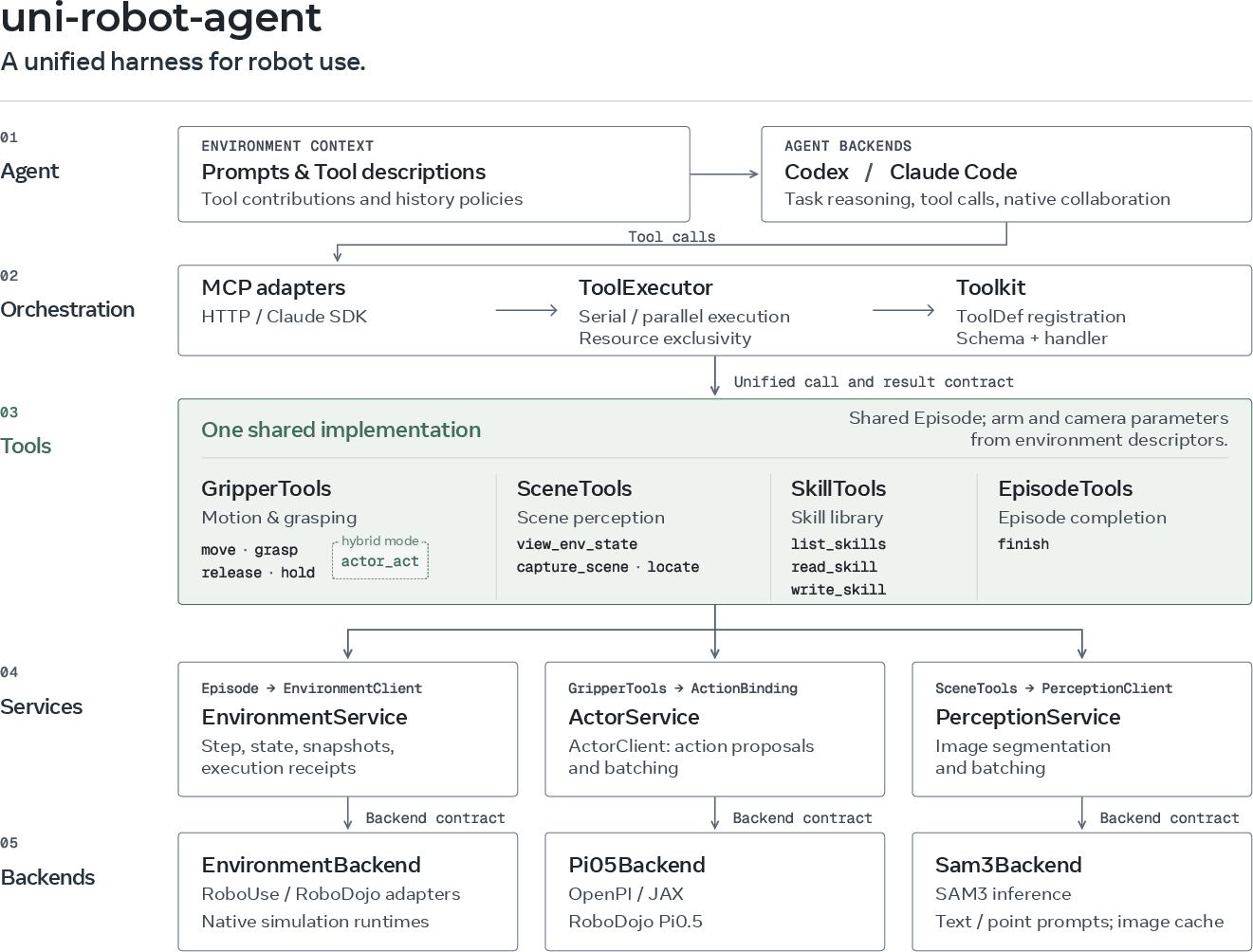
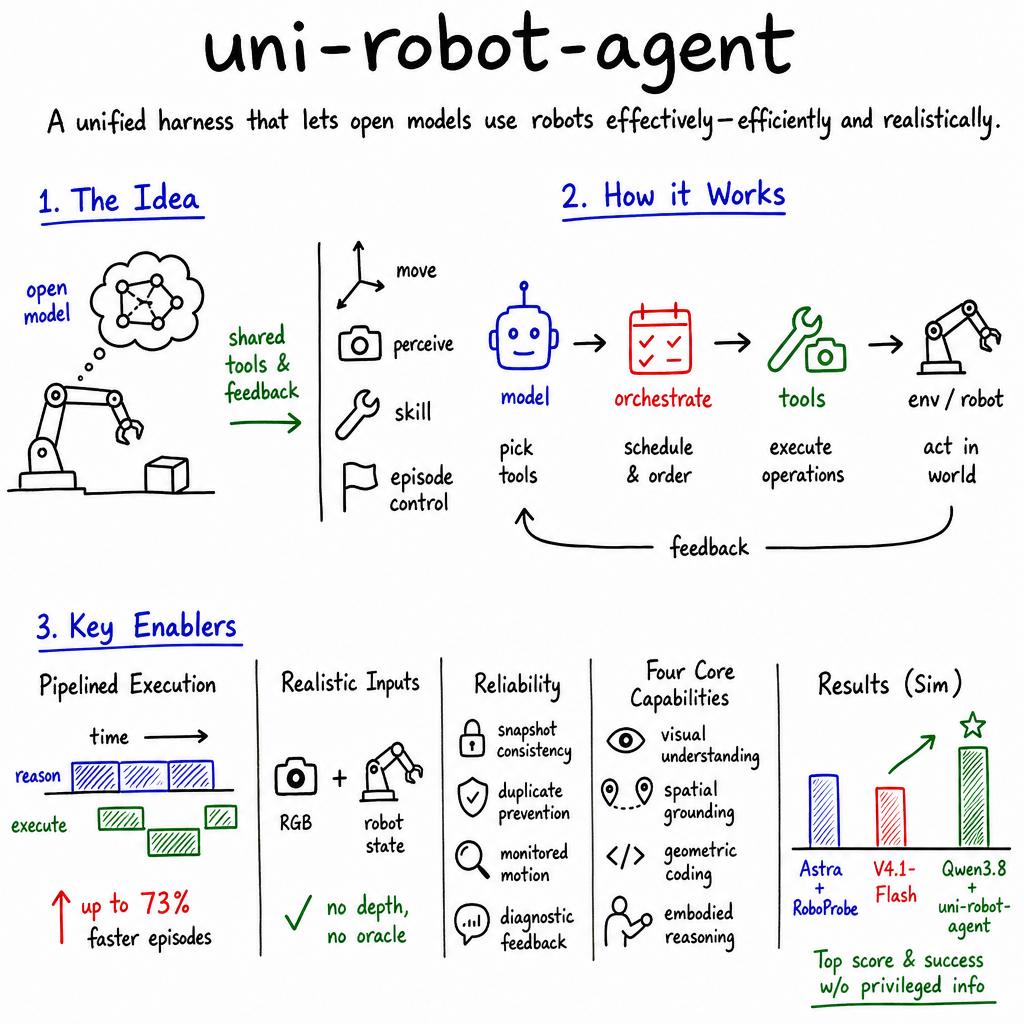
uni-robot-agent acts like a universal translator between an AI model and different robots.
The AI model decides what it wants to do, such as:
- Move an arm to a position
- Open or close a gripper
- Look at an object
- Check whether an action worked
The system then translates these requests into commands that a particular robot or simulator understands. It also sends information back to the AI, such as pictures, movement results, and warnings.
This is similar to using the same game controller with different video games. The buttons can have the same meanings even though each game works differently underneath.
A shared set of tools
The system provides common tools for different robots and environments. For example, a “move” command means the same basic thing whether the robot is in a simulation or in the real world.
This avoids writing completely new robot-control software for every robot and every task.
Faster actions through pipelining
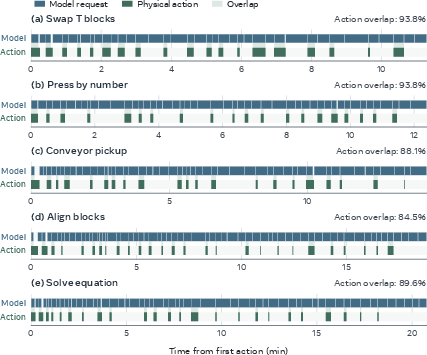
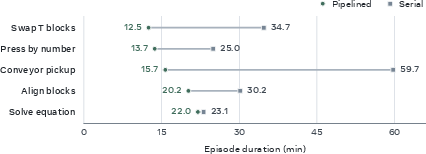
The system allows the AI to think about its next action while the robot is still carrying out the current one.
This is called pipelining. It is like preparing the next step of a recipe while the previous step is cooking. The robot still performs actions in the correct order, but the AI does not waste time waiting.
Realistic information
The researchers tried not to give the AI unfair information that would only be available in a simulator. For example, they usually did not provide perfect answers about whether a task had succeeded.
Instead, the AI had to use information similar to what a real robot would receive:
- Camera images
- Robot position
- Camera information
- Feedback from attempted actions
Testing environments
The researchers tested the system in two main settings:
- Simulation: 42 tasks from the RoboDojo benchmark. These tasks tested abilities such as memory, accuracy, following instructions, and completing long sequences of actions.
- Real robots: 19 tabletop tasks involving two robot arms.
They tested several AI models, including Qwen, DeepSeek, and GPT models, and compared their results with other robot systems.
4. What did they discover?
Open models can control robots surprisingly well
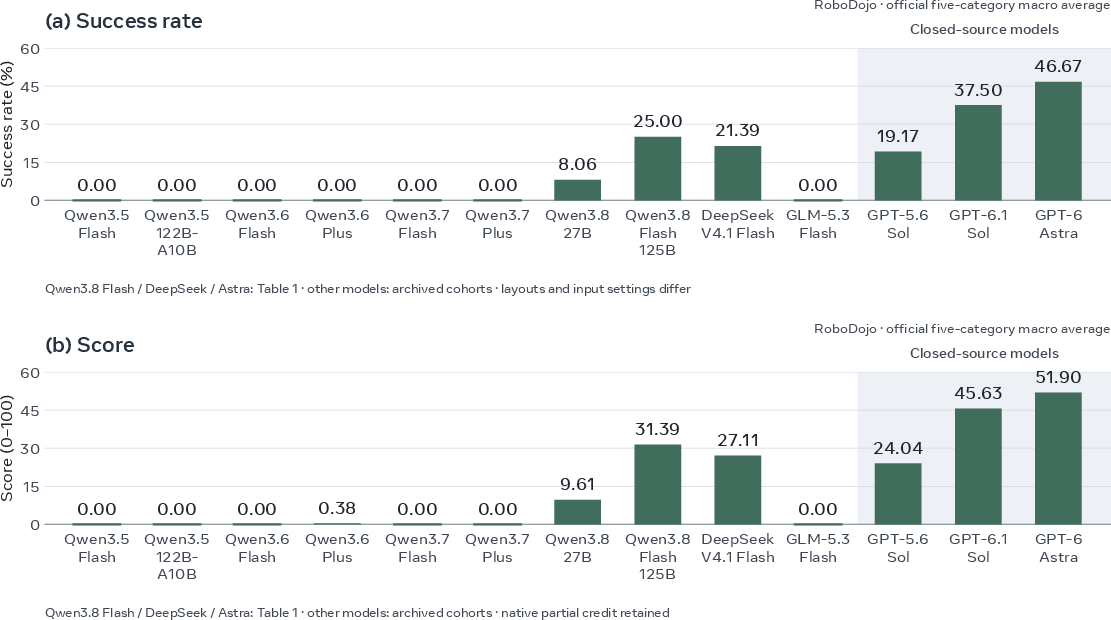
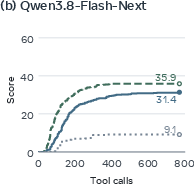
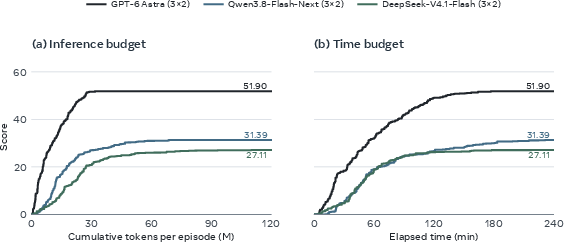
The strongest open-weight model, Qwen3.8-Flash-Next, achieved a RoboDojo score of 31.39 out of 100.
This was higher than the reported score of 28.97 for GPT-6 Astra using another robot-control system. It also performed better than several specialized robot-learning systems.
This is important because Qwen is an open-weight model. Researchers can study it, improve it, and potentially train it further.
Another open model, DeepSeek-V4.1-Flash, also performed better than several specialized robot baselines.
The system itself makes a big difference
When the researchers connected Qwen to other robot-control systems, its performance dropped significantly. With uni-robot-agent, it performed much better.
This suggests that a powerful AI model alone is not enough. The tools, feedback, and communication system connecting the model to the robot are also very important.
The system worked with real robots
On the 19 real-world tasks, Qwen with uni-robot-agent achieved a score of 49.50 out of 100.
This was:
- Better than the zero-shot Dream-1 system, which scored 35.50
- Similar to the fine-tuned system, which scored 47.75
A zero-shot system performs a task without being specially trained on examples of that exact task. This makes the result especially interesting: Qwen was able to handle new physical tasks without task-by-task training.
GPT-6 Astra performed even better in the real-world test, scoring 75.50. However, it was much more expensive to use.
Four abilities were especially important
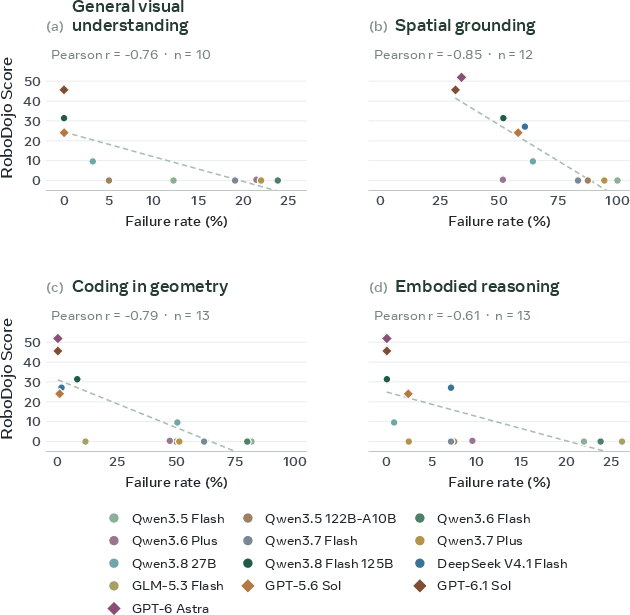
The researchers studied why some models succeeded while others failed. They found four important abilities:
- Understanding what is seen The AI must correctly recognize objects and understand what happened after an action.
- Understanding locations in space The AI must identify exactly where an object is, sometimes using images from different cameras.
- Doing geometry and coordinate calculations The AI needs to calculate positions, directions, and rotations correctly. These calculations help it know where to move the robot arm.
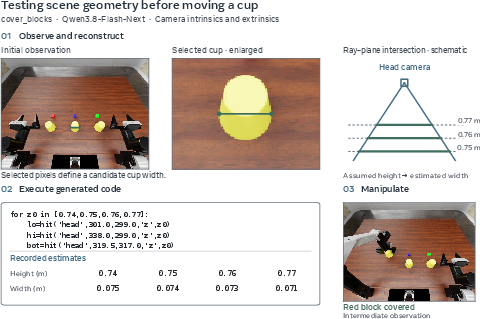
- Embodied reasoning The AI must understand what actions make physical sense. For example, it needs to choose a realistic way to grab a cup instead of trying to grab it from an impossible angle.
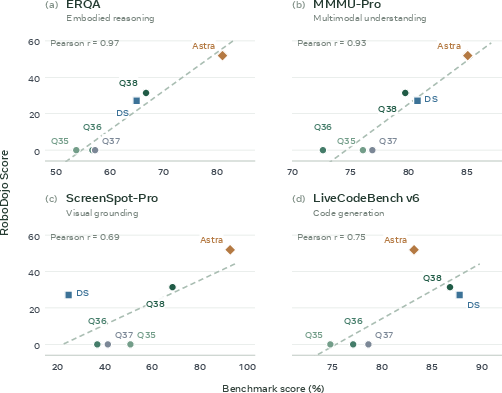
The paper argues that robot control is not just about predicting arm movements. It also requires strong general thinking, vision, mathematics, and understanding of the physical world.
Perfect depth information was not necessary
Some robot systems receive exact 3D information from a simulator. This is called depth information because it tells the system how far away each part of the image is.
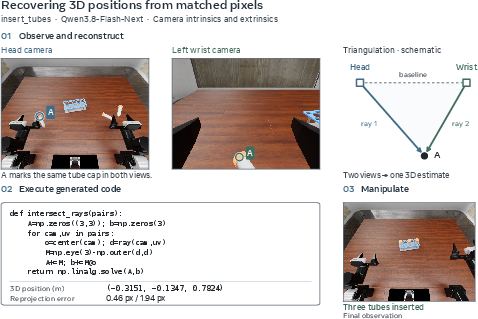
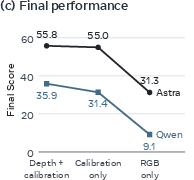
The researchers found that robots could still perform well without depth information if the AI had camera details and could compare different views.
For Qwen, the score decreased from 35.89 with depth to 31.39 without depth. This was a drop, but the system still worked reasonably well.
When the AI received only ordinary images and no camera information, its performance dropped much more. This means that camera details are useful, but perfect simulator information is not always required.
Special robot skills were not essential
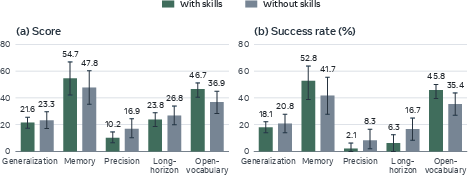
The researchers also tested the system without its library of special robot skills.
Qwen’s score fell only slightly, from 31.39 to 30.31. This suggests that the system was not succeeding simply because it had memorized solutions for particular tasks.
Instead, the model could often use general tools and reason through the task itself.
Open models were much cheaper
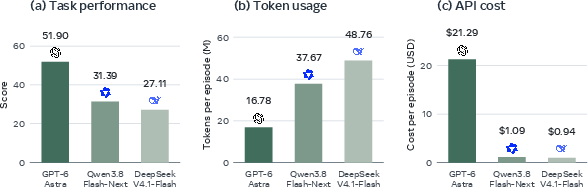
Qwen achieved a score of 31.39 at an estimated cost of about $1.09 per episode.
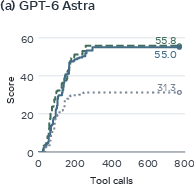
GPT-6 Astra achieved a higher score of 51.90, but cost about $21.29 per episode—almost 20 times more.
This difference matters because researchers need to run many experiments when training and improving robots. Cheaper models make this much easier.
The system improved speed
Because the AI could think while the robot was moving, pipelining made tasks finish faster than when the AI had to wait after every action.
This could be especially useful for real robots, where movements can take a long time.
5. Why is this research important?
This paper suggests that robot intelligence does not have to belong only to a few large technology companies with secret AI models.
An open system such as uni-robot-agent could allow:
- Universities to study robot-control AI
- Smaller companies to build robot applications
- Researchers to train and improve models directly
- Different robots and simulators to share the same tools
- Robot experiments to become less expensive
- AI systems to learn from both simulations and real-world experiences
The paper also gives researchers a clearer plan for future improvements. Instead of only training an AI to copy robot movements, they should also improve its vision, spatial understanding, geometry, and physical reasoning.
Simple conclusion
The paper shows that an open AI model can control robots effectively when it is connected to a carefully designed software system. The system acts like a flexible bridge between the AI’s decisions and the robot’s physical actions.
The results are not perfect—robots still make mistakes, especially when judging positions, calculating movements, or choosing how to grab objects. However, the research shows that affordable and open robot agents are possible.
In the future, this could make robot research more widely available and help more people build robots that can understand instructions, learn from experience, and work safely in the real world.
Practical Applications
Immediate Applications
- Deployable open-weight robotic manipulation pilots — Robotics and manufacturing
- Organizations can use
uni-robot-agentas a control and orchestration layer for tabletop tasks such as pick-and-place, object rearrangement, sorting, simple assembly, and instruction-following. - The unified tool interface allows the same high-level agent logic to be connected to different simulators, robot arms, cameras, and grippers through environment adapters.
- Potential product/workflow: an internal robotics platform in which engineers define a task description and environment adapter rather than implementing a separate policy for every robot.
- Dependencies: reliable robot drivers, calibrated cameras, collision and workspace limits, human supervision, and validation on the specific hardware. The reported real-world results are limited to 19 tabletop tasks and should not be interpreted as evidence of unattended industrial safety.
- Organizations can use
- Simulation-to-real robotics development and testing — Robotics, software, and academia
- Researchers can use the harness to evaluate the same agent, tools, feedback formats, and task descriptions in simulation and on physical robots.
- This supports rapid regression testing: a change to a model, perception component, scheduling policy, or motion tool can be evaluated across standardized tasks before deployment.
- Potential tool: a benchmark runner that records success rate, partial progress, motion errors, failure reasons, token usage, and execution time across multiple embodiments.
- Dependencies: sufficiently realistic simulators, consistent coordinate conventions, accurate robot and camera calibration, and task metrics that correlate with real-world performance.
- Low-cost research on robot-use agents — Academia and open-source AI
- Open-weight models such as Qwen and DeepSeek can be used instead of proprietary APIs for reproducible experiments, local inference, model fine-tuning, and ablation studies.
- The reported Qwen result suggests that a carefully designed harness can substantially improve an otherwise weak robot-use configuration; the paper reports a RoboDojo score of 31.39 and a cost of approximately $1.09 per simulated episode for that configuration.
- Potential products: downloadable research benchmarks, local robot-agent servers, model fine-tuning pipelines, and open datasets containing normalized tool calls and execution feedback.
- Dependencies: access to model weights, adequate GPU infrastructure, licensing compatibility, and independent replication. Cost and performance will vary with hardware, model version, context length, and inference settings.
- Reusable robot middleware and adapter libraries — Software engineering
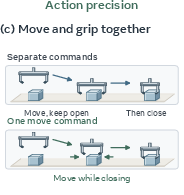
- Developers can implement shared operations such as motion, perception, gripper control, snapshot retrieval, episode reset, progress monitoring, and feedback reporting once, then reuse them across robot backends.
- This reduces the paper’s identified
N × Mimplementation burden, whereNtools would otherwise need separate implementations forMenvironments. - Potential product: a robotics SDK with adapters for common robot arms, simulators, camera systems, and motion planners.
- Dependencies: stable interface specifications, standardized units and coordinate frames, comprehensive error handling, and maintenance of adapters as vendor APIs change.
- Safer action execution and recovery workflows — Industrial automation and laboratory robotics
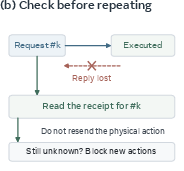
- The harness’s request identities, execution-status records, and duplicate-action rejection can be integrated into robot control systems to prevent repeated physical actions after communication failures.
- Uncertain commands can be marked as unresolved and block subsequent actions until the execution record is recovered, reducing the risk of accidental repeated motions or repeated grasp attempts.
- Potential workflow: an execution ledger comparable to an idempotent transaction system in distributed software, combined with an operator dashboard for unresolved actions.
- Dependencies: persistent logging, reliable robot-side status reporting, recoverable network connections, and conservative fail-safe behavior. This mechanism does not replace emergency stops, safety-rated controllers, or formal risk assessment.
- Improved manipulation feedback and debugging — Robotics operations
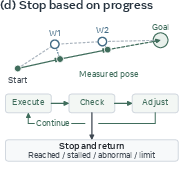
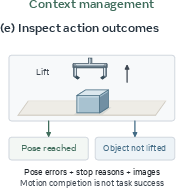
- Numerical pose errors, stopping reasons, images of outcomes, and progress measurements can be exposed to agents and human operators to distinguish between a failed motion, a stalled trajectory, and an unsuccessful grasp.
- This can support faster troubleshooting of calibration errors, unreachable targets, poor grasp geometry, and object slippage.
- Potential tool: a robot-debugging interface that combines video, action traces, coordinate transforms, residual errors, and model-generated diagnoses.
- Dependencies: accurate measurements and meaningful stopping criteria. Visual feedback alone may not reliably establish grasp success, especially for occluded or deformable objects.
- Higher-throughput agent–robot interaction — Robotics infrastructure and cloud robotics
- The two-stage pipeline can overlap model reasoning with physical tool execution while preserving ordering for calls that share an exclusive resource.
- This can reduce idle time in workflows involving repeated perception, planning, and motion calls, particularly when model latency is comparable to action duration.
- Potential product: a resource-aware scheduler for robots that supports background jobs, queued commands, batched result retrieval, and cancellation of unstarted actions.
- Dependencies: correct dependency tracking, safe cancellation semantics, deterministic resource ownership, and a robot controller capable of handling asynchronous requests. Pipelining is inappropriate when an action depends on feedback that has not yet arrived.
- Camera-calibration and RGB-based spatial reasoning workflows — Robotics and laboratory automation
- The results indicate that precise depth is not always necessary when camera parameters are available: agents can triangulate corresponding image points to estimate 3D positions.
- This can benefit deployments where depth sensors are expensive, unreliable, unavailable, or degraded by reflective, transparent, or outdoor surfaces.
- Potential workflow: multi-view RGB localization using camera intrinsics/extrinsics, correspondence selection, triangulation, and geometric consistency checks.
- Dependencies: calibrated and synchronized cameras, sufficiently visible corresponding points, suitable scene geometry, and robust handling of occlusion. Performance drops substantially when both depth and camera parameters are absent.
- Training and evaluation curricula for robot-capable foundation models — Education and academia
- The four identified failure areas—visual understanding, spatial grounding, geometric coding, and embodied reasoning—can be converted into targeted exercises and evaluation modules.
- Students and researchers can diagnose whether an agent failed because it misunderstood an object, selected inconsistent pixels, used an incorrect coordinate transform, or proposed an infeasible grasp.
- Potential educational tool: an interactive robotics course platform that exposes model trajectories and lets learners correct perception, geometry, and action decisions.
- Dependencies: carefully labeled failure cases, task-specific simulators, and evaluation protocols that distinguish genuine reasoning from memorized task solutions.
- Human-in-the-loop assistance for structured daily tasks — Accessibility and domestic robotics
- A supervised agent could assist with simple tabletop activities such as sorting objects, moving items between containers, or preparing materials, while a person approves actions or intervenes after uncertainty.
- The modular feedback and explicit uncertain-action states are particularly suitable for systems where autonomy is limited but robotic assistance is still valuable.
- Dependencies: safe hardware, restricted workspaces, privacy-preserving perception, clear user interfaces, and continuous human oversight. The paper does not establish readiness for unsupervised household deployment.
Long-Term Applications
- General-purpose robot foundation models trained across embodiments — Robotics and AI research
- The common tool and feedback formats could support large-scale training on simulation and real-world interaction data from different robots, tasks, and environments.
- Normalized trajectories could be used for supervised fine-tuning, reinforcement learning, preference optimization, or failure-recovery training.
- Potential product: a cross-embodiment robot model that learns reusable reasoning and tool-use patterns while adapters translate actions to individual robots.
- Dependencies: large, diverse, high-quality interaction datasets; consistent embodiment descriptions; safe exploration; domain randomization; and methods for preventing the model from learning simulator-specific artifacts.
- Autonomous warehouse, logistics, and light-manufacturing cells — Industrial robotics
- With stronger perception and embodied reasoning, the system could perform long-horizon tasks involving picking, bin organization, kitting, packaging, and adaptive recovery from misplaced or partially occluded objects.
- The resource-aware scheduler could coordinate multiple arms, cameras, grippers, and parallel perception services.
- Dependencies: substantially higher reliability than the reported benchmark results, formal safety validation, deterministic cycle-time guarantees, integration with warehouse-management or manufacturing-execution systems, and robust handling of rare failures.
- Multi-robot and bimanual coordination — Advanced manufacturing and service robotics
- The unified interface could be extended to coordinate several arms or mobile manipulators using shared state, resource locks, and synchronized tool calls.
- This could enable tasks requiring handoff, cooperative assembly, transport, or simultaneous manipulation.
- Dependencies: the paper explicitly identifies bimanual coordination as a remaining weakness. Future systems need multi-agent planning, collision-aware scheduling, shared world models, latency compensation, and guarantees against conflicting commands.
- Robot agents for healthcare and laboratory automation — Healthcare and life sciences
- A future system could manipulate labware, organize samples, prepare simple protocols, or assist with noncritical material handling in laboratories and care environments.
- The paper’s snapshot consistency, execution ledgers, diagnostic feedback, and calibrated multi-view perception are relevant to traceable workflows.
- Dependencies: specialized end-effectors, sterile or contamination-controlled operation, regulatory approval, auditable logs, validated accuracy, privacy protections, and strict human authorization. Patient-facing or clinical actions cannot be inferred from the current tabletop evidence.
- Adaptive household and elder-care assistance — Daily life and assistive technology
- A mature version could interpret novel instructions and manipulate unfamiliar household objects, potentially helping with organization, meal preparation, or retrieval tasks.
- The reported strength of robot-use agents on compositional and unseen tasks provides a basis for this direction.
- Dependencies: much stronger robustness to clutter, lighting changes, fragile objects, humans moving nearby, ambiguous instructions, and safety-critical edge cases. Continuous user consent, privacy-preserving sensing, and dependable fallback behavior are essential.
- Self-improving robot skills and failure-recovery systems — Robotics software
- The harness could collect failed trajectories, classify them using the four failure modes, and generate targeted additional training data or corrective skills.
- Because performance remained close to the skill-enabled result when the skill library was removed, future systems might learn reusable skills dynamically rather than relying on a large manually authored library.
- Potential workflow: failure detection → automatic categorization → simulated replay or human correction → fine-tuning → regression testing on held-out tasks.
- Dependencies: reliable failure labels, safeguards against reinforcing unsafe behavior, high-quality human demonstrations for difficult cases, and methods to avoid catastrophic forgetting.
- Foundation-model benchmarking beyond conventional language and vision tests — AI evaluation and policy
- The correlations between robot-use performance and benchmarks for visual understanding, spatial grounding, embodied reasoning, and code generation suggest a broader evaluation suite for models intended to control physical systems.
- Policymakers, procurement teams, and companies could require reporting on physical-world reliability, spatial errors, recovery behavior, resource consumption, and uncertainty—not only language or image benchmarks.
- Potential policy tool: standardized certification or model cards containing robot-use capability profiles and failure-rate breakdowns.
- Dependencies: larger and independently verified benchmarks, consistent test conditions, protection against benchmark overfitting, and metrics that reflect real-world safety rather than only task completion.
- Edge and private robot agents — Privacy-sensitive industry and consumer devices
- Open-weight models could eventually run locally or on private on-premise infrastructure, reducing dependence on proprietary APIs, cloud connectivity, and external transmission of camera data.
- This is relevant to homes, laboratories, factories, and healthcare settings where visual data are sensitive.
- Dependencies: model compression, quantization, adequate edge compute, acceptable latency, local storage security, and preservation of manipulation accuracy after optimization. The paper’s reported model costs do not by themselves demonstrate practical edge deployment.
- Economic and policy frameworks for open robotics — Public-sector innovation
- Lower-cost open-weight agents could broaden access to robotics research for universities, small manufacturers, and public laboratories, reducing dependence on a small number of proprietary model providers.
- Governments and funding agencies could support shared robot testbeds, open adapter standards, safety datasets, and reproducible evaluation infrastructure.
- Dependencies: sustainable hardware access, open licenses, cybersecurity standards, responsible disclosure of robot vulnerabilities, and independent replication of the paper’s results. The reported comparisons also involve different models, tools, hardware, and evaluation conditions, so policy decisions should not rely on headline scores alone.
Glossary
- Ablation: An experiment that removes or disables a component to measure its effect. “we ablate our skill library to test whether performance depends on such leak of privileged information”
- Agent runtime: The software environment responsible for managing an agent model’s interaction and context. “The agent layer manages model interaction and context”
- API: An application programming interface that allows software components to communicate through defined operations. “API dependence makes large-scale interaction costly”
- Embodied reasoning: Reasoning that accounts for physical bodies, actions, spatial constraints, and interactions with the environment. “robot use requires embodied reasoning to propose appropriate interactions”
- Embodiment: The physical robot configuration or body through which an agent acts. “across models, embodiments, tasks, and environments”
- Bootstrap confidence interval: An uncertainty interval estimated by repeatedly resampling observed data. “Error bars indicate approximate 95\% bootstrap confidence intervals.”
- Camera calibration: Parameters describing a camera’s geometry and its relationship to the observed scene. “well-structured information, such as camera calibration and robot descriptions”
- Camera parameters: Numerical values describing a camera’s imaging geometry and pose. “With depth and camera parameters, agent can infer 3D coordinates directly from the pixel.”
- Closed-weight model: A model whose learned parameters are not publicly available. “The main challenge in adapting open-weight models for robot use is the capability gap between open-weight and closed-weight foundation models.”
- Compositional generalization: The ability to apply learned capabilities to novel combinations of familiar elements. “compositional generalization, and unseen tasks”
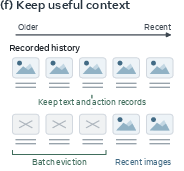
- Context compaction: The process of summarizing or reducing interaction history to fit within a model’s context limit. “we compact the history with the same model that we use for the policy”
- Context policy: A replaceable mechanism that determines how information is selected and represented for an agent. “Context policies and concrete backends are replaceable components”
- Coordinate transformation: A mathematical conversion of positions or orientations between coordinate systems. “errors in geometric calculations, coordinate transformations, or orientation construction”
- Depth measurement: A sensor-derived estimate of the distance from a camera to points in a scene. “In physical settings, depth measurements can vary or be missing even in a static scene”
- Distillation: Training a model to reproduce knowledge or behavior from another model, often a larger or proprietary one. “without privileged informations or distillation from those closed-weight models”
- Dual-arm platform: A robotic system equipped with two independently controllable arms. “All methods use the same dual-arm platform.”
- Embodied reasoning: Physical-world reasoning involving feasible actions, object interactions, and robot configurations. “Embodied reasoning therefore appears to improve across model generations”
- Environment adapter: A software component translating shared operations into an environment’s native commands and state representations. “the adapter translates those targets into native commands and returns the resulting state”
- Exclusive resource: A resource that can be used by only one operation at a time. “Calls sharing an exclusive resource execute in submission order”
- Fine-tuning: Further training of a pretrained model on a task- or domain-specific dataset. “ is fine-tuned on 10 hours of demonstrations per task.”
- Foundation model: A large pretrained model intended to support many downstream tasks. “frontier foundation models”
- Frontier model: A highly capable model at the leading edge of current performance. “Recent breakthroughs in frontier foundation models”
- Geometric coding: Writing or executing code for spatial calculations, coordinate systems, and orientations. “Coding in geometry”
- Gripper: A robot end-effector used to grasp or release objects. “Our move tool accepts a target pose and an optional gripper opening together”
- Ground-truth: Information treated as the correct reference rather than inferred by the model. “leveraging privileged information such as ground-truth simulator states”
- Harness: A software framework that connects an agent to tools, environments, execution systems, and feedback mechanisms. “We introduce uni-robot-agent}, a general-purpose RUA harness.”
- Immutability: A property of an object or record that prevents it from being changed after creation. “We bind images, camera calibration, and robot state to an immutable snapshot”
- Inference: The process of using a trained model to produce outputs or decisions. “despite inference speed being a major bottleneck for RUA”
- Long-horizon execution: Completing tasks that require many sequential actions over an extended interaction. “long-horizon execution”
- Modularity: Designing a system from components that can be replaced independently. “Modularity through interchangeable agent runtimes, tools, and robot backends.”
- Open-weight model: A model whose learned parameters are publicly available for use or modification. “open-weight models can also achieve competitive performance in simulation and on physical robots”
- Oracle feedback: Information that directly and reliably reveals the correct state or outcome, rather than requiring inference. “oracle task-success feedback”
- Orchestration layer: A software layer that schedules, coordinates, and dispatches operations among system components. “The orchestration layer determines how agent interaction proceeds while tools are running.”
- Out-of-the-box: Operating without additional task-specific training or modification. “an out-of-the-box Qwen3.8-Flash-Next achieves a RoboDojo Score of 31.39”
- Pipelining: Overlapping different stages of computation or execution so they proceed concurrently. “We combine background tool calls with resource-aware scheduling to satisfy both requirements, forming a pipeline between agent reasoning and tool execution.”
- Pose: The position and orientation of an object or robot component. “Reaching a target pose does not establish that an object was grasped or placed successfully.”
- Privileged information: Data available in simulation or specialized systems but not normally available in the physical deployment. “Without privileged inputs, Qwen3.8-Flash-Next with uni-robot-agent} achieves a Score of 31.39”
- Quaternion: A four-parameter mathematical representation commonly used to encode three-dimensional orientation. “mix quaternion conventions”
- Real-time grounding: The process of associating model representations or predictions with concrete spatial entities in the current environment. “fine-grained pointing and spatial grounding”
- Reprojection error: The discrepancy between an observed image point and the point predicted after projecting a 3D estimate back into an image. “Selecting inconsistent pixels for the same feature leads to large reprojection errors”
- Robot-use agent (RUA): An AI agent that uses reasoning, tools, and feedback to control robots. “robot-use agents (RUAs)”
- Seed: A value controlling pseudorandomness so that an experiment can be reproduced. “The result is averaged over three seeds with two layouts”
- Skill library: A collection of reusable robot procedures or task-specific capabilities. “Task-specific skill libraries may encode privileged information or predefined solutions”
- Spatial grounding: Identifying the precise location of an object or feature in a spatial or visual representation. “models struggle to pinpoint the same physical feature across camera views”
- Spatial relationship: A position, distance, direction, or geometric relation between entities. “the agents should infer the coordinates through spatial relationships of the objects in the image”
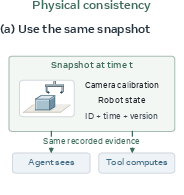
- State snapshot: A recorded, consistent representation of the system at a particular point in time. “We bind images, camera calibration, and robot state to an immutable snapshot”
- Task decomposition: Breaking a complex task into smaller subtasks or operations. “such as task decomposition and failure recovery”
- Task verifier: A mechanism that determines whether a task or subtask has been completed successfully. “simulator task-verifier feedback is unavailable”
- Token usage: The number of tokens processed by a LLM during interaction. “We analyze the results from Section~\ref{sec:simulation-results}, examining how task performance relates to token usage”
- Trajectory analysis: Examination of the sequence of states, actions, and decisions produced during an episode. “Trajectory analysis reveals four common failure patterns”
- Triangulation: Estimating a 3D point from its corresponding 2D observations in multiple views. “agents can still recover object positions with the camera parameters by triangulating the corresponding points across views”
- Uncertainty handling: Procedures for managing actions or states whose outcomes are not known reliably. “If completion is uncertain, further actions are blocked while the session attempts to recover the execution record”
- VLA: A vision-language-action model that maps visual and linguistic inputs to actions. “surpassing listed VLA/WAM baselines”
- Zero-shot: Performing a task without task-specific examples or additional training. “open-weight models can also achieve competitive performance in simulation and on physical robots”

