Comment on "Test of the Gravitational Force Law on Cosmological Scales Using the Kinematic Sunyaev--Zeldovich Effect''
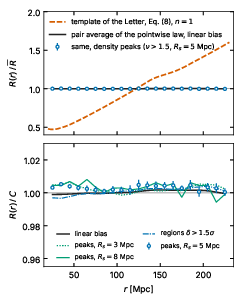
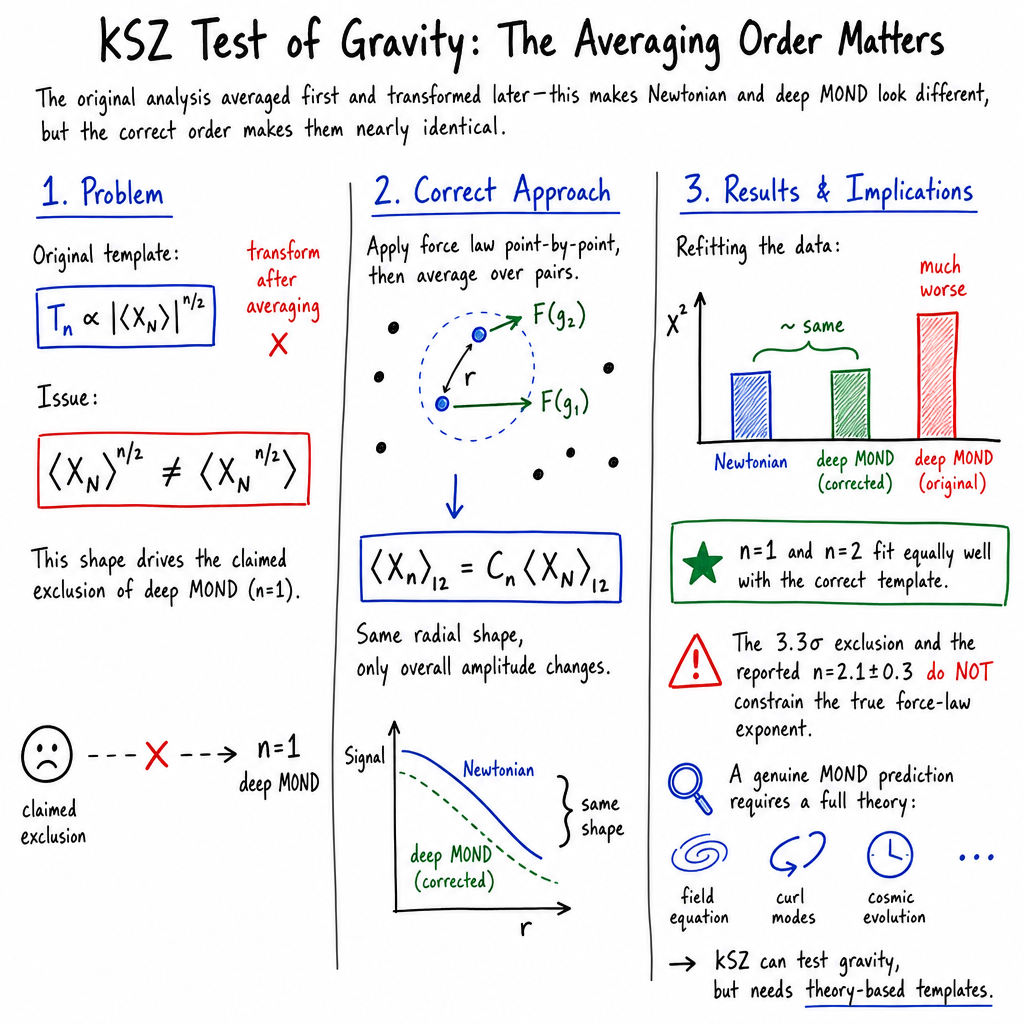
Abstract: Gallardo et al. [Phys. Rev. Lett. \textbf{136}, 151002 (2026)] constrain the index of the force law with pairwise kinematic Sunyaev--Zeldovich measurements, , and exclude the deep-MOND value at $3.3σ$. The exclusion does not follow from their calculation. Their templates for [their Eq.~(8)] raise the pair-averaged Newtonian acceleration to the power , whereas the pair average of the pointwise law [their Eq.~(30) for deep MOND] is the average of the transformed field; the step that identifies the two attributes to the three-point function a correction that is of second order and not small. In a Gaussian linear field with linearly biased tracers, Gaussian integration by parts shows that the correctly averaged template is exactly proportional to the Newtonian one, with a constant that the analysis absorbs into the mean optical depth. Gaussian realizations with peak-selected tracers find the same proportionality to within 2\% (0.5\% for the fiducial selection), and refitting the data of the Letter with the resulting template gives --$20.2$, against $20.1$ for the Newtonian template and $33.8$ for Eq.~(8): in every controlled case examined the data do not discriminate between and , and the $3.3σ$ exclusion, with the $10σ$ forecast that rescales it, rests on the order in which the average and the power were taken. What a self-consistent MOND cosmology predicts for this observable is a separate question, which the Letter does not address.
Paper Prompts
Sign up for free to create and run prompts on this paper.
Explain it Like I'm 14
1. What is this paper about?
This paper is a comment on an earlier study that tried to test the law of gravity on very large, cosmic distances.
The earlier study used the kinematic Sunyaev–Zeldovich (kSZ) effect to study how pairs of galaxies move toward or away from each other. It claimed that the usual Newtonian gravity law fits the data better than the “deep-MOND” alternative.
The usual gravity law can be written roughly as
where is the strength of gravity and is distance. In this notation, the exponent is .
Deep-MOND uses a different behavior, approximately
so it corresponds to .
The earlier paper reported:
and said that was ruled out at about 3.3 standard deviations, or “.”
This comment argues that the conclusion is not justified because the earlier study used the mathematical operations in the wrong order.
2. What questions does the paper ask?
The paper mainly asks:
- Did the earlier study build the correct prediction for how galaxies should move under a modified force law?
- Is the deep-MOND model really ruled out by the kSZ data?
- What happens if the force law is applied correctly, before averaging over many galaxy pairs?
- Does the data truly distinguish Newtonian gravity from deep-MOND in this test?
The author is not saying that MOND is definitely correct. Instead, the main point is that the earlier analysis did not make a fair or mathematically correct comparison.
3. What research methods were used?
The kSZ measurement
The earlier study used the kSZ effect to estimate the average relative motion of galaxy pairs.
The kSZ effect is a small change in the cosmic microwave background caused when microwave light passes through moving clouds of hot electrons. By studying this change near galaxies, scientists can estimate whether galaxies are moving toward or away from one another.
The galaxies in the study were separated by roughly 30 to 230 million light-years. Their motions can provide information about the forces that influence them.
The mathematical problem: average first or transform first?
The central issue is the difference between these two procedures:
- Average the ordinary Newtonian acceleration, then change it using the proposed force law.
- Change the acceleration at every location first, then average the results.
These are generally not the same when the transformation is nonlinear.
A simple analogy is averaging numbers before or after squaring them. For example:
- Average first: the average of 2 and 4 is 3, and .
- Square first: the average of and is .
So, in general,
The earlier study effectively used the second step incorrectly: it took an averaged Newtonian signal and then raised it to a power. But a real force law should act on the acceleration at each point in space, before the averaging is done.
The author’s calculations
The author used several approaches:
- Analytical calculations: These are calculations done with equations. They considered a simplified universe where the matter distribution is described by a Gaussian random field and galaxies follow the matter distribution in a simple way.
- Gaussian integration by parts: This is a mathematical rule for calculating averages involving related random quantities. It is similar in spirit to using known relationships between random variables to simplify a complicated average.
- Computer simulations: The author generated artificial cosmic matter distributions based on the observed large-scale structure of the universe.
- Different galaxy selections: The simulations used both simply weighted galaxies and galaxies selected as high-density “peaks,” which are more realistic locations for galaxies.
- Refitting the real data: The author used the original study’s data and analysis pipeline, but replaced the disputed template with the correctly averaged one.
In the simulations, the modified force was applied to the acceleration at each simulated galaxy first. The pairwise averages were calculated only afterward.
4. What did the paper find?
The earlier calculation used the wrong template
The earlier study used a template that was essentially
where represents the Newtonian acceleration between a pair of galaxies.
For deep-MOND, where , this makes the signal depend on the square root of the averaged Newtonian acceleration.
The comment argues that the correct calculation should instead average the transformed acceleration:
These two expressions only automatically agree when the transformation is linear, such as in the ordinary Newtonian case.
The neglected correction was not a three-point effect
The earlier study treated the difference between the two calculations as if it came mainly from a three-point correlation, involving groups of three matter fluctuations.
The comment shows that this is incorrect. For a square-root transformation, the first important correction depends on the variance, which measures ordinary two-point fluctuations.
In simple terms, the earlier study ignored the fact that the acceleration varies greatly from place to place. This variation matters even if the matter field is otherwise statistically simple.
The author also points out that the expansion used by the earlier study was made around a very small average acceleration caused by a distant partner. However, the actual acceleration at a galaxy is affected by its entire surrounding environment. Therefore, the mathematical expansion was not a reliable approximation.
The correctly averaged result has almost the same shape as the Newtonian result
In the simplified Gaussian model, the author finds that the correctly averaged modified-force signal is exactly proportional to the Newtonian signal:
where is a constant that depends on the force law.
This means that the two theories predict the same dependence on galaxy separation. They differ only by an overall size or amplitude.
However, the amplitude was already allowed to vary freely in the original data analysis because of uncertainty in quantities such as the average optical depth of the gas around galaxies. Therefore, this constant difference cannot be used to distinguish the theories.
The simulations support the analytical result
The simulations found that the ratio between the modified-gravity and Newtonian predictions was nearly constant with distance:
- For the simplest galaxy model, the variation was less than about 1%.
- For more complicated, peak-selected galaxies, the variation was usually below about 2%.
This is very different from the disputed template used in the earlier study. For that template, the predicted shape changed by a factor of about 3.3 across the range of separations.
The data no longer reject deep-MOND
When the author refitted the original data using the correctly averaged template, the results were approximately:
- Correctly averaged modified-gravity template: –$20.2$
- Newtonian template:
- Original deep-MOND template:
A lower generally means a better fit. The correctly averaged deep-MOND prediction fits almost exactly as well as the Newtonian prediction.
Therefore, according to this comment, the data do not distinguish between and in this analysis.
5. Why are these findings important?
The original paper’s claim that deep-MOND was excluded came almost entirely from the predicted shape of its template—the way the signal changed with galaxy separation.
But the comment argues that this shape was created by taking the power of an average, rather than averaging the force law correctly. In other words, the apparent disagreement with MOND may be caused by a mathematical mistake in constructing the prediction.
This means the reported result
does not necessarily measure the true exponent of a physical force law. It measures the exponent of a particular mathematical template that may not correspond to the force law described in the earlier paper.
The forecast that future surveys could exclude deep-MOND at the level of also becomes unreliable, because it was based on the same incorrect template.
6. What does the paper say about MOND itself?
The author is careful to limit the conclusion.
The paper does not prove that MOND is correct. It only shows that the earlier test did not properly calculate the MOND prediction.
A complete MOND prediction would require:
- A full physical equation describing the gravitational field, not just a simple point-by-point rule.
- The effects of the entire matter distribution around each galaxy.
- The history of how cosmic structures grew over time.
- The initial conditions of the universe.
- A calculation of how modified gravity affects galaxy velocities, not just accelerations.
The earlier study did not provide all of these ingredients.
Conclusion
The paper’s main message is:
The earlier study applied the modified force law after averaging the gravitational signal, but it should have applied the force law first and averaged afterward.
Because of this mistake, the earlier study produced a strong difference between Newtonian gravity and deep-MOND that may not be physically real. When the calculation is done in the correct order, both models produce almost the same prediction for the galaxy-pair signal, and both fit the data equally well.
The kSZ effect could still become a useful way to test gravity on very large scales. However, future studies must use predictions that come from a complete and physically consistent theory of gravity.
Practical Applications
Immediate Applications
The paper is primarily a methodological critique rather than a technology-development study. Its most immediate value is therefore in correcting analyses, preventing overinterpretation, and improving the design of cosmological inference workflows.
- Reanalyze existing kSZ constraints on modified gravity (cosmology, astrophysics; deployable now). Replace templates of the form
with templates that first apply the nonlinear force mapping pointwise and then perform the pair average:
This can be implemented immediately in existing kSZ analysis pipelines using simulated acceleration fields, tracer catalogs, and pairwise estimators.
Dependency: The acceleration field must be modeled consistently with the proposed force law, and the transformation must be applied before pair averaging. The paper’s near-degeneracy result is demonstrated for Gaussian or approximately controlled tracer models, not established universally.
- Audit published claims about modified-gravity exclusions (academic peer review, reproducibility; deployable now). The paper provides a general diagnostic: whenever a nonlinear physical law is involved, analysts should test whether they have replaced the average of a transformed field with the transformation of an average. This audit can be applied to kSZ, galaxy clustering, weak lensing, peculiar-velocity, and large-scale-structure analyses.
Dependency: The relevant observable and transformation must be written explicitly at the field level. Agreement between a phenomenological template and the data is not sufficient to establish that the template follows from the underlying theory.
- Update uncertainty assessments and survey forecasts (cosmology and survey planning; deployable now). Forecasts based on the reported exclusion of the deep-MOND value and its projected extension should be recomputed. Increasing the number of galaxies cannot recover discriminatory power if the competing physical models produce effectively identical pairwise templates after correct averaging.
Dependency: Forecasts must include model-template uncertainty, nonlinear tracer selection, covariance from simulations, and possible degeneracies with the mean optical depth .
- Use simulation-based template validation as a standard workflow (scientific software and computational astrophysics; deployable now).
A practical pipeline could:
- generate density and acceleration fields;
- apply the candidate force law at every tracer;
- construct pair differences;
- average over tracer pairs;
- compare the resulting radial shape with the proposed analytic template.
The paper’s use of Gaussian realizations, peak-selected tracers, smoothing-scale variations, and multiple box sizes provides a directly reusable validation protocol.
Dependency: Simulations must reproduce the relevant power spectrum, tracer bias, smoothing scale, selection function, survey geometry, and redshift evolution.
- Treat the fitted amplitude–optical-depth degeneracy explicitly (kSZ data analysis; deployable now). Since the proportionality constant can be absorbed into the fitted amplitude or mean optical depth, analyses should avoid interpreting amplitude-independent shape differences as evidence for a force law unless those differences survive a physically correct forward model.
Dependency: Independent calibration of optical depth, baryonic gas physics, and galaxy–halo relations may be required to recover information from the amplitude.
- Improve graduate training and methodological guidance in statistics and physics (academia; deployable now). The paper offers a concrete example for teaching:
for nonlinear . It can be used in courses and research training on perturbation theory, Gaussian random fields, statistical inference, and reproducible computational physics.
Dependency: The example should be presented as a warning about model construction, not as a general proof that modified gravity is indistinguishable from Newtonian gravity.
- Inform policy and research-funding decisions about evidential strength (science policy; deployable now). Funding agencies, review panels, and survey collaborations can classify the claimed exclusion as requiring reanalysis before it is used to prioritize one gravity model over another. The paper demonstrates that a nominally high-significance result can be driven by an invalid mapping between a theory and its observable template.
Dependency: The critique itself must be independently checked against the original data, covariance, code, and any non-Gaussian or nonlinear effects absent from the controlled tests.
- Daily-life applications are essentially absent (consumer technology and ordinary daily activity). The findings do not directly produce a consumer product, medical intervention, household technology, or operational service. Their indirect everyday relevance is limited to supporting reliable public scientific conclusions and preventing exaggerated claims about cosmological theories.
Long-Term Applications
The paper identifies several research directions that could eventually enable robust tests of gravity on cosmological scales, but these require theory development, simulations, and new observational analyses.
- Develop theory-consistent cosmological predictions for MOND-like or other modified-gravity models (theoretical cosmology; long-term). A valid prediction for the pairwise kSZ signal requires a complete field equation, including effects such as the solenoidal or curl component discussed in the paper, rather than a pointwise algebraic mapping between Newtonian and modified accelerations.
A future framework would need to specify: - the gravitational field equation; - boundary conditions and cosmological background; - baryonic and dark-matter components, where applicable; - nonlinear field solutions around halos; - the evolution of perturbations and peculiar velocities.
Dependency: Different modified-gravity theories can share the same static force-law scaling while predicting different cosmological growth histories and kSZ signals.
- Build end-to-end modified-gravity simulations (high-performance computing, astrophysics; long-term). Large-volume simulations could evolve the density field and velocity field under a theory-specific modified-gravity equation, generate halos and galaxies, model gas pressure and electron optical depth, and produce synthetic microwave maps. These simulations would replace the paper’s controlled Gaussian tests with realistic nonlinear environments.
Dependency: The simulations must resolve halo-scale environments, account for baryonic feedback, and reproduce galaxy selection and redshift distributions. Numerical solvers for nonlinear field equations may be computationally expensive.
- Construct forward models linking gravity to the full kSZ observable (observational cosmology; long-term). Future analysis tools could jointly model:
Such models would distinguish a genuine force-law effect from changes in galaxy bias, optical depth, feedback, and velocity reconstruction.
Dependency: The kSZ signal depends on ionized gas and electron weighting, not only on gravitational acceleration. Better astrophysical calibration is therefore essential.
- Combine kSZ with complementary probes of gravity (cosmology; long-term). A robust modified-gravity program could combine pairwise kSZ with weak lensing, galaxy–galaxy lensing, redshift-space distortions, peculiar velocities, cluster dynamics, and cosmic microwave background observations. Joint analyses may separate changes in the velocity field from changes in the matter distribution or optical depth.
Dependency: The probes must be modeled within the same theory and cosmological parameterization. Combining inconsistent phenomenological templates could amplify rather than resolve systematic errors.
- Develop model-independent tests of nonlinear averaging and tracer selection (statistics and computational science; long-term).
- non-Gaussian initial conditions;
- nonlinear density evolution;
- assembly bias;
- halo occupation models;
- redshift-dependent selection;
- anisotropic environments;
- different smoothing scales.
The resulting tools could quantify when the pair-averaged transformed field is shape-degenerate with the Newtonian template and when measurable deviations appear.
Dependency: Percent-level conclusions require substantially larger simulation ensembles and carefully propagated cosmic variance, finite-volume, and selection uncertainties.
- Design future surveys around identifiable shape differences rather than nominal sample size (survey engineering and policy; long-term).
- broader redshift coverage;
- multiple tracer populations;
- independent optical-depth calibration;
- improved angular resolution;
- cross-correlation with lensing and velocity data;
- environments where competing theories predict genuinely different responses.
Dependency: Survey optimization requires a validated theory-specific forecast rather than extrapolation from an incorrect template family.
- Create reproducibility and template-audit software packages (scientific software; long-term).
- whether nonlinear transformations are applied before averaging;
- whether a template follows from a specified field equation;
- whether nuisance amplitudes absorb theoretically relevant parameters;
- how tracer selection changes the predicted radial shape;
- whether forecast significance is robust to template uncertainty.
Dependency: Such a tool would need standardized data formats, access to simulation outputs, transparent covariance estimation, and integration with existing survey pipelines.
- Establish a general framework for theory-to-observable validation (multiple scientific sectors, especially computational physics; long-term). Beyond modified gravity, the paper’s central lesson can inform any domain where nonlinear physical laws are inferred from averaged data—for example, plasma physics, fluid turbulence, geophysics, and networked dynamical systems. A general workflow would require deriving the observable from the pointwise or microscopic law before applying ensemble, spatial, or pair averaging.
Dependency: The usefulness of this broader application depends on identifying observables where averaging-order errors can produce statistically significant but physically spurious claims.
Glossary
- AQUAL: A relativistic formulation of Modified Newtonian Dynamics based on a nonlinear gravitational field equation. “ in AQUAL”
- Atacama Cosmology Telescope (ACT): A ground-based telescope used to observe the cosmic microwave background. “fit a family of velocity templates labelled by the index of a force law , obtain , and exclude the deep-MOND value at ”
- Baryonic acceleration: The gravitational acceleration produced by ordinary matter, excluding dark matter. “where is the dimensionless baryonic (Newtonian) acceleration”
- Conditional average: An average calculated subject to a specified condition, such as two tracers being separated by a given distance. “the conditional average is taken”
- Conditional mean shift: The change in the expected value of a field caused by conditioning on another object or event. “No expansion in the conditional mean shift and no assumption about the conditional distribution are involved.”
- Cosmological growth history: The time-dependent evolution of density perturbations and cosmic structure. “The observed pairwise velocity requires integrating the modified dynamics over the growth history”
- Deep-MOND: The low-acceleration regime of Modified Newtonian Dynamics in which the gravitational response differs substantially from Newtonian gravity. “which for deep MOND is ”
- Gaussian field: A random field whose values follow a multivariate Gaussian probability distribution. “it does not vanish for a Gaussian field with ”
- Gaussian integration by parts: An identity for evaluating correlations involving jointly Gaussian variables and derivatives of functions. “For jointly Gaussian variables, Gaussian integration by parts (Stein's identity~\cite{Stein1981}) gives”
- Gaussian linear density field: A density-contrast field modeled as Gaussian and described by linear perturbation theory. “a Gaussian linear density field (smoothed on the tracer scale)”
- Gravitational acceleration field: A vector field describing the acceleration generated by a gravitational source distribution. “The deep-MOND map is applied pointwise to the Newtonian acceleration of each tracer”
- Infall: The inward relative motion of matter under gravity. “the sign of the infall () is carried by the fitted amplitude”
- Isotropy: Invariance under rotations, meaning that no spatial direction is statistically preferred. “with, by isotropy,”
- Kinematic Sunyaev–Zeldovich (kSZ) effect: A cosmic microwave background temperature shift caused by CMB photons scattering from moving free electrons. “measure the mean pairwise velocity of SDSS BOSS galaxies through the kSZ effect”
- Linear bias: An approximation in which tracer-density fluctuations are proportional to underlying matter-density fluctuations. “tracers of linear bias ”
- Linear theory: An approximation that treats density and velocity perturbations as small enough that their governing equations can be linearized. “the linear-theory expression in terms of ”
- Mean optical depth: The average Thomson-scattering optical depth associated with the observed tracer population. “The constant is therefore unobservable. With the exact proportionality~(\ref{eq:prop}) the deep-MOND and Newtonian templates give the same by construction.”
- Modified Newtonian Dynamics (MOND): A proposed modification of gravitational dynamics at very low accelerations. “What a self-consistent MOND cosmology predicts for this observable is a separate question”
- Non-Gaussianity: Statistical dependence among higher-order moments of a field beyond what is captured by a Gaussian distribution. “Constraints on primordial non-Gaussianity, invoked in the Letter at this point, have no bearing on it.”
- Pairwise kSZ signal: A kSZ observable measuring the average relative motion of pairs of tracers. “The pairwise kSZ effect may yet become a powerful probe of gravity on cosmological scales”
- Peak-selected tracers: Objects selected because they correspond to high-density peaks in a smoothed density field. “For the peak-selected tracers, to which the derivation does not apply”
- Phenomenological template: A parametrized model used to fit observations without necessarily being derived from a complete physical theory. “The constraint survives as a statement about the exponent of the phenomenological family~(\ref{eq:wrong})”
- Primordial non-Gaussianity: Deviations from Gaussian statistics in density fluctuations originating in the early universe. “Constraints on primordial non-Gaussianity”
- Profile likelihood: A likelihood or equivalent fit statistic evaluated after optimizing nuisance parameters for each value of a parameter of interest. “ at along the profile”
- Solenoidal term: A divergence-free component of a vector field. “planar, cylindrical, or spherical symmetry are sufficient conditions for the solenoidal term to vanish”
- Stein’s identity: A Gaussian expectation identity relating a variable-function correlation to a derivative expectation. “Gaussian integration by parts (Stein's identity~\cite{Stein1981})”
- Three-point function: A statistical measure of correlations among three positions or field values. “attributes the correction to the three-point function ”
- Tracer bias: The difference between the clustering of observed tracers and that of the underlying matter distribution. “Gaussian linear field with linearly biased tracers”
- Two-point quantity: A statistical quantity determined by correlations between pairs of field values or positions. “its leading correction, , is a two-point quantity”
- Velocity template: A model prediction for the scale-dependent velocity signal used in fitting observational data. “fit a family of velocity templates labelled by the index of a force law ”
- Weak-field acceleration regime: A regime in which gravitational accelerations are sufficiently small for modified-gravity effects to become important. “The physical acceleration at the tracers has rms $1.7\times10^{-12}\,\mathrm{m\,s^{-2}$, well inside the deep-MOND regime.”
- Wiener-process-like realization: A numerical sample generated from a specified statistical random field model. “Six realizations of the 1280-Mpc box and two of the 960-Mpc box are used”
- statistic: A goodness-of-fit measure comparing observed data with model predictions. “refitting the data of the Letter with its pipeline and covariance”
- three-point correlation function: A three-point correlation statistic describing non-Gaussian or higher-order clustering. “where vanishes at linear order”