- The paper presents measurements of pairwise kSZ signals, finding consistency with an inverse-square gravitational law (n=2.1 ± 0.3) over 30–230 Mpc.
- It employs a joint likelihood analysis of ACT CMB maps and SDSS galaxy clusters to differentiate between ΛCDM and MOND predictions.
- Results statistically reject MOND at 3.3σ, demonstrating the robustness of standard gravity and constraining alternative models.
Cosmological Tests of Gravitational Force Laws via the Kinematic Sunyaev-Zeldovich Effect
Scientific Context and Motivation
Establishing the validity of the gravitational force law at cosmological scales is fundamental to testing the ΛCDM paradigm and probing alternatives such as Modified Newtonian Dynamics (MOND). Traditional measurements, including solar system tests and analysis of galaxy rotation curves, are limited in spatial extent. The kinematic Sunyaev-Zeldovich (kSZ) effect, accessible via cosmic microwave background (CMB) observations, provides a novel probe of the baryonic velocity field at large scales. By measuring pairwise velocities of galaxy clusters and relating these to theoretical predictions, it is possible to perform direct tests of gravity beyond the linear regime and isolate the functional dependence of gravitational acceleration as g(r)∝1/rn for separations up to hundreds of Mpc.
Methodology and Analytical Framework
The study leverages pairwise velocity measurements derived from the ACT (Atacama Cosmology Telescope) CMB maps, cross-matched with galaxy cluster catalogs from the SDSS (Sloan Digital Sky Survey). The pairwise kSZ signal, p^(r), is expressed as the product of average optical depth, CMB temperature, and the pairwise velocity V(r), which is ultimately tied to the gravitational acceleration profile via galaxy correlation functions.
The authors establish a formalism that is not reliant on scale-independent growth, thereby maintaining generality beyond standard cosmology. The pairwise velocity is written as:
V(r)=A(1+ξgg(r)4πGρbr/aˉξˉgg(r))n/2
where n is the force law index, A is an amplitude term degenerate with optical depth τˉ, ξgg(r) is the galaxy-galaxy correlation function, and ρb is the baryonic matter density. This model accommodates both g(r)∝1/rn0CDM (g(r)∝1/rn1) and MOND (g(r)∝1/rn2) as limiting cases. Amplitude and exponent are constrained via a joint likelihood analysis of ACT DR6 kSZ data.
Observational Results and Numerical Constraints
The analysis reveals that the observed pairwise kSZ data are consistent with a force law exponent of g(r)∝1/rn3, directly supporting Newtonian gravity (g(r)∝1/rn4) over the accessible range (30–230 Mpc). The fit to MOND (g(r)∝1/rn5) is statistically rejected at g(r)∝1/rn6 confidence, with the standard g(r)∝1/rn7CDM prediction in close agreement with independent theoretical curves.
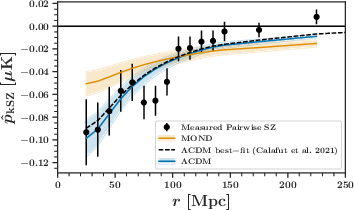
Figure 1: Pairwise kSZ measurements [g(r)∝1/rn8K] as a function of the physical separation of galaxy clusters [g(r)∝1/rn9], compared against p^(r)0CDM and MOND predictions.
Bayesian posteriors for the joint fit (n, p^(r)1) exclude p^(r)2 at 3p^(r)3; forecasted future CMB and optical surveys with larger galaxy catalogs (e.g., DESI, LSST) will reach sensitivity to rule out p^(r)4 at p^(r)5.
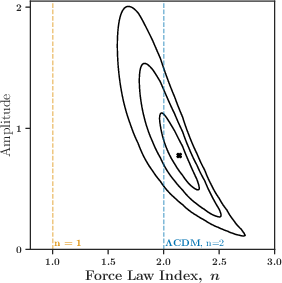
Figure 2: Likelihood contours for the alternative gravitational model defined by Eq. as a function of the force law exponent p^(r)6, illustrating stringent constraints at cosmological scales.
Theoretical Implications and Exclusion of Modified Gravity Models
This direct measurement constitutes the largest-scale test of MOND to date, reinforcing previous indirect constraints from large-scale structures, CMB, and gravitational wave propagation. The approach does not require assumptions about homogeneous expansion beyond measured correlation functions, distinguishing it from previous cosmological probes. The data also constrain generalized power law modifications to gravity, beyond MOND, with p^(r)7 at 95\% confidence.
Importantly, alternative models maintaining linear mass dependence but modifying radial scaling are also constrained, with p^(r)8 at 95\% confidence and p^(r)9 disfavored at V(r)0. The results confirm the robustness of the inverse-square law for gravitational acceleration at scales inaccessible to other techniques.
Future Prospects
Increasing the statistical power through upcoming high-resolution CMB maps and larger spectroscopic galaxy samples will provide more precise kSZ measurements, enabling discrimination between subtle deviations from General Relativity and exotic alternatives. In addition, further exploration will be possible regarding environmental effects such as the external field effect in MOND, though for cluster scales (V(r)1 Mpc) these effects are predicted to be negligible.
Conclusion
This work demonstrates that the kinematic Sunyaev-Zeldovich effect, as measured by ACT and correlated with SDSS galaxy clusters, provides robust and model-independent constraints on the gravitational force law at cosmological scales. The findings confirm the predictions of Newtonian gravity and V(r)2CDM, with MOND and similar alternatives statistically excluded within the measurement precision. The methodology is poised for substantial improvement with forthcoming observational capabilities, establishing kSZ as a definitive probe of cosmological gravity at the largest accessible distances.