AudioFM: Towards General Purpose Audio Representation Learning
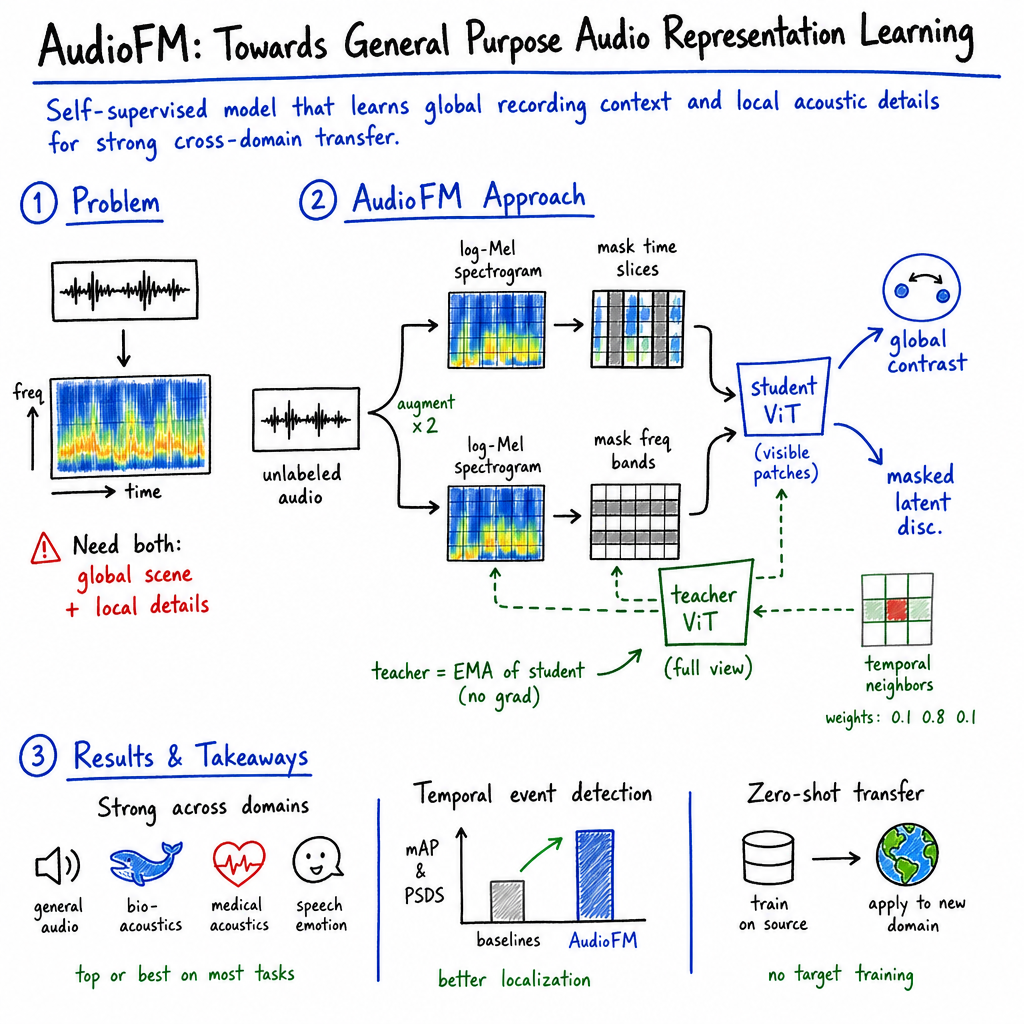
Abstract: Learning audio representations that effectively bridge holistic global soundscapes with fine-grained acoustic moments is a long-standing goal in self-supervised learning. Recording-level contrastive objectives encourage agreement between pooled audio representations, but do not explicitly supervise local time-frequency representations. We introduce AudioFM, a self-supervised framework that combines recording-level contrast with patch-wise masked latent discrimination. Using visible acoustic context, a student predicts representations of masked patches and identifies their corresponding full-view teacher targets among candidates from other recordings. We further incorporate weaker supervision from eligible temporal neighbors to encourage local temporal consistency. Extensive evaluations show that AudioFM achieves state-of-the-art performance across diverse audio domains in linear probing, fine-tuning, and zero-shot transfer, demonstrating superior event detection, robust scene-level understanding, and strong domain generalizability.
Paper Prompts
Sign up for free to create and run prompts on this paper.
Explain it Like I'm 14
1. What is this paper about?
This paper introduces AudioFM, a computer model designed to understand many kinds of sounds.
The goal is to create one audio model that can work well for different tasks, such as:
- Recognizing environmental sounds, like dogs barking or doors closing
- Understanding speech and spoken commands
- Identifying animal sounds
- Studying medical sounds, such as breathing or heart noises
- Recognizing emotion from a person’s voice
- Finding the exact moment when a sound happens
Instead of training a separate model for every task, the researchers want AudioFM to learn useful sound knowledge once and then reuse it for many different jobs.
2. What questions did the researchers ask?
The paper focuses on several main questions:
- Can one model learn both the big picture and small details of a recording? For example, can it understand that a recording is from a busy street while also noticing a short car horn?
- Can the model learn without human labels? Labeling millions of recordings would take a huge amount of time. The researchers investigate whether the model can teach itself using unlabeled audio.
- Does the model work across different sound-related fields? The researchers test it on general sounds, speech, animal sounds, medical audio, and emotional speech.
- Does it improve when the model or training dataset becomes larger?
- Can knowledge learned from one dataset transfer to completely new recordings, speakers, or environments?
3. How did the researchers build and test AudioFM?
Learning from unlabeled audio
AudioFM uses self-supervised learning. This means the model learns from the audio itself instead of being given human-provided answers.
A simple analogy is studying with a puzzle:
- Some pieces of the puzzle are hidden.
- You look at the pieces that are still visible.
- You try to guess what the hidden pieces should look like.
- You check your guess against a version of the puzzle where all pieces are visible.
The researchers trained AudioFM using about 1.68 million audio clips, totaling around 4,665 hours, from AudioSet.
Turning sound into a picture
The model changes each recording into a log-Mel spectrogram. This is a picture showing:
- Time from left to right
- Sound frequency from bottom to top
- Loudness through brightness or color
The researchers cut this picture into many small square sections, called patches. These patches are like tiles in a mosaic.
Hiding parts of the audio
The model receives two different damaged versions of the same recording:
- In one version, parts along the time direction are hidden.
- In the other version, parts along the frequency direction are hidden.
The model must learn that both damaged versions still represent the same original recording. This helps it understand the recording as a whole.
Learning global and local information
AudioFM uses two kinds of learning:
Global learning
The model compares two partly hidden versions of the same recording and tries to give them similar overall descriptions.
For example, if both versions come from a recording of a busy train station, their overall representations should be similar.
This is called contrastive learning. In everyday language, the model learns:
- “These two examples belong together.”
- “These examples from other recordings are different.”
Local learning
The model also predicts the hidden small patches in the spectrogram.
A second network, called the teacher, sees the complete recording. The main network, called the student, sees only the partly hidden version. The student tries to make its prediction match the teacher’s representation of the hidden patch.
The teacher is updated slowly from the student, rather than learning independently. This is known as an exponential moving average, which is similar to keeping a slowly changing reference copy of the model.
The model also uses nearby hidden patches in time as extra clues. Nearby moments often belong to the same sound. For example, several neighboring patches may all contain part of a dog bark or a musical note.
Testing the model
The researchers tested AudioFM in several ways:
- Fine-tuning: The model is further trained for a particular task.
- Linear probing: The model is kept frozen, and only a simple classifier is trained on top of it. This tests how useful the model’s existing knowledge is.
- Zero-shot transfer: A classifier trained on one dataset is used on a different dataset without additional training.
AudioFM was compared with other audio models, including AudioMAE, BEATs, EAT, SSLAM, BAT, and AudioMosaic.
4. What did the researchers find?
Strong performance on common audio tasks
When AudioFM was fine-tuned for specific tasks, it performed very well.
For example, it achieved:
- 42.3% mAP on AudioSet-20K
- 50.2% mAP on AudioSet-2M
- 71.4% mAP on FSD50K
- 98.2% accuracy on ESC-50 environmental sound recognition
- 99.1% accuracy on one spoken-command task
Here, accuracy means the percentage of correct answers. mAP is another scoring method often used when a recording may contain several sounds at once.
Good performance without changing the model
AudioFM also worked well when its main encoder was frozen.
Across 12 tasks in four areas, it often matched or beat the other models. It performed especially well on:
- General environmental audio
- Medical audio
- Speech emotion recognition
- Some animal-sound tasks
For example, using frozen features, AudioFM achieved:
- 79.1% balanced accuracy for distinguishing medical breathing sounds
- 37.9 macro-F1 for identifying medical audio subtypes
- 72.7 macro-F1 for detecting heart murmurs
These results suggest that AudioFM learned useful sound patterns even though it was not specifically trained for medical diagnosis.
Better detection of when sounds happen
The researchers also tested whether AudioFM could locate sounds in time, not just identify whether they appeared somewhere in a recording.
AudioFM outperformed the other tested models on frame-level sound event detection. This means it was better at answering questions like:
“At exactly what moment does the dog bark begin?”
This is important for recordings containing several overlapping or short-lived sounds.
Good transfer to new datasets and speakers
AudioFM also transferred well to unfamiliar data.
For sound event tagging on a new domestic-sound dataset, it achieved 79.9% mAP, better than the other compared models.
It also transferred well when recognizing emotions:
- From one speech collection to another
- From one speaker to another
This shows that the model learned more general patterns than simply memorizing the particular recordings used during training.
Both global and local learning were helpful
The experiments showed that the model worked better when it used both:
- Global information about the entire recording
- Local information about small time-frequency patches
Using nearby time patches as additional learning targets also helped. However, using patches that were too far away reduced performance. This suggests that sound regions close together in time are useful clues, but distant regions may not be related.
Larger models and more data helped
The researchers found that performance improved when they used:
- Larger model sizes
- More pretraining data
This suggests that AudioFM may become even more useful if trained on bigger and more varied audio collections.
5. Why are these findings important?
Many audio systems are built for only one purpose. A model trained to recognize birds may not understand heart sounds or speech emotion.
AudioFM is important because it aims to provide a general-purpose audio foundation model. Like a student who learns broad knowledge before specializing, AudioFM first learns general sound patterns and can later be adapted to specific tasks.
This could reduce the amount of labeled data needed for new applications. For example, researchers studying a rare animal or a medical condition might not need to label millions of recordings from scratch. They could start with AudioFM and train only a small additional layer.
Conclusion and possible impact
AudioFM shows that a model can learn both:
- The overall meaning of a recording
- Small, detailed sound events inside it
Its strong results across environmental audio, speech, animal sounds, medical audio, and emotion recognition suggest that it has broad abilities. It also transfers reasonably well to new datasets and speakers.
In the future, models like AudioFM could help with:
- Wildlife monitoring
- Smart devices that understand surroundings
- More accessible speech and sound technology
- Medical research involving breathing or heart sounds
- Automatic detection of important sounds in long recordings
However, the paper also has limitations. The model was mainly trained on single-channel audio from AudioSet, so it may not yet fully understand where sounds come from in space. It also needs more testing with different recording devices, noisy environments, and larger medical datasets.
Overall, the research suggests that combining whole-recording understanding with small-detail prediction is a promising way to build flexible audio models that can be used for many different real-world problems.
Practical Applications
Immediate Applications
The paper’s strongest near-term contribution is a transferable, frozen audio encoder that can be paired with relatively small task-specific classifiers. These applications are feasible when suitable labeled data, audio hardware, and deployment safeguards are available.
- Environmental sound classification and monitoring — Industry, software, smart-city operations
- Use AudioFM as a feature extractor for detecting alarms, glass breaking, construction noise, sirens, machinery faults, or other environmental events.
- A practical workflow is: microphone stream → log-Mel preprocessing → AudioFM embeddings → lightweight linear classifier or event detector.
- The reported performance on AudioSet, FSD50K, ESC-50, and RealDESED suggests that classifiers trained on one sound domain may transfer to related domestic or environmental soundscapes without retraining.
- Dependencies: the deployed system must handle microphone variation, background noise, class imbalance, privacy restrictions, and real-time latency. The paper does not establish robustness under extreme channel or device shifts.
- Frame-level sound event detection — Security, industrial monitoring, media technology
- Build systems that not only identify what sounds are present but also estimate when events occur, such as a machine vibration, dog bark, alarm, speech segment, or impact.
- AudioFM’s reported gains on AudioSet-Strong frame mAP and PSDS metrics support use in timeline-based alerting, searchable recordings, and automated annotation.
- Dependencies: deployment requires a temporal classifier or detection head trained with frame-level annotations; the pretrained encoder alone does not produce final event boundaries.
- Keyword spotting and voice-triggered interfaces — Consumer electronics, accessibility, edge computing
- Fine-tune AudioFM for wake-word detection, command recognition, appliance control, or hands-free accessibility interfaces.
- The reported Speech Commands results indicate that the representation can support speech-related classification despite being trained on general audio rather than only speech.
- Dependencies: privacy-preserving on-device inference, low power consumption, speaker diversity, false-wake-rate control, and adaptation to accents and languages. The paper evaluates English benchmark tasks rather than broad multilingual deployment.
- Low-label audio product development — Startups, enterprise machine learning, academic labs
- Use AudioFM as a general-purpose initialization or frozen embedding generator when a company has only a small labeled dataset.
- This can reduce annotation requirements for applications such as acoustic quality inspection, content moderation, audio search, or custom sound classification.
- A practical workflow is to first train a linear probe; if performance is insufficient, selectively fine-tune the encoder.
- Dependencies: access to compatible model weights and preprocessing, sufficient similarity between the target domain and pretraining data, and validation against task-specific baselines.
- Automatic audio indexing and retrieval — Media archives, surveillance review, content platforms
- Generate embeddings for large audio collections and use them for semantic clustering, similarity search, duplicate detection, or retrieval of recordings containing particular sound categories.
- The global recording-level representation is suitable for coarse scene-level organization, while local representations and frame-level heads can support event-specific search.
- Dependencies: a retrieval layer, calibrated similarity thresholds, storage and compute capacity, and safeguards against treating embedding similarity as definitive semantic identity.
- Bioacoustic monitoring — Conservation, agriculture, and veterinary technology
- Adapt AudioFM for recognizing bird, dog, livestock, or wildlife vocalizations, potentially reducing the amount of domain-specific annotation needed.
- The reported results on BEANS-Watkins, BEANS-Dogs, and BirdSet indicate that general audio representations preserve useful biological acoustic information.
- Possible products include passive wildlife-monitoring stations, livestock behavior alerts, and automated biodiversity surveys.
- Dependencies: local species coverage, geographically representative recordings, seasonal variation, overlapping calls, and expert validation. Performance is not uniformly superior on every bioacoustic benchmark, so deployment should include domain-specific testing.
- Medical-audio research and decision-support prototyping — Healthcare and biomedical research
- Use AudioFM embeddings as inputs for exploratory models involving respiratory sounds, sleep-related breathing events, or cardiac murmurs.
- The reported improvements on PSG-Audio and CirCor Murmur, together with visible structure in apnea-related embeddings, make it a useful baseline for screening research and cohort stratification.
- Dependencies: this is not evidence of clinical readiness. Clinical deployment requires prospective validation, calibrated uncertainty, demographic and device-shift analysis, regulatory review, secure data handling, and comparison with clinician performance. AudioFM should support—not replace—clinical judgment.
- Speech-emotion and affective-computing prototypes — Education technology, call centers, human-computer interaction
- Train lightweight emotion classifiers for research dashboards, conversation analysis, adaptive interfaces, or customer-service quality monitoring.
- Cross-corpus and cross-speaker transfer results suggest that representations may generalize better than task-specific features to unseen speakers and datasets.
- Dependencies: emotion labels are subjective and culturally dependent; systems require consent, bias audits, transparency, and restrictions against high-stakes inference such as employment or lending decisions.
- Academic benchmarking and reproducible representation studies — Academia
- Adopt the paper’s shared frozen-encoder evaluation protocol to compare audio representation models across general audio, speech, bioacoustics, medical acoustics, emotion, and temporal detection.
- This can help separate the quality of pretrained representations from differences in downstream fine-tuning recipes.
- Dependencies: standardized data splits, licensing-compliant datasets, consistent preprocessing, multiple random seeds, and reporting of device and demographic coverage.
- Public-sector acoustic monitoring pilots — Policy and municipal services
- Pilot non-identifying acoustic monitoring for noise mapping, emergency-signal detection, wildlife surveys, or infrastructure monitoring.
- The model’s cross-domain event-recognition capability can provide a common technical layer across these services.
- Dependencies: local laws on recording and surveillance, data minimization, public consultation, clear retention policies, and human review for consequential alerts.
- Consumer tools for personal sound organization — Daily life
- Develop applications that tag household recordings, identify recurring sounds, notify users about alarms or unusual appliance noises, or assist people with hearing impairments.
- A frozen embedding plus a user-specific classifier could enable personalization with a small number of examples.
- Dependencies: microphone access, battery and latency constraints, false alarms, local processing for privacy, and accessible notification design.
Long-Term Applications
These opportunities require additional research, larger and more diverse datasets, deployment optimization, or validation in high-stakes settings.
- Clinical-grade respiratory and cardiac sound screening — Healthcare
- Develop validated tools for apnea subtype analysis, murmur screening, respiratory-disease monitoring, or longitudinal home-based assessment.
- AudioFM’s local time-frequency modeling could support detection of brief acoustic abnormalities rather than only recording-level diagnosis.
- Dependencies: large multi-site clinical cohorts, standardized acquisition protocols, patient-level splits, prospective trials, uncertainty estimation, fairness analysis, robustness to stethoscope and smartphone differences, and regulatory approval.
- Edge-native acoustic foundation models — IoT, robotics, and embedded systems
- Distill or quantize AudioFM for deployment on microphones, hearing aids, robots, vehicles, and industrial sensors.
- Potential systems include autonomous robots that understand nearby events, smart appliances that respond to acoustic conditions, and predictive-maintenance sensors operating without cloud connectivity.
- Dependencies: model compression, memory and energy limits, streaming inference, continual adaptation, and performance retention after quantization. The paper uses substantial pretraining infrastructure and does not report embedded deployment.
- Spatial and multichannel audio understanding — Robotics, automotive, smart buildings
- Extend the method beyond mono audio to preserve direction, distance, reverberation, and multi-microphone structure.
- This could enable robot sound localization, emergency-source triangulation, vehicle cabin monitoring, and room-level event mapping.
- Dependencies: multichannel pretraining corpora, spatially appropriate augmentations, synchronization, microphone-array calibration, and objectives that distinguish source identity from spatial position. The paper explicitly identifies mono input as a limitation.
- Open-vocabulary audio search and multimodal assistants — Software and media platforms
- Combine AudioFM’s representation with text encoders or LLMs to support queries such as “find recordings containing a distant siren after midnight.”
- The resulting system could enable natural-language search, audio captioning, and interactive soundscape analysis.
- Dependencies: audio-text alignment training, reliable temporal grounding, multilingual coverage, copyright-compliant corpora, and careful evaluation of hallucinated or unsupported descriptions. AudioFM itself is not an audio-LLM.
- Self-supervised learning for rare and emerging events — Public safety, biosecurity, industry
- Use unlabeled continuous recordings to build detectors for rare machine failures, newly observed animal calls, unusual infrastructure sounds, or novel environmental hazards.
- The global-local objective is promising because it retains both scene context and short acoustic events.
- Dependencies: rare-event validation, open-set recognition, continual learning without catastrophic forgetting, robust negative sampling, and procedures for distinguishing novelty from recording artifacts.
- Personalized hearing and assistive technologies — Healthcare and accessibility
- Adapt AudioFM embeddings to individual users for selective sound enhancement, alarm prioritization, event substitution, or context-aware hearing assistance.
- Local event representations could help distinguish personally important sounds from persistent background noise.
- Dependencies: user-specific calibration, strict latency requirements, safety-critical alarm recall, audiological validation, privacy-preserving personalization, and evaluation across hearing profiles.
- Acoustic digital twins and predictive maintenance — Manufacturing and energy
- Integrate AudioFM with sensor systems to detect degradation in pumps, motors, turbines, HVAC equipment, and industrial infrastructure.
- Audio embeddings could complement vibration and telemetry signals in multimodal maintenance workflows.
- Dependencies: longitudinal failure data, controlled operating-condition labels, domain adaptation across facilities, explainability for maintenance engineers, and validation against existing vibration-based systems.
- Large-scale biodiversity and ecosystem policy — Conservation and environmental governance
- Build national or regional acoustic observatories that estimate species presence, migration, habitat change, or ecological disturbance from distributed microphones.
- AudioFM could provide a common representation across species and recording environments, reducing the need to build a separate model for every taxon.
- Dependencies: geographically diverse training data, species-expert annotation, ecological sampling design, battery and communications infrastructure, seasonal calibration, and transparent uncertainty estimates before using outputs in policy decisions.
- Fair and privacy-preserving affective computing — Education, workplaces, and public services
- Investigate whether emotion-related embeddings can support voluntary well-being tools, learning engagement research, or aggregated service-quality analysis without retaining raw audio.
- Dependencies: strong evidence that acoustic emotion predictions are valid across cultures and contexts; informed consent; on-device processing; protection against surveillance; and policies prohibiting unvalidated psychological inference in high-stakes decisions.
- Policy standards for audio foundation models — Research governance and regulation
- Establish shared protocols for evaluating audio models under device shifts, geographic shifts, demographic variation, privacy constraints, and rare-event conditions.
- The paper’s cross-domain and zero-shot evaluation provides a starting template for model cards, procurement standards, and regulatory evidence packages.
- Dependencies: agreement on standardized datasets and metrics, disclosure of pretraining data provenance, licensing clarity, independent audits, and tests that go beyond benchmark accuracy.
- Scaling to broader and more representative audio corpora — Academia and industry research
- Extend AudioFM training to larger multilingual, multichannel, medical, bioacoustic, industrial, and geographically diverse corpora.
- The paper reports consistent gains with increased model capacity and pretraining data, suggesting that scaling may improve transfer further.
- Dependencies: the scaling trend is demonstrated mainly on AudioSet and a limited model range; larger-scale benefits may be affected by data redundancy, label or source bias, licensing constraints, compute cost, and shifts in the target domains.
Glossary
- Acoustic token prediction: Self-supervised learning that predicts discrete tokens representing audio content. “while acoustic token prediction uses learned discrete targets”
- Audio foundation model: A broadly pretrained audio model intended for transfer across many tasks and domains. “These methods provide a path toward audio foundation models that support diverse acoustic applications.”
- Bioacoustics: The study and analysis of sounds produced by animals or other biological systems. “while OPERA and BioFoundation provide domain-focused evaluations in respiratory acoustics and bioacoustics”
- Bottleneck dimension: The dimensionality of a reduced intermediate representation in a neural network. “projects these features to a bottleneck dimension”
- Cross-corpus transfer: Applying a model trained on one dataset or corpus to another dataset. “The evaluation covers CREMA-D → RAVDESS / TESS and bidirectional transfer between the two TESS speakers.”
- Cross-domain generalization: The ability of a model to perform effectively on data from domains different from its training domain. “4.4. Cross-Domain Generalization”
- Cross-view contrast: A contrastive-learning objective that aligns representations of different views or augmentations of the same input. “recording-level cross-view contrast”
- Domain shift: A change in the data distribution between training and deployment settings. “robustness to extreme channel distortion and controlled device shifts remains underexplored.”
- Exponential moving average (EMA): A parameter-updating method in which recent values receive greater weight than older values. “The teacher encoder 𝑓¯𝜃 and local projection head ℎ ¯𝜙 are updated as exponential moving averages (EMA)”
- Fine-tuning: Adapting a pretrained model by further training it on a task-specific dataset. “We jointly fine-tune the encoder and task-specific classification heads”
- Frame-level sound event detection (SED): Identifying sound events at individual temporal frames rather than only at the recording level. “SED: frame-level sound event detection.”
- Full-view teacher target: A representation produced by a teacher model from an unmasked input and used as a prediction target. “with full-view teacher targets and cross-recording negatives.”
- Global-local supervision: Joint training that encourages both whole-recording consistency and sensitivity to local acoustic regions. “Global and local supervision address complementary requirements”
- InfoNCE: A contrastive objective that identifies a positive sample among a set of negative candidates. “our prediction-target discrimination retains the cross-recording InfoNCE formulation above.”
- Latent discrimination: Learning to distinguish hidden or embedded representations rather than raw input signals. “We refer to this local objective as masked latent discrimination (MLD).”
- LayerNorm: A neural-network normalization operation that normalizes activations across features within an individual example. “a linear classifier preceded by LayerNorm (LN).”
- Linear probing: Evaluating frozen pretrained representations by training a simple linear task-specific classifier. “Linear probing and domain transfer”
- Log-Mel spectrogram: A time-frequency representation of audio whose frequency axis uses the perceptually motivated Mel scale and logarithmic magnitudes. “We convert them into log-Mel spectrograms”
- Masked latent discrimination (MLD): An objective in which a model predicts representations of masked regions and contrasts them against representations from other recordings. “We refer to this local objective as masked latent discrimination (MLD).”
- Masked-patch prediction: Predicting the representation of an audio spectrogram patch that was removed from the model’s input. “3.1. Masked-Patch Prediction & Supervision”
- Macro-F1: The unweighted average of F1 scores calculated independently for each class. “Macro-F1”
- mAP: Mean average precision, a metric that averages precision–recall performance across classes or queries. “AS-20K, AS-2M, and FSD50K report mAP”
- Non-contrastive self-distillation: Representation learning in which a student learns from a teacher without explicitly contrasting against negative examples. “through contrastive learning or non-contrastive self-distillation”
- Patch token: A vector representation corresponding to a local patch of an input, such as a time-frequency spectrogram region. “embed each spectrogram as a 𝑇 × 𝐹 grid of non-overlapping patch tokens”
- Pooling: Combining multiple feature vectors into a single aggregate representation. “For global contrast, pooled encoder outputs pass through a shared projection head”
- Positional embedding: A learned or fixed vector that provides a model with information about an element’s location in a sequence or grid. “with their positional embeddings and a class token”
- Projection head: A task-specific neural-network layer that maps encoder features into an objective-specific representation space. “A shared local projection head”
- PSDS: Polyphonic Sound Detection Score, a metric for evaluating sound-event detection while accounting for detection and localization trade-offs. “AudioFM outperforms the evaluated baselines across frame mAP, PSDS1, and PSDS2”
- Respiratory acoustics: The analysis of sounds associated with breathing and other respiratory processes. “domain-focused evaluations in respiratory acoustics and bioacoustics”
- Self-supervised learning (SSL): Learning representations from data without manually provided labels by constructing supervisory signals from the data itself. “Audio self-supervised learning (SSL) seeks to learn general representations from unlabeled recordings”
- Spectrogram reconstruction: Rebuilding an audio spectrogram, or masked portions of it, as a pretraining objective. “spectrogram reconstruction operates on the acoustic signal”
- State-of-the-art: Representing the best reported performance among comparable methods. “AudioFM achieves state-of-the-art performance across diverse audio domains”
- Temporal-neighborhood learning: Learning representations using nearby temporal regions as related supervisory examples. “motivated by temporal-neighborhood learning”
- Temporal neighborhood radius: The number of temporal patch steps included on either side of a reference position. “The default temporal-neighborhood radius is 𝐾 = 1.”
- Time-frequency grid: A two-dimensional arrangement whose axes represent temporal and frequency positions in an audio representation. “on a two-dimensional time-frequency grid.”
- t-SNE: A nonlinear dimensionality-reduction method used to visualize high-dimensional representations in a lower-dimensional space. “t-SNE visualizations of PSG-Audio embeddings”
- Vision Transformer (ViT): A Transformer architecture that processes an input as a sequence of image-like patches. “A shared Vision Transformer student encoder”
- Zero-shot transfer: Applying a model or classifier to a target task or dataset without training on target-domain examples. “Zero-shot transfer: We evaluate zero-shot transfer through sound event tagging and emotion recognition”

