On-Policy Self-Training: Data-Free Self-Improvement in Large Language Models
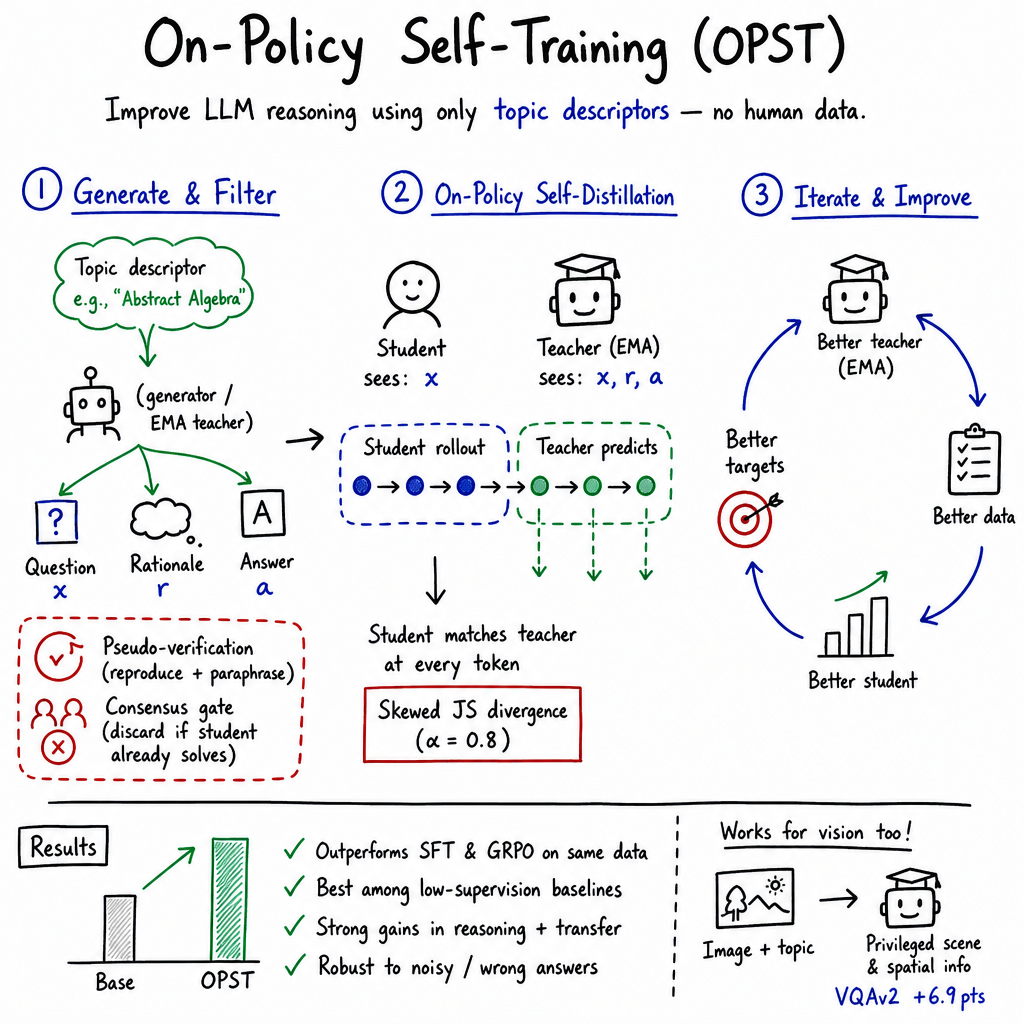
Abstract: On-policy self-distillation enables post-training foundation models without relying on stronger external teachers. However, existing approaches rely on ground-truth question-answer pairs, human-curated problem sets, or other supervised signals. In this work, we reformulate on-policy self-distillation as a self-training framework, driven by self-generated question-answer pairs and privileged reasoning demonstrations. We push supervision to the limit: guided solely by coarse, high-level topic descriptions, the model synthesizes its own curriculum of queries and privileged reasoning traces without access to any human-curated prompts or answers. We find that self-distillation on fully synthetic privileged information enables a model to improve across multiple domains while retaining its capabilities on domains it is not self-trained on. We demonstrate the generality of this framework across text and multimodal domains, achieving consistent self-improvement on standard language benchmarks and Visual Question Answering. Our findings demonstrate that foundation models possess rich latent capabilities that can be amplified without external task supervision or curated problem distributions.
Paper Prompts
Sign up for free to create and run prompts on this paper.
Top Community Prompts
Explain it Like I'm 14
1. What is this paper about?
This paper introduces a method called On-Policy Self-Training, or OPST.
The main idea is that a LLM can improve itself without being given a carefully prepared set of questions and answers made by humans. Instead, the model:
- Creates its own questions.
- Tries to answer and explain them.
- Checks whether the questions and answers seem reliable.
- Uses the best questions to train itself.
This is similar to a student making practice problems, solving them, checking them, and then studying the difficult ones.
The researchers also test whether the same idea can help models understand images, not just text.
2. What questions did the researchers ask?
The paper focuses on several main questions:
- Can a LLM improve its reasoning using questions and answers that it creates itself?
- Does it really need human-written training examples?
- Can the model choose useful problems instead of practicing only questions it already knows?
- Can this method improve one skill without causing the model to forget other skills?
- Can the same approach work with images and visual questions?
- Is using a generated explanation as a hint better than simply copying the generated answer?
The researchers wanted to find out whether models already contain useful abilities that can be strengthened through practice, even without new human-provided data.
3. How did the method work?
Starting with broad topics
The researchers gave the model only broad topic descriptions, such as:
- Abstract algebra
- Common-sense reasoning
- Mathematics
- Understanding relationships between objects in images
These descriptions were not actual questions. They were more like school-subject labels.
Creating questions and answers
For each topic, the model created:
- A question
- A possible answer
- A reasoning explanation, called a rationale
For example, the model might create a math problem and write out how it thinks the problem should be solved.
This information is called privileged information because one part of the model—the teacher—can see it, while another part—the student—cannot.
Checking the generated data
A model can make mistakes, so the researchers used two checks.
Pseudo-verification
The model tried to solve its own question again without looking at its original explanation. It also rewrote the question in different words and solved it again.
The question was kept only if:
- The answer stayed the same when solved again.
- The answer stayed the same after the question was paraphrased.
This is like checking whether a homework problem still works when someone explains it in a different way.
The consensus gate
The model solved each question several times. If it got the same answer every time, the question was probably too easy and was removed.
The researchers kept questions that the model could not solve reliably yet. These questions were near the model’s current ability level—challenging, but potentially learnable.
Training the student model
The researchers used two versions of the same model:
- A student, which saw only the question.
- A teacher, which saw the question plus the generated explanation and answer.
The student attempted the question. Then the teacher gave detailed guidance about which next words were likely to be useful.
This is different from simply telling the student to copy the answer. It is more like a teacher seeing a worked example and helping a student improve their own solution.
The teacher was updated slowly using an exponential moving average, or EMA. This means it changed gradually by averaging many earlier versions of the student. The researchers used this to prevent one bad batch of generated examples from making the teacher worse.
Repeating the process
The entire process was repeated:
- Generate new questions.
- Check them.
- Keep useful, difficult questions.
- Train the model.
- Generate better questions in the next round.
For images, the model was given unlabeled pictures. It created questions about objects, positions, colors, and other visual details, then used these questions for training.
4. What did the researchers find?
Stronger performance on language tasks
The method improved the model’s results on several standard tests.
For the smaller Gemma model without extended “thinking,” OPST improved:
| Test | Improvement |
|---|---|
| MMLU, a broad knowledge test | +10.2 points |
| GPQA, a difficult question-answering test | +4.0 points |
| HellaSwag, a commonsense prediction test | +7.5 points |
For a larger version of the model using extended reasoning, OPST improved:
- GSM8K math performance by 8.2 points
- GPQA performance by 6.5 points
- Overall average performance by 4.6 points
These improvements were often larger than those from other methods using the same generated data.
Human-written questions were not always necessary
OPST performed better than several comparison methods that either:
- Trained directly on the model’s generated answers,
- Used rewards for agreeing with generated answers, or
- Used self-training on human-curated questions.
This suggests that a model may not need a large collection of human-written practice problems to improve.
The model often kept or improved unrelated abilities
The model was trained on selected subjects, but the researchers also tested it on subjects it had not practiced directly.
In many cases, performance on these other subjects stayed the same or improved. This is important because training a model too narrowly can sometimes cause it to forget abilities it already had.
However, this result was not perfect. In one experiment, performance on the MATH-500 test fell by 4.9 points when several subjects were trained together. This shows that the method can still cause problems in some areas.
It worked with images too
When given only unlabeled images, the visual version of OPST improved visual question answering.
For the smaller vision-LLM:
- VQAv2 accuracy increased by 6.9 points.
- The model also became better at avoiding false claims about objects in images.
This means the approach is not limited to text. It may also help models learn from pictures without human-written image questions and answers.
The filters and explanations mattered
The experiments showed that the different parts of the method were useful:
- Removing the quality checks reduced performance.
- Removing the consensus gate reduced performance further.
- Giving the teacher both the explanation and answer worked better than giving only one.
- Training with the generated answer directly was less reliable than using it as information for the teacher.
The method was also fairly resistant to incorrect generated answers. Even when many candidate answers were deliberately changed to wrong answers, OPST still improved the model more than ordinary supervised training did.
5. Why are these results important?
Creating high-quality training data for AI is expensive. Humans may need to write questions, solve problems, label reasoning steps, and check answers. OPST tries to reduce this work.
The paper suggests that a model can use its existing knowledge as a starting point and make progress through self-generated practice. The model is not learning completely new facts from nowhere. Instead, it is strengthening abilities that were already partly present inside it.
The most important idea is that the generated answer is used as a hint for the teacher, rather than being copied directly by the student. The teacher can use its own knowledge to fill in missing steps and reduce the effect of mistakes.
Conclusion: What could this lead to?
If this method continues to work on larger and more advanced models, it could make AI training cheaper and easier. Researchers might need fewer human-written questions and answers, especially for tasks where the model already has some basic knowledge.
It could also allow models to keep practicing over time by creating new challenges for themselves. This might be useful for:
- Mathematics and science reasoning
- General question answering
- Learning from unlabeled images
- Improving models in several subjects at once
However, there are important limits. OPST can mainly strengthen knowledge the model already has; it cannot reliably create completely new knowledge. The model can also make mistakes that look consistent, allowing those mistakes to enter training. In addition, the experiments used relatively small models and still depended on humans to choose the broad topics.
Overall, the paper shows that LLMs may be able to act partly like their own teachers and students. With careful checking, self-generated practice can improve their abilities without relying entirely on human-made training examples.
Knowledge Gaps
Knowledge gaps, limitations, and open questions
- Correctness remains dependent on self-consistency. Pseudo-verification tests whether the model reproduces its own answer across contexts and paraphrases, not whether that answer is objectively correct; systematic, high-confidence errors may therefore be amplified.
- The method’s ability to create genuinely new knowledge is unresolved. OPST is explicitly limited to amplifying capabilities already encoded in the model, but the paper does not quantify how much improvement reflects recombination of existing knowledge versus acquisition of new reasoning procedures.
- The role of hand-selected topic descriptors is insufficiently examined. The experiments assume manually chosen descriptors aligned with benchmark categories, leaving open how performance changes with vague, biased, incomplete, automatically generated, or adversarial topic descriptions.
- The approach is not fully data-free in the multimodal setting. Visual OPST requires an external collection of unlabeled images, and the paper does not evaluate whether it works with procedurally generated, domain-specific, low-resource, or distribution-shifted visual inputs.
- Scalability to larger models is unknown. Experiments use only Gemma 4 E2B and E4B models, so the reported gains may not generalize to substantially larger, smaller, closed-weight, multilingual, or differently pretrained models.
- Long-term iterative stability is not established. Although multiple self-training rounds are proposed, the paper does not characterize performance over many rounds, identify eventual saturation or collapse, or determine whether errors and stylistic artifacts accumulate.
- There is no principled stopping criterion. The paper identifies label-free stopping as future work and does not provide a reliable method for deciding when additional self-training becomes harmful or ceases to produce meaningful gains.
- The optimal curriculum dynamics are unclear. The consensus gate removes questions the student consistently answers correctly, but the paper does not test whether this criterion produces balanced coverage of difficulty levels or causes the curriculum to overfocus on ambiguous, pathological, or narrowly sampled problems.
- The filtering thresholds and sampling choices are underexplored. The effects of the number of rollouts, generation temperature, answer-extraction method, paraphrase procedure, augmentation strength, and verification thresholds are not systematically characterized.
- The computational cost is not compared with supervised alternatives. Generation, paraphrasing, verification, multiple student rollouts, and teacher inference may be expensive, but the paper does not report compute, latency, token, or energy costs relative to SFT, GRPO, or curated-data methods at matched improvement levels.
- The contribution of the EMA teacher is not fully isolated. The paper reports that the EMA teacher performs better than the student, but it does not disentangle the effects of EMA averaging from teacher–student asymmetry, additional inference, or changes in optimization dynamics.
- The causal source of performance gains remains partly ambiguous. Improvements may result from self-distillation, synthetic curriculum generation, filtering, repeated exposure to benchmark-like domains, or implicit regularization; the experiments do not fully separate these mechanisms.
- Synthetic questions may overlap semantically or distributionally with evaluation benchmarks. The paper removes exact duplicates across rounds but does not test for paraphrase overlap, benchmark contamination, memorization, or whether generated curricula reproduce benchmark-specific formats.
- Generalization beyond the selected benchmarks is weakly established. Evaluation centers on MMLU, GPQA, GSM8K, HellaSwag, ARC-Challenge, MATH-500, Winogrande, VQAv2, and POPE; broader testing across languages, factual knowledge, coding, long-context reasoning, safety, instruction following, and real-world tasks is absent.
- Out-of-domain retention is inconsistent and insufficiently explained. The all-domain setting causes a substantial MATH-500 regression despite average OOD improvement, but the paper does not identify whether this arises from domain interference, evaluation-mode differences, data imbalance, or optimization instability.
- The effects of topic and data mixture proportions are unknown. The study compares a few domain combinations but does not determine how training-data allocation, topic difficulty, domain order, or curriculum scheduling affect transfer and forgetting.
- The reliability of answer extraction is not evaluated. Consensus gating and pseudo-verification depend on extracting final answers from free-form reasoning, yet extraction failures, formatting sensitivity, and domain-specific answer representations are not quantified.
- The teacher’s use of incorrect privileged information is only tested in a narrow synthetic ablation. Replacing candidate answers with incorrect ones evaluates answer corruption, but it does not test misleading rationales, internally inconsistent explanations, ambiguous questions, fabricated visual relations, or correlated errors between the generator and teacher.
- The claimed robustness to noisy supervision lacks statistical characterization. Results are reported primarily as point improvements, with limited information about random seeds, confidence intervals, run-to-run variance, and sensitivity to different generated datasets.
- The relationship between benchmark gains and actual reasoning quality is unresolved. Standard accuracy improvements may reflect format adaptation, answer-selection heuristics, or benchmark-specific self-training rather than improved underlying reasoning; process-level and transfer-oriented evaluations are needed.
- The method’s behavior on safety-critical or socially sensitive topics is unexplored. Self-generated curricula and self-verification could reinforce stereotypes, unsafe advice, misinformation, or harmful reasoning, but no safety, calibration, bias, or refusal evaluation is reported.
- Multimodal verification may fail under transformations that preserve semantics but alter visual details. The selected augmentations do not establish robustness to occlusion, viewpoint changes, compression, lighting variation, cropping of relevant objects, or domain shifts in image content.
- The source and quality of visual privileged information are not independently validated. Captions, object detections, and spatial relations are generated by the model itself, so the paper does not determine how hallucinated scene descriptions affect training or how much genuine visual grounding is learned.
- The multimodal results do not establish broad vision-language transfer. Evaluation is limited mainly to VQAv2 and POPE, leaving open whether Visual OPST improves compositional reasoning, OCR, chart understanding, grounding, counting, spatial generalization, and unfamiliar image distributions.
- The method’s dependence on the model’s pretrained language and reasoning prior is not quantified. It is unclear what minimum capability, calibration, or topic familiarity is required for self-generated questions and privileged information to be useful rather than self-reinforcing noise.
- No theoretical account is provided for when privileged context improves the student. The paper motivates teacher conditioning on generated rationales and answers, but does not formalize conditions under which the teacher’s posterior contains more useful information than the student or when misleading context outweighs that benefit.
- Potential mode collapse in self-generated curricula is not measured. The generator may repeatedly produce familiar question templates, topics, reasoning styles, or difficulty levels; diversity and coverage of generated data are not reported.
- The method’s dependence on proprietary or unavailable model components is unclear. The paper does not provide enough detail to establish reproducibility of generation prompts, training budgets, filtering implementations, and all hyperparameters, particularly for the referenced Gemma 4 models.
- The comparison with baselines may not fully control for training budget and data exposure. Although some methods use identical generated data, the paper does not consistently match optimization steps, inference calls, token counts, or compute across SFT, GRPO, OPSD, and OPST.
- Human-curated topics remain an external supervisory input. The claim of data-free improvement removes curated questions and answers but still relies on human decisions about target domains; the limits of this residual supervision are not analyzed.
- The effects of multilingual and cross-cultural topic generation are unknown. It is unclear whether coarse descriptors produce valid, diverse, and culturally appropriate curricula outside the primarily English-language benchmark setting.
- The paper does not evaluate degradation of capabilities not captured by its benchmarks. Retention claims are based on a limited set of OOD accuracy metrics and do not address factuality, calibration, verbosity, instruction adherence, coding ability, conversational behavior, or safety after repeated self-training.
Practical Applications
Immediate Applications
- Cost-efficient domain adaptation for enterprises — software and knowledge management
- Organizations can adapt an existing LLM to topics such as internal procedures, technical support, compliance, programming, or product documentation using only coarse topic descriptors rather than large human-labeled question–answer datasets.
- A practical workflow would generate topic-specific questions and rationales, apply pseudo-verification and consensus filtering, and update the model through EMA-teacher on-policy self-distillation.
- This could produce internal assistants, troubleshooting copilots, or documentation search-and-reasoning systems with substantially lower data-annotation costs.
- Dependencies: The base model must already contain relevant domain knowledge; topic descriptions must be sufficiently precise; generated data should be audited for systematic errors and confidentiality risks.
- Synthetic curriculum generation for model post-training — AI/ML engineering
- ML teams can replace manually assembled problem sets with an automated curriculum that continually targets the model’s “capability frontier”—questions that are verified as well-formed but are not yet solved consistently by the student model.
- The consensus gate can be used as an automated difficulty scheduler, while pseudo-verification removes unstable or wording-dependent examples.
- This is deployable now for experimental fine-tuning of open-weight models, particularly where curated prompts are scarce.
- Dependencies: Training requires substantial compute for generation, paraphrased verification, multiple student rollouts, and teacher inference. Self-consistency is not equivalent to factual correctness, so external evaluation remains necessary.
- Low-resource academic and research model adaptation — academia
- Researchers can adapt open models to mathematics, scientific reasoning, programming, or specialized exam preparation using only topic labels and an initial model.
- OPST provides a reproducible baseline for studying self-improvement without human-curated prompts, allowing laboratories with limited annotation budgets to conduct domain-adaptation experiments.
- The reported gains—such as improvements on MMLU, GPQA, GSM8K, and HellaSwag—suggest immediate value as a research training pipeline rather than merely an inference-time prompting method.
- Dependencies: Results were demonstrated primarily on small Gemma models and benchmark-style reasoning tasks. Transfer to highly specialized scientific fields, larger models, and open-ended research tasks is not established.
- Automated generation of training and assessment material — education
- Educational platforms can use topic descriptors such as “linear algebra,” “causal reasoning,” or “introductory chemistry” to generate exercises, candidate solutions, paraphrases, and adaptive difficulty levels.
- The consensus gate can identify exercises that are too easy for a learner or model, while pseudo-verification can reject ambiguous questions.
- Potential products include practice-question generators, formative assessment engines, and instructor tools for producing differentiated exercises.
- Dependencies: Human review is still important for pedagogical quality, curriculum alignment, age appropriateness, and correctness. The system may reproduce misconceptions that are stable within the model.
- Unlabeled-image adaptation for vision-language systems — healthcare, retail, robotics, and manufacturing
- Visual OPST can adapt a vision-LLM using collections of unlabeled images, generating questions about object counts, attributes, and spatial relations.
- Practical uses include inventory-image understanding, manufacturing inspection assistance, visual documentation, warehouse perception, and medical-image pretraining where labels are expensive—although clinical deployment would require much stronger validation.
- The reported VQAv2 improvement of up to 6.9 points and improved POPE hallucination metrics indicate potential for improving visual question answering and reducing missed objects.
- Dependencies: The model’s generated captions or spatial relations may hallucinate image content. Image augmentation checks improve robustness but do not establish real-world correctness, especially for safety-critical or medical images.
- Continual model improvement with reduced catastrophic forgetting — enterprise AI and software operations
- Teams can run sequential OPST rounds for several domains while monitoring both in-domain gains and out-of-domain retention.
- The EMA teacher, on-policy trajectories, and multi-domain curriculum can support periodic adaptation of assistants to new products, policies, or software libraries without fully retraining from curated datasets.
- This could be integrated into an internal MLOps workflow with evaluation gates after every self-training round.
- Dependencies: Domain mixing is not uniformly safe: the paper reports a substantial MATH-500 regression in one multi-domain configuration. Every round therefore requires regression testing, rollback capability, and domain-specific safety checks.
- Robust synthetic-data training pipelines — data engineering
- The privileged-information design can be used when generated answers are noisy: rather than directly imitating synthetic answers, the system conditions the teacher on them and distills token-level distributions along the student’s own rollout.
- This offers a practical alternative to naïve SFT on generated data and may reduce the effect of incorrect candidate answers.
- The paper’s ablation showing much smaller degradation than SFT under incorrect answers supports immediate experimentation in synthetic instruction-generation pipelines.
- Dependencies: Robustness is limited, not absolute. Consistent errors, model biases, and unsupported reasoning can still be amplified.
- Policy and public-sector experimentation with low-data AI
- Government agencies, universities, and nonprofits could use topic-seeded self-training to prototype assistants for public information, administrative procedures, or educational services when labeled datasets are unavailable or politically sensitive.
- The approach can reduce reliance on crowdsourced annotation and avoid initially exposing sensitive documents to external annotators.
- Dependencies: “Data-free” does not mean risk-free: topic descriptors, model pretraining data, generated content, and evaluation procedures may still encode bias or outdated information. Public-sector deployment requires auditability, procurement controls, privacy review, and human escalation.
- Personalized practice and learning assistants — daily life
- A local or private model could generate exercises around user-selected topics, verify their stability under paraphrase, and increase difficulty as the user consistently answers correctly.
- This could support language learning, mathematics practice, interview preparation, or programming drills without requiring a prebuilt question bank.
- Dependencies: The system should present generated content as practice material rather than authoritative instruction. Users need access to a sufficiently capable model and should be able to report or correct errors.
Long-Term Applications
- Self-improving domain-specialist assistants — healthcare, law, finance, and science
- A mature version of OPST could support continuously improving assistants for clinical reasoning, legal analysis, financial research, or scientific literature interpretation by combining topic-seeded generation with retrieval, tools, simulators, or trusted verifiers.
- For example, a healthcare system could generate diagnostic questions from medical topics, use clinical guidelines or calculators for verification, and distill validated reasoning into a model.
- Dependencies: The current method amplifies existing knowledge and cannot reliably discover knowledge absent from the base model. High-stakes use requires authoritative retrieval, executable checks, expert review, calibrated uncertainty, traceability, and strict update governance.
- Tool- and retrieval-grounded self-training — search, software, and agent systems
- Future pipelines could connect pseudo-verification to search engines, databases, code execution, symbolic mathematics, simulators, or enterprise knowledge bases.
- Generated questions would then be checked against external evidence rather than only against model self-consistency, reducing the risk of stable but false answers.
- Potential products include autonomous coding tutors, research agents, technical-support agents, and domain-specific reasoning models.
- Dependencies: Tool outputs must be trustworthy, current, properly permissioned, and resistant to prompt injection. Retrieval grounding also changes the method from fully data-free self-training to externally grounded self-training.
- Autonomous curriculum design and self-directed model development — AI research
- Models could learn to select topic descriptors, propose new subtopics, estimate when a domain has saturated, and stop training when additional rounds no longer improve validated performance.
- This would extend OPST from topic-seeded self-training into a largely automated research-and-development loop.
- Dependencies: The paper identifies label-free stopping criteria as an open direction. Without independent evaluation, an autonomous loop could optimize for self-consistency, exploit weak filters, or drift away from useful real-world objectives.
- Multimodal perception learning from passive sensor streams — robotics and autonomous systems
- Visual OPST could be extended from static images to video, depth, audio, LiDAR, and robot observations. A robot might generate questions about object locations, affordances, temporal changes, or task states, then use privileged scene descriptions or simulator information for self-distillation.
- Possible applications include warehouse robots, domestic assistants, inspection drones, and autonomous navigation systems.
- Dependencies: Perception errors can create unsafe training signals. Real deployment would require simulator grounding, physical-world validation, temporal consistency checks, and safety constraints; image-level VQA improvements alone do not establish robotic competence.
- Self-training for software engineering agents — programming and DevOps
- Models could generate coding tasks from topic descriptors such as API migration, debugging, testing, or secure coding, then use compilers, test suites, static analyzers, and execution traces as verification tools.
- A future system could continually adapt to changing codebases and generate capability-frontier tasks based on failures in its own coding rollouts.
- Dependencies: Execution-based verification is needed to distinguish syntactically plausible but incorrect code. Security-sensitive code requires sandboxing, vulnerability scanning, human review, and protection against training on malicious generated examples.
- Adaptive decision-support systems in finance and operations — finance and energy
- Topic-seeded self-training could generate scenario analyses for portfolio risk, supply-chain disruption, demand forecasting, or energy-grid planning, while privileged information could include simulator states, optimization outputs, or verified calculations.
- The resulting models might serve as analysts’ copilots or interfaces to planning and simulation systems.
- Dependencies: Financial and energy decisions depend on changing external data and constraints that parametric model knowledge cannot supply. Deployment requires live data, validated simulators, regulatory compliance, explainability, and strict separation between model suggestions and authorized decisions.
- Public policy for compute-efficient AI development
- The approach could enable smaller institutions and countries to improve open models without purchasing large labeled datasets or relying on proprietary teacher models, potentially broadening access to model adaptation.
- Policymakers could support shared open evaluation suites, provenance standards for synthetic data, and compute-efficient research infrastructure.
- Dependencies: Reduced annotation requirements may shift costs toward GPU compute, energy consumption, and evaluation. Policy frameworks should address synthetic-data provenance, model accountability, environmental impact, and the possibility that self-training reinforces hidden biases.
- Reliable personal AI systems with private local adaptation — daily life and consumer technology
- Future local assistants could adapt to a user’s interests, routines, and accessibility needs using private topic descriptors and locally generated curricula, without uploading personal conversations to a cloud provider.
- Applications could include tutoring, accessibility support, household planning, and personalized software assistance.
- Dependencies: Local models must be capable enough for useful self-training, and privacy does not eliminate risks from model memorization or incorrect advice. User controls, secure model updates, transparent provenance, and independent safety evaluation would be required.
Glossary
- Catastrophic forgetting: Loss of previously acquired capabilities when a model is trained on new data. “limiting catastrophic forgetting of existing capabilities acquired from supervised data”
- Consensus gate: A filtering mechanism that removes examples the student model already solves consistently. “the consensus gate then approximates whether it is informative for the current student”
- Curriculum: An ordered or dynamically selected collection of training problems whose difficulty changes as the model improves. “the difficulty of the retained curriculum evolves with the model”
- Data-free post-training: Post-training performed without a curated dataset of questions and answers. “In data-free post-training, neither is available.”
- Divergence: A quantitative measure of how different two probability distributions are. “where D is a divergence between distributions”
- Domain generalization: The ability to perform well on domains or tasks not explicitly used during training. “Multi-Domain Curriculum & Domain Generalization”
- Exponential moving average (EMA): A weighted average that gives greater importance to recent model parameters while smoothing updates over time. “The EMA instead averages out such fluctuations over roughly 1/β steps.”
- Exposure bias: A mismatch caused when a model is trained on teacher-provided sequences but must generate from its own previous outputs at inference time. “which induces exposure bias”
- Forward KL divergence: A Kullback–Leibler divergence that penalizes failing to cover probability mass assigned by a reference distribution. “recovering the mode-covering forward KL divergence”
- Ground-truth: The correct answer or label treated as authoritative for evaluation or training. “existing approaches rely on ground-truth question-answer pairs”
- Hallucination: An output containing unsupported or factually incorrect content, especially in a multimodal model. “whether the candidate answer is supported by the image rather than by a hallucinated premise”
- Information gap: The difference in information available to two models with otherwise shared parameters. “replaces the capability gap of standard distillation with an information gap”
- Jensen–Shannon divergence: A bounded, symmetric measure of the difference between probability distributions based on their divergence from a mixture distribution. “we instantiate the divergence D in Eq. (3) as a skewed Jensen–Shannon divergence”
- Kullback–Leibler (KL) divergence: A measure of the relative difference between two probability distributions. “recovering the mode-seeking reverse KL divergence”
- Latent capabilities: Abilities encoded implicitly in a model’s parameters but not necessarily expressed by its current behavior. “foundation models possess rich latent capabilities that can be amplified”
- Mode-covering: A distribution-matching behavior that attempts to assign probability to all modes represented by a target distribution. “recovering the mode-covering forward KL divergence”
- Mode-seeking: A distribution-matching behavior that concentrates probability on the most likely modes of a target distribution. “which favors the mode-seeking regime”
- Multimodal: Involving or integrating multiple data modalities, such as text and images. “we extend OPST to vision-LLMs”
- On-policy: Using trajectories or samples generated by the model currently being trained. “The student samples its own trajectories”
- On-policy distillation (OPD): Distillation in which a student learns from teacher predictions evaluated along trajectories sampled by the student. “On-policy distillation (OPD) combines the two”
- On-policy self-distillation (OPSD): A form of distillation in which teacher and student are derived from the same model but receive different information. “On-policy self-distillation (OPSD) removes the need for a stronger teacher”
- Parametric knowledge: Information encoded in a model’s learned parameters rather than supplied through an external context. “OPST generates problems from the model’s parametric knowledge alone.”
- Per-token supervision: Training feedback provided separately for each token in a generated sequence. “the teacher provides high-quality token-level supervision to the student”
- Privileged information: Information given to the teacher but withheld from the student to create an information asymmetry during training. “the teacher also receives z as additional privileged information”
- Pseudo-verification: An intrinsic procedure that tests whether a generated problem and answer remain consistent when independently regenerated or paraphrased. “Pseudo-verification ensures that a problem is well-formed”
- Reinforcement learning with verifiable rewards (RLVR): Reinforcement learning in which model outputs receive rewards that can be checked automatically for correctness. “Reinforcement learning with verifiable rewards (RLVR) trains on the model’s own rollouts”
- Reverse KL divergence: A Kullback–Leibler divergence that tends to focus probability mass on high-probability modes of the target distribution. “recovering the mode-seeking reverse KL divergence”
- Self-consistency: A method that samples multiple reasoning paths and uses agreement among their answers as a reliability signal. “We therefore measure answer agreement across sampled reasoning paths as in self-consistency”
- Self-distillation: Training a model to reproduce or approximate supervisory signals generated by the same model or a closely related version of it. “on-policy self-distillation from a privileged EMA teacher”
- Self-play: A training setup in which a model generates tasks or challenges and then attempts to solve them, often using the results as feedback. “Self-play methods let a proposer generate tasks”
- Self-training: Iterative learning in which a model generates data or labels for use in its own further training. “we investigate whether a LLM can self-train without labels”
- Synthetic supervision: Training feedback generated by a model or automated process rather than by human annotation. “This cost has motivated a shift toward synthetic supervision”
- Teacher-forced trajectory: A training sequence in which the model is conditioned on the correct preceding tokens rather than its own generated tokens. “providing dense token-level targets on teacher-forced trajectories”
- Token-level target: A desired probability distribution or label specified for an individual token in a sequence. “providing dense token-level targets”
- Trajectory: A sequence of states, actions, or generated tokens produced during model execution. “the student samples its own trajectories”
- Vision-LLM: A model that jointly processes visual inputs and natural-language inputs or outputs. “Applied to vision-LLMs with unlabeled images alone”
- Visual question answering (VQA): A task in which a model answers natural-language questions about images. “achieving consistent self-improvement on standard language benchmarks and Visual Question Answering”
- Zero-shot: Performing a task without task-specific examples or direct supervised training for that task. “reinforced self-play reasoning with zero data”