Lenses make many points: Pure point spectrum disproves Simon's conjecture
Abstract: For every and $0\leσ<1/3$, we construct with LLM-assistance a smooth bounded nonnegative lens-type potential with arbitrarily small , such that has only pure point spectrum in . Thus, we show that Barry Simon's conjecture, Problem 8 in "Schrödinger operators in the twenty-first century", is false.
Paper Prompts
Sign up for free to create and run prompts on this paper.
Top Community Prompts
Explain it Like I'm 14
1. What is this paper about?
This paper studies a question about how waves behave when they move through space with a potential—a mathematical way of describing forces or obstacles.
The authors challenge a famous prediction by mathematician Barry Simon. His conjecture said, roughly:
If a potential is small enough in a certain averaged sense, then many wave-like states should remain spread out and moving freely.
In mathematical language, these spread-out states are called the absolutely continuous spectrum.
The paper claims to construct a very small, smooth, nonnegative potential that does something surprising: it makes all positive-energy states behave like trapped states. This means the system has only pure point spectrum and no continuous part of the spectrum.
The title, “Lenses make many points,” refers to the special lens-shaped structures used to focus waves.
2. What questions are the researchers asking?
The main research questions are:
- Does Simon’s conjecture always hold in dimensions ?
- Can a very small potential destroy all absolutely continuous spectrum?
- Can waves be trapped even when the potential satisfies an even stronger decay and integrability condition?
- Can this trapping happen at every positive energy, rather than only at a few selected energies?
The authors’ answer is yes: they say that such a potential can be built, so Simon’s conjecture is false.
3. How did they carry out the research?
The mathematical setting
The main operator they study is
Here:
- describes the motion of a free wave or particle.
- is the added potential, which acts like a collection of obstacles.
- describes the total system.
The researchers want to be:
- smooth,
- bounded,
- nonnegative,
- very small overall,
- and spread out so that it becomes weaker at large distances.
They measure the size of the potential using weighted integrals such as
This is a way of checking that the potential is not too large, especially far away from the origin.
Building the potential from distant rings
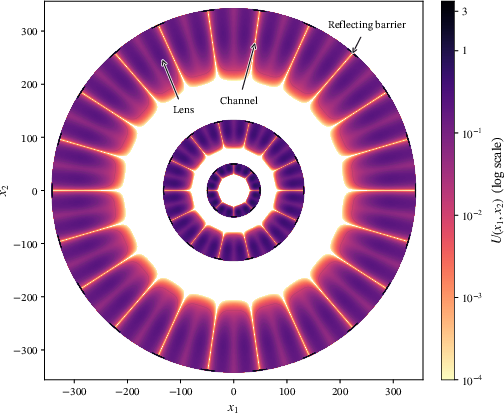
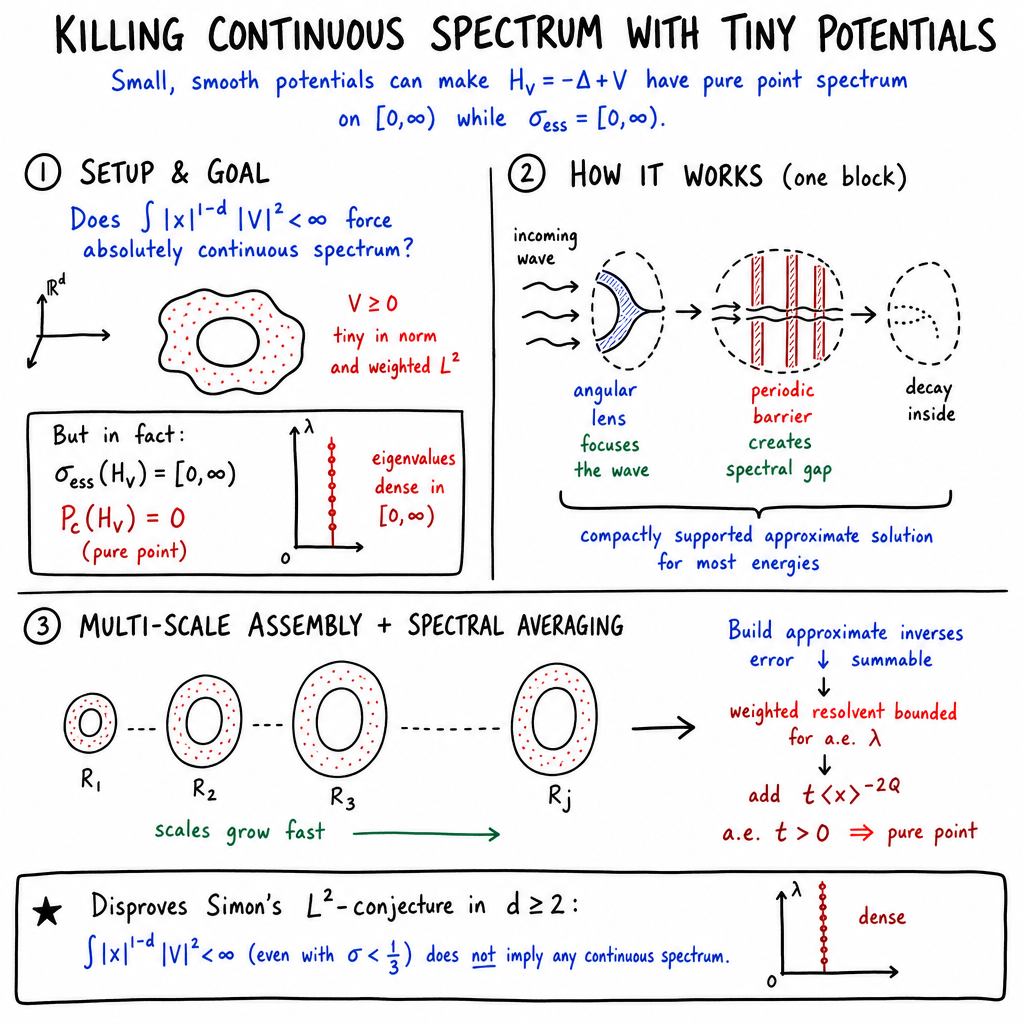
The potential is made from many separate annular blocks. An annulus is a ring-shaped region between two circles or spheres.
These rings are placed very far apart. Each block contains two important parts:
- Angular lenses: These guide waves into narrow directions, much like a glass lens focuses light.
- Reflecting barriers: These act like walls that reflect the focused waves instead of allowing them to escape.
An analogy is a large maze built from many widely separated circular walls. The lenses guide the waves toward the walls, and the walls bounce them back.
Periodic barriers
The barriers are made from repeating patterns of potential. Repeating structures can create spectral gaps, which are energy ranges where waves cannot travel freely through the structure.
The authors choose several periodic patterns so that, together, their forbidden energy ranges cover any chosen interval of energies.
Approximate solutions
The authors construct functions that almost solve the wave equation inside each annular block. These are called compactly supported approximate solutions.
“Compactly supported” means the function is exactly zero outside a limited region. “Approximate” means it solves the equation with only a very small error.
They then make the error smaller and smaller as the rings become larger and farther apart.
Spectral averaging
The paper also uses a tool called spectral averaging.
A simple analogy is this: imagine slightly changing the strength of a weak background force and observing how the energy levels move. If the system has suitable mathematical properties, this averaging process shows that most choices of the strength produce only isolated energy levels.
These isolated energy levels correspond to pure point spectrum.
The authors use this method to show that, for almost every value of a parameter, the operator has pure point spectrum in the energy interval being studied.
Extending to higher dimensions
The construction is first developed in two dimensions.
For three dimensions, the authors extend the two-dimensional structure in one direction and add extra disk-shaped barriers. For dimensions higher than three, they combine lower-dimensional constructions using a mathematical operation called a tensor sum.
4. What are the main findings?
The central theorem says that for every dimension , every
and every small number , the authors can construct a potential such that
In simple terms, the potential can be made as small as desired according to several different measurements.
Even so, the corresponding operator satisfies:
while its continuous spectral part vanishes:
This means:
- The possible energies fill the entire interval .
- These energies are not absent from the system.
- However, the wave states are all localized eigenstates rather than freely spreading states.
- The positive eigenvalues are dense in , meaning there are eigenvalues arbitrarily close to every nonnegative energy.
The authors call this pure point spectrum. In this situation, the eigenfunctions form a complete orthonormal basis, so every wave can be described using localized energy states.
Why is this surprising?
Normally, one might expect a weak and decaying potential to leave some freely traveling waves. Simon’s conjecture predicted exactly that.
This paper says that even a potential satisfying a stronger weighted condition can prevent every continuous type of motion. Thus, the usual condition is not enough to guarantee freely propagating waves.
5. Why are these results important?
The result disproves Simon’s conjecture in dimensions .
This matters because the conjecture was connected to a major question in mathematical physics:
When does a small disturbance leave the ordinary, free behavior of waves unchanged?
The paper shows that smallness, smoothness, and decay alone may not be enough. The shape and organization of the potential also matter greatly.
The construction demonstrates that carefully arranged obstacles can trap waves even when:
- the obstacles are individually weak,
- the total potential is very small,
- the potential becomes sparse and spread out,
- and the energy can be any positive value.
Simple conclusion
The paper builds a complicated but very weak system of ring-shaped “lenses” and barriers. The lenses focus waves, while the barriers reflect them. Repeating this design at larger and larger distances traps waves at many different energies.
The main lesson is:
A potential can be small overall but still be arranged cleverly enough to stop waves from spreading freely.
This changes what mathematicians believed about the relationship between small potentials and wave motion. It may lead to new research about localization, scattering, and how waves behave in carefully structured environments.
Knowledge Gaps
Knowledge gaps, limitations, and open questions
The paper establishes a counterexample within a specific nonnegative, smooth, lens-type class, but leaves the following issues unresolved:
- Endpoint is not addressed. The construction works only for , so it remains unknown whether the same conclusion holds under the critical weighted condition .
- The regime remains open. The paper does not determine whether sufficiently strong positive radial weights could force an absolutely continuous component or otherwise obstruct pure point spectrum.
- The one-dimensional case is excluded. The theorem requires , leaving open whether an analogous arbitrarily small counterexample exists in under the corresponding weighted condition.
- The result does not characterize the threshold for preserving absolutely continuous spectrum. It disproves Simon’s conjecture at , but does not identify any sharp decay, integrability, regularity, or geometric condition that guarantees absolutely continuous spectrum.
- The potentials are highly structured and anisotropic. It is unknown whether pure point spectrum can occur for substantially more generic, radially symmetric, randomly distributed, or isotropic potentials satisfying comparable smallness conditions.
- The construction relies on nonnegativity. The paper does not investigate whether sign-changing potentials, potentials with zero mean, or potentials subject to additional cancellation conditions can produce the same spectral behavior.
- The theorem does not establish stability under perturbations. It remains unclear whether the pure point spectrum persists after adding a generic small decaying perturbation, a compactly supported perturbation, or a perturbation that destroys the annular lens geometry.
- The role of the auxiliary decaying perturbation is not fully clarified. The spectral-averaging proposition proves pure point spectrum for almost every coupling in , whereas the main theorem is stated for an operator ; the precise absorption of this perturbation into the final potential, including preservation of all quantitative bounds, should be made explicit.
- The exceptional coupling parameters are not quantified. Spectral averaging yields pure point spectrum for almost every , but the paper does not describe the exceptional set, whether it has additional structure, or whether a specific deterministic coupling can be identified.
- The spectral type at the energy $0$ is not separately analyzed. The theorem states and , but the threshold behavior at zero—including possible zero-energy resonances, eigenvalues, or threshold singularities—is not discussed in detail.
- The multiplicity structure of the dense positive eigenvalues is not fully described. Finite multiplicity is obtained, but the paper does not provide asymptotics for eigenvalue counting, multiplicity bounds, spacing, or the distribution of eigenvalues across energy intervals.
- The mechanism producing dense positive eigenvalues is not quantitatively characterized. The relationship between annular scales, barrier gaps, and the density of eigenvalues is not converted into an explicit eigenvalue-counting law.
- The construction is not shown to be optimal with respect to smallness. The paper proves that can be made arbitrarily small, but does not determine whether stronger norms, larger weighted exponents, or other critical-space quantities can also be made arbitrarily small.
- Other natural function-space assumptions are not tested. It remains unresolved whether the counterexample can satisfy conditions such as global bounds, Lorentz-space bounds, Sobolev regularity, bounded variation, or pointwise decay rates comparable to the weighted integral assumptions.
- Pointwise decay of the constructed potential is not systematically quantified. Although the annular construction implies decay in an averaged sense, the paper does not state a sharp explicit pointwise decay bound for or compare it with known pointwise spectral-preservation thresholds.
- The barrier construction is established only for bounded energy windows at each stage. The way the energy intervals and periodic barriers are assembled over the full half-line depends on a scale schedule; the argument does not show whether a single uniform barrier mechanism can control all positive energies without this multiscale arrangement.
- Uniformity with respect to the energy parameter is limited. Several constants depend on a fixed upper energy bound , and the paper does not provide global quantitative control as .
- The dependence of the construction on the dimension is not quantitatively optimized. Higher dimensions are obtained through cylindrical extensions and tensor sums, but the resulting bounds, regularity, eigenvalue multiplicities, and geometric complexity are not analyzed sharply as increases.
- The tensor-sum argument may introduce additional spectral degeneracies. The paper does not fully characterize how eigenvalue multiplicities behave under the higher-dimensional tensor construction or whether finite multiplicity can be bounded uniformly in dimension.
- The method’s applicability to manifolds or other geometries is unexplored. It is unknown whether analogous lens-and-barrier constructions work on asymptotically Euclidean manifolds, waveguides, exterior domains, or lattices.
- The relation to singular continuous spectrum is not developed beyond its absence in the example. The construction eliminates the entire continuous component, but does not clarify whether related lens mechanisms can generate purely singular continuous spectrum or mixed spectral types.
- The robustness of the approximate-inverse argument is not tested under less regular potentials. Smoothness is built into the construction, but it remains open whether comparable results hold for merely bounded, measurable, piecewise smooth, or compactly supported-in-each-annulus potentials.
- The excluded-energy sets are not explicitly constructed in a usable form. The proof establishes small measurable sets and uses summability, but does not give effective descriptions or quantitative dependence of these sets on the source space, energy range, and approximation order.
- The proof depends on high-order adiabatic expansions whose complexity grows with the desired error. It is not established whether a simpler or more robust approximation scheme could obtain the same result, nor whether the order- construction is quantitatively efficient.
- The spectral-averaging criterion is used in a highly tailored setting. The paper does not determine whether the pure point conclusion can be obtained directly from the annular approximate solutions without adding the auxiliary rank-one-in-coupling perturbation.
- No numerical or independent verification of the lens dynamics is provided. The concentration, reflection, and matching estimates are analytical, but the behavior of finite annular approximations and the emergence of dense eigenvalues are not numerically examined.
- The effect of replacing exact periodic barriers by more general barriers is unknown. The argument uses periodic spectral gaps; it remains open whether quasiperiodic, random, finite-pattern, or simpler piecewise-constant barriers can yield the same confinement estimates.
- The construction does not address physically or geometrically natural potentials. It remains unresolved whether comparable pure point spectrum can be obtained with radial wells, sparse bumps, monotone potentials, or potentials lacking rapidly oscillating angular structure.
Practical Applications
Immediate Applications
- Revision of spectral assumptions in mathematical physics and PDE research (academia; deployable now) The paper provides an explicit counterexample to Simon’s multidimensional conjecture: even a smooth, bounded, nonnegative potential with arbitrarily small , , and the stronger weighted quantity for can produce an operator with
Researchers can therefore immediately revise conjectures, theorem statements, and numerical or analytical workflows that treat weighted decay as sufficient for preserving absolutely continuous spectrum.
- Benchmark construction for spectral-type algorithms (mathematical software; deployable now)
- finite-volume eigenvalue statistics,
- approximations to spectral measures,
- resolvent growth,
- numerical indicators of absolutely continuous versus pure point spectrum.
- The dense positive eigenvalues and absence of continuous spectral components make these potentials particularly valuable for testing whether numerical methods falsely interpret finite-volume data as scattering behavior.
- Validation tests for resolvent and spectral-averaging methods (academia and mathematical software; deployable now)
- check implementations of finite-volume resolvent estimates;
- test spectral averaging arguments;
- study the difference between approximate local inverses and genuine global resolvents;
- design symbolic or computer-assisted proofs for related operators.
- Counterexample library for mathematical-physics education (academia; deployable now)
- essential spectrum can remain ;
- positive eigenvalues can be dense;
- continuous spectrum can nevertheless be absent;
- smallness in a natural weighted norm does not control spectral type.
- It can be incorporated into graduate courses on Schrödinger operators, scattering theory, spectral analysis, and operator theory.
- Caution in interpreting decay conditions in quantum models (quantum modeling and mathematical physics; deployable now) Analysts can immediately avoid using or with as a standalone proxy for the existence of extended states or ordinary scattering states. Any practical model relying on such an implication should additionally verify pointwise decay, geometric restrictions, monotonicity, randomness, or other structural hypotheses.
- Adversarial test for AI-assisted mathematical reasoning (AI for science; deployable now)
- testing whether automated systems detect missing hypotheses in spectral claims;
- evaluating whether an AI-generated proof preserves quantifiers and uniformity in energy and Fourier modes;
- developing verification pipelines that independently check the annular construction, residual estimates, and spectral-averaging hypotheses.
- The paper itself emphasizes that final mathematical responsibility remains with the authors, so formal verification is essential.
- Policy and research-planning correction for conjecture-driven programs (research policy; deployable now)
- identifying additional hypotheses that guarantee absolutely continuous spectrum;
- classifying the boundary between pure point, singular continuous, and absolutely continuous regimes;
- studying whether analogous counterexamples exist under stronger regularity, decay, or geometric constraints.
Long-Term Applications
- Design principles for engineered wave confinement (quantum devices, photonics, acoustics, and wave physics; requires development)
- annular waveguides;
- energy-selective acoustic cavities;
- photonic or microwave structures with angular focusing;
- metamaterial devices that suppress outward propagation over prescribed energy bands.
- The present result is mathematical and uses scale-separated, widely separated annuli; practical devices would require finite-size designs, material realizability, loss modeling, and robust control of imperfections.
- Multi-band spectral filtering and localization components (photonics, acoustics, and microwave engineering; long-term)
- reflect selected frequency bands;
- transmit or confine other bands;
- combine several periodic unit cells into a tunable spectral filter.
- Dependencies include achievable contrast in material parameters, finite barrier thickness, interface losses, and the sensitivity of spectral gaps to disorder.
- Hybrid analytical–numerical solvers for localized positive-energy states (computational physics; long-term)
The compactly supported approximate inverses and the scale-by-scale assembly suggest a solver architecture:
- solve local finite-volume problems on annular blocks;
- match angular ground-state channels through the lens;
- impose barrier decay in spectral gaps;
- assemble approximate global eigenfunctions;
- estimate residuals and certify localization. Such solvers could be useful for studying positive-energy localization in deterministic systems. They would require stable discretizations, error control across rapidly increasing radii, and methods for resolving dense eigenvalues.
Generalization to other differential operators (mathematical physics; long-term)
- magnetic Schrödinger operators;
- anisotropic elliptic operators;
- waveguides and manifolds with ends;
- discrete lattice Hamiltonians;
- higher-order operators.
- Feasibility depends on preserving the key ingredients: a controllable isolated angular channel, a barrier with uniform spectral gaps, compactly supported approximate solutions, and a suitable spectral-averaging theorem.
- Quantitative classification of spectral transitions (academia; long-term)
- similar counterexamples exist for ;
- stronger weighted norms restore continuous spectrum;
- additional angular regularity or derivative bounds change the conclusion;
- there is a sharp phase diagram between pure point and absolutely continuous behavior.
- This would improve the mathematical basis for predicting transport from decay estimates.
- Transport and diffusion diagnostics in disordered or structured media (energy materials and condensed-matter modeling; long-term)
- electronic conduction;
- wave diffusion;
- energy transfer;
- localization in structured media.
- Any such use would require connecting the continuum operator to a physically calibrated Hamiltonian and distinguishing deterministic confinement from experimentally relevant disorder and finite-temperature effects.
- AI-assisted discovery with formal proof certification (AI research and academia; long-term)
- potential geometries;
- scale schedules;
- spectral-gap constructions;
- approximate inverses and error estimates.
- A proof assistant or computer-algebra layer would then verify all dependencies, including parameter inequalities, summability, domain statements, uniformity over Fourier modes, and exceptional-energy sets. The main dependency is the availability of formal libraries for functional analysis, spectral theory, and PDE estimates.
- No direct daily-life application is established by the paper (daily life; long-term or indirect) The findings do not immediately imply a consumer product, medical intervention, financial tool, or household technology. Any eventual everyday impact would be indirect, arising through improved designs for wave confinement, photonic filtering, quantum devices, or computational tools. Such applications require substantial physical modeling and experimental validation beyond the mathematical construction.
Glossary
- Absolutely continuous spectrum: The part of an operator’s spectrum associated with spectral measures absolutely continuous with respect to Lebesgue measure. “Simon's multidimensional conjecture claims that implies the presence of an absolutely continuous spectrum of infinite multiplicity”
- Adiabatic method: An approximation technique for systems that vary slowly, in which a state follows an instantaneous eigenstate. “The construction is often called adiabatic.”
- Angular ground state: The lowest-energy eigenfunction of an angular operator. “We first show that the angular ground state is concentrated in these regions.”
- Borel–Cantelli lemma: A probabilistic result stating that, under summability conditions, only finitely many events in a sequence occur almost surely. “Borel--Cantelli now gives the full-measure set”
- Cylindrical confinement: Restriction or localization of waves in a cylindrical geometric region. “Section~\ref{sec:dimensions} establishes cylindrical confinement in three dimensions”
- Diamagnetic inequality: An inequality comparing the kinetic energy of a magnetic or complex-valued function with that of its modulus. “The diamagnetic inequality \cite[\S9, (9.24)--(9.27)]{SimonDia} and the trial state give”
- Dirichlet operator: A differential operator defined with boundary values constrained to vanish on the boundary of its domain. “The Dirichlet operators and on have potentials and , respectively.”
- Dirichlet domain: The function space incorporating Dirichlet boundary conditions for an operator. “The functions belong to the Dirichlet domain because they vanish outside .”
- Dilation: A rescaling transformation that changes spatial or geometric scales. “completes the proof of Theorem~\ref{thm:main} in all dimensions by tensor sums and dilation.”
- Essential spectrum: The portion of the spectrum unaffected by compact perturbations, often associated with nonlocalized states or infinite multiplicity. “$\sigma(H_V)=\sigma_{\mathrm{ess}(H_V)=[0,\infty)$”
- Exponential dichotomy: A splitting of solutions into stable and unstable components with exponential decay in opposite time directions. “the system $Y'=\begin{pmatrix}0&1\q_i(x)-\nu&0\end{pmatrix}Y$ has an exponential dichotomy.”
- Fourier mode: A component of a function corresponding to a particular frequency in a Fourier expansion. “the estimates for each periodic angular profile include every Fourier mode.”
- Functional calculus: The assignment of functions of a scalar variable to functions of an operator, such as . “The spectral theorem and the preceding identity imply”
- Ground state: An eigenstate corresponding to the lowest eigenvalue of an operator. “Let be the positive normalized ground state at .”
- Absolutely continuous spectrum: The spectral component represented by absolutely continuous spectral measures, rather than discrete eigenvalues or singular measures. “the persistence of absolutely continuous spectrum.”
- Isolated-band method: A perturbative construction that uses a spectrally separated eigenvalue band and its reduced inverse. “We follow the isolated-band method of \cite[Theorem~2.1 and \S4.5]{PST}”
- Lens-type potential: A potential designed to focus waves into narrow angular channels. “we construct with LLM-assistance a smooth bounded nonnegative lens-type potential ”
- Min–max principle: A variational characterization of eigenvalues of self-adjoint operators. “By nonnegativity and the min--max principle”
- Monodromy: The transformation mapping initial data of a periodic differential system to its data after one period. “Its monodromy in the coordinates is”
- Pure point spectrum: Spectrum consisting entirely of eigenvalues whose eigenfunctions form a complete orthonormal basis. “Pure point spectrum here means that the eigenfunctions form a complete orthonormal basis”
- Quasimode: An approximate eigenfunction whose residual under an operator is small. “The function extends by zero to the line, where . The function extends by zero to the line, where .”
- Rellich compactness: A compact-embedding result ensuring that bounded sequences in a sufficiently regular Sobolev space have convergent subsequences in a weaker norm. “Rellich compactness shows that is compact.”
- Resolvent: The operator , defined when lies outside the spectrum, which encodes spectral information about . “The finite-volume resolvents can be large near their eigenvalues.”
- Spectral averaging: A method that averages spectral measures over a parameterized family of operators to establish spectral-type properties. “For the two- and three-dimensional operators, we obtain pure point spectrum with finite eigenvalue multiplicities by applying the spectral averaging criterion”
- Spectral gap: An interval separating parts of an operator’s spectrum, or the separation between consecutive eigenvalues. “We need a gap above the angular ground state that grows with .”
- Spectral measure: A measure associated with a vector and a self-adjoint operator that represents how spectral mass is distributed over energies. “the mass of spectral measures was concentrated on sets of increasingly small sets.”
- Spectral projection: An operator projecting onto the spectral subspace associated with a specified measurable subset of the spectrum. “We denote by the spectral projection of a self-adjoint on a Borel set .”
- Spectral theorem: The theorem representing a self-adjoint operator through a projection-valued measure and enabling functions of the operator to be defined. “The spectral theorem and the preceding identity imply”
- Stable and unstable projections: Projections onto solution subspaces that decay in forward or backward directions, respectively, for a hyperbolic dynamical system. “ are its stable and unstable projections”
- Tensor sum: An operator constructed by adding operators acting on separate tensor-product factors. “Tensor sums of the two- and three-dimensional operators give the construction in every dimension.”
- Weighted resolvent bound: A uniform estimate on a resolvent after multiplication by spatially decaying weights. “We derive the required weighted resolvent bound from compactly supported approximate solutions.”
- Weyl’s law: An asymptotic formula describing the growth of eigenvalue-counting functions for elliptic operators. “Scaling this ball to and applying Weyl's law”
- Quasimode residual: The error produced when an approximate eigenfunction or approximate solution is substituted into the governing operator equation. “The residual is the cutoff commutator, supported where and its derivative are exponentially small.”

