Counterexamples to the Landis conjecture in dimensions three and higher
Abstract: In every dimension three and higher we construct a nonzero function that satisfies the stationary Schrödinger equation with bounded, real-valued potential and decays like $\exp(-c|x|{4/3})$. This gives a counterexample to the Landis conjecture in dimension three and higher.
Paper Prompts
Sign up for free to create and run prompts on this paper using GPT-5.
Top Community Prompts
Explain it Like I'm 14
1) What is this paper about?
This paper studies how fast special “wave-like” functions can fade away to zero far from the origin while still solving a key physics/math equation, the stationary Schrödinger equation: -Δu + V u = 0.
Here:
- u is the unknown function,
- V is a “potential” (a fixed function that’s part of the equation),
- Δ (the Laplacian) is a mathematical way to measure how u bends/curves in space.
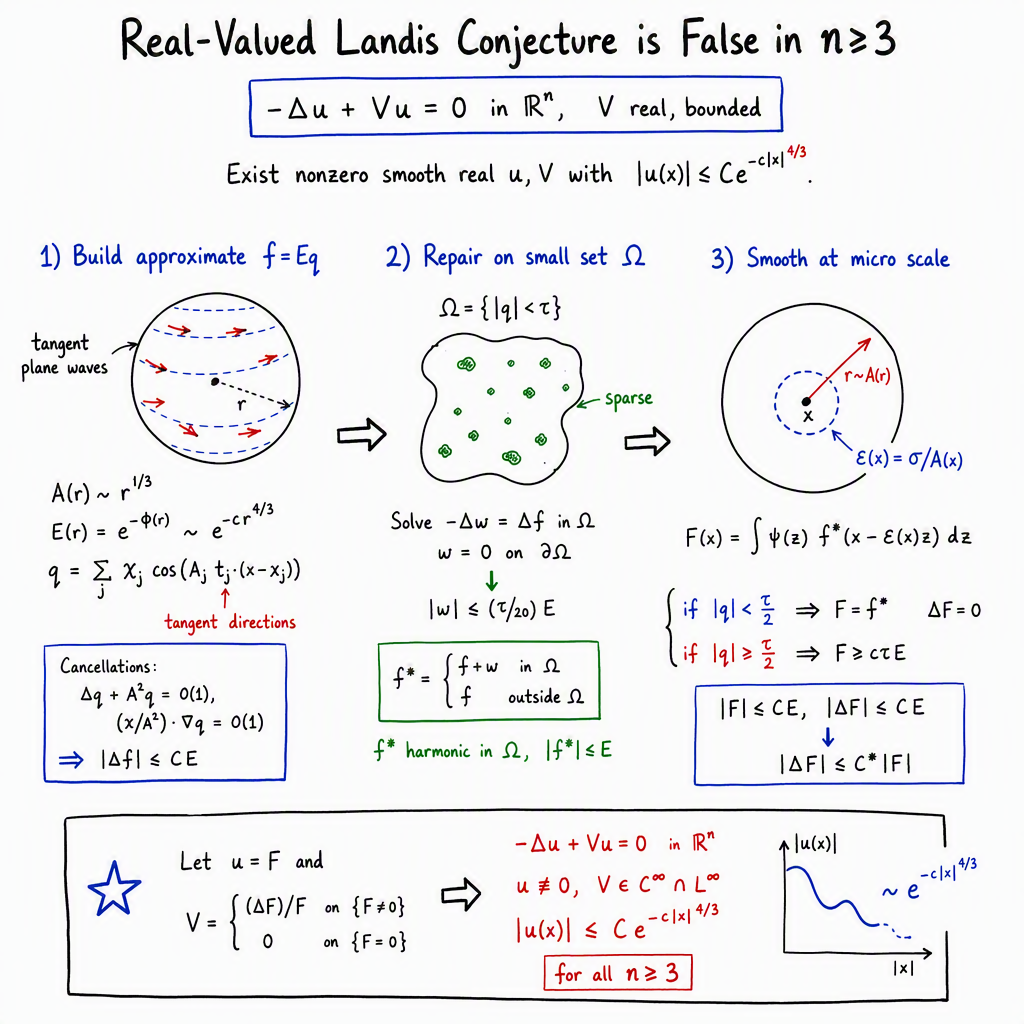
A famous idea called the Landis conjecture predicted that if u fades (decays) very quickly at infinity, then u must be zero everywhere. The authors show this prediction is false in dimensions 3 and higher by building a nonzero solution u that decays like exp(-c|x|{4/3}) even with a nice, bounded, real-valued potential V. That means: in 3D and above, a nontrivial solution can hide extremely well at infinity while still obeying the equation.
2) What questions does it ask?
Put simply, the paper asks:
- If a solution u of the Schrödinger equation with a bounded, real potential V gets very small far away, must it actually be the zero function?
- More specifically, does very fast decay force u to be zero?
Landis’ question (from the 1960s) suggested “yes.” Earlier counterexamples existed only when complex numbers were allowed (either complex-valued u or complex V), and mostly in 2D. This paper asks whether the “no” answer still holds with only real numbers—and in higher dimensions.
3) How do the authors do it? (Methods, in simple terms)
The authors construct a special function u by carefully combining two ingredients:
- a smooth, radially decaying “envelope” E(x) that looks like E(x) = exp(-Φ(|x|)) with Φ(r) behaving like (3/4)r{4/3}, and
- a gently stitched-together “rippling” part q(x) made from local cosine waves.
Think of it like this:
- The envelope E is a dimmer switch that smoothly darkens with distance.
- The ripples q are like small, carefully oriented water waves that vary across space.
- The full function is u = E * q.
Key ideas behind the construction:
- Two scales:
- A “macro” scale that changes slowly with distance, roughly A(r) ≈ r{1/3}.
- A “micro” scale for the wave ripples, roughly 1/A(r), which is much smaller.
- A patchwork cover of space:
- Space is tiled by overlapping “macro” balls (regions). On each tile, the authors choose a direction for a cosine wave.
- Neighboring tiles get carefully separated directions so the waves don’t line up too much. This uses that the dimension is at least 3 (you have enough different directions on a sphere in 3D and higher).
- Cancellations:
- When you apply the Laplacian Δ to u = E * q, two potentially large error terms (from the radial envelope and from the tangential ripples) partially cancel out if the frequencies and directions are tuned just right.
- This tuning is what picks out the special decay rate r{4/3} as “critical.”
A repair step for “danger zones”:
- In places where q is tiny, u = E * q is too small, and a simple ratio like V = (Δu)/u could blow up. The authors show such “tiny-q” regions are very sparse at the micro scale.
- Inside those sparse regions, they solve a Dirichlet problem (a boundary-value problem for harmonic functions) to replace u by a function that is harmonic (Δu = 0) there and matches u outside—think of it as carefully “filling potholes” so the function stays well-behaved.
- Finally, they smooth this repaired function at the micro scale. The end result still decays like E and now satisfies |Δu| ≤ C|u|, so setting V = (Δu)/u gives a bounded, real, smooth potential. This produces the desired counterexample.
4) What did they find and why is it important?
Main finding:
- In every dimension n ≥ 3, there exists a nonzero, smooth, real-valued function u and a smooth, bounded, real-valued potential V such that -Δu + V u = 0 and |u(x)| ≤ C exp(-c|x|{4/3}).
Why this matters:
- It disproves (in dimensions 3 and higher) the real-valued version of the Landis conjecture, which expected that sufficiently fast decay at infinity forces u to be zero.
- The specific exponent 4/3 is not accidental: previous work showed it’s the “critical” boundary between what’s possible and impossible; the authors’ construction exactly matches this threshold.
- It clarifies a big difference between 2D and higher dimensions:
- In 2D, recent results suggest a form of the conjecture remains true under certain conditions (for example, with extra logarithmic decay), and the method in this paper does not work in 2D—consistent with those positive 2D results.
- It advances our understanding of “unique continuation at infinity”—a theme about whether smallness far away forces a solution to vanish everywhere. This is crucial in analysis and mathematical physics, including quantum mechanics and the theory of random Schrödinger operators.
5) What could this mean going forward?
- For analysis and PDEs: It reshapes expectations about how solutions to Schrödinger-type equations behave at large distances in higher dimensions. Methods that rely on strong “small at infinity implies zero” principles must account for these sharp counterexamples.
- For mathematical physics: It refines the boundary between detectable and “hidden” quantum states in models where the potential is real and bounded. Extremely fast decay does not automatically kill off all nontrivial solutions in 3D and above.
- For techniques: The paper blends geometric coverings, clever direction choices, scale separation, and a “harmonic repair” step. These ideas may inspire new constructions in other problems where one needs tight control over error terms and sparse “bad” regions.
- Dimensional insight: The failure in 2D of the directional-separation step highlights a genuine geometric barrier, helping explain why 2D often behaves differently from higher dimensions in PDE problems.
Knowledge Gaps
Unresolved gaps, limitations, and open questions
Below is a consolidated list of what remains missing, uncertain, or unexplored, distilled to guide future research.
- Dimension n = 2 remains open for real-valued, bounded potentials:
- The construction crucially uses a tangential-direction separation that fails in 2D; can an alternative mechanism (not relying on separated plane waves on S0) yield a real-valued counterexample in 2D?
- Does the “full” Landis conjecture with linear-exponential decay e{κr} hold in 2D for arbitrary bounded real V (beyond the known cases V ≥ 0 and the weaker LMNN threshold)?
- Sign constraints on the potential:
- The constructed V changes sign; can one produce counterexamples with V ≥ 0 or V ≤ 0 in n ≥ 3? If not, can one prove a no-go theorem for nonnegative (or nonpositive) V in higher dimensions analogous to the 2D V ≥ 0 case?
- Decay or structure of the potential at infinity:
- Can one enforce V(x) → 0 as |x| → ∞ (short-range) in the real-valued construction, or prescribe quantitative decay/growth of V (analogous to Cruz-Sampedro’s complex-valued case)?
- Can one realize V with additional global structure (e.g., periodic, almost-periodic, or with controlled oscillation scales)?
- Regularity and quantitative control of the potential:
- The paper asserts V ∈ C∞ ∩ L∞ but no uniform bounds on its derivatives; can one attain explicit, scale-invariant bounds on Dk V for k ≥ 1 (e.g., V ∈ W{1,∞} with controlled norm)?
- Is a real-analytic potential achievable within this scheme (or any real-valued scheme) while retaining the critical e{-c|x|{4/3}} decay?
- Quantitative constants and sharp thresholds:
- The constants c_n, C_n, and the L∞ bound on V are non-explicit; can one obtain explicit, dimension-dependent bounds or optimize them?
- What is the sharp threshold in the one-parameter family e{-τ|x|{4/3}} for real-valued, bounded V in n ≥ 3? In particular, identify the largest τ for which nontrivial solutions can exist (complementing the “arbitrarily large τ implies triviality” result).
- Two-sided asymptotics and lower bounds for u:
- Beyond the global upper bound |u(x)| ≤ C_n e{-c_n|x|{4/3}}, can one obtain matching lower bounds (outside a negligible set) or asymptotic expansions for u (WKB-type), quantifying how tightly u follows its radial envelope?
- Control of the small-value region and nodal geometry:
- The construction uses a measure-sparse region Ω where q is small; can one quantify finer geometric features of Ω (e.g., connectivity, size distribution of components, Minkowski/ Hausdorff dimension) and of the nodal set of u?
- Robustness and stability:
- Are the constructed counterexamples stable under small L∞ perturbations of V (persistence of nontrivial solutions with critical decay)?
- Can one describe an open set (in L∞ topology) of real potentials for which nontrivial solutions with e{-c|x|{4/3}} exist?
- Prescribing additional qualitative properties of u:
- Can one construct u that is everywhere nonvanishing and of a fixed sign (or prove impossibility under natural hypotheses, e.g., by maximum principles when V ≥ 0)?
- Can one enforce additional symmetries (e.g., parity or approximate radiality) while preserving the decay rate?
- Extension to variable-coefficient or magnetic operators:
- Does an analogous real-valued construction exist for variable-coefficient uniformly elliptic operators, magnetic Schrödinger operators, or operators with first-order drift terms, while retaining the 4/3 decay?
- Generalization to potentials with prescribed profile or constraints:
- Can one adapt the method to match a target bound on ||V||_{L∞} while keeping the decay rate (especially recover small-norm counterexamples via scaling with explicit parameter control)?
- Is it possible to impose local constraints (e.g., V supported or controlled on prescribed regions) consistent with nontriviality and critical decay? If not, can one prove precise obstructions?
- Higher-dimensional positive results (complementary to the counterexample):
- For n ≥ 3, is there a “weak Landis” uniqueness threshold strictly between e{-cr} and e{-c|x|{4/3}} (in the spirit of LMNN’s 2D result), and can it be quantified for real-valued, bounded V?
- Algorithmic/constructive aspects:
- The tangential-direction coloring is proved by a compactness/measure argument; can one give an explicit, algorithmic scheme to select the directions t_j with effective separation and controlled overlap, suitable for numerical or constructive implementations?
- Porting the architecture to other geometries:
- Can the “radial envelope + localized tangential oscillations + harmonic repair” strategy be adapted to manifolds (e.g., asymptotically Euclidean, cylinders without periodic factors, or warped products), and what geometry-dependent adjustments are needed?
- Limits of the method:
- Identify which parts of the construction are essential for the 4/3 exponent (e.g., the specific cancellations or the local plane-wave architecture) and which are artifacts; can alternative local building blocks reproduce the same exponent or improve constants?
Practical Applications
Immediate Applications
Below are applications that can be adopted now (with reasonable engineering effort) based on the paper’s constructions and estimates. Each item includes sector tags and key dependencies.
- Robust guardrails for PDE-constrained inverse problems (academia, healthcare/imaging, geophysics)
- Use case: When estimating unknown coefficients from fields by quotients like V ≈ (Δu)/u, apply the “safe quotient” workflow from the paper: detect small-value regions of u; replace u there by a harmonic solve (Dirichlet “harmonic repair”); then form the quotient elsewhere.
- Tools/workflow:
- Microscopic-scale detection of {|u| < τ} via local sublevel control;
- Solve Dirichlet Poisson problems on sparse, irregular sets;
- Local smoothing at the local wavelength A(x)−1.
- Dependencies/assumptions: n ≥ 3; access to Poisson/Dirichlet solvers on irregular subsets; small-value set must be sparse at the microscopic scale (θ, ρ parameters).
- Algorithmic priors to avoid non-uniqueness in 3D inverse problems (healthcare EIT/DOT, NDT, seismic, academia)
- Use case: Update pipelines to enforce structure (e.g., V ≥ 0, monotonicity, support limits) because fast-decay of a field does not imply triviality in ≥3D with merely bounded real potentials.
- Tools/workflow: Regularization with sign constraints; model selection that excludes sign-changing V; uncertainty quantification that explicitly allows nontrivial fast-decaying solutions.
- Dependencies/assumptions: Problem set in n ≥ 3; mere boundedness of V is insufficient; constraints must be encoded in the inference model.
- Test-suite generation for Schrödinger/Helmholtz solvers (software, academia)
- Use case: Produce adversarial 3D benchmarks with smooth bounded V and fast-decaying nontrivial solutions to test unique-continuation-based solvers and stabilization techniques.
- Tools/workflow: Implement the paper’s constructive pipeline:
- Envelope E(r) = exp(−Φ(r)) with A(r) = (L6 + r2){1/6}, Φ = 3/4(A4 − L4);
- Macroscopic variable-radius cover + partition of unity with bounded derivatives;
- Tangential-frequency coloring on the overlap graph; build q(x) = Σ χ_j cos(A_j t_j·(x − x_j));
- Identify sparse Ω = {|q| < τ} via sublevel estimates; do harmonic repair and microscopic smoothing.
- Dependencies/assumptions: Dimension n ≥ 3; large but fixed L; availability of graph coloring (bounded degree) and local Poisson solves; numerical resolution at the microscopic scale A(x)−1.
- Plane-wave basis selection with angle separation to reduce ill-conditioning (software, numerical PDE)
- Use case: In plane-wave/Trefftz/PUFEM discretizations, assign local directions on overlapping patches with enforced angular separation (the “tangential-frequency coloring”) to mitigate near-linear dependence.
- Tools/workflow: Build overlap graphs of patches; apply bounded-degree graph coloring with forbidden caps to choose directions with a minimum separation.
- Dependencies/assumptions: Patches with bounded overlap; availability of sphere-cap separation; n ≥ 3 for nontrivial tangent spheres.
- Variable-scale covering and partition-of-unity libraries (software, numerical analysis)
- Use case: Implement “slowly varying” ball coverings and partitions of unity that preserve derivative bounds, enabling multiscale meshing/adaptation where local wavelength varies like A(x)−1.
- Tools/workflow: Lemma-driven APIs: slow-covering construction; uniform multiplicity bounds; derivative-controlled partitions.
- Dependencies/assumptions: Lipschitz control of target scale function; users must set parameters (κ, κ2, overlap tolerances).
- Beamforming and phased-array pattern safety (engineering, communications)
- Use case: Use the uniform sublevel-set estimate for separated trigonometric polynomials to bound deep-cancellation regions of superposed beams locally (i.e., “nulls” occupy small volume fraction when directions are well-separated).
- Tools/workflow: Enforce direction separation constraints among array beams; quantify and limit regions where |Σ cν cos(ξν·z + γν)| is small.
- Dependencies/assumptions: Local direction separation; bounded number of active modes; results are local (on balls of radius ρ) and worst-case—not tailored to a specific antenna geometry.
- Preconditioning and error estimates on sparse/perforated domains (software, energy, materials)
- Use case: Apply weighted Poincaré inequalities and Dirichlet solvability bounds on sets occupying a small fraction of every local ball to design robust preconditioners and error estimators for Laplace/Poisson problems in perforated media.
- Tools/workflow: Local-volume-fraction criteria (θ, ρ) → spectral-gap-style inequalities; incorporate into multigrid/domain-decomposition heuristics.
- Dependencies/assumptions: Local sparsity as in the paper (every microscopic ball has at most θ fraction of the domain); constants depend on θ, ρ, n.
- Curriculum and training modules on counterexample-driven analysis (education, academia)
- Use case: Case studies for courses on PDE/unique continuation/random Schrödinger operators; practical modules on constructing counterexamples, multiscale partitioning, and analytic sublevel controls.
- Tools/workflow: Lab notebooks implementing each construction step; comparison with Meshkov and with positivity-protected 2D results.
- Dependencies/assumptions: Graduate-level background in PDE/function spaces.
Long-Term Applications
These are plausible directions that require further research, scaling, or domain translation before deployment.
- Metamaterial and wave-control design for fast-decaying bound states (energy, photonics, defense)
- Vision: Engineer bounded-index variations (analogs of bounded real V) that admit rapidly decaying nontrivial fields in 3D, enabling localized energy confinement or stealth.
- Potential products: Graded-index profiles achieving targeted decay envelopes; waveguides with engineered leakage characteristics.
- Dependencies/assumptions: Translating Schrödinger potentials to Helmholtz refractive index models; fabrication tolerances; stability to losses/disorder; regulatory constraints.
- Adversarial scenarios for physics-based sensing (policy, defense, autonomous systems)
- Vision: Construct “hard-to-detect” fields/potentials producing fast-decaying signals that evade range-based thresholds in 3D sensing (radar/sonar/EM).
- Potential workflows: Red-team toolkits generating adversarial coefficient fields; blue-team defenses adding positivity/structure checks or multi-modal redundancy.
- Dependencies/assumptions: Mapping mathematical potentials to physically realizable media; safety and ethics governance.
- Refining localization theory and unique continuation in random media (academia, condensed matter)
- Vision: Leverage the counterexample (odd dimensions) to sharpen quantitative unique continuation inputs in proofs of localization/delocalization; revisit thresholds in Anderson-type models.
- Potential tools: Dimension-specific Carleman inequalities incorporating sign constraints; better decay-vs-uniqueness tradeoffs.
- Dependencies/assumptions: Integration with existing probabilistic frameworks; control of real-valued potential structure.
- Inverse scattering/EIT identifiability at low energy (healthcare, geophysics, academia)
- Vision: Redesign uniqueness theorems and algorithms to explicitly incorporate conditions (e.g., V ≥ 0, support, regularity) that are necessary in 3D; quantify non-uniqueness margins when those are violated.
- Potential products: Certifiable inversion toolkits that flag regimes where fast-decay nontrivial solutions can confound inference.
- Dependencies/assumptions: Forward model fidelity; measurement noise; clinical or field constraints.
- General-purpose “safe-quotient” estimators in PDE learning (software, ML + physics)
- Vision: Physics-informed ML frameworks that estimate coefficients through differential quotients while automatically performing harmonic repair in small-amplitude regions to prevent blow-ups.
- Potential products: Layers/ops in PINNs/PDE-constrained learning libraries for robust coefficient recovery.
- Dependencies/assumptions: Scalable Dirichlet/Poisson solvers within training loops; differentiability of repair steps; convergence guarantees.
- Direction-coloring strategies for high-frequency solvers (software, HPC)
- Vision: Global assignment of plane-wave directions across overlapping patches with guaranteed separation to reduce ill-conditioning and pollution error in Helmholtz solvers.
- Potential products: Preprocessing modules for Trefftz/PUFEM/DG codes; condition-number-aware basis managers.
- Dependencies/assumptions: Empirical validation at scale; integration with adaptive meshes; handling of complex geometries and boundary conditions.
- Libraries for multiscale coverings and sublevel-set control (software, numerical analysis)
- Vision: Packaged routines to build slowly varying coverings, partitions of unity with derivative control, and certify sublevel sparsity for trigonometric superpositions—usable across PDE and signal-processing tasks.
- Potential products: Open-source C++/Python libraries; plugins for meshing/FE packages.
- Dependencies/assumptions: API standardization with existing FE frameworks; user education on parameter choices (θ, ρ, L).
- Experimental verification in wave labs (academia, photonics)
- Vision: Emulate bounded “potential” profiles in analog wave platforms (e.g., acoustic or optical metamaterials) to observe nontrivial fast-decaying modes in 3D.
- Potential outcomes: Data to inform model revisions in imaging/sensing and material design.
- Dependencies/assumptions: Precise control over medium parameters; 3D fabrication; measurement resolution.
- Educational policy: communicating limits of inference (policy, education)
- Vision: Guidelines that emphasize where 3D decay-based heuristics for “zero signal” can fail without added structure, improving scientific integrity in applied modeling.
- Potential outputs: Best-practice documents for agencies funding inverse-problem applications.
- Dependencies/assumptions: Community consensus; cross-disciplinary outreach.
Key Assumptions and Dependencies Across Applications
- Dimension: The construction and tangential-direction separation require n ≥ 3. The weak Landis-type uniqueness remains valid in 2D under additional conditions (per LMNN), so 2D workflows differ.
- Potentials: Real-valued, bounded V; no uniform derivative bounds on V are guaranteed by the construction.
- Parameters: Large but fixed L controls the local wavelength A(x)−1; constants depend on dimension and sparsity parameters (θ, ρ).
- Sparse small-value sets: Core estimates rely on the set {|q| < τ} being sparse in every microscopic ball; tools must detect and operate at that scale.
- Solvers: Practical implementations need robust Poisson/Dirichlet solvers on irregular, possibly fragmented open sets; smoothing at the local wavelength must preserve key bounds.
Glossary
- Anderson–Bernoulli model: A random Schrödinger model with Bernoulli-distributed potential used in mathematical physics to study localization. "to settle a long-standing open problem about the continuous Anderson--Bernoulli model."
- bounded overlap (of a cover): A property of a covering by sets where each point lies in at most a uniformly bounded number of sets, enabling controlled summations and partitions of unity. "cover n by a family of balls with bounded overlap"
- covering by slowly varying balls: A geometric covering where ball radii change slowly with location, ensuring comparability on overlaps. "Covering by slowly varying balls"
- Dirichlet Laplacian: The Laplace operator with Dirichlet (zero) boundary conditions on a domain, governing harmonic functions that vanish on the boundary. "pointwise contraction for the Dirichlet Laplacian on "
- Dirichlet problem: The boundary value problem of finding a function with prescribed values on the boundary that solves a PDE (often Laplace’s equation) inside the domain. "harmonic replacement via a Dirichlet problem"
- harmonic: A function satisfying Laplace’s equation (Δu = 0), representing equilibrium states. "and is harmonic in ."
- harmonic replacement: Replacing a function by a harmonic function on a subregion (with matching boundary data) to improve analytic properties. "harmonic replacement via a Dirichlet problem"
- L∞ space: The space of essentially bounded measurable functions; here used for potentials with bounded magnitude. ""
- Laplacian (Δ): The second-order differential operator measuring the divergence of the gradient; central in PDEs like Schrödinger’s and Laplace’s equations. "-\Delta u+Vu=0"
- Lax–Milgram lemma: A functional-analytic result guaranteeing existence and uniqueness of weak solutions to coercive variational problems. "The Lax--Milgram lemma gives existence and uniqueness."
- Landis conjecture: A conjecture about unique continuation at infinity for solutions of Schrödinger-type equations, asserting that sufficiently fast decay implies triviality. "This gives a counterexample to the Landis conjecture in dimension three and higher."
- macroscopic atlas: A structured family of overlapping coordinate balls at a large (slowly varying) scale used to patch local constructions. "construct the macroscopic atlas."
- macroscopic scale: The large, slowly varying spatial scale on which parameters like A(x) are essentially constant within covering balls. "on the macroscopic scale with the scale function "
- Meshkov example: A celebrated counterexample showing sharp decay rates for Schrödinger solutions, initially with complex-valued potential/solution. "Meshkov example."
- microscopic scale: The small length scale (here ∼ A(x){-1}) on which the oscillatory factor varies rapidly. "oscillates on the microscopic scale "
- partition of unity: A collection of smooth, nonnegative functions subordinated to a cover that sum to one, enabling localized constructions. "Partition of unity"
- plane wave: A function with constant-frequency oscillation in a fixed direction, typically of the form cos(k·x) or e{ik·x}. "we place the real plane wave"
- Poincaré inequality: An inequality bounding the L2 norm of a function by the L2 norm of its gradient under suitable boundary/zero-set conditions. "The usual Poincar e inequality gives"
- Poisson equation: The inhomogeneous Laplace equation Δu = f, fundamental in potential theory and PDE. "solve a Poisson equation in "
- real-valued potential: A real function V(x) acting as the potential in Schrödinger’s equation, as opposed to complex-valued. "bounded, real-valued potential"
- Schrödinger equation: A fundamental PDE in quantum mechanics; here the stationary (time-independent) version with potential V. "stationary Schr\"odinger equation"
- Sobolev space (W_0{1,2}): A function space of square-integrable functions with square-integrable weak gradients, vanishing on the boundary in the trace sense. ""
- spectral gap: A positive lower bound on the spectrum (eigenvalues) of an operator, indicating coercivity or exponential decay properties. "gives both a spectral gap"
- sublevel estimate: A bound controlling the measure of the set where a function is small; crucial for handling regions where cancellations occur. "a uniform sublevel estimate."
- tangential directions: Directions orthogonal to the radial normal at a point on a sphere; used to place oscillations that are tangential to level sets. "the sphere of unit tangent directions"
- trigonometric polynomial: A finite linear combination of sines/cosines (or complex exponentials) with distinct frequencies. "compact family of nonzero trigonometric polynomials."
- unique continuation at infinity: The principle that sufficiently fast decay of a solution at infinity forces it to be identically zero. "unique continuation at infinity"
- quantitative unique continuation: A strengthened form of unique continuation giving explicit bounds on how small a solution can be over sets. "quantitative unique continuation principles."
- Vandermonde system: A linear system with a Vandermonde matrix, arising from evaluating exponentials/polynomials at distinct points, ensuring linear independence. "gives a Vandermonde system."
- weighted Poincaré inequality: A Poincaré inequality with spatial weights (here involving A(x)), yielding coercivity adapted to variable scales. "Weighted Poincar e inequality on "
- sparse small-value region: A region where a function (here q) is small but occupies a small measure fraction in each microscopic ball. "Sparse small-value region"
Collections
Sign up for free to add this paper to one or more collections.

