Evolving Agent Interfaces
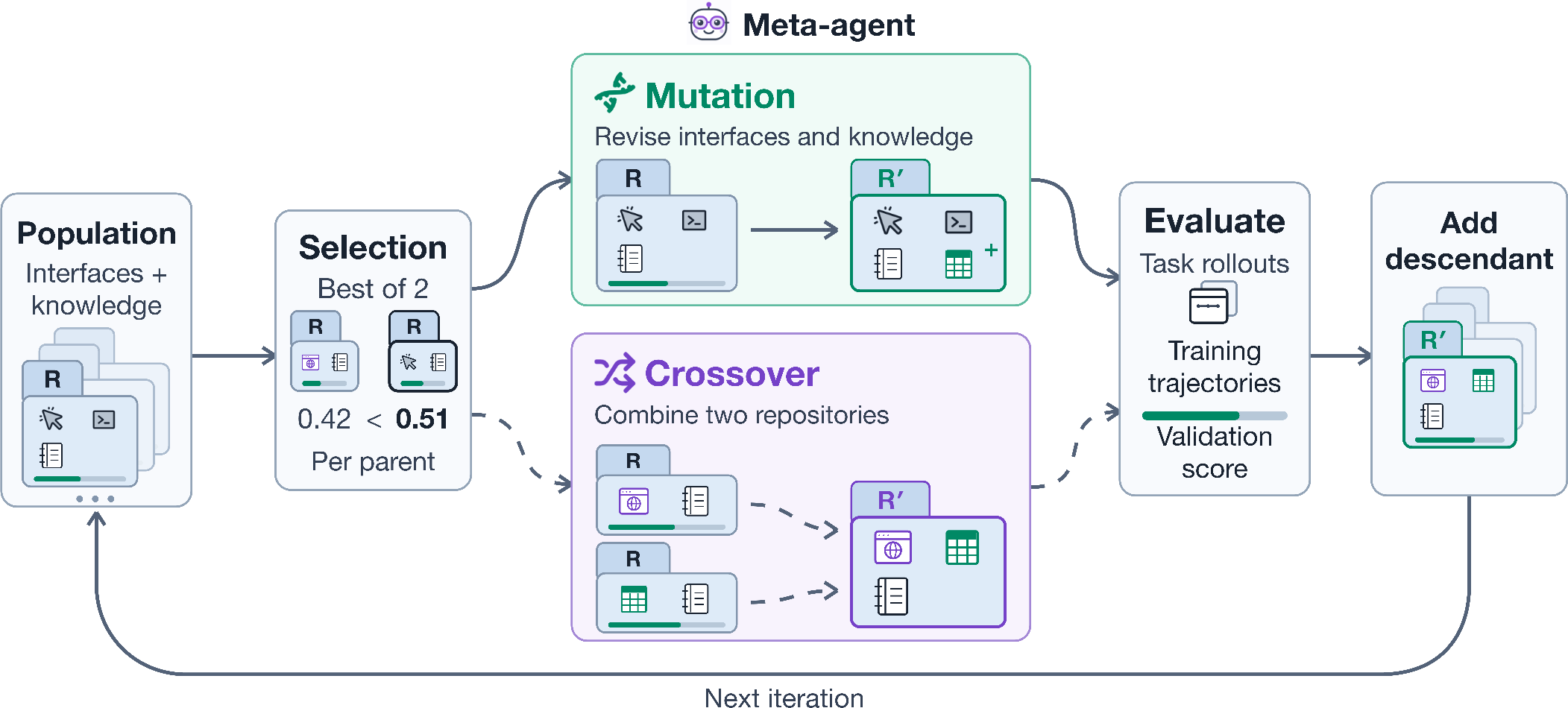
Abstract: Computer-use agents are limited by the interfaces humans give them. An agent may type a spreadsheet cell by cell when a single line of code would do, or print all two thousand lines of a file through a shell to find one function. Both the interfaces and the knowledge of when to use each are built by hand, which cannot keep pace with new applications, workflows, and models. We argue that interface design should itself be an agent capability. We introduce Agent S4, an autonomous computer-use scientist that builds Evolving Agent Interfaces from task experience. A meta-agent examines task agents' trajectories on synthetic training tasks, without success labels, and constructs and revises interfaces and usage knowledge in a repository. Population-based evolution then selects which repositories to develop further by their performance on validation tasks the meta-agent never sees, favoring changes that generalize beyond the seen tasks. On OSWorld V2, Agent S4, with Qwen3.8-27B and the evolved repository of interfaces, sets a new state of the art in open-source computer-use agents, reaching 21.3% binary score, 3.8 times the same model with fixed interfaces. This is above both GPT-5.5 (13.0%) and Claude Opus 4.8 (20.6%), at about 4.3% and 1.5% of their respective costs. On ScienceBoard, the evolved interfaces improve the success rate from 41.4% to 58.6% with the same model. These results suggest that useful interfaces can be evolved from experience, making autonomous interface design a source of improvement complementary to advances in models and harnesses. We open-source our code at https://github.com/simular-ai/agent-s.
Paper Prompts
Sign up for free to create and run prompts on this paper.
Top Community Prompts
Explain it Like I'm 14
1. ¿De qué trata el artículo?
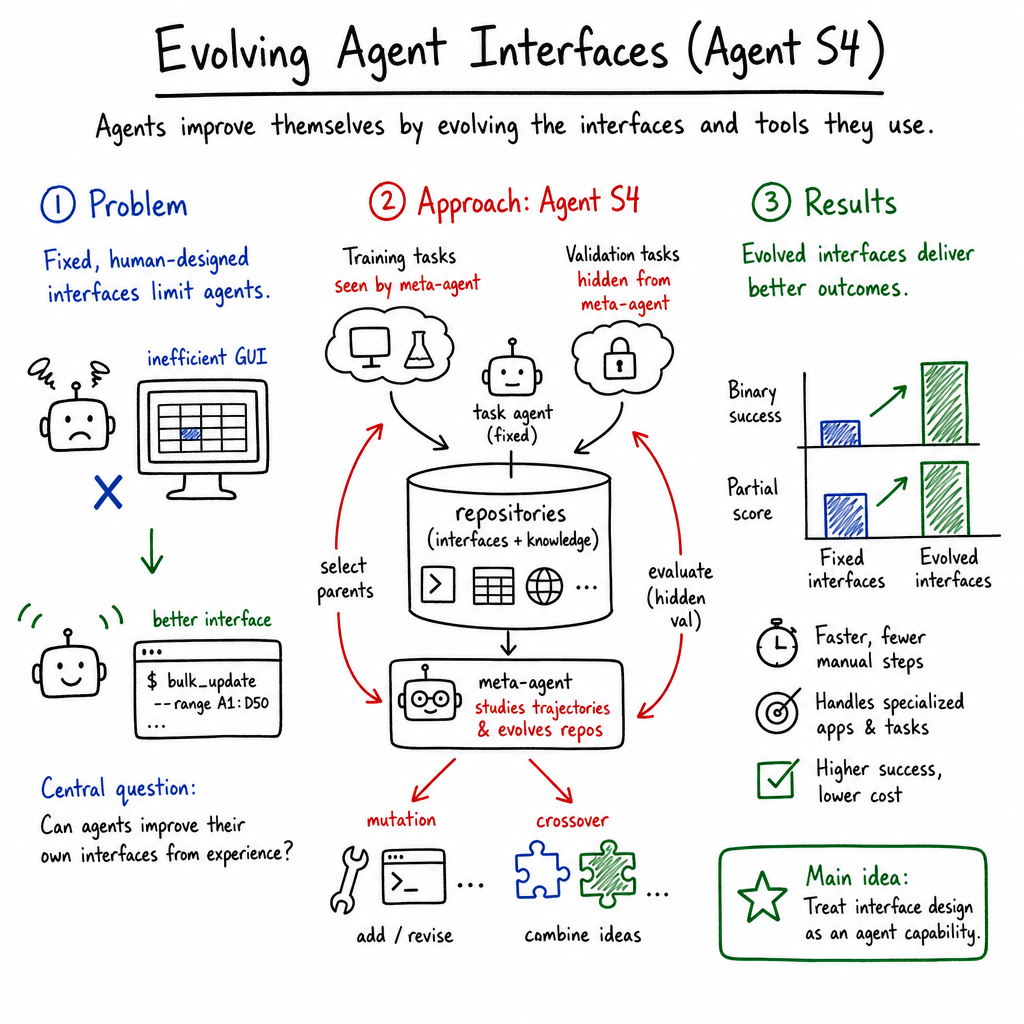
El artículo presenta una idea llamada Agent S4: un sistema que permite que un agente de inteligencia artificial mejore sus propias “herramientas” para usar computadoras.
Normalmente, los investigadores humanos deciden cómo puede interactuar una IA con una computadora. Por ejemplo, pueden darle herramientas para:
- hacer clic y escribir con el teclado;
- leer capturas de pantalla;
- usar una terminal;
- editar una hoja de cálculo;
- abrir aplicaciones.
El problema es que estas herramientas suelen ser fijas. Si una tarea sería más fácil usando una herramienta nueva, la IA no puede crearla por sí sola.
Agent S4 intenta cambiar esto. Observa cómo trabaja un agente, detecta sus dificultades y crea o modifica herramientas para que pueda resolver mejor tareas futuras.
Una comparación sencilla sería esta: en vez de darle a un estudiante siempre el mismo estuche de herramientas, el sistema observa qué problemas tiene y le ayuda a construir una regla, una calculadora o una herramienta especial cuando las necesita.
2. Objetivos y preguntas de investigación
El artículo intenta responder principalmente a estas preguntas:
- ¿Puede una IA diseñar y mejorar sus propias herramientas para usar computadoras?
- ¿Puede aprender de sus experiencias, incluso cuando no recibe una respuesta clara de “correcto” o “incorrecto”?
- ¿Las herramientas creadas por la IA ayudan a resolver tareas nuevas, y no solo las tareas que ya ha visto?
- ¿Puede una IA relativamente pequeña rendir mejor si tiene mejores herramientas?
- ¿Qué tipo de herramientas nuevas son más útiles?
La idea importante es que mejorar las herramientas puede ser tan valioso como crear un modelo de IA más grande o más inteligente.
3. ¿Cómo realizaron la investigación?
Agentes que cumplen tareas
El estudio utiliza un agente de uso de computadoras. Este agente recibe una instrucción, como:
- modificar una hoja de cálculo;
- buscar información en un navegador;
- trabajar con un programa científico;
- editar un documento;
- completar una prueba matemática.
El agente observa la computadora y realiza acciones para completar la tarea.
Interfaces
Una interfaz es la forma en que el agente se comunica con la computadora.
Por ejemplo:
- una interfaz gráfica permite hacer clic, escribir y leer capturas de pantalla;
- una interfaz de terminal permite enviar comandos y recibir texto;
- una interfaz de hoja de cálculo puede leer o cambiar muchas celdas de una sola vez;
- una interfaz para un programa científico puede ejecutar directamente una función del programa.
La diferencia puede compararse con escribir una dirección letra por letra en un mapa frente a decirle directamente al mapa: “llévame a esta dirección”. Ambas opciones funcionan, pero una es mucho más rápida y clara.
Un repositorio de herramientas
Las interfaces y las instrucciones sobre cómo usarlas se guardan en un repositorio. Este repositorio contiene:
- programas y herramientas;
- explicaciones sobre lo que hace cada herramienta;
- consejos sobre cuándo utilizarla;
- procedimientos reutilizables.
El agente puede consultar este repositorio durante sus tareas.
El meta-agente
Agent S4 incluye otro agente llamado meta-agente. Este no intenta resolver directamente las tareas principales. Su trabajo es estudiar cómo se comportó el agente principal.
Por ejemplo, puede observar que el agente:
- modifica una hoja de cálculo celda por celda, aunque podría cambiar muchas celdas de una vez;
- usa muchas capturas de pantalla para encontrar información;
- tiene problemas para comprobar si terminó correctamente;
- repite muchas veces el mismo procedimiento.
A partir de estas observaciones, el meta-agente puede crear una herramienta nueva, mejorar una existente o eliminar una que no sea útil.
Evolución de una población de repositorios
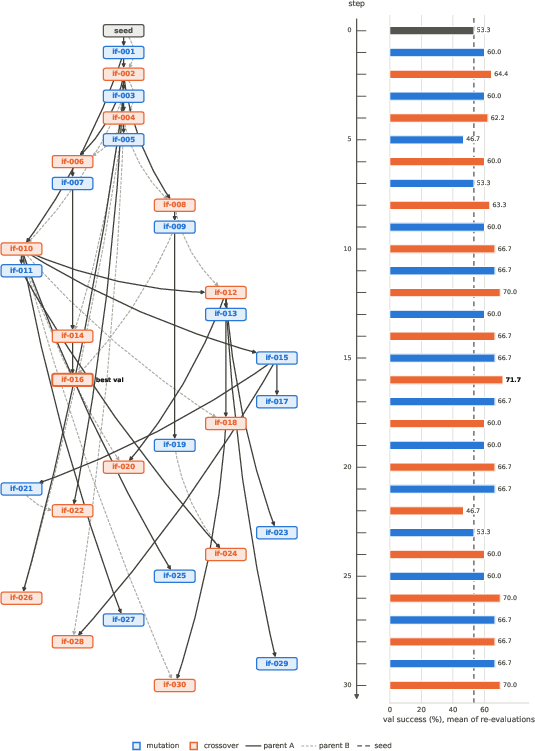
El sistema crea diferentes versiones del repositorio, como si fueran distintas versiones de un invento.
Hay dos formas principales de modificarlos:
- Mutación: cambiar una sola versión, añadiendo, eliminando o mejorando herramientas.
- Cruce: combinar ideas de dos versiones diferentes para crear una nueva.
Después, el agente principal prueba cada versión en tareas. Las mejores versiones tienen más posibilidades de ser utilizadas como base para futuras mejoras.
Esto se parece a una competición entre varios diseños de bicicletas: se prueban, se conservan las que funcionan mejor y se combinan sus mejores características para crear nuevos modelos.
Tareas de entrenamiento y validación
Los investigadores separaron las tareas en varios grupos:
- Tareas de entrenamiento: sirven para que el meta-agente descubra problemas y proponga cambios.
- Tareas de validación: se usan para decidir qué repositorios funcionan mejor, pero el meta-agente no puede verlas directamente.
- Tareas finales: se utilizan para medir el resultado final del sistema.
Esta separación es importante porque evita que el sistema simplemente memorice las tareas utilizadas durante el desarrollo. Es parecido a estudiar con unos ejercicios y después hacer un examen con preguntas nuevas.
Además, muchas tareas de entrenamiento no tenían una etiqueta que dijera claramente si el agente había tenido éxito. El meta-agente debía aprender observando las acciones y los resultados de los intentos.
Pruebas realizadas
El artículo utiliza dos pruebas principales:
- OSWorld V2: tareas variadas de uso de computadoras, como trabajar con documentos, sitios web y aplicaciones de escritorio.
- ScienceBoard: tareas relacionadas con programas científicos, como astronomía, mapas, moléculas, álgebra, demostración de teoremas y escritura científica.
El modelo principal utilizado fue Qwen3.8-27B. Los investigadores mantuvieron igual el modelo y el sistema que lo controla, y cambiaron principalmente las interfaces disponibles.
4. Principales resultados
Mejora en OSWorld V2
En OSWorld V2, el agente con interfaces fijas consiguió completar completamente el 5,56 % de las tareas.
Cuando utilizó el repositorio evolucionado por Agent S4, completó completamente el 21,30 % de las tareas.
Esto representa una mejora de aproximadamente 3,8 veces con el mismo modelo de IA.
| Sistema | Tareas completadas por completo |
|---|---|
| Qwen con interfaces fijas | 5,56 % |
| Qwen con repositorio evolucionado | 21,30 % |
También mejoró la puntuación parcial, que mide cuánto avanzó el agente aunque no terminara la tarea:
- interfaces fijas: 20,69 %;
- interfaces evolucionadas: 46,90 %.
Comparación con modelos más costosos
El sistema evolucionado obtuvo mejores resultados que algunos modelos comerciales mucho más caros:
- Agent S4 con Qwen: 21,3 %;
- GPT-5.5: 13,0 %;
- Claude Opus 4.8: 20,6 %.
El coste aproximado por tarea también fue mucho menor:
- Agent S4: alrededor de 1,10 dólares;
- GPT-5.5: alrededor de 25,50 dólares;
- Claude Opus 4.8: alrededor de 72,40 dólares.
Esto no significa necesariamente que Agent S4 sea mejor en todos los tipos de problemas. Significa que, en esta prueba concreta, un modelo abierto y menos costoso funcionó muy bien cuando recibió mejores herramientas.
Mejora en ScienceBoard
En ScienceBoard, los resultados también mejoraron:
- repositorio inicial: 55,03 % de éxito;
- repositorio evolucionado: 58,58 % de éxito.
El agente resolvió:
- 93 de 169 tareas con el repositorio inicial;
- 99 de 169 tareas con el repositorio evolucionado.
Las mejoras fueron especialmente importantes en algunas aplicaciones. Por ejemplo, en KAlgebra, el éxito subió del 48 % al 68 %.
El repositorio creó herramientas específicas para programas como:
- ChimeraX, para visualizar moléculas;
- GRASS GIS, para trabajar con mapas;
- KAlgebra, para hacer cálculos;
- Lean, para comprobar demostraciones matemáticas.
¿Qué tipo de herramientas creó?
Las nuevas herramientas pertenecían a varias categorías:
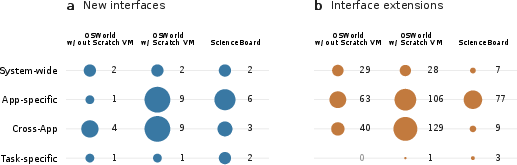
- Herramientas generales del sistema: observar ventanas o iniciar programas.
- Herramientas específicas de una aplicación: trabajar directamente con objetos de una hoja de cálculo o un programa de diseño.
- Herramientas para varias aplicaciones: leer archivos o datos que pueden utilizarse en distintos programas.
- Herramientas específicas para una tarea: realizar un procedimiento completo y comprobar si terminó bien.
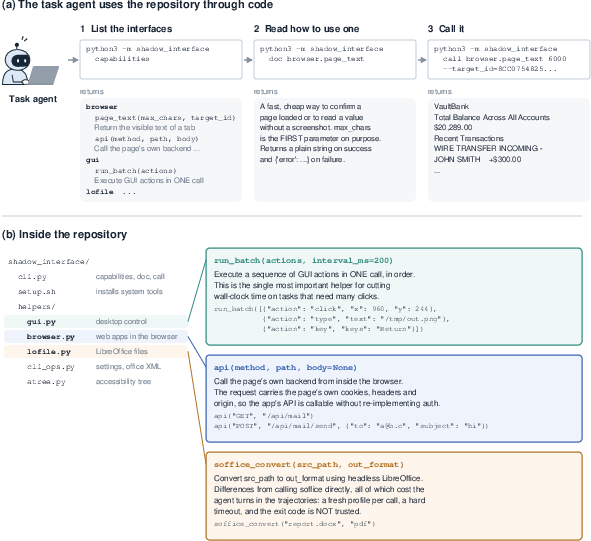
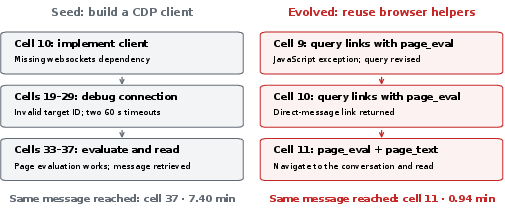
Un ejemplo importante aparece en una tarea relacionada con correos electrónicos y cargos bancarios. El agente con interfaces fijas tuvo que abrir mensajes, hacer clic muchas veces, esperar descargas y desplazarse por páginas.
El agente con la interfaz evolucionada pudo:
- leer directamente los datos del correo;
- descargar los archivos;
- convertir los documentos a texto;
- buscar los cargos bancarios;
- comparar la información.
Así evitó muchos pasos lentos y propensos a errores.
No siempre fue mejor tener un entorno de prueba
Los investigadores también permitieron, en algunos experimentos, que el meta-agente utilizara una máquina virtual para probar sus herramientas.
Esto mejoró la puntuación parcial en algunos casos, pero la mejor puntuación de tareas completamente terminadas se obtuvo sin ese entorno de prueba. Esto muestra que más información no siempre produce automáticamente mejores resultados.
5. ¿Por qué son importantes estos resultados?
El artículo sugiere que mejorar las herramientas de un agente puede ser una forma poderosa de mejorar su rendimiento.
Muchas veces el problema no es que la IA “no sepa” qué hacer. El problema es que solo puede hacerlo de una manera incómoda. Por ejemplo, puede saber que necesita cambiar una hoja de cálculo, pero tener que hacer clic y escribir en cada celda por separado.
Una interfaz mejor permite que el agente:
- haga más acciones en menos pasos;
- reciba información más clara;
- compruebe mejor sus resultados;
- cometa menos errores;
- gaste menos tiempo y dinero.
Por eso, el artículo defiende que las interfaces no deberían diseñarse una sola vez y dejarse sin cambios. También deberían poder aprender y evolucionar a partir de la experiencia.
6. Limitaciones del estudio
Aunque los resultados son prometedores, el trabajo tiene algunas limitaciones:
- Solo se probó en determinados conjuntos de tareas.
- Las tareas de entrenamiento fueron sintéticas, es decir, creadas especialmente para el experimento.
- El éxito puede variar entre diferentes intentos de la misma tarea.
- El sistema todavía necesita investigadores que definan el entorno, las reglas y los conjuntos de evaluación.
- Un buen resultado en OSWorld V2 o ScienceBoard no garantiza que funcione igual de bien en todas las computadoras o situaciones reales.
- El artículo compara costes estimados, por lo que esas cifras pueden cambiar según el proveedor y la forma de realizar los cálculos.
7. Implicaciones y posible impacto
La principal conclusión es que un agente de IA puede mejorar no solo sus respuestas, sino también las herramientas que utiliza para pensar y actuar.
En el futuro, esto podría permitir crear agentes que:
- aprendan a manejar programas nuevos;
- construyan herramientas para tareas repetitivas;
- trabajen mejor con aplicaciones científicas o profesionales;
- se adapten a diferentes usuarios y computadoras;
- mejoren sin que una persona tenga que programar manualmente cada nueva función.
En términos sencillos, Agent S4 intenta que las IA no sean solo usuarias de herramientas diseñadas por humanos, sino también inventoras y mejoradoras de sus propias herramientas. Si esta idea continúa desarrollándose, podría hacer que los agentes informáticos sean más rápidos, baratos, flexibles y capaces de resolver tareas complejas en el mundo real.
Knowledge Gaps
Knowledge Gaps, Limitations, and Open Questions
The paper demonstrates promising gains from evolving agent interfaces, but leaves the following issues unresolved:
- Limited benchmark coverage: Evaluation is restricted to OSWorld V2 and ScienceBoard, so it remains unclear whether the method generalizes to other operating systems, web environments, enterprise software, coding tasks, mobile interfaces, or real-world workflows.
- Small evolution datasets: Repository evolution uses only 30 synthetic OSWorld tasks and 48 synthetic ScienceBoard tasks, leaving uncertainty about whether such limited experience is sufficient for broader interface discovery.
- Dependence on synthetic task quality: The effectiveness of Agent S4 may depend strongly on the coverage, realism, and diversity of agentically generated training tasks. The paper does not quantify how omissions or systematic biases in these tasks affect the evolved repository.
- Potential validation overfitting: Although validation tasks are hidden from the meta-agent, they are repeatedly used for parent selection and repository selection. The final improvements may therefore overfit the 15-task validation sets, especially given the small number of candidates and repeated evaluations.
- No independent held-out evaluation: The paper reports full benchmark results, but does not provide a separate, independently sampled test distribution designed specifically to measure generalization beyond the benchmark and its validation tasks.
- Unclear statistical reliability: Most reported results appear to come from single runs or single rollouts per task. Confidence intervals, significance tests, random-seed sensitivity, and per-task variance are not systematically reported.
- Run-to-run instability: The paper shows substantial evaluation variance on ScienceBoard, but does not fully characterize how often evolution produces beneficial, neutral, or harmful repositories across independent evolution runs.
- Incomplete ablation of evolution components: The effects of mutation, crossover, tournament selection, lineage retention, population size, pruning, operator schedules, and repository denoising are not isolated individually.
- Limited comparison with simpler alternatives: The experiments do not adequately compare Agent S4 with strong non-evolutionary baselines such as supervised interface design from the same trajectories, retrieval-based tool selection, automated tool synthesis without population search, or repeated prompt and workflow optimization.
- Unclear causal source of improvements: It is not established how much of the performance gain comes from new executable interfaces, usage instructions, reusable workflows, improved observations, task-specific checks, or merely increased access to programmatic execution.
- Seed repository confounding: The seed repository itself substantially improves performance over the no-repository condition. Consequently, the reported gains attributed to evolution may partly reflect the manually engineered seed rather than autonomous interface discovery.
- Manual design remains in the pipeline: Synthetic task construction, the seed repository, benchmark-specific selection criteria, prompts, harness configuration, and implementation constraints all involve human design. The extent to which Agent S4 reduces rather than relocates human engineering effort is unresolved.
- Evolution cost is excluded from the main cost comparison: Reported task-solving costs omit repository-construction costs, meta-agent inference, VM usage, repeated validation, engineering effort, and infrastructure. The total cost and break-even point of evolution are therefore unknown.
- Scalability to larger repositories is untested: The ScienceBoard repository grows from 15 to 64 functions, while the OSWorld repositories receive many extensions. The paper does not measure whether repository size eventually harms context length, tool discovery, selection accuracy, latency, or task performance.
- Repository maintenance is unexplored: There is no systematic analysis of how evolved interfaces behave when applications, APIs, file formats, operating systems, or authentication states change.
- Interface conflicts and regressions are insufficiently studied: Adding or revising interfaces may introduce overlapping capabilities, ambiguous tool choices, incompatible assumptions, or regressions on previously solved tasks. The population mechanism does not guarantee backward compatibility.
- Limited evidence for compositional generalization: It remains unclear whether evolved interfaces can be reliably composed in novel combinations, rather than primarily solving tasks that resemble the capabilities represented in the synthetic training set.
- No evaluation of transfer across models: The repository is evolved for a fixed Qwen3.8-27B task agent. Whether the same interfaces and usage knowledge transfer to smaller, larger, open-source, or closed-source models is not tested.
- No evaluation of transfer across harnesses: Because the model and harness are fixed during evolution, it is unknown whether the repository remains effective under different context-management strategies, tool-execution systems, action budgets, or permission models.
- Meta-agent capability dependence is unclear: The method uses a powerful fixed model and substantial construction budgets, but the paper does not examine how evolution quality changes with weaker meta-agents, different reasoning settings, or constrained coding abilities.
- Scratch-VM effects are not explained: Scratch access increases partial performance in one comparison but not binary success. The paper does not identify which interface properties benefit from execution-based testing or why scratch access can reduce final binary performance.
- Evaluator and verifier dependence remains unresolved: Training is described as verifier-free, but validation and final selection rely on benchmark evaluators. The method’s behavior when reliable evaluators are unavailable, noisy, delayed, or adversarial is not established.
- Security and safety risks are underexplored: Evolved interfaces can execute shell commands, access files, interact with logged-in websites, and potentially bypass intended GUI or permission boundaries. The paper does not evaluate malicious interfaces, accidental data leakage, privilege escalation, or unsafe tool behavior.
- Permission-boundary preservation is unclear: The relationship between evolved interfaces and the harness’s permission model is not fully analyzed. It is unknown whether generated interfaces can unintentionally circumvent restrictions imposed by the harness.
- Robustness to adversarial or ambiguous tasks is unknown: The experiments do not test prompt injection, malicious webpages, misleading application state, corrupted files, ambiguous instructions, or adversarial task artifacts.
- Human usability is not evaluated: The paper studies agent performance but does not assess whether evolved interfaces are understandable, inspectable, debuggable, or reusable by human developers and operators.
- Interface quality is measured mainly through task success: There is little direct evaluation of reliability, latency, interpretability, maintainability, error recovery, observability, or API ergonomics of the generated interfaces.
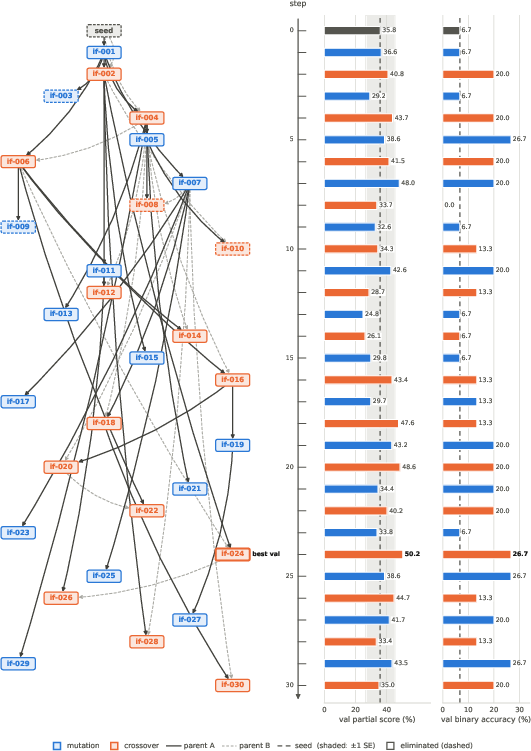
- Long-term repository dynamics are unknown: Evolution is run for only 30 construction steps. It remains unclear whether continued evolution converges, oscillates, accumulates redundant code, or gradually degrades repository quality.
- Cross-domain reuse is not demonstrated: Separate evolution runs are conducted for OSWorld V2 and ScienceBoard. The paper does not test whether a single repository can support multiple domains or whether capabilities learned in one domain transfer to another.
- Benchmark contamination risks are not fully characterized: Although synthetic-task authors were instructed not to overlap with official tasks, the method uses benchmark construction principles and taxonomies. The degree of semantic or capability overlap, and its effect on measured generalization, remains uncertain.
- Reported comparisons may not be fully controlled: Results for competing frontier models are taken from another study, potentially involving differences in prompts, harnesses, batching, environment versions, evaluator settings, or cost assumptions.
- Cost estimates rely on assumptions: The reported costs depend on token pricing and an assumed 80% input-cache hit rate. Sensitivity to cache rates, provider pricing, infrastructure costs, and meta-agent expenses is not reported.
- Partial-score and binary-score trade-offs are unresolved: Scratch-enabled evolution improves partial score but not binary success, while the no-scratch repository shows the reverse pattern. The paper does not determine which objective better reflects practical usefulness or how repositories should optimize both simultaneously.
- Failure mechanisms are not systematically categorized: Qualitative case studies illustrate successful interface use, but there is no comprehensive analysis of failures caused by incorrect tool selection, faulty interface implementation, stale observations, API errors, or misuse of evolved knowledge.
- Automatic correctness of generated interfaces is unverified: The paper does not report unit tests, formal checks, sandbox validation, differential testing, or independent code review for interfaces created by the meta-agent.
- Reproducibility details may be insufficient: Exact prompts, model sampling parameters, environment states, repository versions, randomness controls, and complete lineage artifacts are not presented in the main text, making independent replication difficult.
- The optimal repository objective is underspecified in practice: The formal objective focuses on expected task score, but does not incorporate construction cost, execution cost, safety, latency, repository complexity, maintainability, or robustness, all of which may materially affect the best repository in deployment.
- Human-designed interfaces are not directly optimized under the same budget: The paper does not establish whether a comparable amount of human effort, trajectory analysis, and interface engineering could achieve similar or better results than Agent S4.
- Real deployment feedback is absent: All evolution occurs offline from preconstructed tasks. It remains open whether Agent S4 can safely and effectively learn from continuously arriving user tasks, nonstationary environments, incomplete feedback, and changing organizational requirements.
Practical Applications
Immediate Applications
- Cost-efficient enterprise computer-use agents — software, operations, and automation. Organizations can deploy the open-source Agent S4 framework with a fixed LLM and a repository of executable interfaces to automate browser, spreadsheet, document, email, file-management, and desktop workflows. The paper shows that replacing screenshot-based interaction with structured operations—such as bulk spreadsheet edits, browser data extraction, direct PDF parsing, or application APIs—can substantially improve task completion while reducing model-call costs. Potential products and workflows: internal IT assistants, finance and expense-processing agents, procurement assistants, document-processing pipelines, and browser-based research tools. Dependencies: reliable application APIs or scriptable interfaces, sandboxed execution, authentication management, and task-specific validation. The reported results are benchmark-based and do not establish reliability for unsupervised production use.
- Agent interface optimization for existing models — AI infrastructure and software engineering. Model providers and agent-platform developers can use Agent S4 as an offline optimization layer that improves an agent without changing its underlying model or general harness. A development team could collect agent trajectories, identify repeated inefficient behavior, evolve interface repositories, and deploy the selected repository as a versioned tool layer. Potential tool: a repository compiler or “interface optimizer” integrated into frameworks such as code-execution agents, browser agents, or desktop automation systems. Dependencies: representative training tasks, held-out validation tasks, reproducible evaluation, and controls preventing the meta-agent from modifying unsafe permissions or core execution infrastructure.
- Application-specific interfaces for office and business software — productivity and enterprise IT. Companies can build structured interfaces for recurring operations in spreadsheets, word processors, presentation tools, email systems, accounting platforms, CRM systems, and project-management applications. Instead of asking an agent to navigate menus and enter data cell by cell, an interface can expose high-level actions such as “update this range,” “find all invoices matching these charges,” or “apply and verify tracked changes.” Potential products: spreadsheet bulk-edit tools, automated reconciliation assistants, document-review agents, and cross-application reporting workflows. Dependencies: stable software versions, permission boundaries, audit logs, and safeguards against incorrect edits or unauthorized data access.
- Web research and information retrieval — knowledge work, finance, and administration. The evolved browser interface demonstrates a practical workflow in which agents retrieve structured page data, mailbox contents, attachment URLs, and dashboard records rather than repeatedly scrolling through visual pages. This can support expense verification, supplier comparison, market research, compliance checks, and evidence collection. Potential workflow: browser API calls → attachment download → text or table extraction → cross-source consistency check → human approval. Dependencies: website terms of service, login/session security, anti-automation mechanisms, changing page structures, privacy requirements, and source-quality verification.
- Scientific software assistants — research and laboratory computing. Research groups can evolve interfaces for domain-specific applications such as molecular visualization, astronomy, geographic information systems, algebra systems, theorem provers, and scientific typesetting. The ScienceBoard results indicate that application-specific interfaces can improve performance on specialized software, particularly when visual workflows are replaced by commands that expose the application's own objects and state. Potential tools: ChimeraX command assistants, GRASS GIS analysis agents, KAlgebra batch calculators, Lean proof-checking workflows, and automated TeXstudio editing assistants. Dependencies: domain-expert review, correct interpretation of scientific outputs, compatibility with local installations, and independent verification of calculations or proofs.
- Reusable interface and workflow libraries — academia and open-source development. Researchers can use the released code to create repositories containing executable interfaces, usage documentation, reusable workflows, and task-specific checks. These repositories can be versioned like software libraries and shared across agents or research groups. Potential artifact: a domain repository with entries such as capability descriptions, example calls, known failure modes, and automated regression tests. Dependencies: clear licensing, secure code review, standardized repository schemas, and benchmarks that measure generalization rather than memorization.
- Evaluation and regression testing for computer-use systems — AI safety and quality assurance. The paper’s separation of synthetic training tasks from hidden validation tasks can be adopted as a practical testing workflow. Teams can generate representative tasks, use trajectory data for interface development, and reserve unseen tasks for model and repository selection. Repeated validation can identify repositories that appear strong on one run but are unstable across runs. Potential workflow: synthetic task generation → trajectory analysis → repository evolution → repeated held-out evaluation → deployment gate. Dependencies: high-quality task generation, leakage prevention, meaningful success evaluators, and variance-aware metrics. Synthetic tasks alone may fail to represent real operational edge cases.
- Human-in-the-loop desktop assistants — daily life and accessibility. Evolved interfaces could support users who have difficulty performing complex GUI actions by allowing an assistant to execute structured tasks such as organizing files, filling forms, comparing bills, preparing documents, or managing calendars. The agent could present a concise plan and request confirmation before consequential actions. Dependencies: explicit user consent, accessible explanations, reversible operations, protection of personal data, and reliable confirmation of the target and scope of each action.
- Policy and governance tooling for AI agents — public-sector and regulated environments. Regulators and organizational compliance teams can use the repository-and-harness distinction to define what an agent is allowed to do. The harness can enforce permissions, budgets, network restrictions, and approval requirements, while the evolving repository determines how the agent interacts within those boundaries. Potential tool: a policy-aware agent gateway that records interface calls, blocks prohibited operations, and requires approval for financial, legal, medical, or account-changing actions. Dependencies: enforceable access controls, complete audit trails, sector-specific regulation, and the ability to inspect generated interface code.
Long-Term Applications
- Self-improving enterprise automation platforms — cross-application operations. A mature version of Agent S4 could continuously discover new interfaces for an organization’s software ecosystem and maintain repositories that evolve as applications, workflows, and failure modes change. For example, an agent could learn a more efficient workflow spanning email, ERP, spreadsheets, document storage, and procurement systems. Potential product: an enterprise “agent operating layer” that maintains application adapters, workflow knowledge, verification routines, and lineage records. Dependencies: continual monitoring, robust rollback, compatibility testing, stable APIs, protection against repository drift, and reliable detection of harmful or over-specialized changes.
- Autonomous interface engineering for newly released software — software development and robotics. The central innovation could generalize beyond desktop applications to automatically create interfaces for new software systems, simulators, APIs, or robot-control environments. A meta-agent might inspect documentation and trajectories, construct tools, test observation formats, and evolve higher-level actions such as “grasp object,” “run simulation,” or “inspect sensor state.” Potential applications: robotic manipulation, industrial control, digital-twin environments, game agents, and simulation-based engineering. Dependencies: formal safety constraints, deterministic or bounded execution, simulator fidelity, hardware validation, and much stronger guarantees than those required for benchmark computer use.
- Scientific discovery agents with domain-specific tool ecosystems — research and engineering. Evolving interfaces could allow agents to build persistent, specialized toolchains for computational biology, materials science, astronomy, climate modeling, and engineering design. The agent might combine data retrieval, simulation, visualization, analysis, and result verification into reusable scientific workflows. Potential workflow: retrieve data → preprocess through a domain interface → run simulation → visualize results → test statistical or formal conditions → produce a reproducible report. Dependencies: scientific validity, provenance tracking, reproducibility, expert supervision, uncertainty quantification, and safeguards against generating plausible but incorrect conclusions.
- Adaptive interfaces for healthcare and other high-stakes sectors — healthcare, law, and finance. In principle, the approach could evolve interfaces for electronic health records, medical imaging, insurance systems, legal case-management platforms, or financial operations. Task-specific observation and verification interfaces could reduce clerical work and expose relevant structured state more reliably than screenshots. Dependencies: regulatory approval, privacy-preserving infrastructure, validated clinical or financial rules, human authorization, explainability, comprehensive auditability, and extensive prospective testing. The paper does not provide evidence sufficient for autonomous high-stakes deployment.
- Personalized agent interfaces — education and consumer technology. An agent could evolve interfaces based on an individual’s recurring workflows, preferred applications, accessibility needs, and error patterns. Students might receive interfaces for laboratory software or mathematics tools, while consumers might obtain assistants tailored to budgeting, scheduling, or household administration. Dependencies: privacy-preserving learning, prevention of harmful personalization, portability across devices, user control over retained knowledge, and evaluation across diverse users rather than only synthetic task distributions.
- Economic and policy assessment of agent efficiency — labor and public policy. The paper’s cost-per-task comparisons suggest a framework for evaluating whether interface improvements, rather than larger models, deliver better productivity gains. Policymakers and organizations could measure task completion, total inference cost, human review time, error rates, and energy consumption together. Potential tool: a standardized agent-efficiency dashboard comparing fixed-interface and evolving-interface systems across sectors. Dependencies: comparable workloads, transparent cost accounting, inclusion of infrastructure and repository-construction costs, and metrics that capture safety and quality rather than success alone.
- Verified self-modifying tool repositories — AI safety and dependable autonomy. Future systems could combine population-based interface evolution with static analysis, sandbox testing, formal specifications, capability restrictions, and cryptographic signing. Only repositories that pass security and behavioral checks would be eligible for deployment. Potential architecture: meta-agent proposes interface changes → isolated test environment executes them → policy and security checks run → repeated validation measures robustness → human or automated approval signs the repository. Dependencies: effective specifications for interface behavior, robust adversarial testing, protection from benchmark overfitting, and methods for detecting subtle data exfiltration or privilege escalation.
- General-purpose autonomous computer-use infrastructure — broad digital labor. In the longer term, repositories could become a transferable layer between foundation models and the digital world, allowing agents to discover when to use GUI actions, shell commands, application APIs, document parsers, or task-specific procedures. This could reduce dependence on manually engineered interfaces and make agents more adaptable to new software environments. Dependencies: stronger generalization beyond OSWorld and ScienceBoard, improved success rates, stable long-horizon behavior, resistance to distribution shift, scalable evolution costs, and rigorous protection against unsafe autonomous actions. The current results demonstrate promise but remain limited by benchmark size, model and harness choices, and the absence of production-scale reliability evidence.
Glossary
- Agent-computer interface (ACI): The interaction layer that determines how an agent observes and acts on a computer. “SWE-agent showed that this agent-computer interface shapes performance”
- Asymmetric evaluation: An evaluation design in which the system constructing candidates cannot access the data used to select among them. “Only training trajectories are exposed to the meta-agent.”
- Binary success: A metric indicating whether a task was completed fully rather than partially. “Binary success measures complete task execution”
- Binary tournament selection: A selection method that compares two randomly chosen candidates and retains the one with the better score. “For each parent, binary tournament selection draws two eligible variants uniformly and chooses the one with the higher validation score.”
- Context compaction: The reduction or summarization of an interaction context so that it fits within a model’s context window. “including any context compaction”
- Crossover: An evolutionary operation that combines features or ideas from two parent candidates to create a descendant. “The descendant need not contain the union of its parents.”
- Directed acyclic graph (DAG): A graph whose edges have direction and that contains no directed cycles. “Parent links form a directed acyclic graph, with one parent per mutation and two per crossover.”
- Denoising: Repeated evaluation intended to reduce the influence of noisy or unusually high single-run scores. “In the case of Scienceboard, we also run a Denoise operation after every 5 steps.”
- Distillation: The transfer or compression of capabilities, behavior, or knowledge into another representation or system. “Distillation can reorder what the interface allows, but it cannot extend it.”
- Evolution budget: The limit on the number of repository-construction iterations performed during evolutionary search. “evolution budget ”
- Evolutionary baseline: A comparison method that applies a simpler evolutionary strategy against which the proposed strategy is evaluated. “We compare our setup against evolutionary baselines such as linear evolution”
- Fitness: A numerical measure used to evaluate and compare candidate solutions during optimization. “Validation rollouts provide a separate selection score for each candidate ”
- Generalization: The ability of a system or learned artifact to perform effectively on tasks or domains not used directly during its construction. “These results suggest that useful interfaces can be evolved from experience”
- Ground-truth success label: An authoritative annotation indicating whether a task attempt succeeded. “Training trajectories have no ground-truth success labels.”
- Harness: A software framework that manages model invocation, execution, permissions, budgets, and context preparation. “A harness manages model invocation, request execution, task budgets, permissions , and preparation of the model's context”
- Held-out validation: Evaluation on tasks withheld from the data used to construct or modify a candidate. “held-out validation guides subsequent selection”
- Implicit-state inference: The deduction of hidden or unobserved environmental state from available evidence. “These targets guided the representation of capabilities such as cross-source reasoning, visual-spatial precision, and implicit-state inference.”
- Interface evolution: The iterative revision of an interface based on observed task trajectories and failures. “We call this process interface evolution.”
- Lineage: The record of parent–descendant relationships among successive candidate repositories. “The updated population supplies candidates for the next iteration.”
- Meta-agent: An agent that analyzes task-agent behavior and constructs or revises the interfaces and knowledge used by task agents. “The meta-agent studies these trajectories and forms hypotheses about how changes to actions, observations, or usage knowledge could help the task agent.”
- Mutation: An evolutionary operation that modifies a single parent candidate by adding, revising, or removing components. “Starting from one parent , the meta-agent adds, revises, or removes interfaces and knowledge.”
- Observation language: The set of possible information returns produced by an interface after an agent’s request. “a language of requests and a language of observations ”
- Open-ended computer use: Computer interaction involving a broad and changing range of tasks, applications, and workflows. “Computer use is open-ended, and each new family of tasks or model release exposes new failure modes.”
- Operator schedule: A predefined rule that determines which evolutionary operation is applied at each iteration. “At each step, an operator schedule chooses mutation or crossover.”
- Partial score: A metric measuring intermediate task progress even when the complete task is not finished. “Binary success measures complete task execution, partial score measures intermediate progress”
- Population-based evolution: An evolutionary search strategy that maintains multiple candidate solutions and develops selected candidates over successive iterations. “Population-based evolution then selects which repositories to develop further by their performance on validation tasks”
- Programmatic access: The ability to interact with an application or data through code rather than manual graphical operations. “Agents with fixed interfaces already seek programmatic access”
- Repository: A persistent collection of executable interfaces and supporting usage knowledge. “It contains executable interfaces and supporting knowledge such as capability descriptions, reusable workflows, configuration, and notes about when and how to use them.”
- Rollout: One recorded execution of an agent attempting a task from an initial state under specified constraints. “Each rollout starts from task 's initial state within its budget”
- Scratch virtual machine: An isolated virtual computer that allows an agent to inspect applications and test interface code during construction. “A scratch VM with the same AMI as the benchmark tasks lets the meta-agent inspect running applications and try interface code during construction.”
- Selection pressure: The tendency of an evolutionary procedure to favor candidates with higher evaluation scores. “Validation performance guides parent selection.”
- Synthetic task: An artificially authored task designed to provide experience for training or system development. “We constructed 30 synthetic tasks for OSWorld V2 and 50 for ScienceBoard”
- Task distribution: A probability distribution describing the kinds of tasks a system is intended to solve. “Let be the target distribution of tasks”
- Task trajectory: A chronological record of an agent’s interactions, including requests, interfaces, and observations, while attempting a task. “The task agent uses candidate repositories of Evolving Agent Interfaces to attempt synthetic tasks, producing trajectories without ground-truth success labels.”
- Test-time compute: Computational resources or additional sampling used while solving an individual task rather than during model training. “current methods compensate with test-time compute instead of a better interface.”
- Validation score: The numerical performance of a candidate on held-out validation tasks, used to guide evolutionary selection. “The selected repositories and their saved training trajectories provide the starting point for the next descendant.”
- Verifier-free: Conducted without an automated procedure that directly checks whether a task attempt succeeded. “without success labels or task verifiers”
- Visual-spatial precision: The ability to reason accurately about locations, geometry, and spatial relationships in visual environments. “These targets guided the representation of capabilities such as cross-source reasoning, visual-spatial precision, and implicit-state inference.”
- Wall-clock limit: A restriction based on elapsed real-world time rather than computation steps or model calls. “New OSWorld V2 training and validation rollouts also have a two-hour wall-clock limit.”

